

10: Atmospheric Forces and Winds
- Page ID
- 9595

\( \newcommand{\vecs}[1]{\overset { \scriptstyle \rightharpoonup} {\mathbf{#1}} } \)
\( \newcommand{\vecd}[1]{\overset{-\!-\!\rightharpoonup}{\vphantom{a}\smash {#1}}} \)
\( \newcommand{\dsum}{\displaystyle\sum\limits} \)
\( \newcommand{\dint}{\displaystyle\int\limits} \)
\( \newcommand{\dlim}{\displaystyle\lim\limits} \)
\( \newcommand{\id}{\mathrm{id}}\) \( \newcommand{\Span}{\mathrm{span}}\)
( \newcommand{\kernel}{\mathrm{null}\,}\) \( \newcommand{\range}{\mathrm{range}\,}\)
\( \newcommand{\RealPart}{\mathrm{Re}}\) \( \newcommand{\ImaginaryPart}{\mathrm{Im}}\)
\( \newcommand{\Argument}{\mathrm{Arg}}\) \( \newcommand{\norm}[1]{\| #1 \|}\)
\( \newcommand{\inner}[2]{\langle #1, #2 \rangle}\)
\( \newcommand{\Span}{\mathrm{span}}\)
\( \newcommand{\id}{\mathrm{id}}\)
\( \newcommand{\Span}{\mathrm{span}}\)
\( \newcommand{\kernel}{\mathrm{null}\,}\)
\( \newcommand{\range}{\mathrm{range}\,}\)
\( \newcommand{\RealPart}{\mathrm{Re}}\)
\( \newcommand{\ImaginaryPart}{\mathrm{Im}}\)
\( \newcommand{\Argument}{\mathrm{Arg}}\)
\( \newcommand{\norm}[1]{\| #1 \|}\)
\( \newcommand{\inner}[2]{\langle #1, #2 \rangle}\)
\( \newcommand{\Span}{\mathrm{span}}\) \( \newcommand{\AA}{\unicode[.8,0]{x212B}}\)
\( \newcommand{\vectorA}[1]{\vec{#1}} % arrow\)
\( \newcommand{\vectorAt}[1]{\vec{\text{#1}}} % arrow\)
\( \newcommand{\vectorB}[1]{\overset { \scriptstyle \rightharpoonup} {\mathbf{#1}} } \)
\( \newcommand{\vectorC}[1]{\textbf{#1}} \)
\( \newcommand{\vectorD}[1]{\overrightarrow{#1}} \)
\( \newcommand{\vectorDt}[1]{\overrightarrow{\text{#1}}} \)
\( \newcommand{\vectE}[1]{\overset{-\!-\!\rightharpoonup}{\vphantom{a}\smash{\mathbf {#1}}}} \)
\( \newcommand{\vecs}[1]{\overset { \scriptstyle \rightharpoonup} {\mathbf{#1}} } \)
\(\newcommand{\longvect}{\overrightarrow}\)
\( \newcommand{\vecd}[1]{\overset{-\!-\!\rightharpoonup}{\vphantom{a}\smash {#1}}} \)
\(\newcommand{\avec}{\mathbf a}\) \(\newcommand{\bvec}{\mathbf b}\) \(\newcommand{\cvec}{\mathbf c}\) \(\newcommand{\dvec}{\mathbf d}\) \(\newcommand{\dtil}{\widetilde{\mathbf d}}\) \(\newcommand{\evec}{\mathbf e}\) \(\newcommand{\fvec}{\mathbf f}\) \(\newcommand{\nvec}{\mathbf n}\) \(\newcommand{\pvec}{\mathbf p}\) \(\newcommand{\qvec}{\mathbf q}\) \(\newcommand{\svec}{\mathbf s}\) \(\newcommand{\tvec}{\mathbf t}\) \(\newcommand{\uvec}{\mathbf u}\) \(\newcommand{\vvec}{\mathbf v}\) \(\newcommand{\wvec}{\mathbf w}\) \(\newcommand{\xvec}{\mathbf x}\) \(\newcommand{\yvec}{\mathbf y}\) \(\newcommand{\zvec}{\mathbf z}\) \(\newcommand{\rvec}{\mathbf r}\) \(\newcommand{\mvec}{\mathbf m}\) \(\newcommand{\zerovec}{\mathbf 0}\) \(\newcommand{\onevec}{\mathbf 1}\) \(\newcommand{\real}{\mathbb R}\) \(\newcommand{\twovec}[2]{\left[\begin{array}{r}#1 \\ #2 \end{array}\right]}\) \(\newcommand{\ctwovec}[2]{\left[\begin{array}{c}#1 \\ #2 \end{array}\right]}\) \(\newcommand{\threevec}[3]{\left[\begin{array}{r}#1 \\ #2 \\ #3 \end{array}\right]}\) \(\newcommand{\cthreevec}[3]{\left[\begin{array}{c}#1 \\ #2 \\ #3 \end{array}\right]}\) \(\newcommand{\fourvec}[4]{\left[\begin{array}{r}#1 \\ #2 \\ #3 \\ #4 \end{array}\right]}\) \(\newcommand{\cfourvec}[4]{\left[\begin{array}{c}#1 \\ #2 \\ #3 \\ #4 \end{array}\right]}\) \(\newcommand{\fivevec}[5]{\left[\begin{array}{r}#1 \\ #2 \\ #3 \\ #4 \\ #5 \\ \end{array}\right]}\) \(\newcommand{\cfivevec}[5]{\left[\begin{array}{c}#1 \\ #2 \\ #3 \\ #4 \\ #5 \\ \end{array}\right]}\) \(\newcommand{\mattwo}[4]{\left[\begin{array}{rr}#1 \amp #2 \\ #3 \amp #4 \\ \end{array}\right]}\) \(\newcommand{\laspan}[1]{\text{Span}\{#1\}}\) \(\newcommand{\bcal}{\cal B}\) \(\newcommand{\ccal}{\cal C}\) \(\newcommand{\scal}{\cal S}\) \(\newcommand{\wcal}{\cal W}\) \(\newcommand{\ecal}{\cal E}\) \(\newcommand{\coords}[2]{\left\{#1\right\}_{#2}}\) \(\newcommand{\gray}[1]{\color{gray}{#1}}\) \(\newcommand{\lgray}[1]{\color{lightgray}{#1}}\) \(\newcommand{\rank}{\operatorname{rank}}\) \(\newcommand{\row}{\text{Row}}\) \(\newcommand{\col}{\text{Col}}\) \(\renewcommand{\row}{\text{Row}}\) \(\newcommand{\nul}{\text{Nul}}\) \(\newcommand{\var}{\text{Var}}\) \(\newcommand{\corr}{\text{corr}}\) \(\newcommand{\len}[1]{\left|#1\right|}\) \(\newcommand{\bbar}{\overline{\bvec}}\) \(\newcommand{\bhat}{\widehat{\bvec}}\) \(\newcommand{\bperp}{\bvec^\perp}\) \(\newcommand{\xhat}{\widehat{\xvec}}\) \(\newcommand{\vhat}{\widehat{\vvec}}\) \(\newcommand{\uhat}{\widehat{\uvec}}\) \(\newcommand{\what}{\widehat{\wvec}}\) \(\newcommand{\Sighat}{\widehat{\Sigma}}\) \(\newcommand{\lt}{<}\) \(\newcommand{\gt}{>}\) \(\newcommand{\amp}{&}\) \(\definecolor{fillinmathshade}{gray}{0.9}\)Winds power our wind turbines, push our sailboats, cool our houses, and dry our laundry. But winds can also be destructive — in hurricanes, thunderstorms, or mountain downslope windstorms. We design our bridges and skyscrapers to withstand wind gusts. Airplane flights are planned to compensate for headwinds and crosswinds.
Winds are driven by forces acting on air. But these forces can be altered by heat and moisture carried by the air, resulting in a complex interplay we call weather. Newton’s laws of motion describe how forces cause winds — a topic called dynamics.
Many forces such as pressure-gradient, advection, and frictional drag can act in all directions. Inertia creates an apparent centrifugal force, caused when centripetal force (an imbalance of other forces) makes wind change direction. Local gravity acts mostly in the vertical. But a local horizontal component of gravity due to Earth’s non-spherical shape, combined with the contribution to centrifugal force due to Earth’s rotation, results in a net force called Coriolis force.
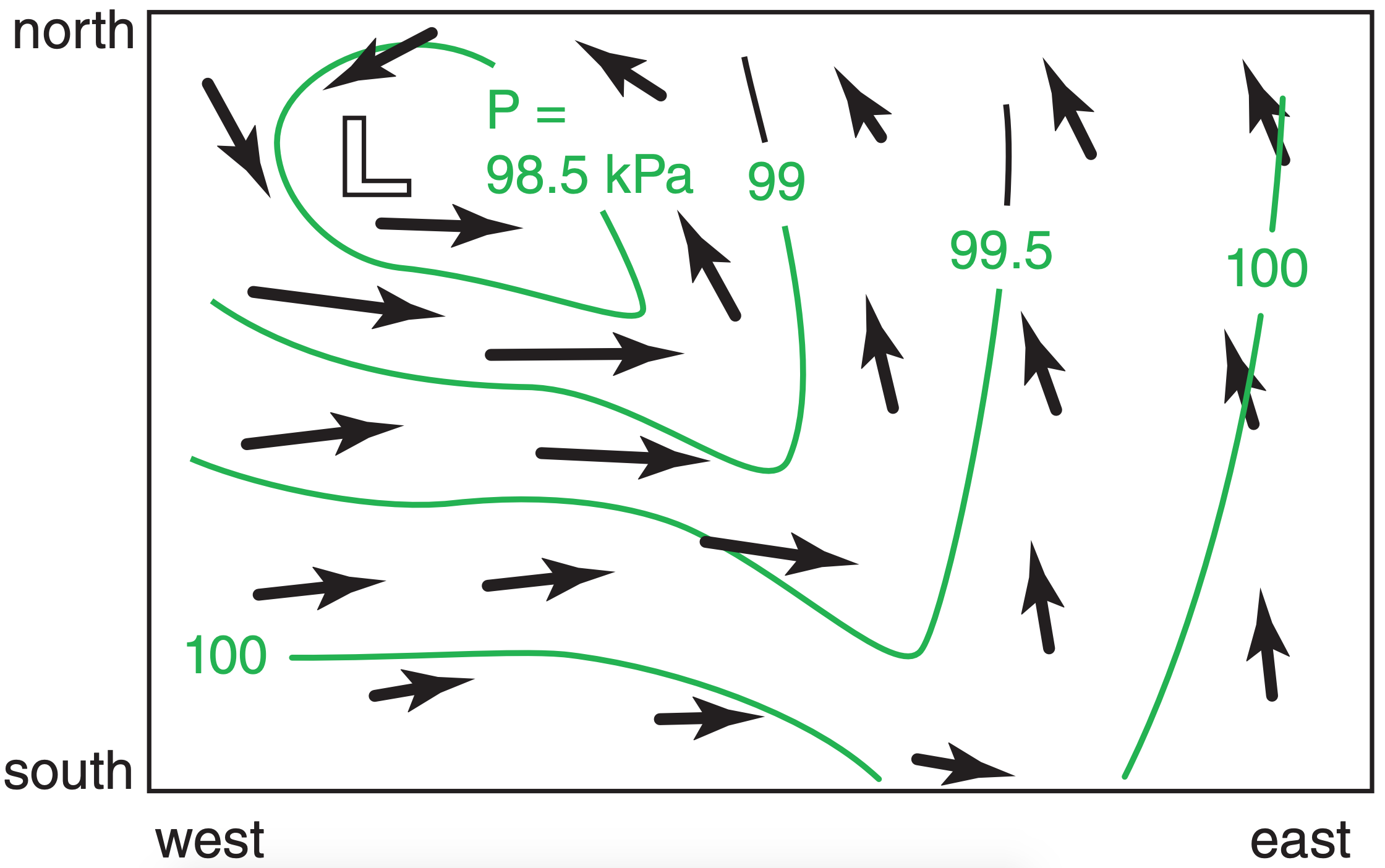
These different forces are present in different amounts at different places and times, causing large variability in the winds. For example, Fig. 10.1 shows changing wind speed and direction around a lowpressure center. In this chapter we explore forces, winds, and the dynamics that link them.
- 10.0: Winds and Weather Maps
- This page explores the pressure-gradient force's role in wind formation and the use of constant height and isobaric maps in meteorology. It explains how pressure varies with altitude and describes isobaric surfaces. The relationship between height and pressure contours is emphasized, illustrating their interchangeability. The page also details wind barb notation on weather maps and discusses the significance of isobaric charts for upper-atmospheric analysis and aviation.
- 10.1: Newton's 2nd Law
- This page covers Newton's Laws of Motion, emphasizing their significance in fluid dynamics and weather forecasting. It introduces Lagrangian and Eulerian perspectives, focusing on the application of these laws to predict motion, particularly of air parcels and wind speeds. Additionally, it explores the significance of horizontal winds in meteorology, and it reflects on Isaac Newton's early life and his creative contributions to science.
- 10.3: Horizontal Forces
- This page covers the forces impacting horizontal wind acceleration, detailing pressure-gradient force, advection, centrifugal force, Coriolis force, and turbulent drag. The pressure-gradient force drives winds from high to low pressure, while the Coriolis force, influenced by Earth's rotation, alters wind direction. Advection is noted for its effect on wind speed.
- 10.4: Equations of Horizontal Motion
- This page derives simplified equations for horizontal wind motion using Newton's Second Law and various forces. It introduces forecast equations for wind, noting circumstances where terms like Coriolis force can be neglected, such as at the equator or low-pressure areas. Additionally, it addresses scenarios needing extra terms, such as molecular friction and convective mixing.
- 10.5: Horizontal Winds
- This page covers the dynamics of steady-state and gradient winds, emphasizing geostrophic winds, pressure gradients, and the forces affecting winds in the Atmospheric Boundary Layer (ABL). It explains the principles behind wind behavior around high and low-pressure systems, and introduces calculations addressing wind speeds, including subgeostrophic and supergeostrophic conditions.
- 10.6: Horizontal Motion
- This page covers the equations of atmospheric motion, emphasizing geostrophic wind as a representation of the pressure-gradient force and introducing ageostrophic wind. It highlights varying horizontal motion scales in weather systems, noting that larger events are more persistent and have restricted vertical reach. The text also outlines the chapter structure, transitioning from large-scale to smaller-scale meteorological phenomena.
- 10.10: Measuring Winds
- This page covers methods for measuring wind speed and direction at Earth's surface using devices like wind vanes and various types of anemometers, including cup, propeller, hotwire, and sonic. It also explains techniques for measuring wind profiles with tools such as rawinsonde balloons, dropsondes, pilot balloons, and Doppler weather radar. These measurements enhance the understanding of atmospheric conditions and wind patterns.
- 10.11.: Review
- This page explains the dynamics of wind formation through Newton's second law, focusing on the pressure-gradient force as the main driver. It also explores additional influences such as turbulent drag and the Coriolis effect. Key concepts include various wind types, force balances (hydrostatic and geostrophic), and the continuity equation for air mass conservation. The page distinguishes between kinematics (behavior of wind) and dynamics (forces affecting wind).
- 10.12: Homework Exercises
- This page provides a comprehensive exploration of meteorological principles, emphasizing atmospheric forces, wind patterns, and pressure gradients through practical exercises. Topics include calculations of geostrophic wind speeds, boundary layer dynamics, and the Coriolis effect. Scenarios encourage participants to analyze theoretical and practical implications of these concepts on climate and weather.
- 10.7: Vertical Forces and Motion
- This page explains the vertical forces impacting atmospheric motion through Newton's Second Law, focusing on motion equations and hydrostatic balance's role in determining mean states. It highlights how deviations can produce non-hydrostatic motions, such as thermals, and introduces the Boussinesq approximation for analyzing density variations.
- 10.8: Consercation of Air Mass
- This page covers concepts related to atmospheric dynamics, starting with the Eötvös effect, which notes variations in perceived gravitational acceleration based on motion. It introduces the continuity equation and discusses air density changes, particularly in extreme weather like hurricanes. It then explains the calculation of vertical velocity (WABL) in relation to atmospheric boundary layers, pressure gradients, and winds.
- 10.9: Kinematics
- This page discusses key kinematic concepts in atmospheric motion, including horizontal divergence (D) which measures air spreading, and vorticity (ζr) that indicates air rotation, with positive values for counterclockwise motion. It also differentiates between stretching (F1) and shearing (F2) deformations crucial for understanding wind patterns. The combination of these factors—divergence, vorticity, and deformation—illustrates the complexity of real atmospheric flows.