

2: The Atmosphere
- Page ID
- 40011

\( \newcommand{\vecs}[1]{\overset { \scriptstyle \rightharpoonup} {\mathbf{#1}} } \)
\( \newcommand{\vecd}[1]{\overset{-\!-\!\rightharpoonup}{\vphantom{a}\smash {#1}}} \)
\( \newcommand{\dsum}{\displaystyle\sum\limits} \)
\( \newcommand{\dint}{\displaystyle\int\limits} \)
\( \newcommand{\dlim}{\displaystyle\lim\limits} \)
\( \newcommand{\id}{\mathrm{id}}\) \( \newcommand{\Span}{\mathrm{span}}\)
( \newcommand{\kernel}{\mathrm{null}\,}\) \( \newcommand{\range}{\mathrm{range}\,}\)
\( \newcommand{\RealPart}{\mathrm{Re}}\) \( \newcommand{\ImaginaryPart}{\mathrm{Im}}\)
\( \newcommand{\Argument}{\mathrm{Arg}}\) \( \newcommand{\norm}[1]{\| #1 \|}\)
\( \newcommand{\inner}[2]{\langle #1, #2 \rangle}\)
\( \newcommand{\Span}{\mathrm{span}}\)
\( \newcommand{\id}{\mathrm{id}}\)
\( \newcommand{\Span}{\mathrm{span}}\)
\( \newcommand{\kernel}{\mathrm{null}\,}\)
\( \newcommand{\range}{\mathrm{range}\,}\)
\( \newcommand{\RealPart}{\mathrm{Re}}\)
\( \newcommand{\ImaginaryPart}{\mathrm{Im}}\)
\( \newcommand{\Argument}{\mathrm{Arg}}\)
\( \newcommand{\norm}[1]{\| #1 \|}\)
\( \newcommand{\inner}[2]{\langle #1, #2 \rangle}\)
\( \newcommand{\Span}{\mathrm{span}}\) \( \newcommand{\AA}{\unicode[.8,0]{x212B}}\)
\( \newcommand{\vectorA}[1]{\vec{#1}} % arrow\)
\( \newcommand{\vectorAt}[1]{\vec{\text{#1}}} % arrow\)
\( \newcommand{\vectorB}[1]{\overset { \scriptstyle \rightharpoonup} {\mathbf{#1}} } \)
\( \newcommand{\vectorC}[1]{\textbf{#1}} \)
\( \newcommand{\vectorD}[1]{\overrightarrow{#1}} \)
\( \newcommand{\vectorDt}[1]{\overrightarrow{\text{#1}}} \)
\( \newcommand{\vectE}[1]{\overset{-\!-\!\rightharpoonup}{\vphantom{a}\smash{\mathbf {#1}}}} \)
\( \newcommand{\vecs}[1]{\overset { \scriptstyle \rightharpoonup} {\mathbf{#1}} } \)
\(\newcommand{\longvect}{\overrightarrow}\)
\( \newcommand{\vecd}[1]{\overset{-\!-\!\rightharpoonup}{\vphantom{a}\smash {#1}}} \)
\(\newcommand{\ket}[1]{\left| #1 \right>}\)
\(\newcommand{\bra}[1]{\left< #1 \right|}\)
\(\newcommand{\braket}[2]{\left< #1 \vphantom{#2} \right| \left. #2 \vphantom{#1} \right>}\)
\(\newcommand{\braopket}[3]{\left< #1 \vphantom{#2}\vphantom{#3} \right| #2 \vphantom{#1}\vphantom{#3} \left| #3 \vphantom{#1}\vphantom{#2} \right>}\)
\(\newcommand{\qmvec}[1]{\mathbf{\vec{#1}}}\)
\(\newcommand{\op}[1]{\hat{\mathbf{#1}}}\)
\(\newcommand{\expect}[1]{\langle #1 \rangle}\)
\(\newcommand{\dfn}[1]{\emph{\textbf{#1}}}\)
Overview
The atmosphere is the layer of gas that wraps around our planet, and it's essential for life. Its composition is constantly shaped by the interaction of all of Earth's major systems—living things, oceans, and land. For instance, biological processes and geological events like volcanic eruptions both release gases and particles that change the air's makeup and heat dynamics. Figure \(\PageIndex{1}\) shows a NASA image of the the earth's atmospheric layers revealing the troposphere (orange-red), stratosphere and above that was taken on July 31, 2011. All the different atmospheric layers have different characteristics and we will look at them in detail in this chapter.
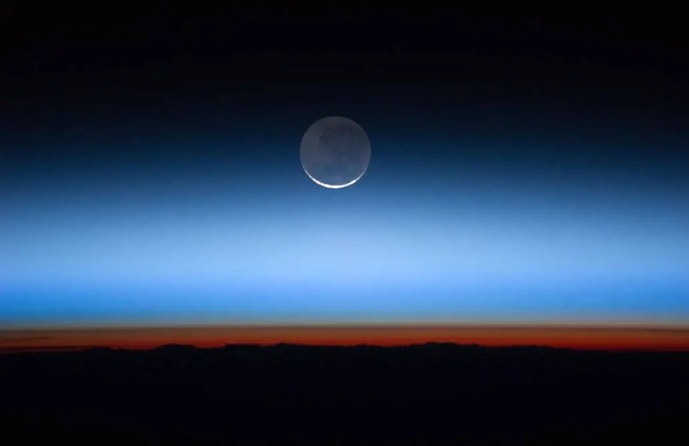
(Public Domain; via NASA/JSC Gateway to Astronaut Photography of Earth).
The atmosphere plays three vital roles for us: it provides the air we breathe, it regulates Earth's temperature to keep the planet habitable, and it acts as a protective shield that blocks harmful UV rays and burns up incoming meteors. However, human activities are now causing significant changes to the composition of the air worldwide.
In this chapter, you will explore the atmosphere's structure, its complex composition, and its profound influence on Earth's physical systems.
By the end of the chapter you should be able to:
- Draw a diagram of the layers of the atmosphere based on temperature change.
- List and explain the importance of the permanent and variable gases that comprise the atmosphere.
- Explain what the greenhouse effect is and how human activities influence global warming.
- Explain the difference between normal and environmental lapse rate.
- Explain the function of the ionosphere and ozonosphere.
See if you are prepared for this chapter by Getting Ready for Chapter 3: The Atmosphere.
- 2.4: Greenhouse Effect
- Solar radiation (shortwave) passes through most of the atmospheric gases without being absorbed to a significant extent. However, longwave radiation emitted from the Earth's surface and directed toward the sky is readily absorbed by greenhouse gases. When absorbed, the temperature of the atmosphere increases. Some of this absorbed energy is emitted to space while some is emitted back towards the Earth. This is the basis for the greenhouse effect.