

2.1: Getting Ready for Chapter 2
- Page ID
- 40017

\( \newcommand{\vecs}[1]{\overset { \scriptstyle \rightharpoonup} {\mathbf{#1}} } \)
\( \newcommand{\vecd}[1]{\overset{-\!-\!\rightharpoonup}{\vphantom{a}\smash {#1}}} \)
\( \newcommand{\dsum}{\displaystyle\sum\limits} \)
\( \newcommand{\dint}{\displaystyle\int\limits} \)
\( \newcommand{\dlim}{\displaystyle\lim\limits} \)
\( \newcommand{\id}{\mathrm{id}}\) \( \newcommand{\Span}{\mathrm{span}}\)
( \newcommand{\kernel}{\mathrm{null}\,}\) \( \newcommand{\range}{\mathrm{range}\,}\)
\( \newcommand{\RealPart}{\mathrm{Re}}\) \( \newcommand{\ImaginaryPart}{\mathrm{Im}}\)
\( \newcommand{\Argument}{\mathrm{Arg}}\) \( \newcommand{\norm}[1]{\| #1 \|}\)
\( \newcommand{\inner}[2]{\langle #1, #2 \rangle}\)
\( \newcommand{\Span}{\mathrm{span}}\)
\( \newcommand{\id}{\mathrm{id}}\)
\( \newcommand{\Span}{\mathrm{span}}\)
\( \newcommand{\kernel}{\mathrm{null}\,}\)
\( \newcommand{\range}{\mathrm{range}\,}\)
\( \newcommand{\RealPart}{\mathrm{Re}}\)
\( \newcommand{\ImaginaryPart}{\mathrm{Im}}\)
\( \newcommand{\Argument}{\mathrm{Arg}}\)
\( \newcommand{\norm}[1]{\| #1 \|}\)
\( \newcommand{\inner}[2]{\langle #1, #2 \rangle}\)
\( \newcommand{\Span}{\mathrm{span}}\) \( \newcommand{\AA}{\unicode[.8,0]{x212B}}\)
\( \newcommand{\vectorA}[1]{\vec{#1}} % arrow\)
\( \newcommand{\vectorAt}[1]{\vec{\text{#1}}} % arrow\)
\( \newcommand{\vectorB}[1]{\overset { \scriptstyle \rightharpoonup} {\mathbf{#1}} } \)
\( \newcommand{\vectorC}[1]{\textbf{#1}} \)
\( \newcommand{\vectorD}[1]{\overrightarrow{#1}} \)
\( \newcommand{\vectorDt}[1]{\overrightarrow{\text{#1}}} \)
\( \newcommand{\vectE}[1]{\overset{-\!-\!\rightharpoonup}{\vphantom{a}\smash{\mathbf {#1}}}} \)
\( \newcommand{\vecs}[1]{\overset { \scriptstyle \rightharpoonup} {\mathbf{#1}} } \)
\(\newcommand{\longvect}{\overrightarrow}\)
\( \newcommand{\vecd}[1]{\overset{-\!-\!\rightharpoonup}{\vphantom{a}\smash {#1}}} \)
\(\newcommand{\ket}[1]{\left| #1 \right>}\)
\(\newcommand{\bra}[1]{\left< #1 \right|}\)
\(\newcommand{\braket}[2]{\left< #1 \vphantom{#2} \right| \left. #2 \vphantom{#1} \right>}\)
\(\newcommand{\braopket}[3]{\left< #1 \vphantom{#2}\vphantom{#3} \right| #2 \vphantom{#1}\vphantom{#3} \left| #3 \vphantom{#1}\vphantom{#2} \right>}\)
\(\newcommand{\qmvec}[1]{\mathbf{\vec{#1}}}\)
\(\newcommand{\op}[1]{\hat{\mathbf{#1}}}\)
\(\newcommand{\expect}[1]{\langle #1 \rangle}\)
\(\newcommand{\dfn}[1]{\emph{\textbf{#1}}}\)
What you should already know ...
Chapter 3 sets the stage for a comprehensive survey of the earth system. The structure and composition of our present day atmosphere has been relatively stable for millions of years. During the depths of the ice ages, the carbon dioxide content of the atmosphere especially decreased which helped keep air temperatures cool. But levels of oxygen have remained fairly constant, even through the ice ages for the last 50 million years or so. But, the composition of the atmosphere especially greenhouse gases like carbon dioxide and methane are changing at rates much greater than they did in the past. These changes are in part due to natural forces, but increasingly are due to the activities of humans.
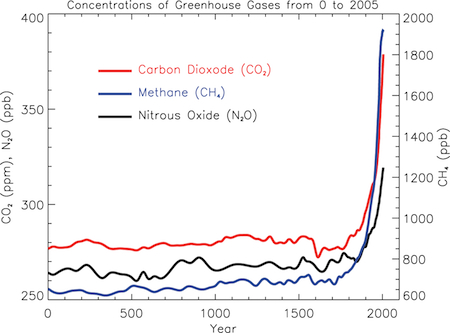
Figure \(\PageIndex{1}\) is a line graph titled “Concentrations of Greenhouse Gases from 0 to 2005.” It shows how atmospheric levels of three gases change over time.
Axes and scales:
- The horizontal axis (x-axis) is labeled Year and spans from 0 to about 2005.
- The left vertical axis (y-axis) measures:
- Carbon dioxide (CO₂) in parts per million (ppm)
- Nitrous oxide (N₂O) in parts per billion (ppb) Values range approximately from 250 to 400.
- The right vertical axis measures methane (CH₄) in ppb, ranging from about 600 to 2000.
Data series (three gases) - The graph shows three separate lines:
- Carbon dioxide (CO₂)
- Starts around 275 ppm.
- Remains relatively stable with small fluctuations for most of the timeline.
- After about 1800, increases sharply.
- Reaches nearly 380–390 ppm by 2005.
- Function: Shows a strong long-term upward trend, especially in recent centuries.
- Methane (CH₄)
- Starts near 600–700 ppb.
- Shows gradual increase over time.
- After about 1800, rises very steeply.
- Reaches close to 1900–2000 ppb by 2005.
- Function: Demonstrates the most dramatic relative increase among the three gases.
- Nitrous oxide (N₂O)
- Starts near 260–265 ppb.
- Changes slowly with small fluctuations.
- Slight upward trend over the entire period.
- Ends around 310–320 ppb by 2005.
- Function: Indicates gradual but steady increase compared to the sharper rises of CO₂ and CH₄.
A legend identifies which line corresponds to each gas (CO₂, CH₄, N₂O). The legend helps distinguish the datasets but is not required to interpret overall trends because each line follows a distinct vertical scale.
In Chapter 3 we examine the composition of the atmosphere and the importance of particular gases to the functioning of the earth system. We'll look out the structure of the atmosphere and how scientists have subdivided it based on vertical temperature patterns and the function of the different atmospheric layers. We'll also peek into the future to see what changes we can expect in our atmosphere as it changes in response to the activities of an ever-increasing population and an evolving world economy.
Chapter 3 explores the the composition and structure of the atmosphere. The atmosphere interacts with the other subsystems of the earth system. Have a good understanding of the atmosphere as a system. Biogeochemical cycles are the means whereby substances are transformed and transported through the earth system. The composition of the atmosphere is directly influenced by these cycles.
- The atmosphere is considered
- an open system
- a closed system
- an isolated system
- None of the above
- The early atmosphere was a product of _____.
- accretion
- tectonic plate movement
- outgassing
- none of the above
- A change in a system property that encourages further system change is called
- a positive feedback
- a negative feedback
- a threshold
- an equilibrium trigger
- Evaporation transfers _____ from the hydrosphere to the atmosphere.
- heat
- mass
- heat and mass
- none of the above
- ______ is a feature of systems where no additional forcing is required for a large climate change and impact to occur.
- A positive feedback
- A tipping point
- A negative feedback
- None of the above
- Which of the following would act to keep a system in a state of equilibrium?
- a positive feedback
- a negative feedback
- a threshold
- an equilibrium trigger
- _______ is responsible for most of the oxygen found in the atmosphere.
- Transpiration
- Photosynthesizing vegetation
- Rock weathering
- Animal respiration
- ______ is responsible for most of the water vapor entering the atmosphere.
- Plant transpiration
- Precipitation
- Evaporation of water from land
- Evaporation of water from the oceans
- Though the atmosphere's temperature has varied throughout geologic history, much of the time it has been considered to be
- in a state of dynamic equilibrium
- in steady-state equilibrium
- in a non-equilibrium state
- in a geo-equilibrium state
- The heat to raise the temperature of the air ultimately comes from ______ sources of energy.
- endogenic
- exogenic
- both endogenic and exogenic
- none of the above
- Answer
-
- A
- C
- A
- C
- B
- B
- B
- D
- A
- B
About your score ....
If you scored 80% or above, Great! ... start reading the chapter.
If you scored 70% to 80% you should consider reviewing the previous chapter.
If you scored less than 70% you should consider reviewing the previous chapter and seeking help from your instructor.