

14.4: Hunting and Defense
- Page ID
- 45634
\( \newcommand{\vecs}[1]{\overset { \scriptstyle \rightharpoonup} {\mathbf{#1}} } \)
\( \newcommand{\vecd}[1]{\overset{-\!-\!\rightharpoonup}{\vphantom{a}\smash {#1}}} \)
\( \newcommand{\dsum}{\displaystyle\sum\limits} \)
\( \newcommand{\dint}{\displaystyle\int\limits} \)
\( \newcommand{\dlim}{\displaystyle\lim\limits} \)
\( \newcommand{\id}{\mathrm{id}}\) \( \newcommand{\Span}{\mathrm{span}}\)
( \newcommand{\kernel}{\mathrm{null}\,}\) \( \newcommand{\range}{\mathrm{range}\,}\)
\( \newcommand{\RealPart}{\mathrm{Re}}\) \( \newcommand{\ImaginaryPart}{\mathrm{Im}}\)
\( \newcommand{\Argument}{\mathrm{Arg}}\) \( \newcommand{\norm}[1]{\| #1 \|}\)
\( \newcommand{\inner}[2]{\langle #1, #2 \rangle}\)
\( \newcommand{\Span}{\mathrm{span}}\)
\( \newcommand{\id}{\mathrm{id}}\)
\( \newcommand{\Span}{\mathrm{span}}\)
\( \newcommand{\kernel}{\mathrm{null}\,}\)
\( \newcommand{\range}{\mathrm{range}\,}\)
\( \newcommand{\RealPart}{\mathrm{Re}}\)
\( \newcommand{\ImaginaryPart}{\mathrm{Im}}\)
\( \newcommand{\Argument}{\mathrm{Arg}}\)
\( \newcommand{\norm}[1]{\| #1 \|}\)
\( \newcommand{\inner}[2]{\langle #1, #2 \rangle}\)
\( \newcommand{\Span}{\mathrm{span}}\) \( \newcommand{\AA}{\unicode[.8,0]{x212B}}\)
\( \newcommand{\vectorA}[1]{\vec{#1}} % arrow\)
\( \newcommand{\vectorAt}[1]{\vec{\text{#1}}} % arrow\)
\( \newcommand{\vectorB}[1]{\overset { \scriptstyle \rightharpoonup} {\mathbf{#1}} } \)
\( \newcommand{\vectorC}[1]{\textbf{#1}} \)
\( \newcommand{\vectorD}[1]{\overrightarrow{#1}} \)
\( \newcommand{\vectorDt}[1]{\overrightarrow{\text{#1}}} \)
\( \newcommand{\vectE}[1]{\overset{-\!-\!\rightharpoonup}{\vphantom{a}\smash{\mathbf {#1}}}} \)
\( \newcommand{\vecs}[1]{\overset { \scriptstyle \rightharpoonup} {\mathbf{#1}} } \)
\(\newcommand{\longvect}{\overrightarrow}\)
\( \newcommand{\vecd}[1]{\overset{-\!-\!\rightharpoonup}{\vphantom{a}\smash {#1}}} \)
\(\newcommand{\avec}{\mathbf a}\) \(\newcommand{\bvec}{\mathbf b}\) \(\newcommand{\cvec}{\mathbf c}\) \(\newcommand{\dvec}{\mathbf d}\) \(\newcommand{\dtil}{\widetilde{\mathbf d}}\) \(\newcommand{\evec}{\mathbf e}\) \(\newcommand{\fvec}{\mathbf f}\) \(\newcommand{\nvec}{\mathbf n}\) \(\newcommand{\pvec}{\mathbf p}\) \(\newcommand{\qvec}{\mathbf q}\) \(\newcommand{\svec}{\mathbf s}\) \(\newcommand{\tvec}{\mathbf t}\) \(\newcommand{\uvec}{\mathbf u}\) \(\newcommand{\vvec}{\mathbf v}\) \(\newcommand{\wvec}{\mathbf w}\) \(\newcommand{\xvec}{\mathbf x}\) \(\newcommand{\yvec}{\mathbf y}\) \(\newcommand{\zvec}{\mathbf z}\) \(\newcommand{\rvec}{\mathbf r}\) \(\newcommand{\mvec}{\mathbf m}\) \(\newcommand{\zerovec}{\mathbf 0}\) \(\newcommand{\onevec}{\mathbf 1}\) \(\newcommand{\real}{\mathbb R}\) \(\newcommand{\twovec}[2]{\left[\begin{array}{r}#1 \\ #2 \end{array}\right]}\) \(\newcommand{\ctwovec}[2]{\left[\begin{array}{c}#1 \\ #2 \end{array}\right]}\) \(\newcommand{\threevec}[3]{\left[\begin{array}{r}#1 \\ #2 \\ #3 \end{array}\right]}\) \(\newcommand{\cthreevec}[3]{\left[\begin{array}{c}#1 \\ #2 \\ #3 \end{array}\right]}\) \(\newcommand{\fourvec}[4]{\left[\begin{array}{r}#1 \\ #2 \\ #3 \\ #4 \end{array}\right]}\) \(\newcommand{\cfourvec}[4]{\left[\begin{array}{c}#1 \\ #2 \\ #3 \\ #4 \end{array}\right]}\) \(\newcommand{\fivevec}[5]{\left[\begin{array}{r}#1 \\ #2 \\ #3 \\ #4 \\ #5 \\ \end{array}\right]}\) \(\newcommand{\cfivevec}[5]{\left[\begin{array}{c}#1 \\ #2 \\ #3 \\ #4 \\ #5 \\ \end{array}\right]}\) \(\newcommand{\mattwo}[4]{\left[\begin{array}{rr}#1 \amp #2 \\ #3 \amp #4 \\ \end{array}\right]}\) \(\newcommand{\laspan}[1]{\text{Span}\{#1\}}\) \(\newcommand{\bcal}{\cal B}\) \(\newcommand{\ccal}{\cal C}\) \(\newcommand{\scal}{\cal S}\) \(\newcommand{\wcal}{\cal W}\) \(\newcommand{\ecal}{\cal E}\) \(\newcommand{\coords}[2]{\left\{#1\right\}_{#2}}\) \(\newcommand{\gray}[1]{\color{gray}{#1}}\) \(\newcommand{\lgray}[1]{\color{lightgray}{#1}}\) \(\newcommand{\rank}{\operatorname{rank}}\) \(\newcommand{\row}{\text{Row}}\) \(\newcommand{\col}{\text{Col}}\) \(\renewcommand{\row}{\text{Row}}\) \(\newcommand{\nul}{\text{Nul}}\) \(\newcommand{\var}{\text{Var}}\) \(\newcommand{\corr}{\text{corr}}\) \(\newcommand{\len}[1]{\left|#1\right|}\) \(\newcommand{\bbar}{\overline{\bvec}}\) \(\newcommand{\bhat}{\widehat{\bvec}}\) \(\newcommand{\bperp}{\bvec^\perp}\) \(\newcommand{\xhat}{\widehat{\xvec}}\) \(\newcommand{\vhat}{\widehat{\vvec}}\) \(\newcommand{\uhat}{\widehat{\uvec}}\) \(\newcommand{\what}{\widehat{\wvec}}\) \(\newcommand{\Sighat}{\widehat{\Sigma}}\) \(\newcommand{\lt}{<}\) \(\newcommand{\gt}{>}\) \(\newcommand{\amp}{&}\) \(\definecolor{fillinmathshade}{gray}{0.9}\)All marine species must ensure that enough individuals survive predation to produce the next generation. Carnivorous species must also adopt a successful hunting method that can counter the defensive methods of their prey and provide adequate food. Although there are only a few basic approaches to either offense or defense, combining these approaches makes possible an incredible variety of offensive and defensive strategies. The situation is analogous to the game of chess, in which a few simple permitted moves of the chess pieces can be combined into an almost infinite variety of offensive or defensive strategies. Each species has its own unique combination of defensive and offensive strategies. In a chess game, the most successful strategy is usually one in which individual moves are combined in such a way that each contributes to both defense and offense. Similarly, marine species often use the same approach for both purposes.
Basic offensive and defensive approaches used by marine organisms are summarized in Table 14-1. The following sections describe and illustrate how these approaches are used by various species, and how fish species have evolved to optimize variations of them. The unusual sensing mechanisms that some marine species use to locate prey are discussed in a subsequent section.
Speed
The most familiar approach to hunting and defense in terrestrial ecosystems is speed. The predator chases the prey, and the prey tries to outrun the predator. For example, lions and tigers chase antelopes, but antelopes often escape by outrunning their pursuers. Speed is used in much the same way in the marine environment.
Predators that hunt by using their swimming speed include a variety of sharks, bony fishes, marine mammals, and squid. The prey are generally other species of fishes, marine mammals, or squid. In some cases the hunt is similar to the lion–antelope chase, but it occurs in three dimensions. Prey outnumber the predator and live uneasily in the predator’s presence, always carefully monitoring its movements and maintaining a respectful distance. Suddenly the predator selects a potential victim and begins the chase. Unwary prey or prey that are weak or injured fail to elude the predator and are consumed. Stronger individuals and those that are more successful in avoiding predators preferentially survive to reproduce and pass on their more successful genes to future generations. The predatory species is subject to a similar natural selection process because stronger and more skillful predators outcompete weaker and less successful members of their species for the available food resources.
Only the largest predators and prey can invest the considerable energy required to overcome water resistance and swim long distances at high speed. These species must obtain large quantities of food to replace energy reserves used in the chase. Consequently, most ocean predators use speed in ways that ensure a quick kill, and prey species seek ways to escape their predators quickly.
Predators may use a short burst of speed as the final component of a hunting strategy in which stealth or other approaches are used to initially get within striking distance of the prey. A variety of fish species, including lizardfishes (Fig. 14-14a), frogfishes (Fig. 14-14b), and hawkfishes (Fig. 14-14c), lie quietly in wait on the seafloor until their prey passes nearby. Then a quick burst of speed is sufficient to capture the prey. Lizardfishes rely on their prey’s mistake in approaching within half a meter or so, a distance across which a lizardfish can make a very fast attack. Frogfishes are among the fastest-moving marine animals, but they can maintain their speed for only a few tens of centimeters and must be very close to their prey for a successful hunt. To ensure that its prey approaches close enough for such attacks, a frogfish uses two other approaches in its hunting strategy: camouflage and a lure, which are discussed below.

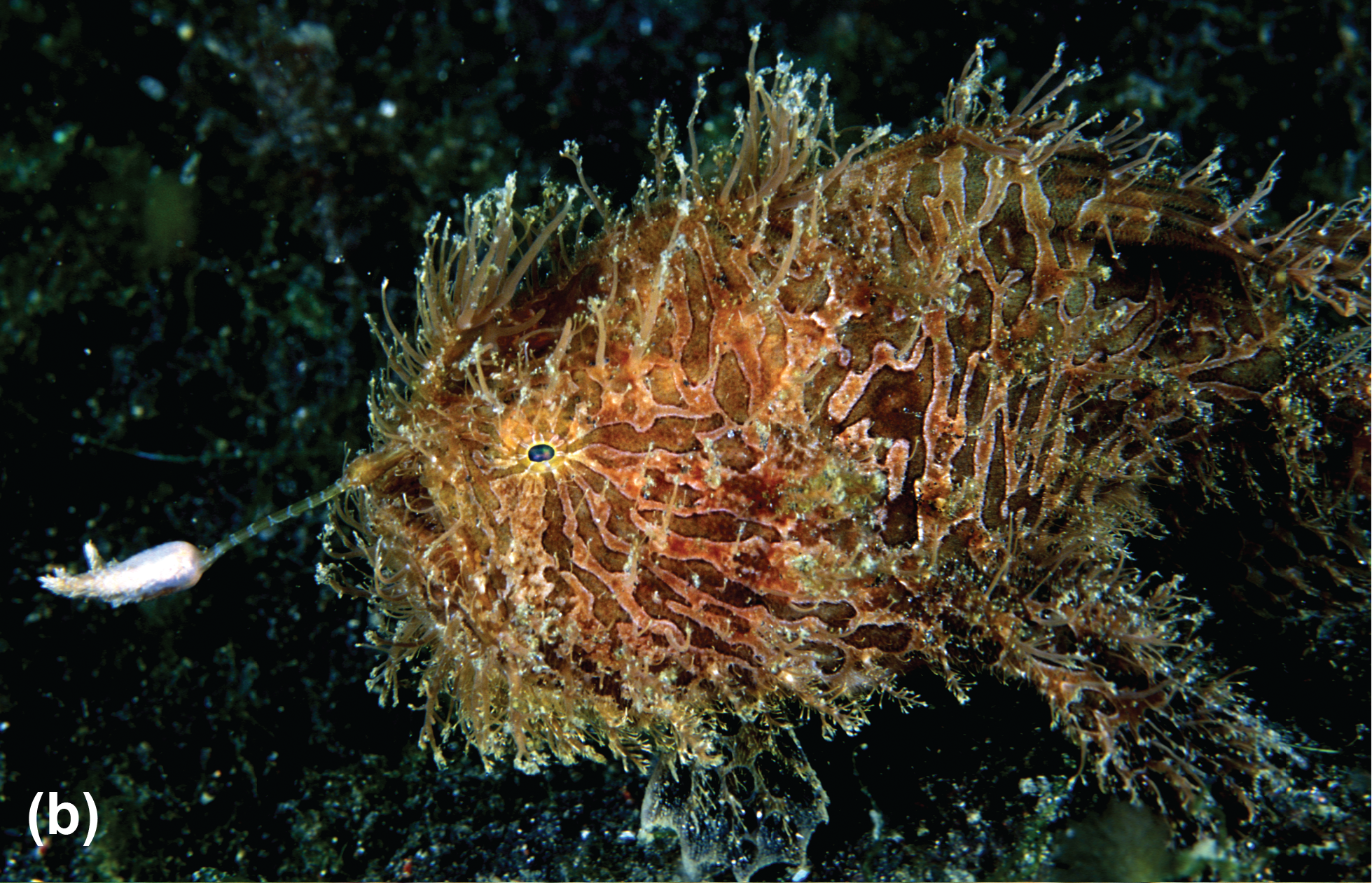
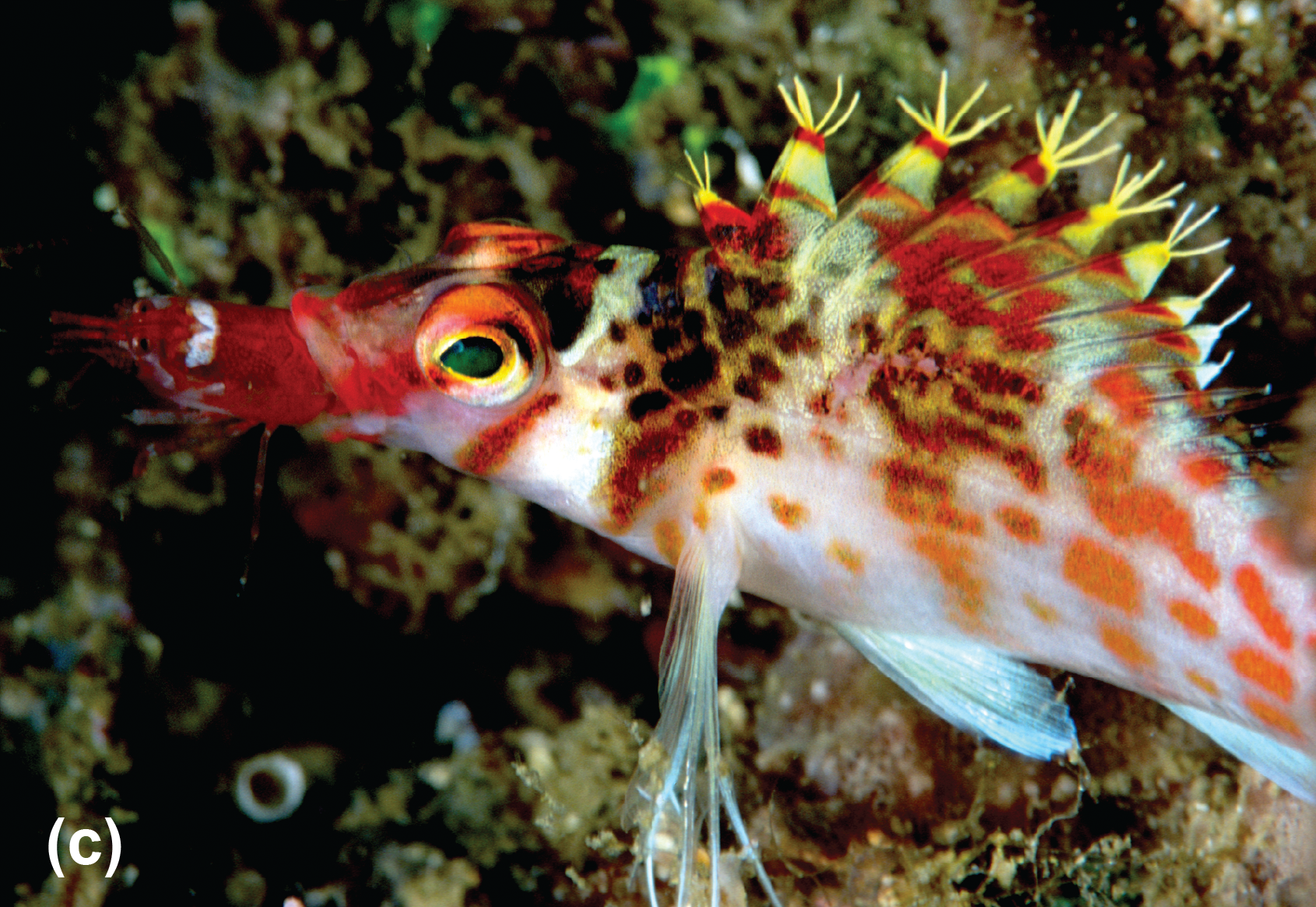
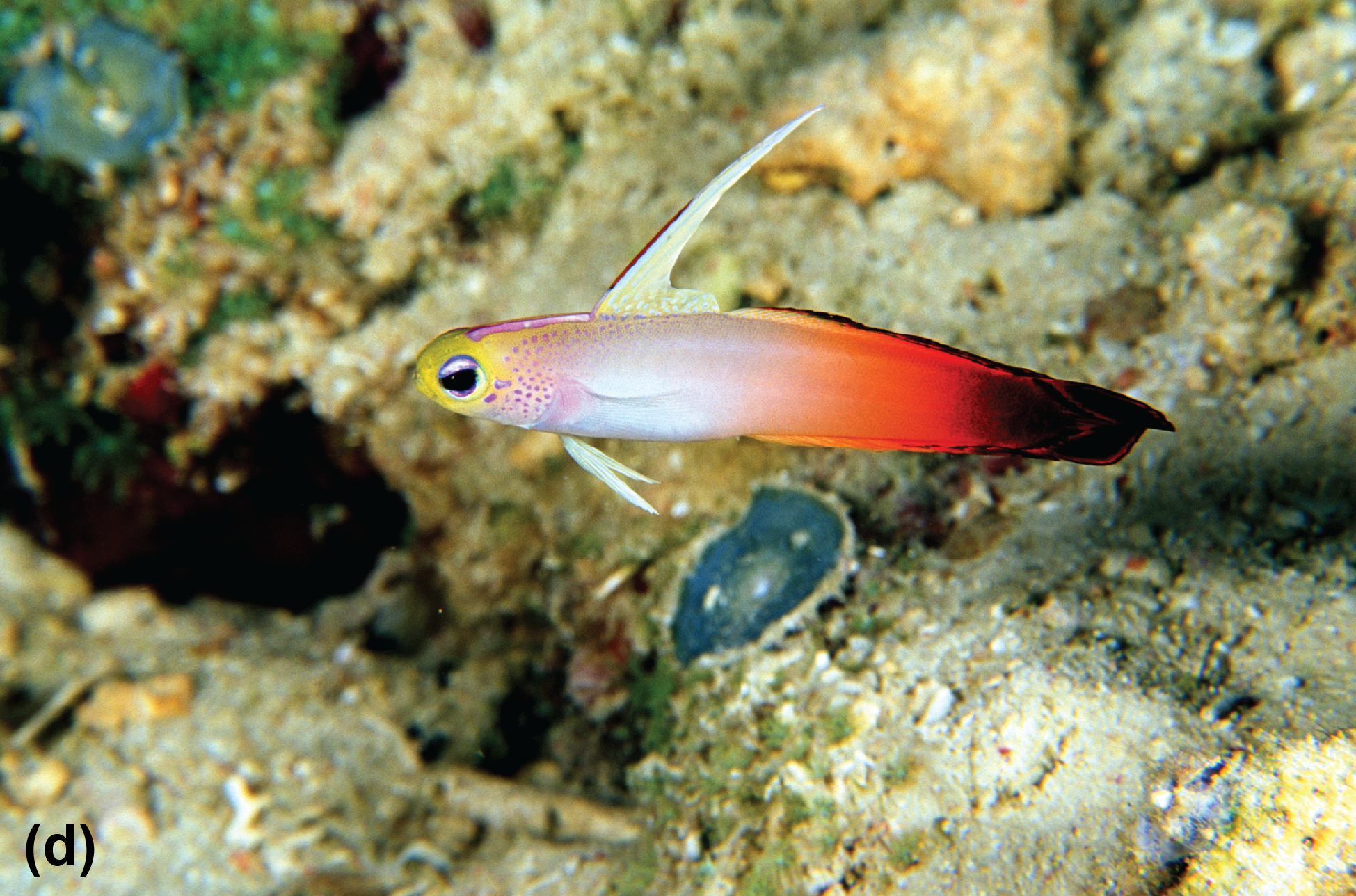

Speed is also used in a variety of ways as a component of defensive strategies. Gobies use short bursts of speed to retreat to their home, which is generally a hole in the sand or reef where they are safe from predators (Fig. 14-14d). Some invertebrates, such as the fan worm (Fig. 14-10c), Christmas tree worm (Fig. 14-10d), and some sand anemones (Fig. 14-6c), use a high-speed, almost instantaneous, retreat into a protected tube or burrow to avoid predation. Many fish species change direction quickly to evade an onrushing predator. For example, butterflyfishes (Fig. 14-14e) can evade predators by swimming quickly in and out of the tortuous nooks and crannies of a reef or by simply making tight turns.
Lures
Lures are used by ocean predators to attract fishes and other prey just as they are used in sportfishing. The lure is made to look like a tasty morsel of food to attract the prey species to the concealed predator (or fishhook). The best-known practitioners of this technique are frogfishes (Fig. 14-14b). Lying still and camouflaged, a frogfish wiggles a fleshy knob on the end of a stalk-like projection extending from above the mouth. When another fish approaches, this lure appears to be a small fish, shrimp, or other food morsel. By the time an unwary approaching fish is close enough to realize its mistake, it is within striking distance of the frogfish’s lightning-quick, short-range attack. Because the predator uses little energy while lying in wait, it requires successful hunts only infrequently. In addition, the lure can attract more prey than would normally swim by. The deep-sea anglerfish (Fig. 14-15) uses the lure-based ambush strategy to perfection. Its bioluminescent lure appears as a tantalizing tiny point of light to prey that live in perpetual dark, although many potential prey species in this zone are sightless.

Ironically, lures can also be used for defensive purposes. They are used by many reef fish species, especially butterflyfishes, which have a dark spot near the tail (Fig. 14-14e) that resembles an eye. The real eye is often camouflaged in a vertical black line. When a predator makes its initial move toward a butterflyfish, it aims its attack toward the front of the fish to block its expected escape route. If the predator is lured into orienting its attack to the false eye location, the butterflyfish gains valuable moments in which to swim in a direction other than that expected by the predator. The false eye may also be larger than the real eye to make the prey seem much bigger and thus more capable of retaliatory defense. You may have seen some of the many butterflies and moths that have false eyes for the same reason.
Camouflage and Mimicry
Camouflage (the art of making an object difficult or impossible to see against its background) and mimicry (the art of making an individual look like a completely different species or object) are practiced by many marine species. The principal use of camouflage is probably to enable an organism to escape detection by its predators, but it is also used by predators to enable them to get close to their prey without detection. In many cases, camouflage is extremely effective (Fig. 14-16). Countless times when my diving partner has pointed out an organism on a reef, I have needed many seconds of careful visual examination before I could suddenly see through the effective camouflage to discern the organism.


Marine animals take many different approaches to camouflage, but the predominant basic approach is to make texture, color, and pattern appear the same as those of the background. Some animals, such as octopuses and cuttlefish, can change their colors almost instantly to blend into their background. These species can also change their body texture to blend into a reef. Octopuses, cuttlefish, and many other species change color by using muscles to expand or contract pigment filled cells in their outer body surface called “chromatophores” under direct control of their nervous system. However, this is not the only way to match the color of a background. For example, some species of frogfishes (Fig. 14-14b) have a variety of colors and color patterns, and each individual finds itself a permanent or semipermanent home where it is surrounded by similarly colored sponges or sponge-encrusted rocks. The frogfish’s body is lumpy and irregular, so its shape and texture do not instantly reveal its presence. In addition, the frogfish has small eyes surrounded by confusing decoration, again for camouflage. Scorpionfishes and many seahorses (Fig. 14-16d,h,i) use a very similar camouflage technique: a mixture of drab colors that blend into their background on a reef or rubble-covered bottom, and frilly appendages that disguise their body outline.
The differences in frogfish and scorpionfish camouflage reflect their different preferred habitats and habits. Frogfishes live in or on a reef and rarely move from one preferred location. Scorpionfishes live primarily on a coral rubble seafloor and move periodically from place to place to hunt. Scorpionfishes therefore need a more generalized camouflage than frogfishes do, to blend with the variety of backgrounds they encounter. Like frogfishes and scorpionfishes, the ghost pipefish (Fig. 14-16e) is a master of both color and body form camouflage. Some species live among algae or turtle grass (Thalassia) and even swim in a vertical orientation to parallel the algae or turtle grass blades.
Tiny shrimp, crabs, and other invertebrates that live on crinoids and soft corals make very effective use of camouflage (Fig. 14-16a,b,g,j,k,l). Many of these tiny and beautiful invertebrates spend their entire life cycle on a single host crinoid or soft coral that they perfectly mimic. These hosts have a wide variety of colors and color patterns, and the guest species often match the pattern. Many of the tiny invertebrate species that inhabit crinoids and soft corals have not been well studied, so we do not know how each of these species achieves its perfect camouflage. Some species of shrimp will change color within several days to match a new host perfectly when they are moved from one crinoid or soft coral to a differently colored individual or colony of the same species. The shrimp likely achieves this color change by using its chromatophores, or by eating small parts of its host and incorporating the host’s colored pigments into its own body, or possibly by a combination of these techniques.
Sometimes even the perfect color-matching capabilities of crinoid and soft coral inhabitants appear to provide insufficient camouflage. Many invertebrates, particularly several species of tiny crabs, also have modified body shapes to match the structure of their host. In some cases, the crab’s or other lodger’s body is covered with spines and protuberances that mimic the appearance of the host or its individual polyps. In other cases, the lodger plucks off some of its host’s polyps and places them on its shell or appendages (Fig. 14-16g). The technique of placing other organisms on one’s own body for camouflage is practiced by many invertebrate species. For example, the decorator crab (Fig. 14-16f) covers its entire body with algae, sponges, and other invertebrates, beneath which the crab is not easily seen, particularly if it stays motionless when a predator nears. The polyps, sponges, and other species used for camouflage can live and reproduce while attached to the camouflaged crab. As will be discussed later in the chapter, the association may even be beneficial to both species.
Pelagic fishes and marine mammals that swim in the water column away from the seafloor take advantage of somewhat different camouflage. Many of these species have countershading that minimizes the contrast of their bodies against the background as viewed by predators from above or below. Species that rely on counter-shade camouflage have a white or silver and highly reflective underside (Fig. 14-17a,b) that efficiently reflects the ambient light downward and reduces the contrast between the fish’s (or mammal’s) body and the water surface as seen by a predator from below. The upper side of the countershaded species is dull, nonreflective, and often mottled gray or blue-gray to reduce upward reflection of light and soften the outline by providing variations in the light reflected. A predator looking downward must distinguish the dull and confusing shape of the countershaded prey seen against the murky, confused background of the seafloor or deep water below.


Some species conceal their identity by mimicking another species. Again, this approach can be used in either hunting or defense. The false cleaner wrasse is a small carnivorous fish that mimics a species of cleaner wrasse (Fig. 14-17e). Cleaner wrasses establish stations where they wait to eat parasites off larger fishes, and they advertise their services by their bright colors and a jerky dance that is similar for all cleaner species. The cleaner benefits from the food supply of parasites, and the cleaned fish benefits by being rid of the parasites. The false cleaner mimics not only the cleaner’s coloration and body shape, but also its advertising dance. The unsuspecting parasitized fish moves in and lowers its defensive guard to the false cleaner, which simply takes a bite out of the fish. Often the fish is startled but stays and allows the false cleaner a second bite before realizing its mistake and scurrying away in complete confusion.
The black-saddled mimic filefish (also known as the mimic leatherjacket) uses mimicry for defensive purposes. The filefish (Fig. 14-17c) is virtually indistinguishable in size, shape, and markings from a pufferfish, the black-saddled toby (Fig. 14-17d). Because the puffer is poisonous and predators are unable to distinguish the two species, they ignore both the puffer and its mimic. The juvenile mimic surgeonfish (Fig. 14-17f) mimics both the looks and the behavior of the pearlscale angelfish (Fig. 14-17g), and it is about the same size as the angelfish, but the larger adult mimic surgeonfish (Fig. 14-17f) looks completely different from the juvenile. Angelfishes have sharp spines on their cheeks to deter predators, so the predators do not attack the juvenile mimic surgeonfish even though surgeonfishes do not have such a spine.
Concealment
Although many marine predators use senses other than vision to locate their prey, most marine predators in the photic zone hunt primarily by sight. Consequently, concealment is an excellent technique that is widely used for defensive purposes and also by certain predators to ambush their prey. Camouflage and concealment are often used together to prevent detection. For example, flounders and soles (Fig. 14-16c) are not only camouflaged, but also may partially bury themselves in sand to conceal their presence further.
Concealment is a very effective strategy for many invertebrates and fishes that bury themselves in sand or mud; hide in cracks, crevices, or caves of a reef or rubble-covered seafloor; or build and live in holes in a reef, sediments, or rocks. Most species that use concealment for defense against visual hunters remain concealed by day and come out to feed at night. Other species emerge during the day but seldom stray far from their hiding places. These species use concealment places in two ways: to hide in to escape detection when predators approach and as a refuge into which the usually much larger would-be predator cannot follow. For example, fire gobies (Fig. 14-14d) live in holes excavated in coarse sand or rubble areas around coral reefs. Some will dive into these holes, of which they may have several, when a predator is in sight. Others will stay out until the predator reaches a distance of a meter or two and then dive into their holes at lightning speed. Photographing these gobies, and many other reef fishes that have similar habits, requires the patience to lie quietly in wait until the fish re-emerges.
Nocturnal species that conceal themselves by day and hunt at night are often a deep red color and have big eyes (Fig. 14-18a,b,e) that enable them to hunt when light levels are very low. The red color aids concealment in caves or at night because red light is strongly absorbed by seawater. Consequently, these organisms appear dark gray or black unless seen near the surface in daylight or when illuminated with artificial light. In addition, many marine species have eyes that are not sensitive to red wavelengths.


A wide variety of fishes, shrimp, crabs, sea urchins, octopuses, and many other invertebrate species conceal themselves by day and emerge at night (Fig. 14-18). In contrast, many species that hunt or feed during the day conceal themselves at night (Fig. 14-19a). Diving at night on a reef or rocky area reveals a community very different from the one seen during the day. Many invertebrates, including certain sea pens (Fig. 14-6a,b), shrimp, crabs, and mollusks (Fig. 14-19b), emerge only at night and bury themselves in the soft seafloor by day. Nocturnal predators use the cover of night as a form of concealment to ambush their prey.


Concealment would seem to be impossible for species that live in the water column. Nevertheless, squid and octopuses are able to conceal themselves by speeding off behind an opaque cloud of ink that they release when threatened.
In the open ocean, where there are no reefs or backgrounds to blend into, some pelagic animals use transparency as a means of concealment. By having bodies composed largely of water, animals like jellies, comb jellies (ctenophores) and salps allow light to pass directly through them so they are nearly invisible to predators. Other organisms, like glass squid and certain larval fishes, have transparent tissues and organs, leaving only their eyes visible. This strategy makes it almost impossible to detect in the sunlit upper layers of the ocean.
Spines and Armor
Numerous invertebrates have evolved thickened shells or long spines to prevent predators from reaching their vital soft parts. Many mollusks have external shells that protect them after they retreat inside. Bivalve mollusks, including clams and scallops, have two hinged valves that they can close tightly together. Gastropod mollusks have a single shell (Fig. 14-19c) into which the animal’s soft parts can be withdrawn. The entrance to the shell is closed off with a tough door called an “operculum.” Some fishes, such as puffers and burrfishes (Fig. 14-19d,e), have developed special jaws to crush mollusk shells. Crabs have a large armored crushing claw for the same purpose. In turn, many mollusks have developed extremely thick and strong shells or armored spines. Spines increase the size of the shell and make it more difficult for a crab’s claw or fish’s jaw to grasp and crush it. Many mollusks conceal themselves during the day and hunt only at night to avoid predators, but some predators, particularly crabs, are also nocturnal. There is a perpetual contest between predator and prey as each evolves better adaptations for survival.
Many sea urchins (Fig. 14-18d) have evolved long sharp spines that cover their entire upper body. The spines are often tipped with reverse barbs or venom injectors. A direct approach by a predator to one of these sea urchins is likely to result in severe stab wounds or even paralysis and death. However, some triggerfishes will methodically pick off one spine at a time until they can attack the underlying external shell of its, then helpless, inhabitant. Other triggerfishes use a jet of water from the mouth to blow the sea urchin over, exposing the vulnerable underside that has no spines—an elegant means of circumventing the urchin’s defenses. In addition to their formidable spines and, in some species, highly toxic venom, many sea urchins have become nocturnal to avoid daytime predators.
Crustaceans, including shrimp, crabs, and lobsters, have developed hard external shells that they must periodically shed and regrow as the soft animal within becomes larger. Worms, such as the fan worm and Christmas tree worm (Fig. 14-10c,d), use rocks, coral, or sand to build armored burrows into which they can withdraw. Sea cucumbers do not have hard shell armor, but they have developed thick leathery outer skins containing calcium carbonate that, although pliable, are almost impossible to bite through.
Certain fish species have also developed armor and spines. Boxfishes (Fig. 14-19f) have a hard, boxlike body that allows only slow and awkward swimming but makes them large in cross section to prevent a predator’s jaw from grasping and crushing them. The armor also prevents the predator from taking small bites off a boxfish’s body. When attacked, burrfishes (Fig. 14-19d,e) gulp large amounts of water and swell up, extending spines that normally lie flat on their body. Burrfishes reportedly may even inflate when already caught in a predator’s jaws and simply wait for the predator to weaken or die from hunger before deflating and releasing themselves.
Toxins
A variety of invertebrate species, many marine algae, and certain fishes produce or concentrate from their food a wide spectrum of toxic substances. These substances are sometimes used to kill parasites and larval stages of other organisms that may settle on the toxin-producing species, but their main use is to discourage predators. Most of the myriad toxic substances synthesized by marine species have not been identified, and many thousands of these compounds are likely to be found. Because most toxic substances discourage predators, including bacteria and viruses, by interfering with their biochemistry, these substances hold the potential to be used as, or to lead to the development of, drugs that can treat human illness. Several drugs derived from marine toxins are already in routine use or are undergoing clinical trials. For example, a powerful painkiller derived from the venom of cone snails (Fig. 14-19c) that blocks nerve channels has been found to be more potent than morphine without being addictive.
Many species that produce toxins to make themselves inedible, notably nudibranchs (Fig. 14-11c,d), are brightly colored. The conspicuous color schemes of nudibranchs and similarly toxic tunicates, sponges, and other invertebrates warn predators of the poison defense. In response, many predators have evolved mechanisms to detoxify the poison produced by their prey species.
Numerous species inject toxins into the predator to repel its attack. Sea urchins inject such venom with the tips of their spines. Stonefishes and scorpionfishes (Fig. 14-16d) inject deadly venom with sharp spines along their dorsal (upper) fin. Anemones, corals, hydroids, and other invertebrates all inject venom by firing little poisonous darts called “nematocysts” from their tentacles. Some nudibranchs even steal these defenses by consuming anemones or hydroids and assimilating the undischarged nematocysts into their own body tissues to fire at their own predators.
Toxins are used for hunting as well as defense. For example, anemones (Fig. 14-20a) use toxin-laden nematocysts to attack and stun or immobilize invertebrates and small fishes that blunder into their trap. Once stunned, the prey is trapped by mucus-laden anemone tentacles that fold over and pass the prey toward the mouth or open stomach at the anemone’s center. Anemonefishes (often called “clownfishes” or “clown anemonefishes”) live in or near the anemone (Fig. 14-20b-f), retreating into its protective toxic folds and tentacles when threatened. The anemonefishes avoid being stung by developing a specialized mucus coating that prevents the anemone’s stinging cells from firing, effectively camouflaging the fish as part of the anemone’s own body, essentially a way of gaining immunity.


Other notable species that use toxins to immobilize their prey include cone shells (Fig. 14-19c), which inject their venom through a long, thin tube extended from their body, and blue-ringed octopuses (Fig. 12-1), which transmit their toxin in mucus as they bite their prey. A number of human deaths have been caused by cone shell toxin injected when people inadvertently stepped on a cone shell living just buried in the sand in shallow water near the beach. One species of blue-ringed octopus, which lives in tide pools and on shallow reefs around Australia, is not aggressive but will bite if threatened or stepped on. The venom injected by this species is especially toxic, and there is no known antidote. A bite often results in death.
Numerous species excrete poisons into the surrounding water to discourage competitors or potential predators. On the West Coast of the U.S., certain species of the diatom Pseudo-nitzschia produce a potent neurotoxin called domoic acid during large algal events. While these diatoms are the source, the toxin accumulates in the tissues of filter-feeders like sardines and anchovies. When larger marine mammals, such as California sea lions and whales, consume these fish, they ingest concentrated doses of the toxin, which causes seizures, brain damage, and often death. Domoic acid is also the cause of amnesic shellfish poisoning which can cause persistent neurological symptoms in humans who consume filter feeding shellfish.
Group Cooperation
Both hunting and defense can be aided by cooperative approaches involving several or many individuals of the same species and sometimes between members of two different species. The Portuguese man-of-war is a good example (Chap. 12). Group cooperation is a common adaptation, but two special categories are of interest: colonial forms and schooling in pelagic animals.
Colonial species abound in the oceans and include many sponges and cnidarians. In some colonial forms, each individual feeds and reproduces separately, but the individuals cooperate to enhance each other’s and the species’ success. For example, individual polyps of sea fans and corals, by growing attached to each other, extend the colonies’ reach into the water column. This extension gives each polyp a better chance of encountering food and reduces competition by other species that live on sediment or rock surfaces.
Pelagic species, including many fishes, squid, and marine mammals, congregate in schools. Similarly, phytoplankton and zooplankton often have patchy (clustered) distributions. Schooling and clustering behavior affords advantages. For example, a group of fish can often overcome the defenses of a single individual of an otherwise superior species. Damselfishes lay their eggs in clusters on a reef surface and then defend them aggressively. Wrasses and other fishes arrive in groups to feed briefly but voraciously on the eggs as the damselfishes frantically try to chase them off but fail because there are too many attackers.
Fish schools have no leader, but each fish precisely matches the seemingly random twists and turns of the school, maintaining a precise distance from each of its neighbors. Movements of the school may confuse predators by making the school appear to be a single large organism. In addition, predators may have difficulty singling out a victim from the moving school. Schooling may have benefits in reproduction as well. Finding a mate is easier in a school, and a high rate of fertilization is ensured if eggs and sperm are released to the water column simultaneously by many members of the school. Mass spawning can in fact be considered a form of “schooling” of the fertilized eggs and larvae.
When prey is concentrated in schools, the predator spends much of its time searching for the school. Once it encounters a school, it cannot consume the entire school, so most individuals will survive, even if the predator gorges itself. Predators are able to consume less food through periodic gorging than they could by continuous steady feeding. Schooling of the prey and mass spawning thus reduce the efficiency of predator feeding, and consequently more of the prey species survive. This outcome may be the principal advantage of schooling.