

14.3: Feeding
- Page ID
- 45633
\( \newcommand{\vecs}[1]{\overset { \scriptstyle \rightharpoonup} {\mathbf{#1}} } \)
\( \newcommand{\vecd}[1]{\overset{-\!-\!\rightharpoonup}{\vphantom{a}\smash {#1}}} \)
\( \newcommand{\dsum}{\displaystyle\sum\limits} \)
\( \newcommand{\dint}{\displaystyle\int\limits} \)
\( \newcommand{\dlim}{\displaystyle\lim\limits} \)
\( \newcommand{\id}{\mathrm{id}}\) \( \newcommand{\Span}{\mathrm{span}}\)
( \newcommand{\kernel}{\mathrm{null}\,}\) \( \newcommand{\range}{\mathrm{range}\,}\)
\( \newcommand{\RealPart}{\mathrm{Re}}\) \( \newcommand{\ImaginaryPart}{\mathrm{Im}}\)
\( \newcommand{\Argument}{\mathrm{Arg}}\) \( \newcommand{\norm}[1]{\| #1 \|}\)
\( \newcommand{\inner}[2]{\langle #1, #2 \rangle}\)
\( \newcommand{\Span}{\mathrm{span}}\)
\( \newcommand{\id}{\mathrm{id}}\)
\( \newcommand{\Span}{\mathrm{span}}\)
\( \newcommand{\kernel}{\mathrm{null}\,}\)
\( \newcommand{\range}{\mathrm{range}\,}\)
\( \newcommand{\RealPart}{\mathrm{Re}}\)
\( \newcommand{\ImaginaryPart}{\mathrm{Im}}\)
\( \newcommand{\Argument}{\mathrm{Arg}}\)
\( \newcommand{\norm}[1]{\| #1 \|}\)
\( \newcommand{\inner}[2]{\langle #1, #2 \rangle}\)
\( \newcommand{\Span}{\mathrm{span}}\) \( \newcommand{\AA}{\unicode[.8,0]{x212B}}\)
\( \newcommand{\vectorA}[1]{\vec{#1}} % arrow\)
\( \newcommand{\vectorAt}[1]{\vec{\text{#1}}} % arrow\)
\( \newcommand{\vectorB}[1]{\overset { \scriptstyle \rightharpoonup} {\mathbf{#1}} } \)
\( \newcommand{\vectorC}[1]{\textbf{#1}} \)
\( \newcommand{\vectorD}[1]{\overrightarrow{#1}} \)
\( \newcommand{\vectorDt}[1]{\overrightarrow{\text{#1}}} \)
\( \newcommand{\vectE}[1]{\overset{-\!-\!\rightharpoonup}{\vphantom{a}\smash{\mathbf {#1}}}} \)
\( \newcommand{\vecs}[1]{\overset { \scriptstyle \rightharpoonup} {\mathbf{#1}} } \)
\(\newcommand{\longvect}{\overrightarrow}\)
\( \newcommand{\vecd}[1]{\overset{-\!-\!\rightharpoonup}{\vphantom{a}\smash {#1}}} \)
\(\newcommand{\avec}{\mathbf a}\) \(\newcommand{\bvec}{\mathbf b}\) \(\newcommand{\cvec}{\mathbf c}\) \(\newcommand{\dvec}{\mathbf d}\) \(\newcommand{\dtil}{\widetilde{\mathbf d}}\) \(\newcommand{\evec}{\mathbf e}\) \(\newcommand{\fvec}{\mathbf f}\) \(\newcommand{\nvec}{\mathbf n}\) \(\newcommand{\pvec}{\mathbf p}\) \(\newcommand{\qvec}{\mathbf q}\) \(\newcommand{\svec}{\mathbf s}\) \(\newcommand{\tvec}{\mathbf t}\) \(\newcommand{\uvec}{\mathbf u}\) \(\newcommand{\vvec}{\mathbf v}\) \(\newcommand{\wvec}{\mathbf w}\) \(\newcommand{\xvec}{\mathbf x}\) \(\newcommand{\yvec}{\mathbf y}\) \(\newcommand{\zvec}{\mathbf z}\) \(\newcommand{\rvec}{\mathbf r}\) \(\newcommand{\mvec}{\mathbf m}\) \(\newcommand{\zerovec}{\mathbf 0}\) \(\newcommand{\onevec}{\mathbf 1}\) \(\newcommand{\real}{\mathbb R}\) \(\newcommand{\twovec}[2]{\left[\begin{array}{r}#1 \\ #2 \end{array}\right]}\) \(\newcommand{\ctwovec}[2]{\left[\begin{array}{c}#1 \\ #2 \end{array}\right]}\) \(\newcommand{\threevec}[3]{\left[\begin{array}{r}#1 \\ #2 \\ #3 \end{array}\right]}\) \(\newcommand{\cthreevec}[3]{\left[\begin{array}{c}#1 \\ #2 \\ #3 \end{array}\right]}\) \(\newcommand{\fourvec}[4]{\left[\begin{array}{r}#1 \\ #2 \\ #3 \\ #4 \end{array}\right]}\) \(\newcommand{\cfourvec}[4]{\left[\begin{array}{c}#1 \\ #2 \\ #3 \\ #4 \end{array}\right]}\) \(\newcommand{\fivevec}[5]{\left[\begin{array}{r}#1 \\ #2 \\ #3 \\ #4 \\ #5 \\ \end{array}\right]}\) \(\newcommand{\cfivevec}[5]{\left[\begin{array}{c}#1 \\ #2 \\ #3 \\ #4 \\ #5 \\ \end{array}\right]}\) \(\newcommand{\mattwo}[4]{\left[\begin{array}{rr}#1 \amp #2 \\ #3 \amp #4 \\ \end{array}\right]}\) \(\newcommand{\laspan}[1]{\text{Span}\{#1\}}\) \(\newcommand{\bcal}{\cal B}\) \(\newcommand{\ccal}{\cal C}\) \(\newcommand{\scal}{\cal S}\) \(\newcommand{\wcal}{\cal W}\) \(\newcommand{\ecal}{\cal E}\) \(\newcommand{\coords}[2]{\left\{#1\right\}_{#2}}\) \(\newcommand{\gray}[1]{\color{gray}{#1}}\) \(\newcommand{\lgray}[1]{\color{lightgray}{#1}}\) \(\newcommand{\rank}{\operatorname{rank}}\) \(\newcommand{\row}{\text{Row}}\) \(\newcommand{\col}{\text{Col}}\) \(\renewcommand{\row}{\text{Row}}\) \(\newcommand{\nul}{\text{Nul}}\) \(\newcommand{\var}{\text{Var}}\) \(\newcommand{\corr}{\text{corr}}\) \(\newcommand{\len}[1]{\left|#1\right|}\) \(\newcommand{\bbar}{\overline{\bvec}}\) \(\newcommand{\bhat}{\widehat{\bvec}}\) \(\newcommand{\bperp}{\bvec^\perp}\) \(\newcommand{\xhat}{\widehat{\xvec}}\) \(\newcommand{\vhat}{\widehat{\vvec}}\) \(\newcommand{\uhat}{\widehat{\uvec}}\) \(\newcommand{\what}{\widehat{\wvec}}\) \(\newcommand{\Sighat}{\widehat{\Sigma}}\) \(\newcommand{\lt}{<}\) \(\newcommand{\gt}{>}\) \(\newcommand{\amp}{&}\) \(\definecolor{fillinmathshade}{gray}{0.9}\)With the exception of organisms that obtain their energy needs through phototrophy or chemosynthesis, all marine species must obtain energy from organic compounds that they obtain as food. The food can consist of another living organism, nonliving organic particles, or dissolved organic compounds.
Because concentrations of dissolved organic compounds in seawater are extremely low, few marine species are known to rely on dissolved organic matter as their principal source of sustenance. Nevertheless, this source of food may be important to some species, including bacteria and other decomposers, and a few higher animals. To use dissolved organic matter, an organism must take up individual dissolved molecules through its membrane surface. This process is very slow if dissolved compounds are transported to the membrane by diffusion, but it can be enhanced if water flows over the membrane.
In terrestrial ecosystems, animals feed in three basic ways: by grazing the abundant macroscopic (large) plants that cover much of the Earth’s surface, by consuming detrital organic particles in leaf litter and soils, and by hunting and eating other animals. Similarly, in the oceans many species graze on the seafloor, eat detritus in the sediment, and hunt and eat other animals. However, because most autotrophs and detritus in the oceans consist of small particles dispersed in the water column, many marine species are suspension feeders that feed on particles.
Suspension Feeding
Suspension feeders must be able to efficiently gather the phytoplankton, zooplankton, and detritus particles that constitute their food. They do so in several different ways. Many suspension feeders are filter feeders that have a web-like or mat-like structure to capture particles as water flows through it. This simple method works efficiently for suspension feeders that filter out and eat large particles, but filter feeding becomes more difficult as the size of the filtered particles becomes smaller. Zooplankton that eat small phytoplankton and detritus particles would need a filter mesh so small that viscosity would restrict the flow of water through the filtering apparatus. Consequently, these zooplankton generally have evolved hairlike appendages, called “setae,” on their mouths. As water passes through the mouth, particles are captured by the setae.
As an alternative or sometimes an addition to filter feeding, many suspension feeders secrete mucus to which particles adhere as water flows past. The organism then ingests the mucus and the food that it contains. Many other suspension feeders capture particles that come in contact with appendages designed to grab or grasp a particle and transfer it to the mouth. A number of zooplankton species feed on relatively large prey by capturing them in this way with setae on their appendages. When this mechanism is used to capture live prey, it can be considered a hunting method and the organism can be considered a predator.
Many suspension feeders ingest particles selectively, most often by size. Particles smaller than a certain size are not captured by the filtering or other feeding apparatus, and particles larger than a certain size cannot be captured or passed into the mouth. Different species have evolved to collect different size ranges of particles. Certain zooplankton species that are adapted for capturing large phytoplankton, such as diatoms, tend to be most abundant where and when diatoms are the dominant phytoplankton. Other zooplankton species are better adapted to capture smaller phytoplankton, such as flagellates, and therefore are most abundant when flagellates dominate. Because different species of carnivores feed on different herbivorous zooplankton species, the size of food particles available to suspension feeders can affect the entire food web.
Many suspension feeders selectively ingest only certain species within a selected size range of particles. For example, herbivores consume only living phytoplankton cells and reject detritus particles of similar size. Such selective feeding requires the feeding organism to expend energy to sort its food supply. The benefit gained is that the selected food has higher nutritional value than non-selected species or detritus has. In contrast, many suspension feeders are nonselective omnivores that ingest bacteria, archaea, algae, animal, and detritus particles of appropriate size without discrimination.
Suspension-feeding species inhabit both pelagic and benthic environments. Pelagic suspension feeders include zooplankton and nekton. Some planktonic suspension feeders simply drift through the water, capturing food particles brought to them by turbulence and diffusion. The chance of encountering a food particle in this way is low because of the low concentrations and slow movement of the particles in the water, so filter feeders generally have evolved methods of ensuring a flow of water through their feeding apparatus. The three basic methods are:
- Actively pumping water through the filtering apparatus
- Moving the filtering apparatus through the water
- Keeping the filtering apparatus stationary and allowing ocean currents to move water through it
Marine organisms have developed numerous physiological variations and apply one or a combination of these methods to capture food.
Pelagic Suspension Feeders
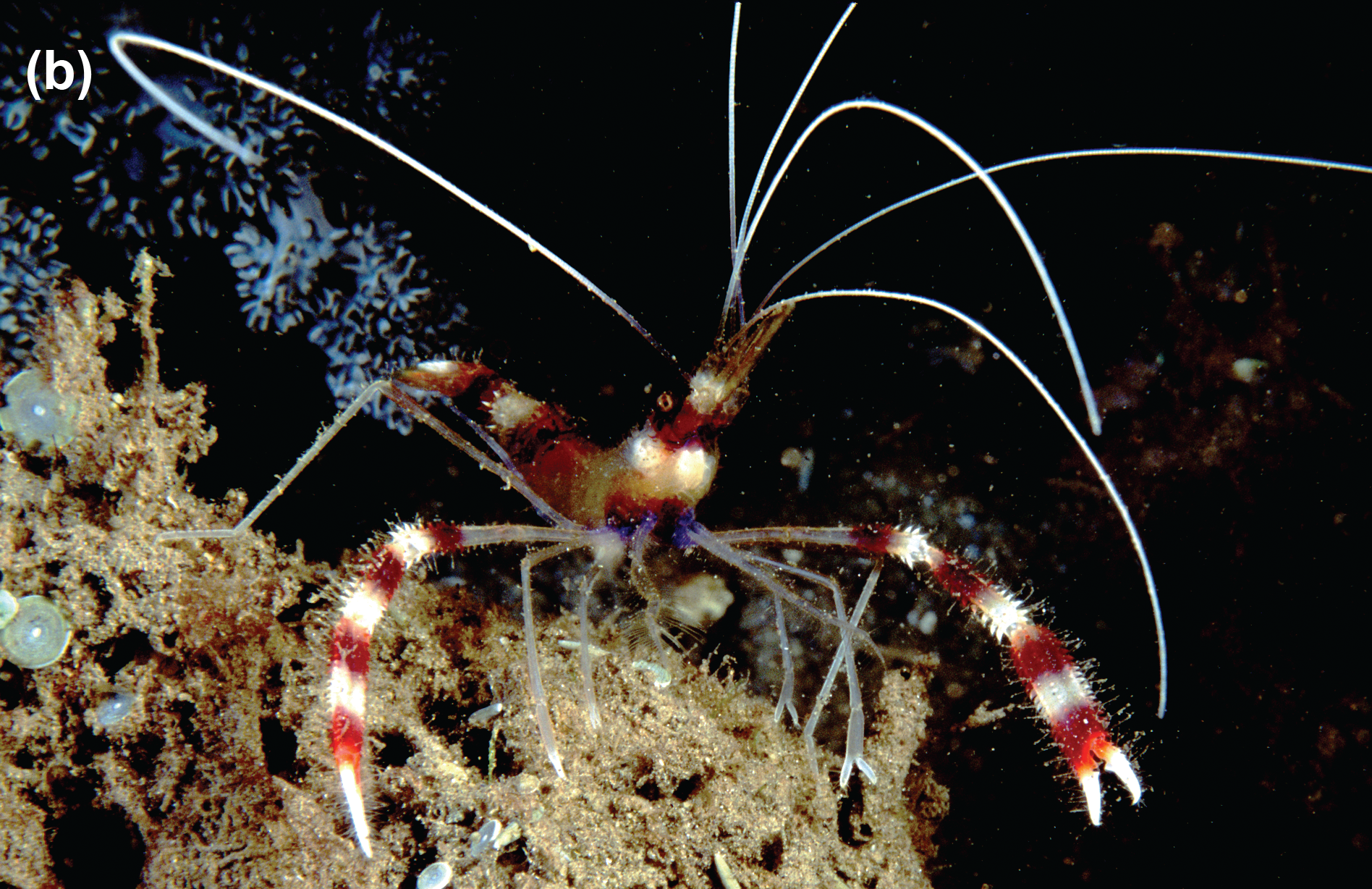
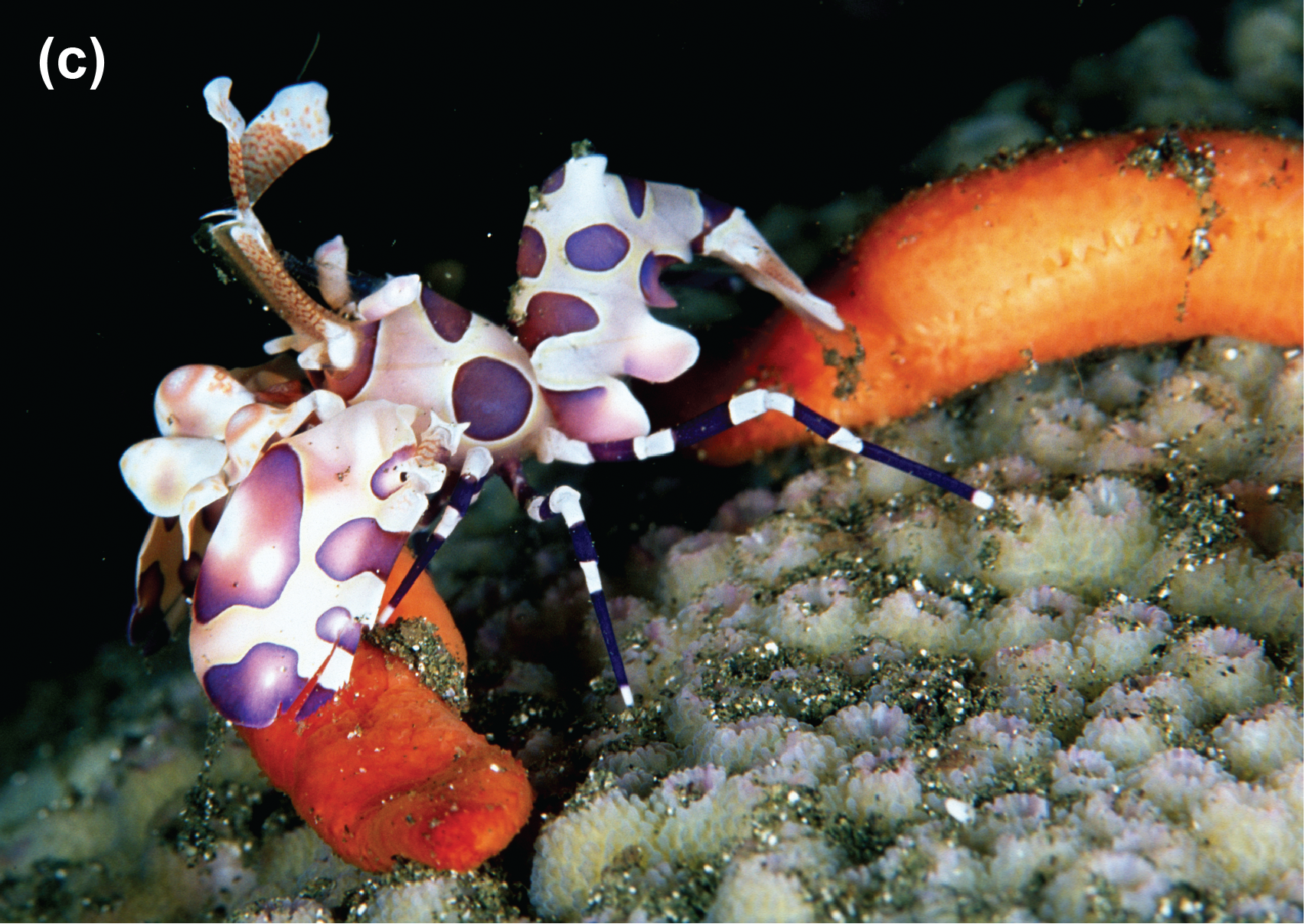
Many pelagic suspension feeders have evolved mechanisms to move or pump water past or through their feeding apparatus as they drift through water. Crustaceans such as copepods and euphausiids (Fig. 12-19a,b) have long, slender forelimbs or appendages surrounding their mouths (Fig. 14-2a), with which they grasp or direct suspended food particles toward the mouth. In contrast, the equivalent mouthparts of most shrimp, also crustaceans, are designed to cut or crush, reflecting the shrimp’s hunting or scavenging feeding habits (Fig. 14-2b,c). Suspension-feeding crustaceans and many other zooplankton can swim weakly through the water to increase their chances of encountering food particles.

Pteropods, which are mollusks related to slugs and snails, have adapted to suspension feeding by evolution of their foot (like the foot on which a snail crawls) to be a membrane that extends from the body (Fig. 14-3). The pteropod uses this sail-like membrane as a paddle to propel itself slowly through the water. This action moves water past the mucus-covered membrane, which captures suspended food particles that brush against it.


Salps, a type of tunicate, evolved in aquatic environments to take advantage of suspended particulate food. Many salps have a simple body resembling an elongated barrel (Fig. 12-20e) with an opening at either end. Within the barrel, the salp is coated with a continuously moving mucous sheath, which captures food particles from water pumped continuously through the salp’s body by sequenced contractions of bands of muscles. There are also colonial salps, which are composed of individual members joined to form the outer wall of a sac-like structure. Each individual’s incurrent opening faces outward, and each excurrent opening discharges into the common open space inside the sac (Fig. 14-4). This arrangement enables the colony to “swim” as water is forced out of the relatively narrow sac opening by the combined pumping efforts of its members. As a result, each individual is more likely to encounter food particles than it would if it operated alone.


Most jellies and ctenophores (Fig. 14-20d) feed on suspended particles by extending long trailing tentacles that, in some species, have poisonous stinging cells and, in others, are covered with a sticky substance to capture food. These organisms are generally carnivores that feed selectively on zooplankton or small fishes, and many propel themselves by contracting rhythmically while trailing their tentacles through the water in order to increase their chances of encountering food. The Portuguese man-of-war achieves a similar increase in mobility and feeding efficiency by allowing winds to blow the colony across the ocean surface.
Although many jellies and ctenophores are suspension feeders, larger species of these organisms are clearly hunters that selectively seek, kill, and consume small fishes and other nekton. The distinction between suspension feeding and hunting is not precise. Some species are clearly suspension feeders and some are clearly hunters, but other species use elements of both approaches and feed on both suspended particles (plankton and/or detritus) and small nekton.
Benthic Suspension Feeders
Like other benthos, benthic suspension feeders benefit from the low energy needs of their sedentary lifestyle and the lack of a need to control buoyancy. They have the additional advantage that ocean currents bring food to them, which reduces the energy needed to hunt for food. Consequently, many benthic epifaunal and infaunal species are suspension feeders. Suspension feeders are especially abundant in coastal regions where suspended particulate food is plentiful.
In soft sediments that cover much of the seafloor, certain infaunal suspension feeders pump water into their feeding apparatus through tubes that they extend upward into the water (Fig. 14-5). This feeding method is particularly advantageous in intertidal mudflats because a buried mollusk can withdraw its siphon and close its shell for protection when the sediment is exposed at low tide. On mudflats or muddy sand beaches where cockles are abundant, buried cockles can be detected as the tide ebbs because they squirt a small fountain of water into the air as they close abruptly when the water recedes.

The sea pen is a benthic infaunal suspension feeder that extends a beautiful and intricate fanlike structure into the water column to feed (Fig. 14-6a,b). Suspended particles are captured as they drift with the current into the fan. The fan can be folded up and withdrawn into the sediment where the main body of the organism is buried. Many sea pens withdraw by day and open to feed only at night, when zooplankton are more abundant because many species migrate from below the photic zone and nocturnal zooplankton emerge from their daytime hiding places. Other types of invertebrates, including some species of tube worms, sea cucumbers, and anemones, live in soft sediment and extend feeding tentacles or webs into the water (Fig. 14-6).


Epifaunal suspension feeders are especially abundant and diverse in continental shelf regions, where there is a solid substrate to which they can attach without being covered by sediment. In temperate and high latitudes these areas are limited to a few rocky outcrops on the seafloor, but in tropical regions coral reefs provide extensive areas of suitable substrate. Suspension-feeding epifaunal invertebrates include species of mollusks, crustaceans, tunicates, corals, anemones, sea cucumbers, sea stars, and worms.
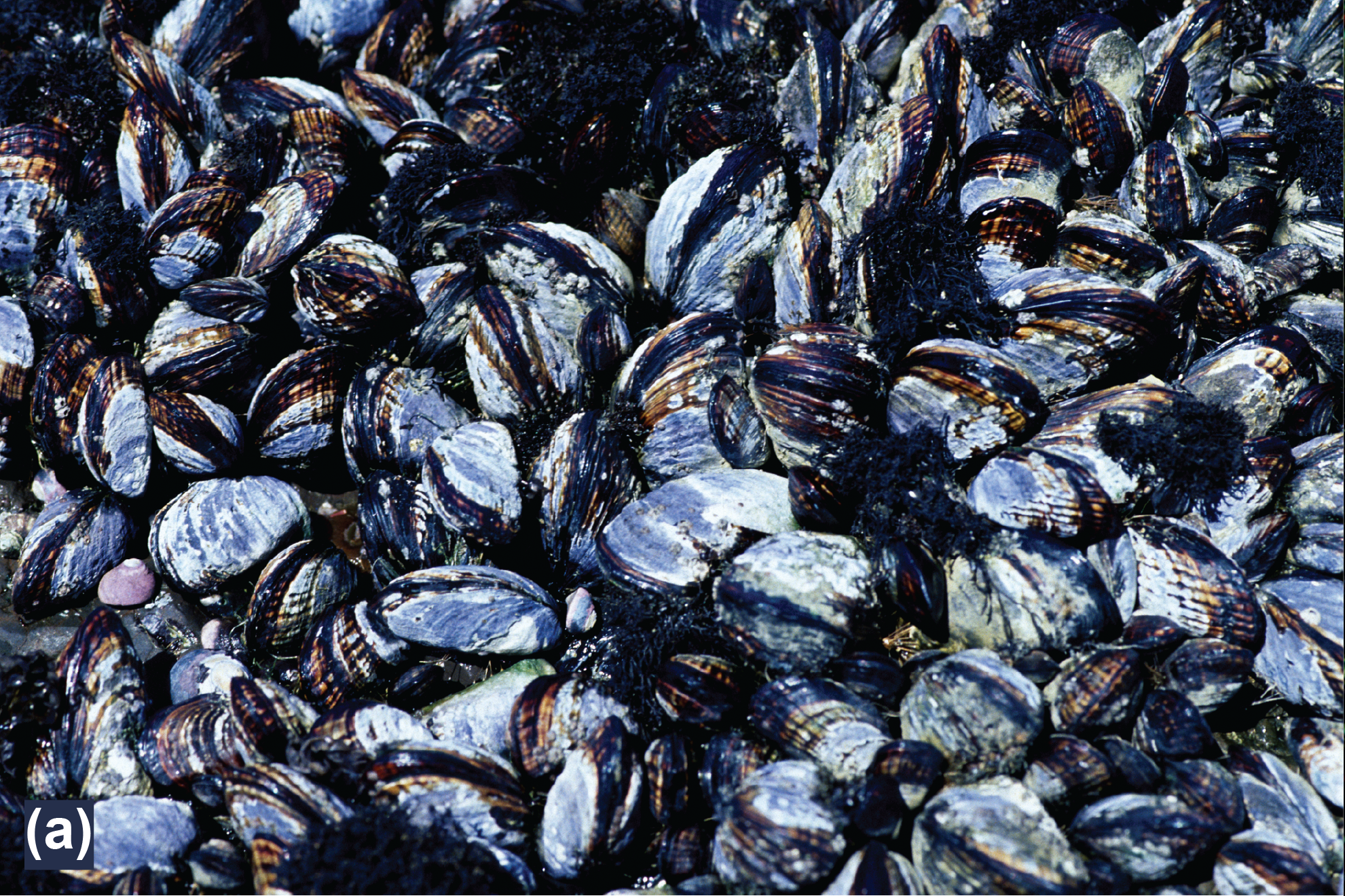
The most familiar epifaunal suspension-feeding mollusk is the mussel (Fig. 14-7a), which attaches itself to any available substrate and partially opens its shell to pump water through its body and feed. Other bivalve mollusks, such as the spiny oyster (Fig. 14-7b), use a similar method in coral reef communities, where they are firmly attached to the reef. Some scallop species in temperate latitudes do not attach to the seafloor, but instead live on coarse sand or gravel bottoms, from which they can “swim” up into the water column for short distances by snapping their shells shut to create propulsive jets of water.


Barnacles are suspension-feeding epifaunal crustaceans (Fig. 14-7c) that look nothing like their close relatives shrimp and crabs, because they have evolved an unusual feeding method. Barnacles, in essence, lie on their backs, strongly attached to rocks or other hard substrates such as ships’ hulls, and are protected by hard plates and shells. They open the plates and extend their much altered legs as a weblike structure that sweeps through the water to grasp and capture suspended particles (Fig. 14-7d).
Most of us think of coral reefs as large, strangely shaped, hard, rocklike structures (Fig. 14-8a,b). However, reef-building corals are actually extremely small suspension-feeding epifaunal organisms that grow in colonies, each of which may contain millions or even billions of individuals, called polyps. Some of the many species of corals have hard parts that are left behind when individuals die and thus serve as a base on which other polyps can grow.


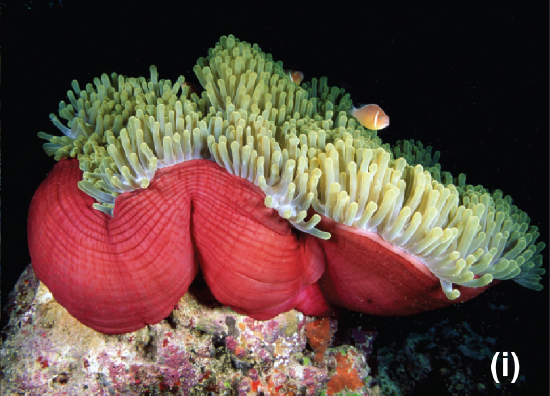
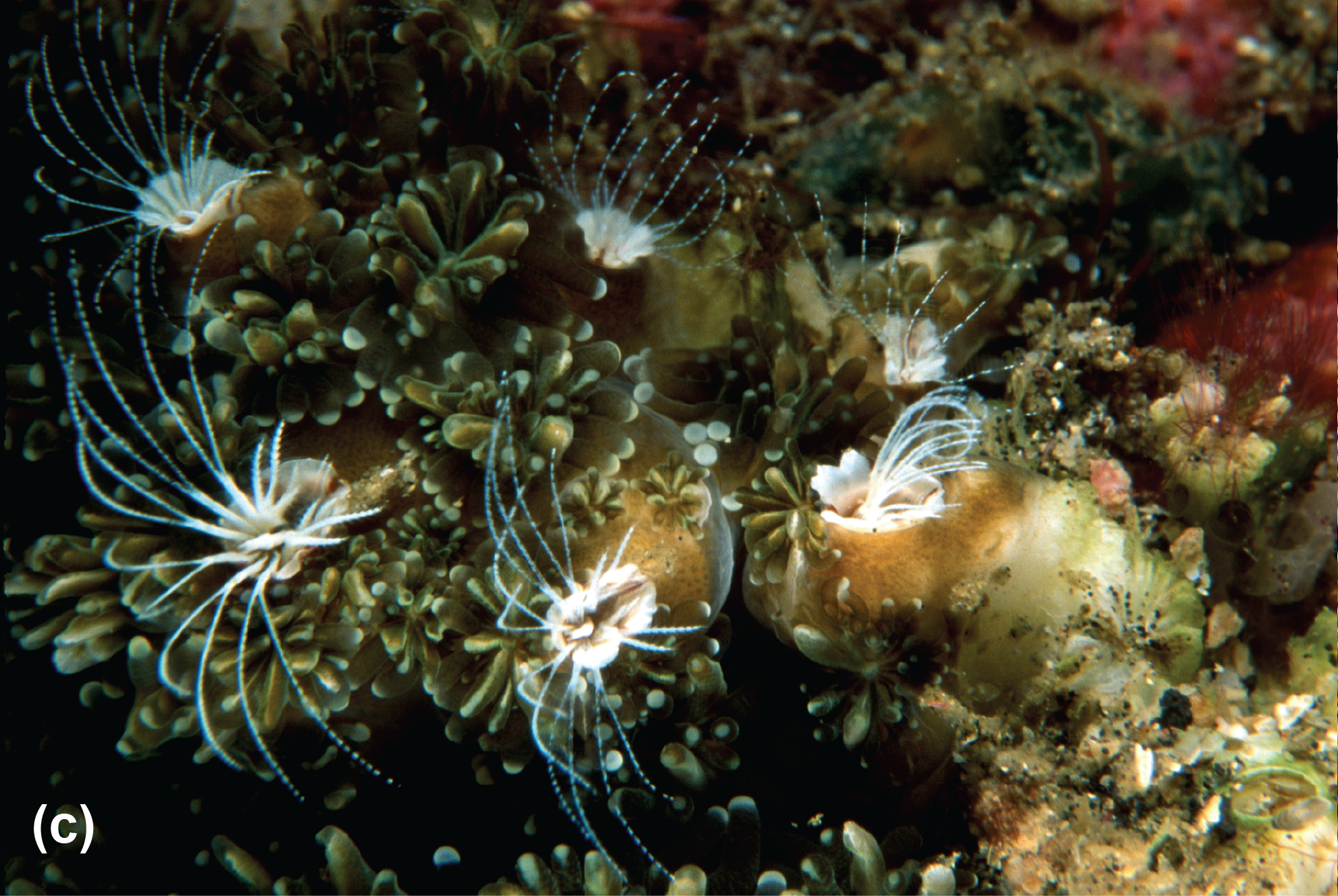
The living coral individuals, or polyps, feed by extending tentacles that capture food particles, primarily zooplankton, and draw them down into the mouth (Fig. 14-8c). Most hard corals extend their tentacles to feed only at night, but many species of soft corals, which are found mostly in the Pacific and Indian Oceans, feed both day and night. Many of these spectacular soft corals (Fig. 14-8d,f) come out to feed (open their polyps) only when there is a strong current to bring abundant food supplies to the colony. Many corals, both soft and hard, produce colonies that extend upward or outward into the water from their attachment point (Fig. 14-8b,d,e). This spreading maximizes the volume of water that passes over the colony and, thus, the amount of particulate food that passes within reach. Many species of zooanthids and anemones, close relatives of corals, are also suspension feeders that eat plankton and detritus (Fig. 14-8g,h), but larger anemones (Fig. 14-8i) are primarily carnivorous hunters that eat fishes and invertebrates.
There are many species of suspension-feeding epifaunal tunicates, particularly on coral reefs. They feed in the same way as salps but are attached to the substrate and have both their incurrent and excurrent openings on their upper bodies. Tunicate species include a variety of single and colonial forms (Fig. 14-9).


Certain species of sea cucumbers, sea stars, and worms suspension feed by extending intricate tentacles or weblike structures into the water column (Fig. 14-10). The elaborate basket star (Fig. 14-10b) comes out to feed only at night and spreads its intricate arms, which can extend more than a meter, across the current to capture food efficiently from huge volumes of water. During the day, the basket star coils into a tiny ball and hides in crevices in the reef. Fan worms (Fig. 14-10c) and Christmas tree worms (Fig. 14-10d) live in tubes that are usually drilled into, or built with the surrounding growth of a hard coral colony. They feed by day but have an amazing ability to sense movement or shadows of moving objects and withdraw into their tubes instantaneously as divers or predators approach.


Surface Grazing
Although shallow seafloor areas with macroscopic algae that can be grazed by herbivores are rare, much of the seafloor provides sufficient, and in some areas abundant, food for grazers. This food supply varies in composition from location to location, but on most of the ocean floor it consists primarily of detritus and the bacteria and other decomposers associated with the detritus. The concentration of these foods generally decreases with ocean depth and is higher where the seafloor is below a region of high pelagic primary productivity.
Note that, in marine ecosystems, the term grazing includes feeding on detritus and animals and is not restricted to plant eating, its common terrestrial usage. On the seafloor within the photic zone, detritus and associated decomposer biomass are supplemented by other sources of grazer food, including benthic microalgae and macroalgae. Benthic microalgae, particularly diatoms, are abundant on shallow seafloor, where light and nutrients are abundant and where waves or other water motions rarely resuspend sediments to cause abrasive scour.
Many marine animals that live on the seafloor, especially species that live on hard substrates, are colonial forms whose individuals are small and immobile. The colonies can be grazed by other animals without significant harm to the colony because grazing removes only a limited proportion of the colony’s individuals, which can be replaced relatively quickly by reproduction. Many colonial animal species thus provide a renewable food supply for grazers in much the same way that plants do for terrestrial grazers.
Numerous adaptations have evolved for surface grazing. Many species of surface grazers obtain food by sifting the upper layer of sediment and therefore can also be considered deposit feeders. Deposit feeders, which are species that obtain food from within sediments, are described later in this chapter. Species that surface-graze may also suspension-feed or hunt larger prey.
Some surface grazers, such as sea urchins (Fig. 14-11a), have evolved such that their mouth is on their underside. These organisms crawl over sand and rocks, scraping off encrusting benthic algae and ingesting detritus as they move. Tiny allied cowries crawl across their favorite food, the sea fan, and ingest the individual polyps (Fig. 14-11b). Other surface grazers include nudibranchs, or sea slugs (Fig. 14-11c,d), that crawl across the substrate (including corals and other immobile animals that constitute or cover the hard surface of the substrate) to eat algae, detritus, or animals such as corals, sponges, hydroids, and tunicates.


Surface grazers do not necessarily live on the sediment surface. For example, some clams live buried in the sediment and extend long siphon tubes to the water above. They use the siphon tubes to select food particles and “vacuum” them off the sediment surface (Fig. 14-12a).


In some shallow areas, large concentrations of macroalgae (Fig. 13-4) are extensively grazed by many animal species. In extremely shallow water, the seafloor may be covered with the sea grass, Thalassia sp., (Fig. 14-12b) or with other rooted plants, such as the marsh grass Spartina (Fig. 14-12c). These plants are not heavily grazed, because they are difficult to digest. The plants must be broken down by bacteria and fungi to detritus before they become a desirable and widely used food source. Small animals like the marsh periwinkle snail do not eat the tough grass itself, but instead graze on the nutritious film of diatoms, bacteria, and fungi that coat the surface of the plants. Some notable species, such as the manatee (Fig. 12-26) and the green sea turtle (Fig. 14-12d), are adapted to feed directly on sea grasses. Thalassia, the favorite food of green sea turtles, is commonly called “turtle grass.”
Deposit Feeding
Organic detritus that falls to the sediment surface is used mostly by decomposers and surface-grazing benthic fauna, but some detritus is buried by bioturbation and by accumulating sediment, especially in areas of high sedimentation rate or anoxic bottom water.
Organic matter buried in sediments serves as food for decomposers and deposit-feeding animals (Fig. 14-13). As this food is depleted, the concentration of organic matter generally decreases with depth below the sediment surface, which is one reason that deposit feeders are concentrated in the upper layers of sediment. Some fish species that live in the water column hunt and feed on small animals, such as clams, that live below the surface of the sediments and are often considered to be a special category of deposit feeders.


Deposit-feeding infauna generally eat their way through sediments, digesting organic particles or the organic matter that coats some particles in much the same way that earthworms eat their way through soil. Much of the detrital organic matter that survives decomposition to be buried in sediment is refractory (difficult to decompose) and has low food value. Consequently, many deposit-feeding infauna obtain most of their food by consuming bacteria and fungi, many species of which live within the sediment. Other deposit-feeding infauna have evolved means of decomposing refractory detritus.
Because detritus particles are generally small and have lower density than inorganic sediment particles, detritus tends to settle and concentrate in low-energy areas where fine-grained sediments also accumulate. Consequently, fine mud deposits tend to have higher organic matter concentrations than coarser sediments have, and they are more favorable habitats for deposit feeders. However, to live and feed in sediment, deposit feeders must have a supply of oxygen for respiration. In muddy sediment where organic matter is abundant, respiration by animals and decomposers quickly uses up the oxygen dissolved in pore waters. Oxygen is not readily replenished from the water column above, because downward diffusion of oxygenated water through the sediment is slow.
Many deposit feeders either are restricted to the near-surface oxygenated sediment layer or have evolved mechanisms to acquire oxygen from the water column above. For example, the heart urchin has adapted some of its tube feet to create a periscope-like breathing apparatus that it extends upward to the sediment surface (Fig. 14-13a). Deposit-feeding clams extend their siphons to the sediment surface for this same purpose. Many other infaunal deposit feeders form and live in a U-shaped or similar burrow and draw oxygenated water through the burrow as they feed. The innkeeper worm (Fig. 14-13b), lugworm (Fig. 14-13c), and many other species use variations of this method.
Muddy sediments tend to be dominated by annelid worm populations, whereas sandy substrates are more likely to be dominated by various species of deposit- or filter-feeding clams. Many deposit feeders pass sediment through the gut and discharge feces containing large volumes of processed sediment through the excurrent end of their burrow or breathing tube. In this way, food-depleted material is transported to the sediment surface, where it will not be reingested. Some species, particularly annelid worms, produce tightly packaged fecal pellets that accumulate on the sediment surface and protect it from erosion. Other species, especially certain clams, excrete their fecal material as a cloud of loose particles.
Clams may discharge their wastes as a cloud of particles for reasons other than to get rid of food-depleted sediment. This form of waste disposal may protect the clams’ environment from invasion by other species. By working through the upper layer of sediment and continuously dispersing this material at the surface, clams prevent the silty sand in which they live from compacting and becoming firm enough for epifauna to attach to or lie on without being buried. In addition, the clouds of fine inorganic particles that the clams continuously create tend to clog the feeding apparatus of filter-feeding organisms with non-nutritious material.