

10.4: When Did Life Begin?
- Page ID
- 33483

\( \newcommand{\vecs}[1]{\overset { \scriptstyle \rightharpoonup} {\mathbf{#1}} } \)
\( \newcommand{\vecd}[1]{\overset{-\!-\!\rightharpoonup}{\vphantom{a}\smash {#1}}} \)
\( \newcommand{\dsum}{\displaystyle\sum\limits} \)
\( \newcommand{\dint}{\displaystyle\int\limits} \)
\( \newcommand{\dlim}{\displaystyle\lim\limits} \)
\( \newcommand{\id}{\mathrm{id}}\) \( \newcommand{\Span}{\mathrm{span}}\)
( \newcommand{\kernel}{\mathrm{null}\,}\) \( \newcommand{\range}{\mathrm{range}\,}\)
\( \newcommand{\RealPart}{\mathrm{Re}}\) \( \newcommand{\ImaginaryPart}{\mathrm{Im}}\)
\( \newcommand{\Argument}{\mathrm{Arg}}\) \( \newcommand{\norm}[1]{\| #1 \|}\)
\( \newcommand{\inner}[2]{\langle #1, #2 \rangle}\)
\( \newcommand{\Span}{\mathrm{span}}\)
\( \newcommand{\id}{\mathrm{id}}\)
\( \newcommand{\Span}{\mathrm{span}}\)
\( \newcommand{\kernel}{\mathrm{null}\,}\)
\( \newcommand{\range}{\mathrm{range}\,}\)
\( \newcommand{\RealPart}{\mathrm{Re}}\)
\( \newcommand{\ImaginaryPart}{\mathrm{Im}}\)
\( \newcommand{\Argument}{\mathrm{Arg}}\)
\( \newcommand{\norm}[1]{\| #1 \|}\)
\( \newcommand{\inner}[2]{\langle #1, #2 \rangle}\)
\( \newcommand{\Span}{\mathrm{span}}\) \( \newcommand{\AA}{\unicode[.8,0]{x212B}}\)
\( \newcommand{\vectorA}[1]{\vec{#1}} % arrow\)
\( \newcommand{\vectorAt}[1]{\vec{\text{#1}}} % arrow\)
\( \newcommand{\vectorB}[1]{\overset { \scriptstyle \rightharpoonup} {\mathbf{#1}} } \)
\( \newcommand{\vectorC}[1]{\textbf{#1}} \)
\( \newcommand{\vectorD}[1]{\overrightarrow{#1}} \)
\( \newcommand{\vectorDt}[1]{\overrightarrow{\text{#1}}} \)
\( \newcommand{\vectE}[1]{\overset{-\!-\!\rightharpoonup}{\vphantom{a}\smash{\mathbf {#1}}}} \)
\( \newcommand{\vecs}[1]{\overset { \scriptstyle \rightharpoonup} {\mathbf{#1}} } \)
\(\newcommand{\longvect}{\overrightarrow}\)
\( \newcommand{\vecd}[1]{\overset{-\!-\!\rightharpoonup}{\vphantom{a}\smash {#1}}} \)
\(\newcommand{\avec}{\mathbf a}\) \(\newcommand{\bvec}{\mathbf b}\) \(\newcommand{\cvec}{\mathbf c}\) \(\newcommand{\dvec}{\mathbf d}\) \(\newcommand{\dtil}{\widetilde{\mathbf d}}\) \(\newcommand{\evec}{\mathbf e}\) \(\newcommand{\fvec}{\mathbf f}\) \(\newcommand{\nvec}{\mathbf n}\) \(\newcommand{\pvec}{\mathbf p}\) \(\newcommand{\qvec}{\mathbf q}\) \(\newcommand{\svec}{\mathbf s}\) \(\newcommand{\tvec}{\mathbf t}\) \(\newcommand{\uvec}{\mathbf u}\) \(\newcommand{\vvec}{\mathbf v}\) \(\newcommand{\wvec}{\mathbf w}\) \(\newcommand{\xvec}{\mathbf x}\) \(\newcommand{\yvec}{\mathbf y}\) \(\newcommand{\zvec}{\mathbf z}\) \(\newcommand{\rvec}{\mathbf r}\) \(\newcommand{\mvec}{\mathbf m}\) \(\newcommand{\zerovec}{\mathbf 0}\) \(\newcommand{\onevec}{\mathbf 1}\) \(\newcommand{\real}{\mathbb R}\) \(\newcommand{\twovec}[2]{\left[\begin{array}{r}#1 \\ #2 \end{array}\right]}\) \(\newcommand{\ctwovec}[2]{\left[\begin{array}{c}#1 \\ #2 \end{array}\right]}\) \(\newcommand{\threevec}[3]{\left[\begin{array}{r}#1 \\ #2 \\ #3 \end{array}\right]}\) \(\newcommand{\cthreevec}[3]{\left[\begin{array}{c}#1 \\ #2 \\ #3 \end{array}\right]}\) \(\newcommand{\fourvec}[4]{\left[\begin{array}{r}#1 \\ #2 \\ #3 \\ #4 \end{array}\right]}\) \(\newcommand{\cfourvec}[4]{\left[\begin{array}{c}#1 \\ #2 \\ #3 \\ #4 \end{array}\right]}\) \(\newcommand{\fivevec}[5]{\left[\begin{array}{r}#1 \\ #2 \\ #3 \\ #4 \\ #5 \\ \end{array}\right]}\) \(\newcommand{\cfivevec}[5]{\left[\begin{array}{c}#1 \\ #2 \\ #3 \\ #4 \\ #5 \\ \end{array}\right]}\) \(\newcommand{\mattwo}[4]{\left[\begin{array}{rr}#1 \amp #2 \\ #3 \amp #4 \\ \end{array}\right]}\) \(\newcommand{\laspan}[1]{\text{Span}\{#1\}}\) \(\newcommand{\bcal}{\cal B}\) \(\newcommand{\ccal}{\cal C}\) \(\newcommand{\scal}{\cal S}\) \(\newcommand{\wcal}{\cal W}\) \(\newcommand{\ecal}{\cal E}\) \(\newcommand{\coords}[2]{\left\{#1\right\}_{#2}}\) \(\newcommand{\gray}[1]{\color{gray}{#1}}\) \(\newcommand{\lgray}[1]{\color{lightgray}{#1}}\) \(\newcommand{\rank}{\operatorname{rank}}\) \(\newcommand{\row}{\text{Row}}\) \(\newcommand{\col}{\text{Col}}\) \(\renewcommand{\row}{\text{Row}}\) \(\newcommand{\nul}{\text{Nul}}\) \(\newcommand{\var}{\text{Var}}\) \(\newcommand{\corr}{\text{corr}}\) \(\newcommand{\len}[1]{\left|#1\right|}\) \(\newcommand{\bbar}{\overline{\bvec}}\) \(\newcommand{\bhat}{\widehat{\bvec}}\) \(\newcommand{\bperp}{\bvec^\perp}\) \(\newcommand{\xhat}{\widehat{\xvec}}\) \(\newcommand{\vhat}{\widehat{\vvec}}\) \(\newcommand{\uhat}{\widehat{\uvec}}\) \(\newcommand{\what}{\widehat{\wvec}}\) \(\newcommand{\Sighat}{\widehat{\Sigma}}\) \(\newcommand{\lt}{<}\) \(\newcommand{\gt}{>}\) \(\newcommand{\amp}{&}\) \(\definecolor{fillinmathshade}{gray}{0.9}\)First Life on Earth
Life most likely started during the late Hadean or early Archean eon. While the timing and location of the origin of life on Earth remain debated, it is widely recognized as the most critical, planet-changing event, and various theories have been developed to explain the conditions that enabled its emergence.
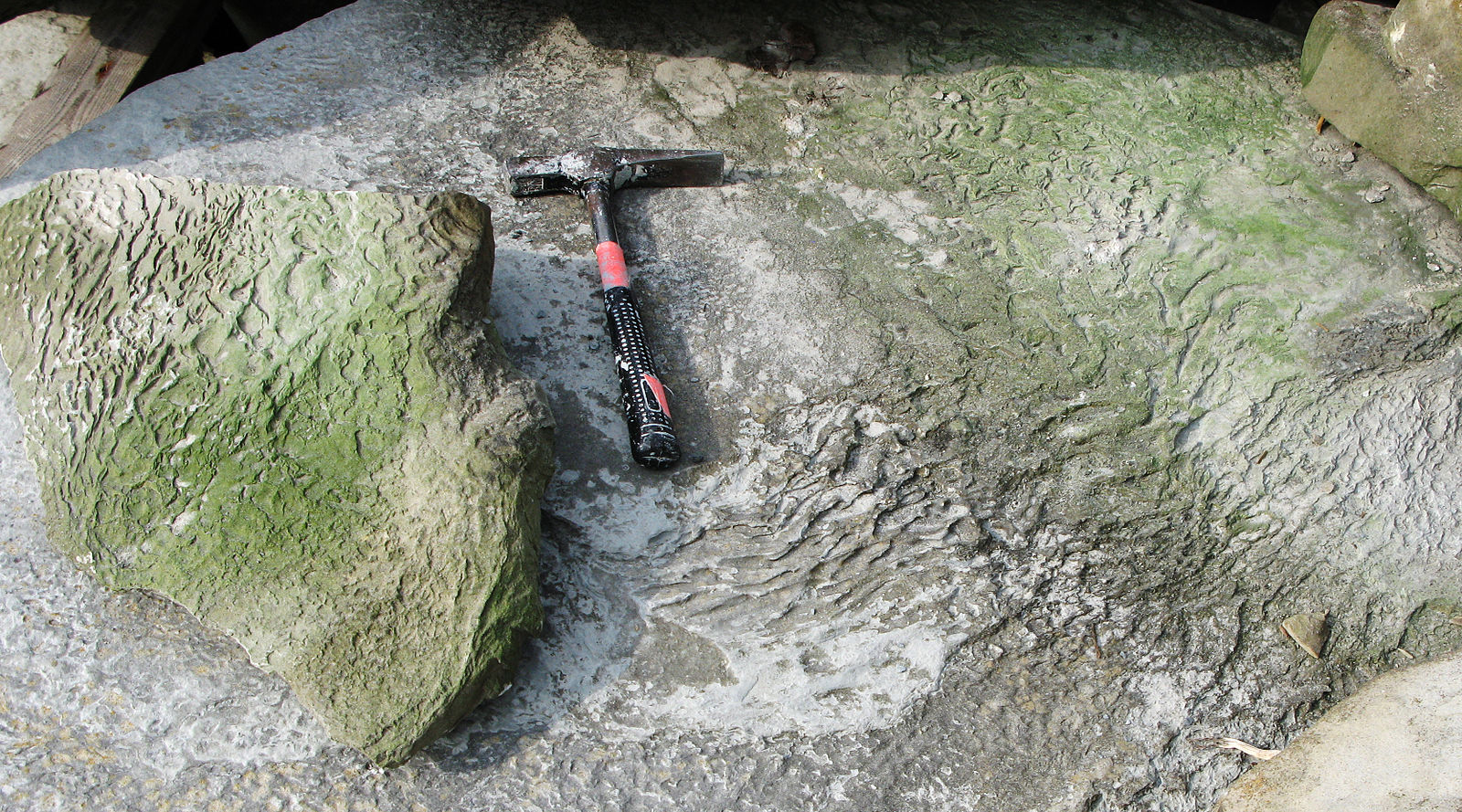
Some of the most concrete evidence of early life comes from stromatolites, fossilized microbial mats dating to 3.5 billion years ago, found in Australia. These photosynthetic microorganisms, like cyanobacteria, lived in the shallow oceans with abundant sunlight. They trapped sediment as they grew, resulting in a distinctive layered, mound-like structure (see below).

Stromatolite mounds. Image from Wilson44691, CC0, via Wikimedia Commons.
It's likely, however, that life on Earth started earlier, perhaps even in the Hadean. For example, microscopic filaments from a hydrothermal vent deposit in Quebec, Canada, prove that life could have started as early as 3.8–4.3 billion years ago.
Conditions for First Life
Conventional scientific thought suggests that the extreme heat from the early meteorite bombardment of Earth during the Hadean would have made conditions at the surface too harsh for life to begin, with portions of the early crust melted from these collisions (e.g., Marchi et al., 2014). Despite the relentless impacts of the Late Heavy Bombardment at the start of the Archean, though, some studies suggest only a fraction of the planet’s crust would have melted, leaving potential areas of refuge deep in the crust or within hydrothermal vents at the bottom of the oceans. Based on geochemical data, oceans are thought to have developed about 4.3 billion years ago, relatively early in the Hadean. While it's possible life arose during this earliest chapter of Earth's history, finding evidence is difficult because the Hadean is poorly represented in the rock record.
Despite the extreme conditions, signs of life are preserved in very old rocks. Some of the oldest, the 3.8-4.3 billion-year-old Nuvvuagittuq Greenstone Belt (NGB), contains banded iron formations (BIF) with microscopic tubes of iron mineral hematite. These tubes match the shape and size of those made by bacteria in modern hydrothermal vent environments, where they consume iron for their metabolism. The researchers also discovered the mineral graphite in the BIF, which is composed entirely of carbon. The graphite likely formed by metamorphism of organic material as it contains reduced levels of the heavy carbon isotope, carbon-13. Lifeforms prefer the lighter isotope of carbon, carbon-12. If this discovery holds true, this will be the oldest evidence of fossil life yet discovered. The NGB banded iron formation can be interpreted as having been deposited on the ancient seafloor, as represented by greenstone. This NGB has been dated by cross-cutting igneous intrusions to have formed at least 3.77 Ga. This would predate any previously discovered fossil evidence by at least several hundred million years.
Video: World's Oldest Fossils (UCL)
Hydrothermal Vents
Today, hydrothermal vents are found in the deep ocean along mid-oceanic ridges at divergent plate boundaries and volcanic hot spots. In these environments, cold water from the bottom of the ocean seeps along fissures found at the plate boundary. While underground, the water is heated and mixed with fluids released from the rising magma. Superheated water can transport numerous dissolved minerals and mobile ions, which are transported to the seafloor and then precipitate as mineral deposits around the vents. Sometimes, these mineral deposits are infused into the surrounding deep-sea sediments, and sometimes, they build impressive “chimneys” of towering rock. Sulfur-based minerals are particularly common near the vents. The vents are surprisingly diverse in life, with sulfur-reducing bacteria extracting energy from compounds in the vented fluids. Using the principle of uniformitarianism, "the present is the key to the past", the first organisms at Hadean hydrothermal vents were therefore also likely sulfur-reducing bacteria. These bacteria were chemoautotrophs, meaning they extracted the energy necessary for cellular functions from inorganic compounds. In the case of sulfur-reducing bacteria, they “breathe” sulfate (), and reduce sulfur to hydrogen sulfide (). Sulfur-reducing bacteria are found today at the Mid-Atlantic Ridge and the East Pacific Rise, and in pools associated with land-based hydrothermal activity, such as the hot springs and geysers of Yellowstone National Park in Wyoming. These prokaryotes belong to the Domain Archaea, which encompasses a diverse array of microbes that can survive in chemically harsh conditions across a wide range of temperatures.
How Did Life Begin?
The origin of life on Earth is not yet known. Hypotheses include a chemical origin in the early atmosphere and ocean, deep-sea hydrothermal vents, and delivery to Earth by comets or other objects.
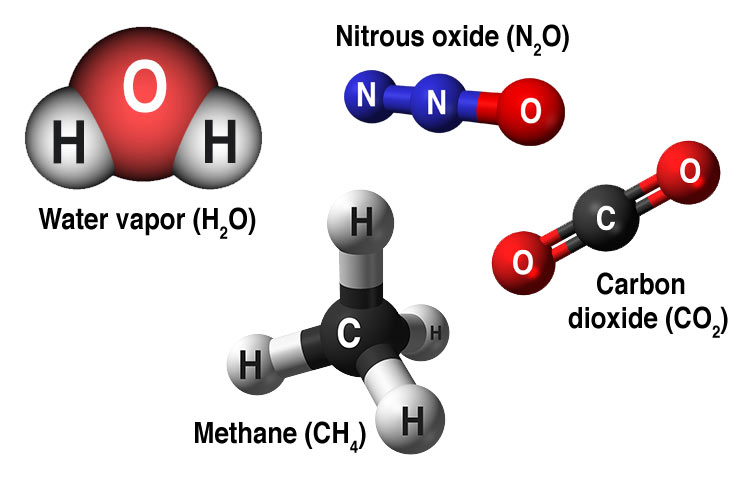
One hypothesis is that life arose from the chemical environment of Earth’s early atmosphere and oceans, which was very different from today's. The oxygen-free atmosphere produced a reducing environment with abundant methane, carbon dioxide, sulfur, and nitrogen compounds. This is what the atmosphere is like on other bodies in the solar system. Researchers in the famous Miller-Urey experiment simulated early Earth’s atmosphere and lightning within a sealed vessel. After igniting sparks within the vessel, they discovered the formation of amino acids, the fundamental building blocks of proteins.
Another explanation is that life began around hydrothermal vents on a deep-sea mid-ocean ridge. Life was discovered along modern mid-ocean ridge systems in 1977, sparking this idea. Using uniformitarianism, we can reason that hydrothermal vents also provided the nutrients for life in the ancient past.
Another possibility is that life or its building blocks came to Earth from space, carried aboard comets or other objects.
Video: Did Asteroids Spark Life?
Amino acids, for example, have been found within comets and meteorites. This intriguing possibility also implies a high likelihood of life existing elsewhere in the cosmos.
The Prokaryotic Pioneers
The first life forms on Earth were likely sulfur-reducing prokaryotes. Prokaryotes are single-celled bacteria, small in size (0.1 – 10.0 \(\mu\)m), with no nucleus or other organelles. Nevertheless, these simple organisms have changed the trajectory of Earth’s history.
Two of the three Domains of life depicted in the Phylogenetic Tree of Live below, Archaea and Bacteria, are prokaryotes. Eukarya, to which you belong, is the third. Prokaryotes live on and in just about everything on Earth. They have been found in sulfuric volcanic lakes, hypersaline springs, glacial ice, growing on crystals deep in caves, and under rocks at the tops of mountains. In the human body, they outnumber human cells by 3 to 1. Rough estimates of modern oceanic prokaryotic diversity suggest more than 2 million species exist, which does not even include all the possible diversity on land.

In many rocks of similar age as those preserving the Archean sulfur-reducing bacteria, sedimentary structures known as stromatolites record the history of another important group–the cyanobacteria. Stromatolites are layered structures created when mats of cyanobacteria are smothered by fine calcite mud distributed by wave action in shallow marine environments. The bacteria grow through the mud layer to create a new mat, and the process repeats, producing a thinly laminated structure that is visible when lithified. Nutman et al. (2016) suggested they had found stromatolites in Greenland that were 3.7 billion years old (Archean), but this has been disputed by Allwood et al. (2018). The most widely accepted definitive stromatolites are those in Australia's 3.5 billion year old (Archean) Dresser Formation.


Cyanobacteria are photoautotrophs that require sunlight to produce their own food via photosynthesis. Therefore, these organisms are found in the shallow, photic zone of marine environments where sunlight can readily penetrate the water. Photosynthesis uses carbon dioxide (\(\ce{CO2}\)) as a source of carbon for cellular functions and produces free oxygen (\(\ce{O2}\)) as a waste product. Cyanobacteria were the dominant life form on Earth for about 2 billion years, spanning the Archean and most of the Proterozoic. As a result of all that photosynthesis, the amount of \(\ce{O2}\) in Earth’s atmosphere significantly increased over time in one of the slowest-building and life-on-Earth-changing events of all time, the Great Oxidation Event (GOE). BIFs help tell this story.

An oxygenated world also significantly changed the planet's chemistry. For example, iron remained in solution in the non-oxygenated environment of the earlier Archean Eon. However, once the environment was oxygenated, iron combined with free oxygen to form solid precipitates of iron oxide, such as hematite or magnetite. These precipitates accumulated into expansive Archean and Proterozoic mineral deposits with red chert known as banded-iron formations.

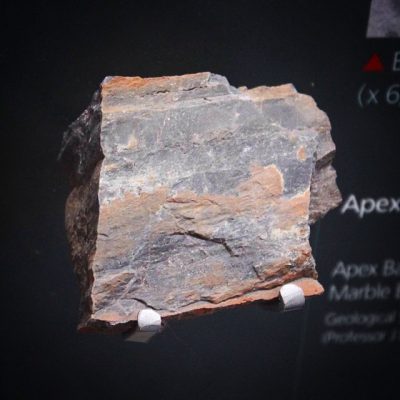
The formation of iron oxide minerals and red chert (see figure) in the oceans persisted for a long time; it prevented oxygen levels from increasing significantly, since precipitation removed oxygen from the water and deposited it into the rock strata. As oxygen continued to be produced and mineral precipitation leveled off, dissolved oxygen gas eventually saturated the oceans and started bubbling out into the atmosphere. Oxygenation of the atmosphere is the single biggest event that distinguishes the Archean and Proterozoic environments. In addition to changing mineral and ocean chemistry, the GOE is also responsible for triggering Earth’s first ice age around 2.1 billion years ago, the Huron Glaciation. Free oxygen reacted with methane (CH4) in the atmosphere to produce carbon dioxide (CO2). Carbon dioxide and CH4 are called greenhouse gases because they trap heat within the Earth’s atmosphere, like the insulated glass of a greenhouse. Methane more effectively insulates than CO2, so as CH4 was converted to CO2 and the concentration of CH4 decreased, the greenhouse effect also decreased, and the planet cooled.
The interpretation of BIFs is that excess oxygen produced by photosynthesizing cyanobacteria in shallow oceans was available to combine with iron ions in seawater, forming the dark, oxidized iron layers (see rock below). The source of iron is likely a combination of both ions released from hydrothermal vents and input from chemical weathering of mafic-rich crustal rock from land. These distinct chemical sedimentary rocks were globally pervasive until about 1.8 billion years ago. The decline of BIFs in the rock record continued as atmospheric oxygen levels rose. With more atmospheric oxygen available, iron ions were oxidized on land before being transported to the oceans, consuming the iron that had previously been oxidized there. Consequently, BIFs stopped forming.

- Banded Iron Formations (BIF) - sedimentary rock units with distinctive alternating layers of dark gray to black iron oxides and red to yellow chert that formed in seawater from oxygen produced by photosynthetic cyanobacteria
- prokaryotes - organisms whose cells lack a nucleus and other organelles
- stromatolites - layered sedimentary structures formed by the growth of bacteria or algae