

10.3: Archean Eon
- Page ID
- 33436
\( \newcommand{\vecs}[1]{\overset { \scriptstyle \rightharpoonup} {\mathbf{#1}} } \)
\( \newcommand{\vecd}[1]{\overset{-\!-\!\rightharpoonup}{\vphantom{a}\smash {#1}}} \)
\( \newcommand{\dsum}{\displaystyle\sum\limits} \)
\( \newcommand{\dint}{\displaystyle\int\limits} \)
\( \newcommand{\dlim}{\displaystyle\lim\limits} \)
\( \newcommand{\id}{\mathrm{id}}\) \( \newcommand{\Span}{\mathrm{span}}\)
( \newcommand{\kernel}{\mathrm{null}\,}\) \( \newcommand{\range}{\mathrm{range}\,}\)
\( \newcommand{\RealPart}{\mathrm{Re}}\) \( \newcommand{\ImaginaryPart}{\mathrm{Im}}\)
\( \newcommand{\Argument}{\mathrm{Arg}}\) \( \newcommand{\norm}[1]{\| #1 \|}\)
\( \newcommand{\inner}[2]{\langle #1, #2 \rangle}\)
\( \newcommand{\Span}{\mathrm{span}}\)
\( \newcommand{\id}{\mathrm{id}}\)
\( \newcommand{\Span}{\mathrm{span}}\)
\( \newcommand{\kernel}{\mathrm{null}\,}\)
\( \newcommand{\range}{\mathrm{range}\,}\)
\( \newcommand{\RealPart}{\mathrm{Re}}\)
\( \newcommand{\ImaginaryPart}{\mathrm{Im}}\)
\( \newcommand{\Argument}{\mathrm{Arg}}\)
\( \newcommand{\norm}[1]{\| #1 \|}\)
\( \newcommand{\inner}[2]{\langle #1, #2 \rangle}\)
\( \newcommand{\Span}{\mathrm{span}}\) \( \newcommand{\AA}{\unicode[.8,0]{x212B}}\)
\( \newcommand{\vectorA}[1]{\vec{#1}} % arrow\)
\( \newcommand{\vectorAt}[1]{\vec{\text{#1}}} % arrow\)
\( \newcommand{\vectorB}[1]{\overset { \scriptstyle \rightharpoonup} {\mathbf{#1}} } \)
\( \newcommand{\vectorC}[1]{\textbf{#1}} \)
\( \newcommand{\vectorD}[1]{\overrightarrow{#1}} \)
\( \newcommand{\vectorDt}[1]{\overrightarrow{\text{#1}}} \)
\( \newcommand{\vectE}[1]{\overset{-\!-\!\rightharpoonup}{\vphantom{a}\smash{\mathbf {#1}}}} \)
\( \newcommand{\vecs}[1]{\overset { \scriptstyle \rightharpoonup} {\mathbf{#1}} } \)
\(\newcommand{\longvect}{\overrightarrow}\)
\( \newcommand{\vecd}[1]{\overset{-\!-\!\rightharpoonup}{\vphantom{a}\smash {#1}}} \)
\(\newcommand{\avec}{\mathbf a}\) \(\newcommand{\bvec}{\mathbf b}\) \(\newcommand{\cvec}{\mathbf c}\) \(\newcommand{\dvec}{\mathbf d}\) \(\newcommand{\dtil}{\widetilde{\mathbf d}}\) \(\newcommand{\evec}{\mathbf e}\) \(\newcommand{\fvec}{\mathbf f}\) \(\newcommand{\nvec}{\mathbf n}\) \(\newcommand{\pvec}{\mathbf p}\) \(\newcommand{\qvec}{\mathbf q}\) \(\newcommand{\svec}{\mathbf s}\) \(\newcommand{\tvec}{\mathbf t}\) \(\newcommand{\uvec}{\mathbf u}\) \(\newcommand{\vvec}{\mathbf v}\) \(\newcommand{\wvec}{\mathbf w}\) \(\newcommand{\xvec}{\mathbf x}\) \(\newcommand{\yvec}{\mathbf y}\) \(\newcommand{\zvec}{\mathbf z}\) \(\newcommand{\rvec}{\mathbf r}\) \(\newcommand{\mvec}{\mathbf m}\) \(\newcommand{\zerovec}{\mathbf 0}\) \(\newcommand{\onevec}{\mathbf 1}\) \(\newcommand{\real}{\mathbb R}\) \(\newcommand{\twovec}[2]{\left[\begin{array}{r}#1 \\ #2 \end{array}\right]}\) \(\newcommand{\ctwovec}[2]{\left[\begin{array}{c}#1 \\ #2 \end{array}\right]}\) \(\newcommand{\threevec}[3]{\left[\begin{array}{r}#1 \\ #2 \\ #3 \end{array}\right]}\) \(\newcommand{\cthreevec}[3]{\left[\begin{array}{c}#1 \\ #2 \\ #3 \end{array}\right]}\) \(\newcommand{\fourvec}[4]{\left[\begin{array}{r}#1 \\ #2 \\ #3 \\ #4 \end{array}\right]}\) \(\newcommand{\cfourvec}[4]{\left[\begin{array}{c}#1 \\ #2 \\ #3 \\ #4 \end{array}\right]}\) \(\newcommand{\fivevec}[5]{\left[\begin{array}{r}#1 \\ #2 \\ #3 \\ #4 \\ #5 \\ \end{array}\right]}\) \(\newcommand{\cfivevec}[5]{\left[\begin{array}{c}#1 \\ #2 \\ #3 \\ #4 \\ #5 \\ \end{array}\right]}\) \(\newcommand{\mattwo}[4]{\left[\begin{array}{rr}#1 \amp #2 \\ #3 \amp #4 \\ \end{array}\right]}\) \(\newcommand{\laspan}[1]{\text{Span}\{#1\}}\) \(\newcommand{\bcal}{\cal B}\) \(\newcommand{\ccal}{\cal C}\) \(\newcommand{\scal}{\cal S}\) \(\newcommand{\wcal}{\cal W}\) \(\newcommand{\ecal}{\cal E}\) \(\newcommand{\coords}[2]{\left\{#1\right\}_{#2}}\) \(\newcommand{\gray}[1]{\color{gray}{#1}}\) \(\newcommand{\lgray}[1]{\color{lightgray}{#1}}\) \(\newcommand{\rank}{\operatorname{rank}}\) \(\newcommand{\row}{\text{Row}}\) \(\newcommand{\col}{\text{Col}}\) \(\renewcommand{\row}{\text{Row}}\) \(\newcommand{\nul}{\text{Nul}}\) \(\newcommand{\var}{\text{Var}}\) \(\newcommand{\corr}{\text{corr}}\) \(\newcommand{\len}[1]{\left|#1\right|}\) \(\newcommand{\bbar}{\overline{\bvec}}\) \(\newcommand{\bhat}{\widehat{\bvec}}\) \(\newcommand{\bperp}{\bvec^\perp}\) \(\newcommand{\xhat}{\widehat{\xvec}}\) \(\newcommand{\vhat}{\widehat{\vvec}}\) \(\newcommand{\uhat}{\widehat{\uvec}}\) \(\newcommand{\what}{\widehat{\wvec}}\) \(\newcommand{\Sighat}{\widehat{\Sigma}}\) \(\newcommand{\lt}{<}\) \(\newcommand{\gt}{>}\) \(\newcommand{\amp}{&}\) \(\definecolor{fillinmathshade}{gray}{0.9}\)Overview
The Archean Eon, lasting from 4.0 to 2.5 billion years ago, is named after the Greek word for beginning, which seems appropriate, as this time period marks the beginning of the observable rock record: assuming that the 4 billion years old Acosta Gneiss is the oldest intact rock (see previous section), and the start of Earth operating with modern geological processes, such as plate tectonics. As we have already learned, rocks and minerals existed during the Hadean Eon, but the rock record from the Archean is considerably more complete.

Late Heavy Bombardment
Objects were chaotically flying around at the start of the solar system, building the planets and moons. Around the start of the Archean, about 4.1–3.8 billion years ago, a second large spike in asteroid and comet impacts occurred on Earth and the Moon. This event is called the Late Heavy Bombardment. Meteorites and comets in stable or semi-stable orbits became unstable and impacted objects throughout the solar system. During the late heavy bombardment, the Earth, Moon, and all the planets in the solar system were pummeled by material from the asteroid and Kuiper belts. Most of the Moon's craters are from this event, where samples have been collected to support the timing.
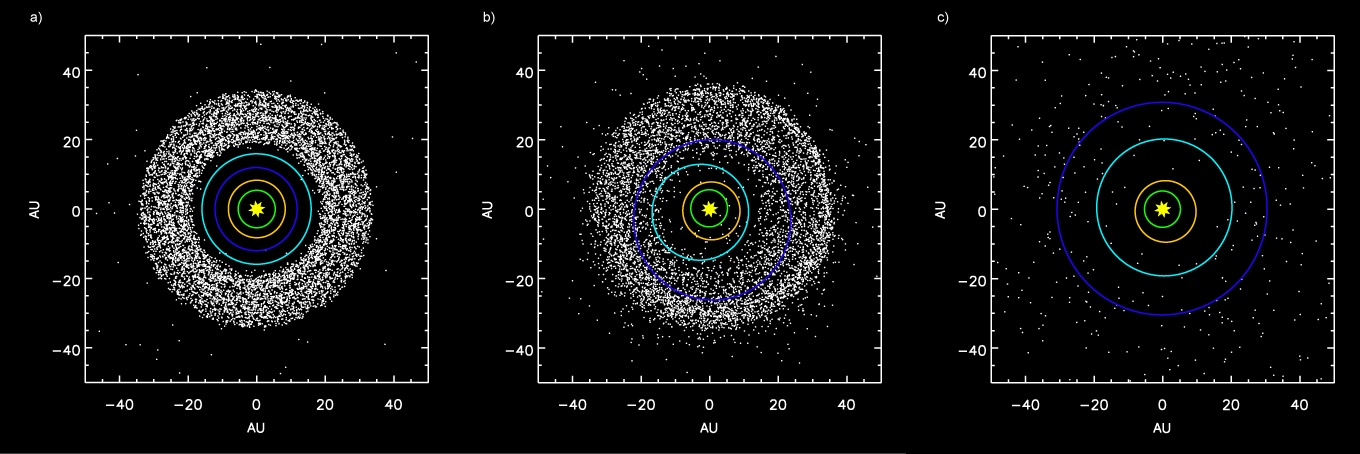
It is widely accepted that the planets in our solar system experienced extensive asteroid and comet bombardment during their formation; however, another process must have caused the second increase in impacts hundreds of millions of years later, once they were fully formed. A leading theory blames gravitational resonance between Jupiter and Saturn, in which the gravity of these two giants disturbed orbits within the asteroid belts and the Kuiper Belt, based on a similar process observed in another solar system, Eta Corvi.

The First Continents and Plate Tectonics
The continents were formed incrementally throughout Earth's early history. After all, only about 8% of continental crust is of Archean age (Goodwin A.M. Principles of Precambrian Geology. Academic Press; London, UK: 1996. [Google Scholar]). Initially, when Earth was hotter, lighter, more felsic materials floated upward, while heavier ultramafic materials and metallic iron sank. This differentiation process led to the layering of the Earth, with lighter materials forming the lithosphere and continental crust, and heavier materials forming the interior layers. This internal layering is revealed through seismic data. While the timing and specific processes remain debated, volcanic activity must have brought the first continental material to Earth’s surface during the Hadean, and the continents formed through some incremental process during the Archean. Forming continents was initially challenging because a significantly hotter core drove vigorous mantle convection that rifted apart young, thin, and weak crustal pieces.
For plate tectonics to work as it does currently, there must be continents. As the Earth cooled, permanent continental crust could form, and plate tectonic-like activity could begin. The video below, "The World Before Plate Tectonics," provides a useful discussion. It will start at 1:49 and should be viewed until at least 4:22.
It seems that early plate tectonic processes started at least at the end of the Archean, suggesting that a stable continental lithosphere was already in place. An earlier beginning is possible, but evidence of earlier tectonic activity has been erased by subduction and the rock cycle. In any event, once stable pieces of continental crust were established, plate tectonics moved them, and they started to grow through accretion (smashing together) and continental volcanic activity.
The cores of the continents were made in the Archean. These tectonically stable interiors are called cratons. Cratons have two main parts: the shield, composed of crystalline basement rocks such as gneiss and greenstone, and the platform, which is covered by sedimentary rock. Most cratons have remained relatively unchanged, with most tectonic activity, such as subduction and accretion, occurring around cratons instead of within them. Shields were the building blocks for the Proterozoic continents that now define Earth's land surface, and contain the oldest rocks.

Sedimentary Rocks
Interestingly, the oldest Archean sedimentary rocks are entirely marine chemical sedimentary rocks. There are no siliciclastic (detrital) sedimentary rocks, which are made from sediments derived from the physical weathering of crustal rocks. There are no sandstones or conglomerates, for example. This implies that no land was exposed above sea level, and no rock exposures were available for weathering and erosion.
- accretion - the addition of crustal material through collisions
- chemical sedimentary rocks - rocks that form through mineral precipitation in water
- craton - tectonically stable interiors of continents composed of the shield, which is crystalline basement rock like gneiss and greenstone, and the platform of sedimentary rocks covering the shield
- Kuiper Belt - a doughnut-shaped region of icy objects beyond the orbit of Neptune; it is home to Pluto and most of the known dwarf planets and some comets
- Late Heavy Bombardment - a period of extraordinary meteorite impacts at the start of the Archean, thought to have been triggered by the gravitational interaction of Jupiter and Saturn