

10.2: Earth's Oldest Rocks
- Page ID
- 33479
\( \newcommand{\vecs}[1]{\overset { \scriptstyle \rightharpoonup} {\mathbf{#1}} } \)
\( \newcommand{\vecd}[1]{\overset{-\!-\!\rightharpoonup}{\vphantom{a}\smash {#1}}} \)
\( \newcommand{\dsum}{\displaystyle\sum\limits} \)
\( \newcommand{\dint}{\displaystyle\int\limits} \)
\( \newcommand{\dlim}{\displaystyle\lim\limits} \)
\( \newcommand{\id}{\mathrm{id}}\) \( \newcommand{\Span}{\mathrm{span}}\)
( \newcommand{\kernel}{\mathrm{null}\,}\) \( \newcommand{\range}{\mathrm{range}\,}\)
\( \newcommand{\RealPart}{\mathrm{Re}}\) \( \newcommand{\ImaginaryPart}{\mathrm{Im}}\)
\( \newcommand{\Argument}{\mathrm{Arg}}\) \( \newcommand{\norm}[1]{\| #1 \|}\)
\( \newcommand{\inner}[2]{\langle #1, #2 \rangle}\)
\( \newcommand{\Span}{\mathrm{span}}\)
\( \newcommand{\id}{\mathrm{id}}\)
\( \newcommand{\Span}{\mathrm{span}}\)
\( \newcommand{\kernel}{\mathrm{null}\,}\)
\( \newcommand{\range}{\mathrm{range}\,}\)
\( \newcommand{\RealPart}{\mathrm{Re}}\)
\( \newcommand{\ImaginaryPart}{\mathrm{Im}}\)
\( \newcommand{\Argument}{\mathrm{Arg}}\)
\( \newcommand{\norm}[1]{\| #1 \|}\)
\( \newcommand{\inner}[2]{\langle #1, #2 \rangle}\)
\( \newcommand{\Span}{\mathrm{span}}\) \( \newcommand{\AA}{\unicode[.8,0]{x212B}}\)
\( \newcommand{\vectorA}[1]{\vec{#1}} % arrow\)
\( \newcommand{\vectorAt}[1]{\vec{\text{#1}}} % arrow\)
\( \newcommand{\vectorB}[1]{\overset { \scriptstyle \rightharpoonup} {\mathbf{#1}} } \)
\( \newcommand{\vectorC}[1]{\textbf{#1}} \)
\( \newcommand{\vectorD}[1]{\overrightarrow{#1}} \)
\( \newcommand{\vectorDt}[1]{\overrightarrow{\text{#1}}} \)
\( \newcommand{\vectE}[1]{\overset{-\!-\!\rightharpoonup}{\vphantom{a}\smash{\mathbf {#1}}}} \)
\( \newcommand{\vecs}[1]{\overset { \scriptstyle \rightharpoonup} {\mathbf{#1}} } \)
\(\newcommand{\longvect}{\overrightarrow}\)
\( \newcommand{\vecd}[1]{\overset{-\!-\!\rightharpoonup}{\vphantom{a}\smash {#1}}} \)
\(\newcommand{\avec}{\mathbf a}\) \(\newcommand{\bvec}{\mathbf b}\) \(\newcommand{\cvec}{\mathbf c}\) \(\newcommand{\dvec}{\mathbf d}\) \(\newcommand{\dtil}{\widetilde{\mathbf d}}\) \(\newcommand{\evec}{\mathbf e}\) \(\newcommand{\fvec}{\mathbf f}\) \(\newcommand{\nvec}{\mathbf n}\) \(\newcommand{\pvec}{\mathbf p}\) \(\newcommand{\qvec}{\mathbf q}\) \(\newcommand{\svec}{\mathbf s}\) \(\newcommand{\tvec}{\mathbf t}\) \(\newcommand{\uvec}{\mathbf u}\) \(\newcommand{\vvec}{\mathbf v}\) \(\newcommand{\wvec}{\mathbf w}\) \(\newcommand{\xvec}{\mathbf x}\) \(\newcommand{\yvec}{\mathbf y}\) \(\newcommand{\zvec}{\mathbf z}\) \(\newcommand{\rvec}{\mathbf r}\) \(\newcommand{\mvec}{\mathbf m}\) \(\newcommand{\zerovec}{\mathbf 0}\) \(\newcommand{\onevec}{\mathbf 1}\) \(\newcommand{\real}{\mathbb R}\) \(\newcommand{\twovec}[2]{\left[\begin{array}{r}#1 \\ #2 \end{array}\right]}\) \(\newcommand{\ctwovec}[2]{\left[\begin{array}{c}#1 \\ #2 \end{array}\right]}\) \(\newcommand{\threevec}[3]{\left[\begin{array}{r}#1 \\ #2 \\ #3 \end{array}\right]}\) \(\newcommand{\cthreevec}[3]{\left[\begin{array}{c}#1 \\ #2 \\ #3 \end{array}\right]}\) \(\newcommand{\fourvec}[4]{\left[\begin{array}{r}#1 \\ #2 \\ #3 \\ #4 \end{array}\right]}\) \(\newcommand{\cfourvec}[4]{\left[\begin{array}{c}#1 \\ #2 \\ #3 \\ #4 \end{array}\right]}\) \(\newcommand{\fivevec}[5]{\left[\begin{array}{r}#1 \\ #2 \\ #3 \\ #4 \\ #5 \\ \end{array}\right]}\) \(\newcommand{\cfivevec}[5]{\left[\begin{array}{c}#1 \\ #2 \\ #3 \\ #4 \\ #5 \\ \end{array}\right]}\) \(\newcommand{\mattwo}[4]{\left[\begin{array}{rr}#1 \amp #2 \\ #3 \amp #4 \\ \end{array}\right]}\) \(\newcommand{\laspan}[1]{\text{Span}\{#1\}}\) \(\newcommand{\bcal}{\cal B}\) \(\newcommand{\ccal}{\cal C}\) \(\newcommand{\scal}{\cal S}\) \(\newcommand{\wcal}{\cal W}\) \(\newcommand{\ecal}{\cal E}\) \(\newcommand{\coords}[2]{\left\{#1\right\}_{#2}}\) \(\newcommand{\gray}[1]{\color{gray}{#1}}\) \(\newcommand{\lgray}[1]{\color{lightgray}{#1}}\) \(\newcommand{\rank}{\operatorname{rank}}\) \(\newcommand{\row}{\text{Row}}\) \(\newcommand{\col}{\text{Col}}\) \(\renewcommand{\row}{\text{Row}}\) \(\newcommand{\nul}{\text{Nul}}\) \(\newcommand{\var}{\text{Var}}\) \(\newcommand{\corr}{\text{corr}}\) \(\newcommand{\len}[1]{\left|#1\right|}\) \(\newcommand{\bbar}{\overline{\bvec}}\) \(\newcommand{\bhat}{\widehat{\bvec}}\) \(\newcommand{\bperp}{\bvec^\perp}\) \(\newcommand{\xhat}{\widehat{\xvec}}\) \(\newcommand{\vhat}{\widehat{\vvec}}\) \(\newcommand{\uhat}{\widehat{\uvec}}\) \(\newcommand{\what}{\widehat{\wvec}}\) \(\newcommand{\Sighat}{\widehat{\Sigma}}\) \(\newcommand{\lt}{<}\) \(\newcommand{\gt}{>}\) \(\newcommand{\amp}{&}\) \(\definecolor{fillinmathshade}{gray}{0.9}\)The Acasta Gneiss Complex
The Jack Hills detrital zircons indicate that rocks that were eroded into sediment were present around 4.404 Ga. Ancient rocks exceeding 3.5 billion years old are found on all continents, but 4.4 Ga rocks have not been found.
The oldest intact rock on Earth is the Acasta Gneiss Complex, part of the North American craton in Northwest Canada. This complex includes a variety of highly deformed and metamorphosed tonalite-trondhjemite-granodiorite (TTG) rock. TTGs are similar to granite in that they are silica-rich and felsic, but they differ in their mineralogy. They are typical of igneous rocks produced from magma along active continental margins today.
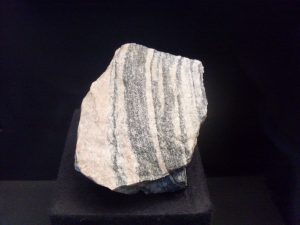
The Acasta Gneiss has been radiometrically dated using U/Pb isotopic dating techniques on zircon formed during the crystallization of these rocks. The presence of zircon in an indicates that the original TTG was derived from magma that had “evolved” (it was formed through remelting a pre-existing rock) and that solidified between 3.92 and 4.02 Ga. Its composition, similar to that of continental crust rocks today, indicates that continental crust existed in the Hadean. Extensive geochemical analysis has led to the interpretation that the oldest rock of the Acasta Gneiss Complex was derived from the partial melting of 4.3 Ga mafic Hadean crust [1] [2].

The Nuvvuagittuq Greenstone Belt
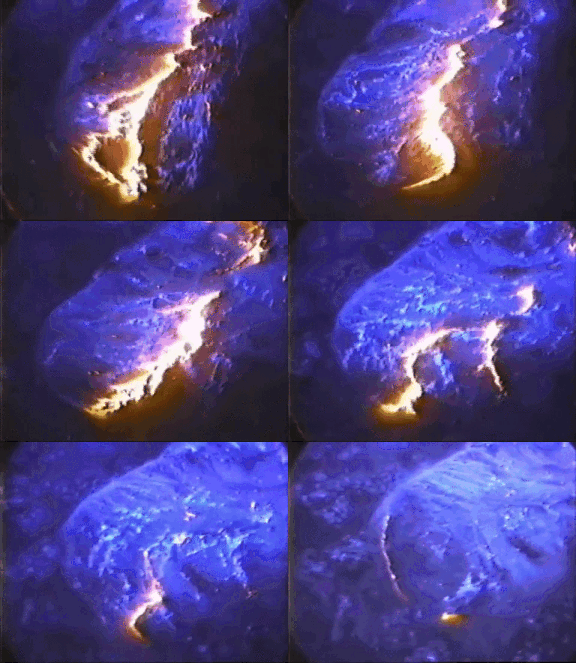
The dating of the rock from the Nuvvuagittuq Greenstone Belt (NGB) has been controversial, but if accepted, it may actually provide the best representation of Earth’s earliest crust. The NGB is located in northern Quebec, on the eastern shore of Hudson Bay. It's mostly metamorphosed mafic and ultramafic volcanic rock that initially erupted in an ancient ocean, as evidenced by the presence of pillow lava: A lava structure that forms during underwater eruptions. Lava that erupts underwater forms conspicuous pillow shapes as a crust solidifies instantly around the oozing lava as it spills out underwater.
Another rock type in the NGB is banded iron formation (BIF). BIFs are sedimentary rocks that formed in the ocean as sedimentary iron minerals formed and settled out of the water column.

Around the NGB is a felsic intrusive rock called tonalite. The NGB and tonalite are cross-cut by a pegmatite, another type of intrusive igneous rock. The tonalite and pegmatite intrusive bodies contain zircons, which have been accurately dated at 3.77 Ga. This means that the NGB is at least 3.77 Ga old, since, according to the principle of cross-cutting relationships, it must have existed to be cut by the pegmatite.
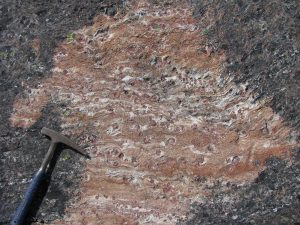
In 2008, Jonathan O’Neil, a young PhD student at McGill University in Quebec, Canada, challenged the assumed date for NGB by investigating an odd-looking amphibolite patch within NGB. An amphibolite is a metamorphosed mafic rock and does not contain zircon. O’Neil used a dating technique and isotopic-ratio comparisons of the rare but ubiquitous elements samarium (Sm) and neodymium (Nd). Using this technique, O’Neil determined the actual age of the NGB to be 4.28 Ga [3]. Further analysis of additional samples since then has pushed the date back even further to 4.31 Ga [4]. If true, the NGB rock would represent the oldest preserved Hadean rock on the planet, providing a snapshot of Earth's earliest crust.
Not all geologists investigating these rocks concur with O’Neil’s findings, and this controversy will likely continue until zircon is found within the NGB.

- Acasta Gneiss Complex - located in Canada, it preserves the oldest rocks on Earth some of which where derived from the partial melting of 4.3 billion year old Hadean crust
- Nuvvuagittuq Greenstone Belt (NGB) - located in Canada, rock from this has been dated back to 4.31 Ga making it the oldest preserved rock on earth (though the dating is controversial)
- tonalite-trondhjemite-granodiorite (TTG) - rocks similar to granite that have been metamorphosed and are part of the Acasta Gneiss Complex