

10.1: Hadean Eon
- Page ID
- 33435

\( \newcommand{\vecs}[1]{\overset { \scriptstyle \rightharpoonup} {\mathbf{#1}} } \)
\( \newcommand{\vecd}[1]{\overset{-\!-\!\rightharpoonup}{\vphantom{a}\smash {#1}}} \)
\( \newcommand{\dsum}{\displaystyle\sum\limits} \)
\( \newcommand{\dint}{\displaystyle\int\limits} \)
\( \newcommand{\dlim}{\displaystyle\lim\limits} \)
\( \newcommand{\id}{\mathrm{id}}\) \( \newcommand{\Span}{\mathrm{span}}\)
( \newcommand{\kernel}{\mathrm{null}\,}\) \( \newcommand{\range}{\mathrm{range}\,}\)
\( \newcommand{\RealPart}{\mathrm{Re}}\) \( \newcommand{\ImaginaryPart}{\mathrm{Im}}\)
\( \newcommand{\Argument}{\mathrm{Arg}}\) \( \newcommand{\norm}[1]{\| #1 \|}\)
\( \newcommand{\inner}[2]{\langle #1, #2 \rangle}\)
\( \newcommand{\Span}{\mathrm{span}}\)
\( \newcommand{\id}{\mathrm{id}}\)
\( \newcommand{\Span}{\mathrm{span}}\)
\( \newcommand{\kernel}{\mathrm{null}\,}\)
\( \newcommand{\range}{\mathrm{range}\,}\)
\( \newcommand{\RealPart}{\mathrm{Re}}\)
\( \newcommand{\ImaginaryPart}{\mathrm{Im}}\)
\( \newcommand{\Argument}{\mathrm{Arg}}\)
\( \newcommand{\norm}[1]{\| #1 \|}\)
\( \newcommand{\inner}[2]{\langle #1, #2 \rangle}\)
\( \newcommand{\Span}{\mathrm{span}}\) \( \newcommand{\AA}{\unicode[.8,0]{x212B}}\)
\( \newcommand{\vectorA}[1]{\vec{#1}} % arrow\)
\( \newcommand{\vectorAt}[1]{\vec{\text{#1}}} % arrow\)
\( \newcommand{\vectorB}[1]{\overset { \scriptstyle \rightharpoonup} {\mathbf{#1}} } \)
\( \newcommand{\vectorC}[1]{\textbf{#1}} \)
\( \newcommand{\vectorD}[1]{\overrightarrow{#1}} \)
\( \newcommand{\vectorDt}[1]{\overrightarrow{\text{#1}}} \)
\( \newcommand{\vectE}[1]{\overset{-\!-\!\rightharpoonup}{\vphantom{a}\smash{\mathbf {#1}}}} \)
\( \newcommand{\vecs}[1]{\overset { \scriptstyle \rightharpoonup} {\mathbf{#1}} } \)
\(\newcommand{\longvect}{\overrightarrow}\)
\( \newcommand{\vecd}[1]{\overset{-\!-\!\rightharpoonup}{\vphantom{a}\smash {#1}}} \)
\(\newcommand{\avec}{\mathbf a}\) \(\newcommand{\bvec}{\mathbf b}\) \(\newcommand{\cvec}{\mathbf c}\) \(\newcommand{\dvec}{\mathbf d}\) \(\newcommand{\dtil}{\widetilde{\mathbf d}}\) \(\newcommand{\evec}{\mathbf e}\) \(\newcommand{\fvec}{\mathbf f}\) \(\newcommand{\nvec}{\mathbf n}\) \(\newcommand{\pvec}{\mathbf p}\) \(\newcommand{\qvec}{\mathbf q}\) \(\newcommand{\svec}{\mathbf s}\) \(\newcommand{\tvec}{\mathbf t}\) \(\newcommand{\uvec}{\mathbf u}\) \(\newcommand{\vvec}{\mathbf v}\) \(\newcommand{\wvec}{\mathbf w}\) \(\newcommand{\xvec}{\mathbf x}\) \(\newcommand{\yvec}{\mathbf y}\) \(\newcommand{\zvec}{\mathbf z}\) \(\newcommand{\rvec}{\mathbf r}\) \(\newcommand{\mvec}{\mathbf m}\) \(\newcommand{\zerovec}{\mathbf 0}\) \(\newcommand{\onevec}{\mathbf 1}\) \(\newcommand{\real}{\mathbb R}\) \(\newcommand{\twovec}[2]{\left[\begin{array}{r}#1 \\ #2 \end{array}\right]}\) \(\newcommand{\ctwovec}[2]{\left[\begin{array}{c}#1 \\ #2 \end{array}\right]}\) \(\newcommand{\threevec}[3]{\left[\begin{array}{r}#1 \\ #2 \\ #3 \end{array}\right]}\) \(\newcommand{\cthreevec}[3]{\left[\begin{array}{c}#1 \\ #2 \\ #3 \end{array}\right]}\) \(\newcommand{\fourvec}[4]{\left[\begin{array}{r}#1 \\ #2 \\ #3 \\ #4 \end{array}\right]}\) \(\newcommand{\cfourvec}[4]{\left[\begin{array}{c}#1 \\ #2 \\ #3 \\ #4 \end{array}\right]}\) \(\newcommand{\fivevec}[5]{\left[\begin{array}{r}#1 \\ #2 \\ #3 \\ #4 \\ #5 \\ \end{array}\right]}\) \(\newcommand{\cfivevec}[5]{\left[\begin{array}{c}#1 \\ #2 \\ #3 \\ #4 \\ #5 \\ \end{array}\right]}\) \(\newcommand{\mattwo}[4]{\left[\begin{array}{rr}#1 \amp #2 \\ #3 \amp #4 \\ \end{array}\right]}\) \(\newcommand{\laspan}[1]{\text{Span}\{#1\}}\) \(\newcommand{\bcal}{\cal B}\) \(\newcommand{\ccal}{\cal C}\) \(\newcommand{\scal}{\cal S}\) \(\newcommand{\wcal}{\cal W}\) \(\newcommand{\ecal}{\cal E}\) \(\newcommand{\coords}[2]{\left\{#1\right\}_{#2}}\) \(\newcommand{\gray}[1]{\color{gray}{#1}}\) \(\newcommand{\lgray}[1]{\color{lightgray}{#1}}\) \(\newcommand{\rank}{\operatorname{rank}}\) \(\newcommand{\row}{\text{Row}}\) \(\newcommand{\col}{\text{Col}}\) \(\renewcommand{\row}{\text{Row}}\) \(\newcommand{\nul}{\text{Nul}}\) \(\newcommand{\var}{\text{Var}}\) \(\newcommand{\corr}{\text{corr}}\) \(\newcommand{\len}[1]{\left|#1\right|}\) \(\newcommand{\bbar}{\overline{\bvec}}\) \(\newcommand{\bhat}{\widehat{\bvec}}\) \(\newcommand{\bperp}{\bvec^\perp}\) \(\newcommand{\xhat}{\widehat{\xvec}}\) \(\newcommand{\vhat}{\widehat{\vvec}}\) \(\newcommand{\uhat}{\widehat{\uvec}}\) \(\newcommand{\what}{\widehat{\wvec}}\) \(\newcommand{\Sighat}{\widehat{\Sigma}}\) \(\newcommand{\lt}{<}\) \(\newcommand{\gt}{>}\) \(\newcommand{\amp}{&}\) \(\definecolor{fillinmathshade}{gray}{0.9}\)The Geologic Time Scale
The first two "chapters" in the story of Earth are the Hadean and Archean Eons. During these times, Earth transformed from an uninhabitable hellscape into a place that started to resemble the planet we know today. The names Hadean (derived from Hades, the Greek God of the underworld) and Archean (from the Greek word for the beginning) come from the Geologic Time Scale, the table of contents for the "Book of Earth." It chronologically arranges and names chapters in Earth's history according to major geologic and biologic events in Earth’s history, recorded as significant changes in rocks and fossils.

Hadean Eon
Earth’s oldest Eon of geologic time is appropriately named the “Hadean”, after the Greek god of the underworld, Hades, and dates from 4.6–4.0 billion years ago. The Hadean can be described as “Hell on Earth,” the time when an extremely hostile environment existed with magma oceans boiling on the surface, widespread volcanic activity, a superheated atmosphere of noxious gases, and frequent bolide (meteorites, comments, and astroid) impacts.

The new Earth was incredibly hot due to gravitational compression, radioactive decay, and bolide impacts. Most of this initial heat still exists inside the Earth, which is crucial for driving geologic processes today, like plate tectonics. As Earth cooled through this Eon, the planet began to take on its current structure.
Differentiation of Earth’s Interior
Planetary geologists believe that toward the end of the accretionary stage in Earth's formation, 4.5 – 4.6 Ga (billions of years ago) when the planet was being assembled, Earth was pummeled by larger, planetesimal-sized space debris. The energy of these massive collisions melted the surface of the young planet, resulting in the formation of vast “magma oceans.” Energetic radioactive decay of unstable elements added to the heat production inside the early Earth. This double whammy of interior and exterior heat may have melted the entire planet or turned it into a thick, slushy mass of highly convective molten rock material.[1], [2] This allowed the Earth and other developing planets in our solar system to go through a process of differentiation where the heaviest, iron-associated elements sank toward the core and lighter elements rose toward the surface.
Earth's Original Crust
As differentiation proceeded, the surface magma ocean cooled, and a thin, early crust began to form from high-melting-point silicate minerals (see Bowen’s Reaction Series), such as olivine and calcium-rich plagioclase, that could crystallize at high temperatures. Meteors, asteroids, and comets continued their impacts, puncturing the earliest crust so magma continually welled up, flowing over Earth's surface and crystallizing into komatiite, a volcanic rock composed of the mineral olivine. Rising heat from the core prevented large crustal blocks from remaining intact. Denser mafic and ultramafic minerals (minerals rich in iron and magnesium) sank to form the mantle, while the highest-density materials, like iron and nickel, sank into the core. Differentiation transformed Earth from a homogeneous sphere of molten material into a heterogeneous planet with distinct layers: a felsic and mafic crust, an ultramafic mantle, and an iron and nickel core.
![Hypothetical core-mantle differentiation processes: Percolation, diking, and diapirism. After Rubie et al. (2015).[X] By AlexInMetal - Own work, CC BY-SA 4.0, https://commons.wikimedia.org/w/index.php?curid=76607390](https://geo.libretexts.org/@api/deki/files/26601/Core-mantle_differentiation_processes-1-768x585.png?revision=1)
Magma Composition
Differentiation produced our iron-rich inner and outer cores, the silicate-dominated mantle, and, ultimately, the crust. The relatively low-density silicates are minerals composed chiefly of silicon and oxygen, bound with other oxygen-seeking elements such as aluminum, calcium, potassium, sodium, iron, and magnesium. In the early Hadean, Earth was continually bombarded by space debris containing all Earth’s natural elements in varying proportions.
Heat powered a convecting ocean of silicate mush, which brought diapirs (teardrop-shaped blobs of deep magma) toward the surface. There, it pooled and the exterior cooled in thick komatiite masses, forming the first crustal pieces. The dense komatiite masses were partially melted by heat from below, causing them to drip back into the magma ocean for recycling. This remelting process further differentiated the early crust, as the “partial melt” was more silica-enriched: the most silica-rich minerals in the komatiite would be the first to melt. This “evolved” silica-rich magma was also less dense and more buoyant, allowing it to rise and float on Earth's surface. This process of magma evolution leads to the varying compositions we recognize today when classifying igneous rocks. Notice where komatiite appears on the diagram below, all the way to the right, with the least amount of silica. As magma evolution proceeds, the composition becomes more silica-enriched, creating magma that becomes increasingly more “felsic” in composition.
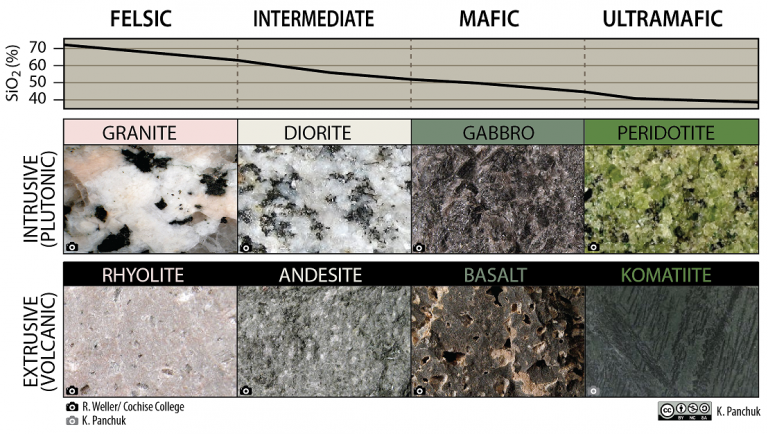
As Earth cooled and the mantle solidified, komatiite became increasingly rare because there wasn't enough heat to melt the minerals needed to produce the highly ultramafic lavas required to form it. [3] The exact formation of the felsic crust of our continents is debated because making granite requires plate tectonic processes, and the timing of the start of plate tectonics remains unknown. Fortunately, recent discoveries in the Jack Hills of western Australia may hold the evidence needed to end this debate.
The Jack Hills Zircon
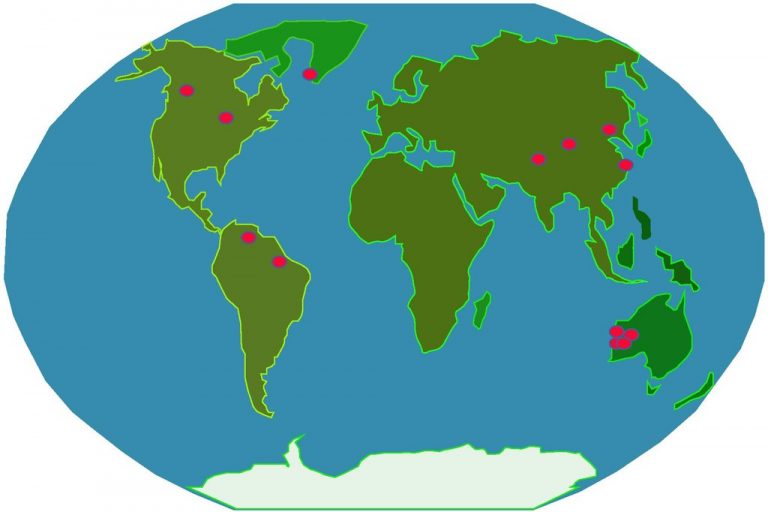
What followed the formation of thin, perturbed komatiite crust is highly debated and an area of intense geological research. Insight into the evolution of the earliest crust was unknown until the discovery of Hadean-age zircons from the Jack Hills area in southwest Australia (map below). It is a common mineral in felsic rocks, with a composition similar to that of continental crust, such as granite. It is uncommon in oceanic crustal rocks, such as basalt, and typically does not occur in ultramafic rocks, such as komatiite.


In the mid-1980s field geologists sampled a metamorphosed sedimentary rock (metaconglomerate) from the Jack Hills. The metaconglomerate is dated as Archean, approximately 3.6 Ga, and the sediment contained in the metaconglomerate must be older than the rock itself, according to the principle of inclusions (particles contained within a rock are older than the rock itself). The original conglomerate's depositional environment may have been an alluvial fan, a fan-shaped pile of sediment formed where a stream flows out of a mountain. Zircon crystals were extracted from the metaconglomerate for analysis.

Zircon is a tiny, very durable mineral and a natural timekeeper. Zircon typically forms during magma crystallization, where radioactive uranium can substitute for zirconium in the mineral lattice. Following crystallization and the formation of an igneous rock, the radiometric clock starts ticking. The unstable radioactive uranium atoms break down through a process known as “decay.” The atoms lose subatomic particles and emit energy. Particle loss results in a decrease in the number of protons, ultimately changing uranium into lead. The rate of this decay is well known, allowing scientists to accurately date zircon. Radiometric dating analysis of the Jack Hills detrital zircon grains yields dates as old as 4.404 Ga - This is the oldest Earth material discovered to date, formed merely ~150 Ma after the inception of Earth!
This discovery has significantly advanced our understanding of the Hadean environment and the evolution of the crust during the Hadean. The discovery of the zircon means that within the first several hundred million years of Earth’s existence, a crust of varying composition existed, some of which was more felsic in composition, more like the continental crust that exists today, and that mountains had been uplifted from which sediment was transported by water. So, did plate tectonics start 4.4 billion years ago and, with it, the formation of our modern continents? Considering other evidence, this seems unlikely; however, this discovery implies that modern geologic processes began shortly after Earth's structure formed and that the earliest Earth more closely resembled today's Earth than previously believed.
Analysis of oxygen-isotope ratios (atoms with varying numbers of neutrons) in zircons revealed even more incredible evidence about the environment of the early Hadean. Analysis of the relative amounts of different isotopes of oxygen \(\ce{^{16}O}\) and \(\ce{^{18}O}\) (ratio denoted with the lowercase Greek delta \(\delta \ce{^{18}O}\)) in the Jack Hills zircon are skewed toward “heavy” \(\ce{^{18}O}\), as opposed to the more common “light” \(\ce{^{16}O}\), indicating it formed by cool, wet, sedimentary processes at the Earth’s surface. This could mean that the magma that formed the zircons came from melted seafloor sediment. So, not only was the very young Earth capable of making rock more felsic than its original ultramafic komatiite crust, but it was also cool enough to have liquid water in oceans. These are surprisingly familiar conclusions about a “hellish” young planet.
Since the discovery of Hadean-age zircon in the Jack Hills area of Australia, other detrital zircons have been found in Archean-age rocks in other parts of the world.
Origin of Earth’s Water
Explanations for the origin of Earth’s water include volcanic outgassing, comets, and meteorites. The volcanic outgassing hypothesis for the origin of Earth’s water holds that it originated within the planet and emerged through tectonic processes as vapor associated with volcanic eruptions. Since all volcanic eruptions contain some water vapor, at times more than 1% of the volume, these alone could have created Earth’s surface water. Another likely source of water was from space. Comets are composed of dust and ice, with some or all of that ice being frozen water. Seemingly dry meteors can contain small but measurable amounts of water, usually trapped in their mineral structures. During heavy bombardment periods later in Earth’s history, its cooled surface was pummeled by comets and meteorites, which could be why so much water exists above ground. However, the chemistry of Earth’s water isotopically matches water found in meteorites better than that of comets. In particular, chondrite meteorites contain water in the crystal structure of some of their minerals. This water could have been released from minerals when these meteorites bombarded the very young, hot Earth. Oxygen would have been released upon impact and melting, allowing it to combine with atmospheric hydrogen to make water.
In the end, all three sources likely contributed to the origin of Earth’s water.

- Geologic Time Scale - a graphical representation of Earth's history based on the rock record that shows the timing and relationships of geologic and biologic events
- Hadean - the earliest part of the Precambrian Eon starting at the conception of Earth up to 4 Ga
- accretion(ary) - the process of small particles and gases within the solar nebula combining together to form larger particles and, eventually, planets
- differentiation - the process of a planet developing a layered structure according to density and chemical composition