

6.1: Sediment Deposition and Bedding
- Page ID
- 37097

\( \newcommand{\vecs}[1]{\overset { \scriptstyle \rightharpoonup} {\mathbf{#1}} } \)
\( \newcommand{\vecd}[1]{\overset{-\!-\!\rightharpoonup}{\vphantom{a}\smash {#1}}} \)
\( \newcommand{\dsum}{\displaystyle\sum\limits} \)
\( \newcommand{\dint}{\displaystyle\int\limits} \)
\( \newcommand{\dlim}{\displaystyle\lim\limits} \)
\( \newcommand{\id}{\mathrm{id}}\) \( \newcommand{\Span}{\mathrm{span}}\)
( \newcommand{\kernel}{\mathrm{null}\,}\) \( \newcommand{\range}{\mathrm{range}\,}\)
\( \newcommand{\RealPart}{\mathrm{Re}}\) \( \newcommand{\ImaginaryPart}{\mathrm{Im}}\)
\( \newcommand{\Argument}{\mathrm{Arg}}\) \( \newcommand{\norm}[1]{\| #1 \|}\)
\( \newcommand{\inner}[2]{\langle #1, #2 \rangle}\)
\( \newcommand{\Span}{\mathrm{span}}\)
\( \newcommand{\id}{\mathrm{id}}\)
\( \newcommand{\Span}{\mathrm{span}}\)
\( \newcommand{\kernel}{\mathrm{null}\,}\)
\( \newcommand{\range}{\mathrm{range}\,}\)
\( \newcommand{\RealPart}{\mathrm{Re}}\)
\( \newcommand{\ImaginaryPart}{\mathrm{Im}}\)
\( \newcommand{\Argument}{\mathrm{Arg}}\)
\( \newcommand{\norm}[1]{\| #1 \|}\)
\( \newcommand{\inner}[2]{\langle #1, #2 \rangle}\)
\( \newcommand{\Span}{\mathrm{span}}\) \( \newcommand{\AA}{\unicode[.8,0]{x212B}}\)
\( \newcommand{\vectorA}[1]{\vec{#1}} % arrow\)
\( \newcommand{\vectorAt}[1]{\vec{\text{#1}}} % arrow\)
\( \newcommand{\vectorB}[1]{\overset { \scriptstyle \rightharpoonup} {\mathbf{#1}} } \)
\( \newcommand{\vectorC}[1]{\textbf{#1}} \)
\( \newcommand{\vectorD}[1]{\overrightarrow{#1}} \)
\( \newcommand{\vectorDt}[1]{\overrightarrow{\text{#1}}} \)
\( \newcommand{\vectE}[1]{\overset{-\!-\!\rightharpoonup}{\vphantom{a}\smash{\mathbf {#1}}}} \)
\( \newcommand{\vecs}[1]{\overset { \scriptstyle \rightharpoonup} {\mathbf{#1}} } \)
\(\newcommand{\longvect}{\overrightarrow}\)
\( \newcommand{\vecd}[1]{\overset{-\!-\!\rightharpoonup}{\vphantom{a}\smash {#1}}} \)
\(\newcommand{\avec}{\mathbf a}\) \(\newcommand{\bvec}{\mathbf b}\) \(\newcommand{\cvec}{\mathbf c}\) \(\newcommand{\dvec}{\mathbf d}\) \(\newcommand{\dtil}{\widetilde{\mathbf d}}\) \(\newcommand{\evec}{\mathbf e}\) \(\newcommand{\fvec}{\mathbf f}\) \(\newcommand{\nvec}{\mathbf n}\) \(\newcommand{\pvec}{\mathbf p}\) \(\newcommand{\qvec}{\mathbf q}\) \(\newcommand{\svec}{\mathbf s}\) \(\newcommand{\tvec}{\mathbf t}\) \(\newcommand{\uvec}{\mathbf u}\) \(\newcommand{\vvec}{\mathbf v}\) \(\newcommand{\wvec}{\mathbf w}\) \(\newcommand{\xvec}{\mathbf x}\) \(\newcommand{\yvec}{\mathbf y}\) \(\newcommand{\zvec}{\mathbf z}\) \(\newcommand{\rvec}{\mathbf r}\) \(\newcommand{\mvec}{\mathbf m}\) \(\newcommand{\zerovec}{\mathbf 0}\) \(\newcommand{\onevec}{\mathbf 1}\) \(\newcommand{\real}{\mathbb R}\) \(\newcommand{\twovec}[2]{\left[\begin{array}{r}#1 \\ #2 \end{array}\right]}\) \(\newcommand{\ctwovec}[2]{\left[\begin{array}{c}#1 \\ #2 \end{array}\right]}\) \(\newcommand{\threevec}[3]{\left[\begin{array}{r}#1 \\ #2 \\ #3 \end{array}\right]}\) \(\newcommand{\cthreevec}[3]{\left[\begin{array}{c}#1 \\ #2 \\ #3 \end{array}\right]}\) \(\newcommand{\fourvec}[4]{\left[\begin{array}{r}#1 \\ #2 \\ #3 \\ #4 \end{array}\right]}\) \(\newcommand{\cfourvec}[4]{\left[\begin{array}{c}#1 \\ #2 \\ #3 \\ #4 \end{array}\right]}\) \(\newcommand{\fivevec}[5]{\left[\begin{array}{r}#1 \\ #2 \\ #3 \\ #4 \\ #5 \\ \end{array}\right]}\) \(\newcommand{\cfivevec}[5]{\left[\begin{array}{c}#1 \\ #2 \\ #3 \\ #4 \\ #5 \\ \end{array}\right]}\) \(\newcommand{\mattwo}[4]{\left[\begin{array}{rr}#1 \amp #2 \\ #3 \amp #4 \\ \end{array}\right]}\) \(\newcommand{\laspan}[1]{\text{Span}\{#1\}}\) \(\newcommand{\bcal}{\cal B}\) \(\newcommand{\ccal}{\cal C}\) \(\newcommand{\scal}{\cal S}\) \(\newcommand{\wcal}{\cal W}\) \(\newcommand{\ecal}{\cal E}\) \(\newcommand{\coords}[2]{\left\{#1\right\}_{#2}}\) \(\newcommand{\gray}[1]{\color{gray}{#1}}\) \(\newcommand{\lgray}[1]{\color{lightgray}{#1}}\) \(\newcommand{\rank}{\operatorname{rank}}\) \(\newcommand{\row}{\text{Row}}\) \(\newcommand{\col}{\text{Col}}\) \(\renewcommand{\row}{\text{Row}}\) \(\newcommand{\nul}{\text{Nul}}\) \(\newcommand{\var}{\text{Var}}\) \(\newcommand{\corr}{\text{corr}}\) \(\newcommand{\len}[1]{\left|#1\right|}\) \(\newcommand{\bbar}{\overline{\bvec}}\) \(\newcommand{\bhat}{\widehat{\bvec}}\) \(\newcommand{\bperp}{\bvec^\perp}\) \(\newcommand{\xhat}{\widehat{\xvec}}\) \(\newcommand{\vhat}{\widehat{\vvec}}\) \(\newcommand{\uhat}{\widehat{\uvec}}\) \(\newcommand{\what}{\widehat{\wvec}}\) \(\newcommand{\Sighat}{\widehat{\Sigma}}\) \(\newcommand{\lt}{<}\) \(\newcommand{\gt}{>}\) \(\newcommand{\amp}{&}\) \(\definecolor{fillinmathshade}{gray}{0.9}\)Sedimentary Structures
Sedimentary rocks, whether terrigenous, carbonate, chemical, or volcaniclastic, contain a wealth of information that relate how they formed at or close to Earth’s surface, and the various physical and chemical processes that affected them as they were buried. Let's look at some common sedimentary structures that provide insight into how sediments were transported across a substrate and deposited.
Bedding
Layered - or stratified - rocks are organized into beds: centimeter- to meter-thick units of sedimentary rock that were deposited approximately horizontally and are separated by approximately horizontal planes (bedding planes); the rocks typically weather more along these planes. Beds are usually fairly uniform or change gradationally in composition. Bedding planes usually represent breaks in sedimentation or changes in grain size. In other words, they usually represent changes in flow characteristics. (from https://geo.libretexts.org/Courses/U...06%3A_Bedforms)
Bedding is therefore a sedimentary structure. Sediment moved by currents or falling from suspension through water or air will accumulate in a bed; this process will continue in a depositional environment until the supply of sediment is terminated. The bedding plane represents the termination of that depositional event. Renewed deposition will see the accumulation of a new bed. A bedding plane thus represents a period of time in which no, or very little sediment was deposited – the duration of the hiatus might be minutes, weeks, or centuries.

The form of a sedimentary bed can be observed at the outcrop level. In some cases, individual layers may maintain their thickness across the entire outcrop, creating tabular beds, or parallel beds. This type of bedding is common when sediment supplies are constant and the depositional environment is laterally pervasive. Keep in mind that descriptive words like tabular or lenticular bedding depend on the scale of your observations. For example, beds that are tabular at the outcrop scale, may "pinch out" or thicken in exposures farther afield.
 Figure \(\PageIndex{2}\): Tabular bedding can form in many environments. This example is from a turbidite succession but parallel beds can form in almost any sediment type, from conglomerate to mudstone; siliciclastic, carbonate, volcaniclastic. (Brian Ricketts.)
Other times, a sedimentary layer may pinch out, thinning to the point of disappearing from the stratigraphic section, creating a discontinuous bed. This is often seen in fan-shaped structures that develop in alluvial fans, deltas, and submarine fans. In some cases, a layer may pinch out in both directions, creating a lenticular bed. This is common for channel sandstones in river or deltaic systems.
 Figure \(\PageIndex{3}\): Lenticular bedding is common in many environments. In this example of a channel sandstone from West Virginia, note how the thickest light tan layer in the center of the image thins and pinches out into the foreground and background. It can form in any sediment type, from conglomerate to mudstone; siliciclastic, carbonate, volcaniclastic. (K. Layou.)
Ripples and Dunes

Movement of sediment creates beds, structures within beds (e.g., laminations, crossbedding), and entire depositional systems like deltas and submarine fans. The processes by which sediment moves determine what the deposit will look like: a train of ripples, turbidites, a layer of mud, or Martian sand dunes.
Ripples and dunes form when a fluid (usually water or air on Earth, but the same concepts apply to lava flows, crystal mushes in a magma chamber, or even the Martian atmosphere) flows across a sediment surface. Structures formed by air flow are called "subaerial" ripples or dunes; those in water are referred to as "subaqueous". These structures are given the general name bedform. The construction of bedforms requires certain conditions:
- The sand must be cohesionless (i.e., the grains do not stick together).
- Flow across the sediment surface must overcome the forces of gravity and friction, and
- There is a critical flow velocity at which grain movement will begin; this depends on the mass of individual grains and, to some extent, their shape. For example, flat, platy minerals like mica are easier to move than a grain of quartz with the same volume but a chunkier shape.
Most of our knowledge about bedforms and how they form has been garnered from studies of modern environments. After all, if on your walks across a tidal flat or desert dune field you see ripples that look identical to those preserved in rocks, it is quite reasonable to infer that the ancient bedforms developed in ways similar to the modern analogues (this is the Principle of Uniformitarianism in action!).


Ripples are one of the most common bedforms and can form in environments ranging from sand dunes, rivers and alluvial systems, tidal flow on tidal flats, channels, estuaries and continental shelves, and deep ocean basins on submarine fans. Ripples can be asymmetrical, formed from a unidirectional current (like a flowing river) or symmetrical, formed from oscillating currents (like waves). Figure \(\PageIndex{6}\) above shows an asymmetrical ripple form, with the right side of the ripples more gently sloped than the steeper right sides; this indicates that the right side of the ripples are upstream (stoss) while the left side of the ripples are downstream (leeward).
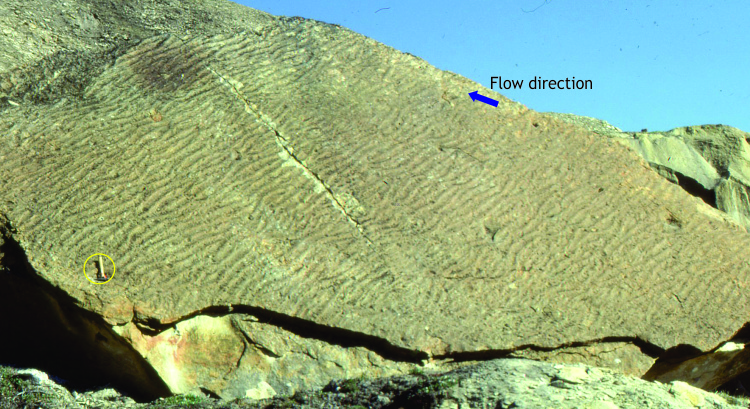 Figure \(\PageIndex{7}\): Straight crested ripples nicely exposed on bedding. Lee slopes on each ripple consistently face in the direction of the blue arrow. The regularity of ripples indicates consistent flow across this Paleocene tidal flat. (Brian Ricketts.)
Laminae and Crossbedding
Laminae are color, composition, or grain size variations defining surfaces within a bed. They typically represent variations in flow velocity, sediment supply, sediment composition, etc. Planar laminae are parallel to bedding: planar and deposited approximately horizontally.
Cross lamination, cross stratification, or crossbedding are laminations or layers that are oriented obliquely to bedding. They truncate older laminae and are truncated by younger laminae. The erosional surfaces that separate sets of similarly oriented laminae are called “bounding surfaces”. There are lots of subdivisions of cross stratification; different types represent different types of bedforms and different flow conditions.
(from https://geo.libretexts.org/Courses/U...06%3A_Bedforms)

Crossbeds are nearly ubiquitous in sedimentary rocks. They can be found on the deep ocean floor, the driest desert, and pretty well any depositional environment in between. They are most common in sandy deposits. They are less common —but no less important— in gravels (e.g., low sinuosity settings such as braided rivers). Crossbeds form where air and water flow across a bed of loose sediment, so long as the individual sediment grains have low cohesion between the particles: in other words, they are not “sticky.” Mud crossbeds are rare because individual clay particles tend to stick to one another (a result of the electrical charges on the surface of these tiny grains).

Crossbeds in the rock record are visible in bed cross-sections, or as exhumed 3D ripples and dunes on exposed bedding planes. The term crossbed refers to their internal structure; i.e., laminations that are usually inclined in the down-flow, or down-stream direction. Crossbeds are therefore useful in interpreting paleocurrent flow direction. Because the laminations often show a tangential relationship to the main bed at the bottom of the main bed and a truncated relationship at the top, they are also useful as geopetal ("way-up") indicators.

Laminae in crossbedding are called foresets. In a 2D cross-section view, a single crossbed consists of any number of foresets bound above and below by flat or curved boundaries. The foresets in Figure 6.1.11 below are indicated by dashed yellow lines.
 Figure \(\PageIndex{11}\): Tabular crossbeds up to 2m thick. The crossbeds formed as part of large gravel bars within a Jurassic river channel. (Brian Ricketts.)
The geometrical arrangement of foresets, their bounding surfaces, and their size or amplitude gives us the information needed to decipher:
- the kind of crossbed,
- the hydraulic conditions under which the crossbed formed
- and, to some extent, the paleoenvironment in which they formed.
Keep in mind that most crossbeds can be found in a range of paleoenvironments, but taking into account other criteria - like body and trace fossils, sediment composition, and stratigraphic trends - will help us pinpoint specific depositional settings.
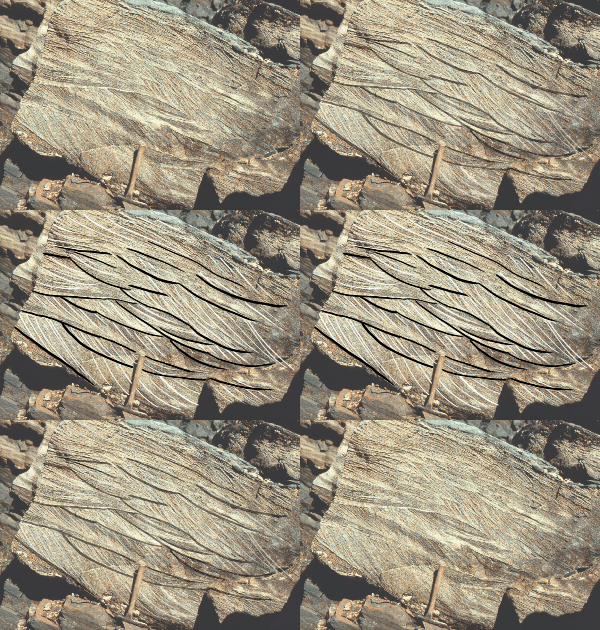 Figure \(\PageIndex{12}\): Trough crossbeds from an ancient tidal channel. In 2D exposures, trough crossbeds have convex-up basal contacts and foresets tend to be tangential. Troughs commonly cross-cut earlier-formed structures, resulting in a complex array of partly preserved bedforms. Common in channelized (confined) flow; found in tidal, estuarine, fluvial, and alluvial fan channels. (Brian Ricketts.)
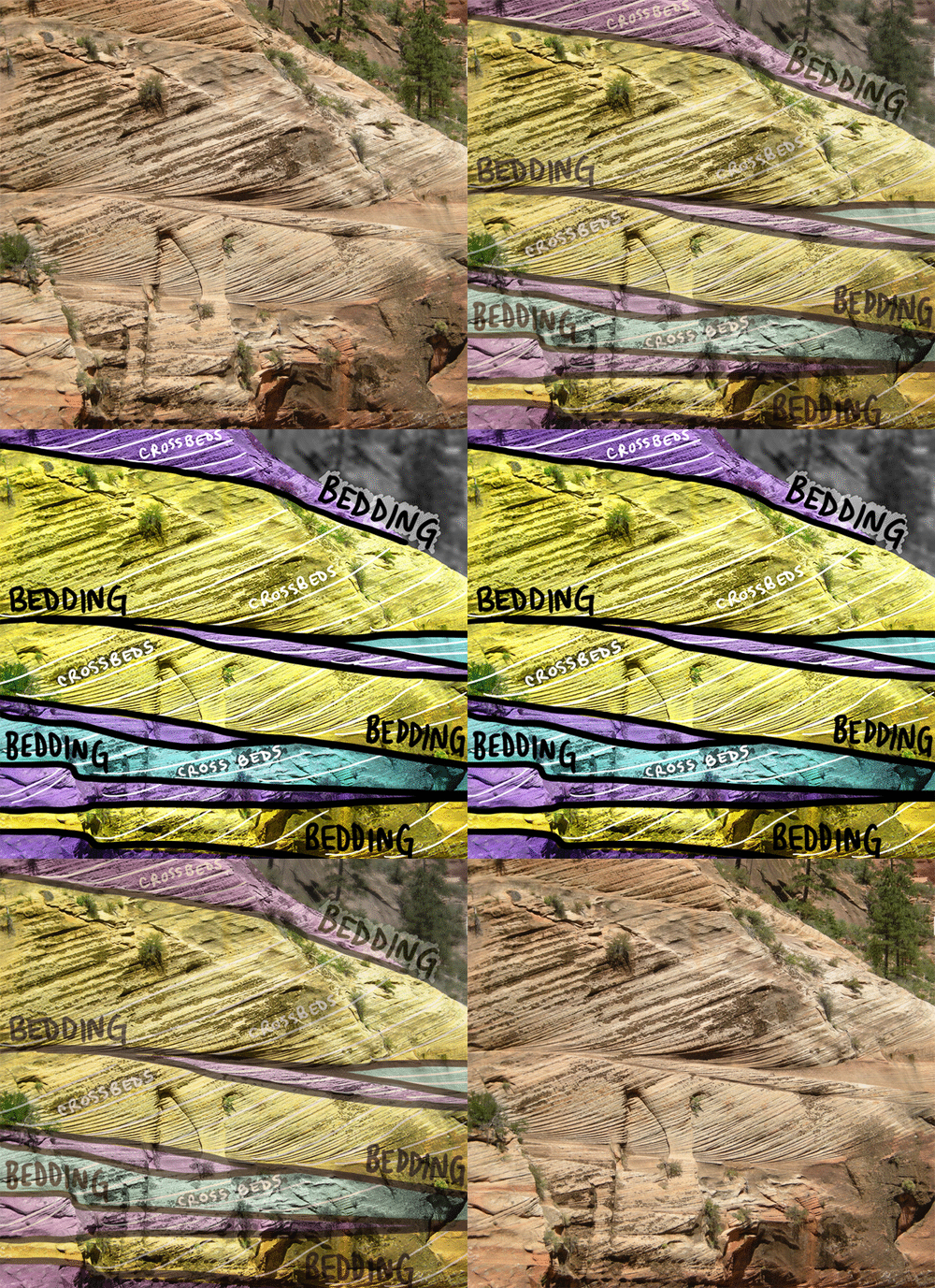 Figure \(\PageIndex{13}\): Large-scale dune crossbedding exposed on a cliff of Jurassic Navajo Sandstone in Zion National Park, Utah. The image cycles between a raw photograph and an annotated view, where each of the ~10 principal beds are highlighted with different colors, and the traces of their internal crossbedding traced out with white. Note the tangential attitude of the cross-beds at the bottom of each bed, and their truncation by the overlying bed. This relationship can serve as a useful way-up indicator. (Callan Bentley.)
Our interpretations can be advanced further if we are lucky enough to see exhumed structures on bedding, such that we can define:
- the shape of the ripple or dune crest line (is it straight or sinuous?),
- the wavelength between successive ripple or dunes, and
- a relatively unambiguous measure of ripple-dune migration across the bed (i.e., paleocurrents).
Dune-Ripple Formation
The above video shows subaqueous dunes forming in a flume (movie presented by Michael Calzi, SUNY Geneseo Dept. of Geological Science). A flume is a narrow tank containing a sand bed, where the velocity of water flow that can be controlled; they are used in experiments to observe the formation of bedforms, and for modeling engineering problems such as the flow of water around bridge foundations. The sequence begins by showing water flow in front of the migrating lee face; look carefully and you will notice:
- sand grains being carried along the stoss slope bed;
- when grains reach the dune crest, they avalanche down the lee face – forming crossbed foresets,
- water flow downstream of the lee face appears to flow backwards – this is the backflow shown schematically in the ripple formation diagram above (Figure \(\PageIndex{10}\)).

- bed - a layer of sediment or sedimentary rock that is distinguishable from adjacent layers due to differences in its composition, texture, or other physical properties
- bedform - a geological feature developed when a moveable bed interfaces with a fluid resulting in the material being shaped by the flow
- cross-bed - a sedimentary structure where layers of sediment are deposited at an angle to the main, horizontal bedding plane
- discontinuous bed - a sediment ary bed that pinches out in one direction
- foreset - an inclined layer of sediment in a bedform that dips in the direction of current flow, forming the steep part of the structure
- lenticular bed - a sedimentary bed that pinches out in both directions
- tabular bed - a broad continuous layer of sedimentary material characterized by a consistent thickness and planar bounding surfaces