

6.2: Other Sedimentary Structures
- Page ID
- 37098

\( \newcommand{\vecs}[1]{\overset { \scriptstyle \rightharpoonup} {\mathbf{#1}} } \)
\( \newcommand{\vecd}[1]{\overset{-\!-\!\rightharpoonup}{\vphantom{a}\smash {#1}}} \)
\( \newcommand{\dsum}{\displaystyle\sum\limits} \)
\( \newcommand{\dint}{\displaystyle\int\limits} \)
\( \newcommand{\dlim}{\displaystyle\lim\limits} \)
\( \newcommand{\id}{\mathrm{id}}\) \( \newcommand{\Span}{\mathrm{span}}\)
( \newcommand{\kernel}{\mathrm{null}\,}\) \( \newcommand{\range}{\mathrm{range}\,}\)
\( \newcommand{\RealPart}{\mathrm{Re}}\) \( \newcommand{\ImaginaryPart}{\mathrm{Im}}\)
\( \newcommand{\Argument}{\mathrm{Arg}}\) \( \newcommand{\norm}[1]{\| #1 \|}\)
\( \newcommand{\inner}[2]{\langle #1, #2 \rangle}\)
\( \newcommand{\Span}{\mathrm{span}}\)
\( \newcommand{\id}{\mathrm{id}}\)
\( \newcommand{\Span}{\mathrm{span}}\)
\( \newcommand{\kernel}{\mathrm{null}\,}\)
\( \newcommand{\range}{\mathrm{range}\,}\)
\( \newcommand{\RealPart}{\mathrm{Re}}\)
\( \newcommand{\ImaginaryPart}{\mathrm{Im}}\)
\( \newcommand{\Argument}{\mathrm{Arg}}\)
\( \newcommand{\norm}[1]{\| #1 \|}\)
\( \newcommand{\inner}[2]{\langle #1, #2 \rangle}\)
\( \newcommand{\Span}{\mathrm{span}}\) \( \newcommand{\AA}{\unicode[.8,0]{x212B}}\)
\( \newcommand{\vectorA}[1]{\vec{#1}} % arrow\)
\( \newcommand{\vectorAt}[1]{\vec{\text{#1}}} % arrow\)
\( \newcommand{\vectorB}[1]{\overset { \scriptstyle \rightharpoonup} {\mathbf{#1}} } \)
\( \newcommand{\vectorC}[1]{\textbf{#1}} \)
\( \newcommand{\vectorD}[1]{\overrightarrow{#1}} \)
\( \newcommand{\vectorDt}[1]{\overrightarrow{\text{#1}}} \)
\( \newcommand{\vectE}[1]{\overset{-\!-\!\rightharpoonup}{\vphantom{a}\smash{\mathbf {#1}}}} \)
\( \newcommand{\vecs}[1]{\overset { \scriptstyle \rightharpoonup} {\mathbf{#1}} } \)
\(\newcommand{\longvect}{\overrightarrow}\)
\( \newcommand{\vecd}[1]{\overset{-\!-\!\rightharpoonup}{\vphantom{a}\smash {#1}}} \)
\(\newcommand{\avec}{\mathbf a}\) \(\newcommand{\bvec}{\mathbf b}\) \(\newcommand{\cvec}{\mathbf c}\) \(\newcommand{\dvec}{\mathbf d}\) \(\newcommand{\dtil}{\widetilde{\mathbf d}}\) \(\newcommand{\evec}{\mathbf e}\) \(\newcommand{\fvec}{\mathbf f}\) \(\newcommand{\nvec}{\mathbf n}\) \(\newcommand{\pvec}{\mathbf p}\) \(\newcommand{\qvec}{\mathbf q}\) \(\newcommand{\svec}{\mathbf s}\) \(\newcommand{\tvec}{\mathbf t}\) \(\newcommand{\uvec}{\mathbf u}\) \(\newcommand{\vvec}{\mathbf v}\) \(\newcommand{\wvec}{\mathbf w}\) \(\newcommand{\xvec}{\mathbf x}\) \(\newcommand{\yvec}{\mathbf y}\) \(\newcommand{\zvec}{\mathbf z}\) \(\newcommand{\rvec}{\mathbf r}\) \(\newcommand{\mvec}{\mathbf m}\) \(\newcommand{\zerovec}{\mathbf 0}\) \(\newcommand{\onevec}{\mathbf 1}\) \(\newcommand{\real}{\mathbb R}\) \(\newcommand{\twovec}[2]{\left[\begin{array}{r}#1 \\ #2 \end{array}\right]}\) \(\newcommand{\ctwovec}[2]{\left[\begin{array}{c}#1 \\ #2 \end{array}\right]}\) \(\newcommand{\threevec}[3]{\left[\begin{array}{r}#1 \\ #2 \\ #3 \end{array}\right]}\) \(\newcommand{\cthreevec}[3]{\left[\begin{array}{c}#1 \\ #2 \\ #3 \end{array}\right]}\) \(\newcommand{\fourvec}[4]{\left[\begin{array}{r}#1 \\ #2 \\ #3 \\ #4 \end{array}\right]}\) \(\newcommand{\cfourvec}[4]{\left[\begin{array}{c}#1 \\ #2 \\ #3 \\ #4 \end{array}\right]}\) \(\newcommand{\fivevec}[5]{\left[\begin{array}{r}#1 \\ #2 \\ #3 \\ #4 \\ #5 \\ \end{array}\right]}\) \(\newcommand{\cfivevec}[5]{\left[\begin{array}{c}#1 \\ #2 \\ #3 \\ #4 \\ #5 \\ \end{array}\right]}\) \(\newcommand{\mattwo}[4]{\left[\begin{array}{rr}#1 \amp #2 \\ #3 \amp #4 \\ \end{array}\right]}\) \(\newcommand{\laspan}[1]{\text{Span}\{#1\}}\) \(\newcommand{\bcal}{\cal B}\) \(\newcommand{\ccal}{\cal C}\) \(\newcommand{\scal}{\cal S}\) \(\newcommand{\wcal}{\cal W}\) \(\newcommand{\ecal}{\cal E}\) \(\newcommand{\coords}[2]{\left\{#1\right\}_{#2}}\) \(\newcommand{\gray}[1]{\color{gray}{#1}}\) \(\newcommand{\lgray}[1]{\color{lightgray}{#1}}\) \(\newcommand{\rank}{\operatorname{rank}}\) \(\newcommand{\row}{\text{Row}}\) \(\newcommand{\col}{\text{Col}}\) \(\renewcommand{\row}{\text{Row}}\) \(\newcommand{\nul}{\text{Nul}}\) \(\newcommand{\var}{\text{Var}}\) \(\newcommand{\corr}{\text{corr}}\) \(\newcommand{\len}[1]{\left|#1\right|}\) \(\newcommand{\bbar}{\overline{\bvec}}\) \(\newcommand{\bhat}{\widehat{\bvec}}\) \(\newcommand{\bperp}{\bvec^\perp}\) \(\newcommand{\xhat}{\widehat{\xvec}}\) \(\newcommand{\vhat}{\widehat{\vvec}}\) \(\newcommand{\uhat}{\widehat{\uvec}}\) \(\newcommand{\what}{\widehat{\wvec}}\) \(\newcommand{\Sighat}{\widehat{\Sigma}}\) \(\newcommand{\lt}{<}\) \(\newcommand{\gt}{>}\) \(\newcommand{\amp}{&}\) \(\definecolor{fillinmathshade}{gray}{0.9}\)In the previous section, we examined common descriptive categories of bedding and bedforms that inform us about current flow and sediment deposition. Identifying sedimentary structures and deciphering how they formed are two of the most important tasks for any sedimentological study. They provide important clues to interpreting ancient environments.
Describing Stratified Rocks
The utility of sedimentary structures to unravel the past becomes even more powerful when used in conjunction with other rock properties, like sediment texture, fabric, color, and fossil content. Basic steps for describing stratified rocks - at the outcrop, core, or hand sample scale - are listed below.
- Examine the bedding.
- How thick are the beds?
- What is the bed geometry (parallel, lenticular, lensoidal)?
- How do the beds weather? Are the rocks more or less resistant to weathering, forming cliffs or recesses?
- Examine the color of the strata. Is it uniform or variable?
- Examine the texture and fabric of the rocks.
- What is the maximum grain size?
- What is the range of grain sizes (i.e. sorting of clasts)?
- What is the clast shape (round vs. angular, platy vs. spherical)?
- What is the clast framework (clast-supported vs. matrix-supported)?
- Is there a preferred clast orientation (alignment/imbrication)?
- Is there a preferred clast distribution (e.g. graded, bimodal, etc.)?
- What is the rock classification (i.e. mudrock, sandstone, conglomerate/breccia)?
- Examine the composition of the rocks.
- Is it a carbonate, siliciclastic, or volcaniclastic?
- What are the main clast types (quartz, feldspar, lithics, bioclasts, etc.)?
- What is the cement (silica, carbonate, iron oxide)?
- How hard is the rock vs. how easily does it break apart (i.e. induration: does it ring when you hit it with a hammer or does it crumble)?
- Examine the fossil content of the rocks.
- Are there body fossils, trace fossils, cast or molds, etc.?
- Are there any preferred faunal or sedimentary associations?
- Do body fossils show signs of transportation (e.g. disarticulation, breakage) or are they in living position?
- What are the fossilized organisms' relationship to the substrate/bedding (i.e. infaunal vs. epifaunal)?
- How are the fossils preserved?
In this section, we will explore more sedimentary structures that can aid our interpretation of depositional environments and Earth's history.
Structures Formed By Sediment Gravity Flows
Graded bedding refers to a sequence of increasingly coarse- or fine-grained sediment layers. Graded bedding often develops when sediment deposition occurs in an environment of decreasing energy.
Turbidites are mostly found in deep marine basins and lakes, but are also known to occur in shallow settings like continental shelves. They are deposited from turbulent, bottom-hugging flows of water carrying (mostly) sand and mud. Turbidity currents can travel many tens of kilometers across the sea floor. Turbidity current deposits, called “turbidites,” are the principal components of submarine fans.
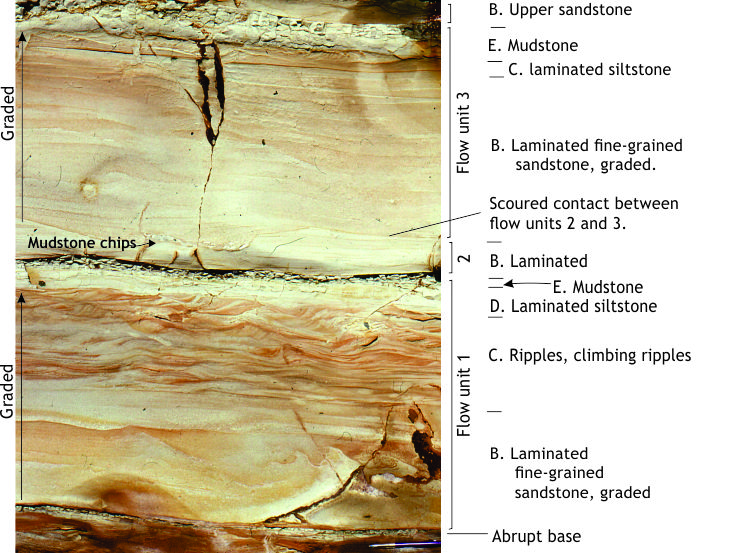
The classic descriptive model of a turbidite deposit was developed by Arnold Bouma, and is appropriately called a Bouma Sequence. Bouma sequence beds are formed by offshore sediment gravity flows, which are underwater flows of sediment. These subsea density flows begin when sediment is stirred up by an energetic process and becomes a dense slurry of mixed grains. The sediment flow courses downward through submarine channels and canyons due to gravity acting on the density difference between the denser slurry and less dense surrounding seawater. As the flow reaches deeper ocean basins it slows down, loses energy, and deposits sediment in a Bouma sequence of coarse grains first, followed by increasingly finer grains.

In thick turbidite successions, it is common to find individual flow units that are incomplete Bouma sequences; thus one flow unit may preserve only A and B interval sands, where others present B, C, D and E, or C, D, and E intervals. Variations like these generally reflect proximity to the source of the turbidity current, as well as the availability of sediment. For example, sandy turbidites containing thick A and B intervals are more likely to be deposited in the proximal parts of submarine fans (i.e. closer to the sediment source and the head of the fan); finer-grained turbidites lacking thick A or B intervals will tend to accumulate in the more distal parts of submarine fans (i.e. further to the sediment source and closer to the outer fringes of the fan).
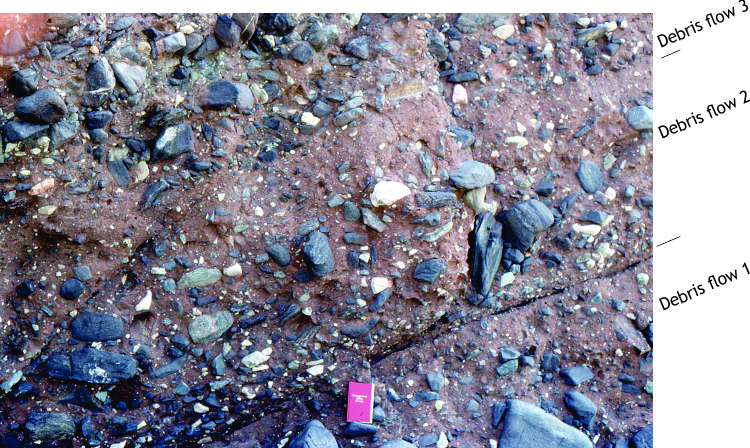
Debris flows are also mixtures of mud, water, and coarse debris, but unlike turbidites they lack fluid turbulence during flow. The capacity of a debris flow to carry material, including house-sized blocks, lies in the viscosity and mechanical strength of its mud matrix. Debris flows are mobile, commonly destructive phenomena. In terrestrial settings, they can evolve from landslides, aided by high precipitation or snow melt. The equivalent phenomena in volcanic terrains are called lahars – debris flows consisting almost entirely of volcanic debris – that develop both during and after eruptions.
Subaqueous debris flows are commonly generated during slope failures (submarine landslides) that are triggered by seismic events or gravitational instability. Turbidites and debris flows are often found together in the rock record.
Sole Structures
Sole structures form on the base of some beds during deposition of sediment. The most common types are structures formed by scouring erosion of the substrate by a flowing current, by objects dragged across the sea or lake floor (e.g., bits of wood, shells, or pebbles), and by objects that bounce along the substrate. The depressions formed are filled by new sediment so that they are part of the basal contact of the overlying bed – i.e., they are casts of the depressions and are located on the bottom of the overlying bed. Like the sole is the bottom of a shoe, sole structures are formed on the underside of beds. They are sometimes called sole casts. Sole structures are most easily identified on exposed bedding. Flute, groove, and bounce casts are common in turbidites but can form on shallow continental shelves and platforms, particularly during the passage of storms. Gutter casts are narrow, elongate scours in the sea floor 15-20 cm deep that form during coastal storm surges.

Structures Formed By Sediment Textures and Fabrics
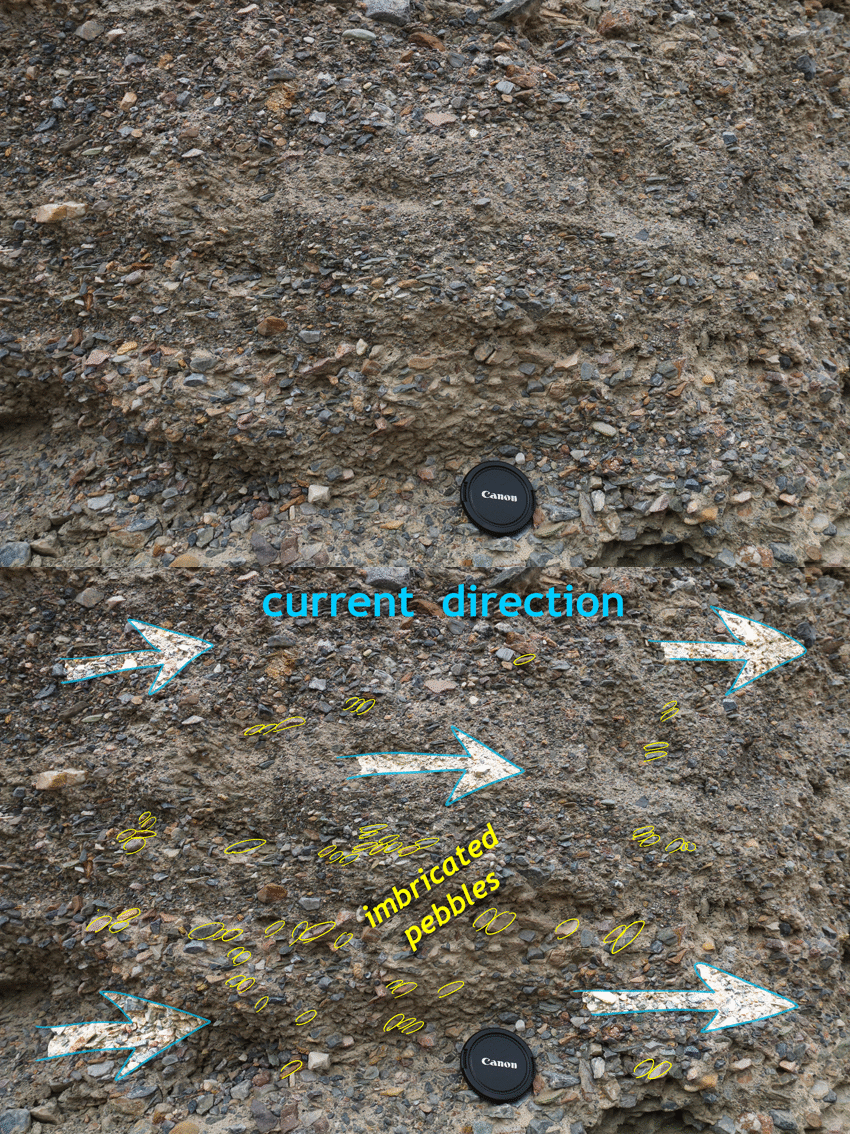
This category of structures is based on textural properties of sediments, such as clast shape and orientation. We often think of sedimentary grains as approximating spheres. However, clasts commonly deviate from this ideal shape – they may be blocky, flattened or plate-like, rod-like, or tapered cones (fossil groups such as gastropods commonly conform to the latter shape). During transport in flowing currents, clasts like these will tend to be aligned according to their most stable hydrodynamic orientation. This preferred alignment of the clasts is referred to as imbrication. Identification of preferred clast orientations provides another useful tool for measuring paleoflow directions.
Structures Formed By Desiccation
Desiccation means “drying out.” Desiccation of subaerially exposed surface sediment or soil drives off ambient moisture, reducing its volume, and resulting in shrinkage. Shrinkage cracks can extend many centimeters below the surface. Propagation of shrinkage cracks, or mud cracks, across a sediment surface commonly produce 5 and 6-sided polygons. If desiccation continues, the polygon margins will begin to curl upward. Mudcracks are common on river floodplains, the inactive parts of alluvial fans, and supratidal environments that are exposed for long periods. Desiccated sediment is prone to reworking during river flooding, and periodic king tides or storm surges across intertidal and supratidal flats.

When preserved in the rock record, mud cracks may indicate:
- falling sea levels,
- changes in the location of river channels and adjacent floodplains,
- arid climate.
Trace Fossils & Bioturbation
_15.jpg?revision=1) Figure \(\PageIndex{7}\): Bioturbated sandstone from the Lower Cambrian Sellick Hill Formation in coastal South Australia. Burrowed textures in sedimentary rocks are referred to as bioturbation. (Trace Fossils 15 by James St. John, licensed under CC BY 2.0.)
Figure \(\PageIndex{7}\): Bioturbated sandstone from the Lower Cambrian Sellick Hill Formation in coastal South Australia. Burrowed textures in sedimentary rocks are referred to as bioturbation. (Trace Fossils 15 by James St. John, licensed under CC BY 2.0.)Trace fossils have the privilege of being two things at once: sedimentary structures and fossils. They occur in sediment, are made of sediment, but represent the activities of creeping, crawling or burrowing critters, mostly at or immediately below the sediment water interface (marine, lacustrine, estuarine, swamp), or subaerial environments such as dune fields. As such, trace fossils represent the range of activities that critters are normally occupied with – grazing or foraging for food, home construction and house-keeping, predating or escaping predators, wandering aimlessly, or taking a nap after an exhausting day. Some critters like to rough it, preferring the tumble of waves or strong currents, while others like the peace and quiet of deeper realms. Lives are frequently interrupted by storms or violent, turbulent flows of sand and mud; trace fossils, or lack of them, also reflect these events.
Most animals produce more than one kind of trace depending on what they are doing. This means that, in most cases, traces reflect animal activity and biometrics, rather than the specific critter species. Most traces do not contain any remnants of the animal that made them (there are a few exceptions); finding a trilobite body fossil at the end of its scampering trail is pretty rare.
Trace fossils provide valuable information on benthic communities, environmental conditions such as wave or current energy, redox conditions (presence or absence of oxygen), rates of sedimentation, or periods of time when sedimentation slowed (e.g. hiatuses, disconformities, omission surfaces).
Intense bioturbation can also obliterate other kinds of sedimentary structures; for a geologist, this may be an annoyance or a happy circumstance. Most Precambrian successions are free of trace fossils and bioturbation; this changed during the Ediacaran, the period that appears to have been a kind of precursor to the Cambrian invertebrate explosion. Most Phanerozoic sedimentary successions (for the last ~540 million years or so) have enjoyed the munching-burrowing efforts of myriad nameless critters.

The images below are organized into six ethological (i.e. behavioral) structures:
1. Resting traces (Cubichnia): the animal is taking a break or escaping a marauding predator.

2. Crawling traces (Repichnia): Moving from one point to another, so the emphasis is on body and limb movement.

3. Grazing traces (Pascichnia): The search for food at the sediment surface or just beneath it – similar to humans strip mining.
 Figure \(\PageIndex{11}\): Helminthopsis, a grazing trace fossil from the Logan Formation (Lower Carboniferous) of Wooster, Ohio. (Wikimedia Commons by Mark A. Wilson.)
4. Feeding structures (Fodichnia): Like grazing, but in this group the critters burrow (like subsurface mining), forming simple temporary burrows or branched burrow complexes.

5. Dwelling structures (Domichnia): These are more permanent burrows that the animals call home.

6. Escape structures (Fugichnia): These, too, are temporary burrows, made while attempting an escape from sediment burial, or from predators; hence the critter may move upward or downward in the sediment, depending on the circumstances.

- bedding - the layered structure of sedimentary rocks, where layers, are separated by planes
- bioturbation - the physical churning and mixing of sediments by the activities of living organisms (such as burrowing)
- Bouma Sequence - a geological model describing the idealized vertical succession of sedimentary structures and lithologies in a turbidite
- composition - the materials something is made of
- debris flow - mixtures of mud, water, and coarse debris, moving down a slope due to gravity that lack fluid turbulence
- fabric - the arrangement and organization of a rock's constituent parts and features
- fossil - a remnant or evidence of past animal or plant activity
- graded bedding - a sedimentary layer characterized by progressively finer-grained particles from the bottom upward
- imbrication - a primary depositional fabric where elongated or flat clasts are arranged in a overlapping pattern indicating flow direction
- texture - the size, shape, and arrangement of mineral grains, crystals, or fragments within a rock
- turbidite - a type of sedimentary rock composed of layered particles that grade upward from coarser to finer sizes thought to have originated from ancient fast-moving, gravity-driven underwater currents carrying a high concentration of suspended sediment in the oceans