

11.3: Barrier Islands and Lagoons
- Page ID
- 45604
\( \newcommand{\vecs}[1]{\overset { \scriptstyle \rightharpoonup} {\mathbf{#1}} } \)
\( \newcommand{\vecd}[1]{\overset{-\!-\!\rightharpoonup}{\vphantom{a}\smash {#1}}} \)
\( \newcommand{\dsum}{\displaystyle\sum\limits} \)
\( \newcommand{\dint}{\displaystyle\int\limits} \)
\( \newcommand{\dlim}{\displaystyle\lim\limits} \)
\( \newcommand{\id}{\mathrm{id}}\) \( \newcommand{\Span}{\mathrm{span}}\)
( \newcommand{\kernel}{\mathrm{null}\,}\) \( \newcommand{\range}{\mathrm{range}\,}\)
\( \newcommand{\RealPart}{\mathrm{Re}}\) \( \newcommand{\ImaginaryPart}{\mathrm{Im}}\)
\( \newcommand{\Argument}{\mathrm{Arg}}\) \( \newcommand{\norm}[1]{\| #1 \|}\)
\( \newcommand{\inner}[2]{\langle #1, #2 \rangle}\)
\( \newcommand{\Span}{\mathrm{span}}\)
\( \newcommand{\id}{\mathrm{id}}\)
\( \newcommand{\Span}{\mathrm{span}}\)
\( \newcommand{\kernel}{\mathrm{null}\,}\)
\( \newcommand{\range}{\mathrm{range}\,}\)
\( \newcommand{\RealPart}{\mathrm{Re}}\)
\( \newcommand{\ImaginaryPart}{\mathrm{Im}}\)
\( \newcommand{\Argument}{\mathrm{Arg}}\)
\( \newcommand{\norm}[1]{\| #1 \|}\)
\( \newcommand{\inner}[2]{\langle #1, #2 \rangle}\)
\( \newcommand{\Span}{\mathrm{span}}\) \( \newcommand{\AA}{\unicode[.8,0]{x212B}}\)
\( \newcommand{\vectorA}[1]{\vec{#1}} % arrow\)
\( \newcommand{\vectorAt}[1]{\vec{\text{#1}}} % arrow\)
\( \newcommand{\vectorB}[1]{\overset { \scriptstyle \rightharpoonup} {\mathbf{#1}} } \)
\( \newcommand{\vectorC}[1]{\textbf{#1}} \)
\( \newcommand{\vectorD}[1]{\overrightarrow{#1}} \)
\( \newcommand{\vectorDt}[1]{\overrightarrow{\text{#1}}} \)
\( \newcommand{\vectE}[1]{\overset{-\!-\!\rightharpoonup}{\vphantom{a}\smash{\mathbf {#1}}}} \)
\( \newcommand{\vecs}[1]{\overset { \scriptstyle \rightharpoonup} {\mathbf{#1}} } \)
\(\newcommand{\longvect}{\overrightarrow}\)
\( \newcommand{\vecd}[1]{\overset{-\!-\!\rightharpoonup}{\vphantom{a}\smash {#1}}} \)
\(\newcommand{\avec}{\mathbf a}\) \(\newcommand{\bvec}{\mathbf b}\) \(\newcommand{\cvec}{\mathbf c}\) \(\newcommand{\dvec}{\mathbf d}\) \(\newcommand{\dtil}{\widetilde{\mathbf d}}\) \(\newcommand{\evec}{\mathbf e}\) \(\newcommand{\fvec}{\mathbf f}\) \(\newcommand{\nvec}{\mathbf n}\) \(\newcommand{\pvec}{\mathbf p}\) \(\newcommand{\qvec}{\mathbf q}\) \(\newcommand{\svec}{\mathbf s}\) \(\newcommand{\tvec}{\mathbf t}\) \(\newcommand{\uvec}{\mathbf u}\) \(\newcommand{\vvec}{\mathbf v}\) \(\newcommand{\wvec}{\mathbf w}\) \(\newcommand{\xvec}{\mathbf x}\) \(\newcommand{\yvec}{\mathbf y}\) \(\newcommand{\zvec}{\mathbf z}\) \(\newcommand{\rvec}{\mathbf r}\) \(\newcommand{\mvec}{\mathbf m}\) \(\newcommand{\zerovec}{\mathbf 0}\) \(\newcommand{\onevec}{\mathbf 1}\) \(\newcommand{\real}{\mathbb R}\) \(\newcommand{\twovec}[2]{\left[\begin{array}{r}#1 \\ #2 \end{array}\right]}\) \(\newcommand{\ctwovec}[2]{\left[\begin{array}{c}#1 \\ #2 \end{array}\right]}\) \(\newcommand{\threevec}[3]{\left[\begin{array}{r}#1 \\ #2 \\ #3 \end{array}\right]}\) \(\newcommand{\cthreevec}[3]{\left[\begin{array}{c}#1 \\ #2 \\ #3 \end{array}\right]}\) \(\newcommand{\fourvec}[4]{\left[\begin{array}{r}#1 \\ #2 \\ #3 \\ #4 \end{array}\right]}\) \(\newcommand{\cfourvec}[4]{\left[\begin{array}{c}#1 \\ #2 \\ #3 \\ #4 \end{array}\right]}\) \(\newcommand{\fivevec}[5]{\left[\begin{array}{r}#1 \\ #2 \\ #3 \\ #4 \\ #5 \\ \end{array}\right]}\) \(\newcommand{\cfivevec}[5]{\left[\begin{array}{c}#1 \\ #2 \\ #3 \\ #4 \\ #5 \\ \end{array}\right]}\) \(\newcommand{\mattwo}[4]{\left[\begin{array}{rr}#1 \amp #2 \\ #3 \amp #4 \\ \end{array}\right]}\) \(\newcommand{\laspan}[1]{\text{Span}\{#1\}}\) \(\newcommand{\bcal}{\cal B}\) \(\newcommand{\ccal}{\cal C}\) \(\newcommand{\scal}{\cal S}\) \(\newcommand{\wcal}{\cal W}\) \(\newcommand{\ecal}{\cal E}\) \(\newcommand{\coords}[2]{\left\{#1\right\}_{#2}}\) \(\newcommand{\gray}[1]{\color{gray}{#1}}\) \(\newcommand{\lgray}[1]{\color{lightgray}{#1}}\) \(\newcommand{\rank}{\operatorname{rank}}\) \(\newcommand{\row}{\text{Row}}\) \(\newcommand{\col}{\text{Col}}\) \(\renewcommand{\row}{\text{Row}}\) \(\newcommand{\nul}{\text{Nul}}\) \(\newcommand{\var}{\text{Var}}\) \(\newcommand{\corr}{\text{corr}}\) \(\newcommand{\len}[1]{\left|#1\right|}\) \(\newcommand{\bbar}{\overline{\bvec}}\) \(\newcommand{\bhat}{\widehat{\bvec}}\) \(\newcommand{\bperp}{\bvec^\perp}\) \(\newcommand{\xhat}{\widehat{\xvec}}\) \(\newcommand{\vhat}{\widehat{\vvec}}\) \(\newcommand{\uhat}{\widehat{\uvec}}\) \(\newcommand{\what}{\widehat{\wvec}}\) \(\newcommand{\Sighat}{\widehat{\Sigma}}\) \(\newcommand{\lt}{<}\) \(\newcommand{\gt}{>}\) \(\newcommand{\amp}{&}\) \(\definecolor{fillinmathshade}{gray}{0.9}\)Many U.S. coasts, including large stretches of coast along the Atlantic Ocean, Gulf of Mexico, and Beaufort Sea (Alaskan Arctic) (Figs. 11-2, 11-3), have low, elongated sandy islands offshore from the mainland coast (Fig 11-21). These islands are aligned approximately parallel to the coast and are called barrier islands. Landward of the barrier island, there is usually a calm shallow lagoon in which sea grasses, mangroves, or marsh grasses may grow. Barrier islands and their sheltered lagoons are important because they protect the coast from erosion caused by storm waves. In addition, the sheltered lagoons provide habitat for the juveniles of many marine species.


Figure 11-21. (a) Spits, baymouth bars, barrier islands, and lagoons are all formed on coastlines where erosion supplies large amounts of sand to the longshore drift. (b) Homer Spit, Alaska. (c) A baymouth bar at the mouth of Tillamook Bay, Oregon. (d) A barrier island, Assateague Island, just south of Ocean City, Maryland looking north.
Formation of Barrier Islands
The mechanisms that lead to the formation and migration of barrier islands are not fully understood. Some barrier islands may be formed from spits created by longshore drift, or they may be coastal sand dunes behind which rising sea level has flooded. Others may originate as a longshore bar when particularly strong storms temporarily raise the sea level and transport sand from the beach to the bar. The enlarged bar emerges when the storm has abated and sea level has dropped. Almost all possible mechanisms depend on or are aided by rising sea level.
Many or most barrier islands are thought to have been formed by erosion of the flat, sediment-filled coastal plains of passive-margin coasts as sea level rose during the past 19,000 years. As sea level rose, the soft sediments and rock of the newly flooded coastal plain were rapidly eroded, providing an abundant supply of beach sands that entered the longshore drift. As it migrated along the coast past headlands, the abundant sand accumulated downcurrent of the headlands to form spits (Figs. 11-9, 11-21). Spits often grow completely across the mouths of bays and inlets between two headlands to become a baymouth bar (Fig. 11-21c).
As sea level rose further, the spits and bars were breached in places, allowing the sea to inundate more of the coastal plain behind the accumulated beach sands. Where sections of beach were separated from the headlands on both sides, barrier islands were formed (Fig. 11-21). Once formed, barrier beaches (including islands, spits, and baymouth bars) continued to be fed with large amounts of sand from the easily eroded coast and began to retreat landward in concert with the rising sea level (Fig. 11-22

As sea level rose rapidly between about 19,000 and 4000 years ago, the barrier islands retreated with the advancing sea (Fig. 11-22). However, barrier beaches do not retreat continuously. The abundant sand in the longshore drift system is accumulated on the seaward side of a barrier island until an exceptionally strong storm and elevated sea surface carry large amounts of the sand over the island. Consequently, as the barrier beaches retreated, they did not catch up to the retreating shoreline in most places. The rising sea continuously flooded more coastal plain through breaches in the barrier beach system, while the shoreline, lagoon, and barrier beach complex retreated onto the continent as sea level rose. The shorelines, lagoons, and barrier beach breaches underwent many changes in their configuration during this process. These changes were related to variations in the coastal-plain topography and in the distribution of storms along the coast.
About 4000 years ago, the rapid rise in sea level diminished, and sea level has risen only slowly since that time. The barrier beaches of the world have not yet responded completely to the virtual halt in sea-level rise, and many of them are still retreating. The retreat can be quite rapid. In some cases, barrier islands have retreated by a distance equal to their entire width within the past several decades.
Future of Barrier Islands
If sea level remains the same as it is today, barrier islands should retreat more slowly, but the retreat may be necessary for their continued existence. Abundant sand eroded from newly inundated coast is needed to sustain a barrier beach, and rising sea level is needed to prevent shallow lagoons behind the barrier island from slowly filling with sediment. If sea level remains stable, barrier islands may slowly disappear. If sea level falls significantly, barrier islands may no longer form. In contrast, more rapidly rising sea level, predicted as a consequence of the enhanced greenhouse effect, will probably result in a renewed cycle of active barrier island formation and retreat.
Development on Barrier Islands
Barrier islands are particularly inviting places to build houses and resorts. In addition, the lagoons behind them are well suited to be harbors for small boats if the channel to the sea between islands is maintained at an adequate depth for navigation. Unfortunately, barrier beaches are dynamic features that undergo continuous change. Each time a major storm or hurricane hits one of the many heavily developed barrier islands, massive damage occurs and “undesirable” sand accumulates in the lagoon and often in channels. Large sums of money must be spent to rebuild and to move sand out of the lagoon and back to the depleted beach.
Although periodic destruction by storms will continue indefinitely, it may be too technologically difficult, too costly, or too environmentally undesirable to indefinitely “restore” the barrier islands as natural processes continue to cause their landward retreat. In addition, we do not know the long-term consequences of continuous beach restoration. Will the lagoon slowly fill with sediment, and will the protected shoreline marshes continue to sustain their vital ecological role (Chap. 13)? Clearly, if sea level rises more rapidly, the task of maintaining civilization’s temporary presence on barrier islands will become increasingly difficult and expensive.
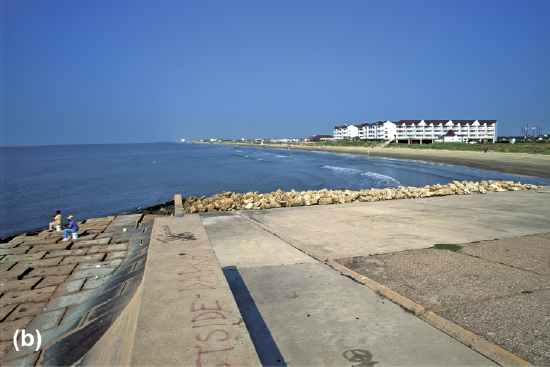
At many places on U.S. coasts, development has led to an endless cycle of efforts to arrest the natural landward retreat of barrier islands. Among the best known of the barrier islands are Miami Beach and Palm Beach in Florida, and Galveston and Corpus Christi in Texas. In Galveston, a seawall was constructed to protect houses that were rebuilt after a strong hurricane in 1900 (Fig. 11-23). However, during hurricane Ike in 2008, considerable areas of Galveston were flooded as ocean water flowed into the city mostly around the ends of the wall where the adjacent sections of the barrier island had already moved a considerable distance landward (Fig. 11-23b).


Corpus Christi has similar problems. Instead of building a seawall, the approach in Corpus Christi was to try to replenish the vanishing beach. Unfortunately, the sand used for replenishment had a larger grain size than the natural beach sand. As a result, the beach stabilized with a much steeper slope than it previously had, and thus it became more dangerous for people entering the water. In addition, beach replenishment must be repeated periodically and continued indefinitely if the beach is to be maintained. Meanwhile, the barrier island adjacent to the area where the beach is replenished continues to retreat, further increasing the exposure of Corpus Christi to ocean waves.
Both Galveston and Corpus Christi suffered flooding and considerable damage during hurricane Harvey in 2017.