

6.5: Depositional Environments
- Page ID
- 37102

\( \newcommand{\vecs}[1]{\overset { \scriptstyle \rightharpoonup} {\mathbf{#1}} } \)
\( \newcommand{\vecd}[1]{\overset{-\!-\!\rightharpoonup}{\vphantom{a}\smash {#1}}} \)
\( \newcommand{\dsum}{\displaystyle\sum\limits} \)
\( \newcommand{\dint}{\displaystyle\int\limits} \)
\( \newcommand{\dlim}{\displaystyle\lim\limits} \)
\( \newcommand{\id}{\mathrm{id}}\) \( \newcommand{\Span}{\mathrm{span}}\)
( \newcommand{\kernel}{\mathrm{null}\,}\) \( \newcommand{\range}{\mathrm{range}\,}\)
\( \newcommand{\RealPart}{\mathrm{Re}}\) \( \newcommand{\ImaginaryPart}{\mathrm{Im}}\)
\( \newcommand{\Argument}{\mathrm{Arg}}\) \( \newcommand{\norm}[1]{\| #1 \|}\)
\( \newcommand{\inner}[2]{\langle #1, #2 \rangle}\)
\( \newcommand{\Span}{\mathrm{span}}\)
\( \newcommand{\id}{\mathrm{id}}\)
\( \newcommand{\Span}{\mathrm{span}}\)
\( \newcommand{\kernel}{\mathrm{null}\,}\)
\( \newcommand{\range}{\mathrm{range}\,}\)
\( \newcommand{\RealPart}{\mathrm{Re}}\)
\( \newcommand{\ImaginaryPart}{\mathrm{Im}}\)
\( \newcommand{\Argument}{\mathrm{Arg}}\)
\( \newcommand{\norm}[1]{\| #1 \|}\)
\( \newcommand{\inner}[2]{\langle #1, #2 \rangle}\)
\( \newcommand{\Span}{\mathrm{span}}\) \( \newcommand{\AA}{\unicode[.8,0]{x212B}}\)
\( \newcommand{\vectorA}[1]{\vec{#1}} % arrow\)
\( \newcommand{\vectorAt}[1]{\vec{\text{#1}}} % arrow\)
\( \newcommand{\vectorB}[1]{\overset { \scriptstyle \rightharpoonup} {\mathbf{#1}} } \)
\( \newcommand{\vectorC}[1]{\textbf{#1}} \)
\( \newcommand{\vectorD}[1]{\overrightarrow{#1}} \)
\( \newcommand{\vectorDt}[1]{\overrightarrow{\text{#1}}} \)
\( \newcommand{\vectE}[1]{\overset{-\!-\!\rightharpoonup}{\vphantom{a}\smash{\mathbf {#1}}}} \)
\( \newcommand{\vecs}[1]{\overset { \scriptstyle \rightharpoonup} {\mathbf{#1}} } \)
\(\newcommand{\longvect}{\overrightarrow}\)
\( \newcommand{\vecd}[1]{\overset{-\!-\!\rightharpoonup}{\vphantom{a}\smash {#1}}} \)
\(\newcommand{\avec}{\mathbf a}\) \(\newcommand{\bvec}{\mathbf b}\) \(\newcommand{\cvec}{\mathbf c}\) \(\newcommand{\dvec}{\mathbf d}\) \(\newcommand{\dtil}{\widetilde{\mathbf d}}\) \(\newcommand{\evec}{\mathbf e}\) \(\newcommand{\fvec}{\mathbf f}\) \(\newcommand{\nvec}{\mathbf n}\) \(\newcommand{\pvec}{\mathbf p}\) \(\newcommand{\qvec}{\mathbf q}\) \(\newcommand{\svec}{\mathbf s}\) \(\newcommand{\tvec}{\mathbf t}\) \(\newcommand{\uvec}{\mathbf u}\) \(\newcommand{\vvec}{\mathbf v}\) \(\newcommand{\wvec}{\mathbf w}\) \(\newcommand{\xvec}{\mathbf x}\) \(\newcommand{\yvec}{\mathbf y}\) \(\newcommand{\zvec}{\mathbf z}\) \(\newcommand{\rvec}{\mathbf r}\) \(\newcommand{\mvec}{\mathbf m}\) \(\newcommand{\zerovec}{\mathbf 0}\) \(\newcommand{\onevec}{\mathbf 1}\) \(\newcommand{\real}{\mathbb R}\) \(\newcommand{\twovec}[2]{\left[\begin{array}{r}#1 \\ #2 \end{array}\right]}\) \(\newcommand{\ctwovec}[2]{\left[\begin{array}{c}#1 \\ #2 \end{array}\right]}\) \(\newcommand{\threevec}[3]{\left[\begin{array}{r}#1 \\ #2 \\ #3 \end{array}\right]}\) \(\newcommand{\cthreevec}[3]{\left[\begin{array}{c}#1 \\ #2 \\ #3 \end{array}\right]}\) \(\newcommand{\fourvec}[4]{\left[\begin{array}{r}#1 \\ #2 \\ #3 \\ #4 \end{array}\right]}\) \(\newcommand{\cfourvec}[4]{\left[\begin{array}{c}#1 \\ #2 \\ #3 \\ #4 \end{array}\right]}\) \(\newcommand{\fivevec}[5]{\left[\begin{array}{r}#1 \\ #2 \\ #3 \\ #4 \\ #5 \\ \end{array}\right]}\) \(\newcommand{\cfivevec}[5]{\left[\begin{array}{c}#1 \\ #2 \\ #3 \\ #4 \\ #5 \\ \end{array}\right]}\) \(\newcommand{\mattwo}[4]{\left[\begin{array}{rr}#1 \amp #2 \\ #3 \amp #4 \\ \end{array}\right]}\) \(\newcommand{\laspan}[1]{\text{Span}\{#1\}}\) \(\newcommand{\bcal}{\cal B}\) \(\newcommand{\ccal}{\cal C}\) \(\newcommand{\scal}{\cal S}\) \(\newcommand{\wcal}{\cal W}\) \(\newcommand{\ecal}{\cal E}\) \(\newcommand{\coords}[2]{\left\{#1\right\}_{#2}}\) \(\newcommand{\gray}[1]{\color{gray}{#1}}\) \(\newcommand{\lgray}[1]{\color{lightgray}{#1}}\) \(\newcommand{\rank}{\operatorname{rank}}\) \(\newcommand{\row}{\text{Row}}\) \(\newcommand{\col}{\text{Col}}\) \(\renewcommand{\row}{\text{Row}}\) \(\newcommand{\nul}{\text{Nul}}\) \(\newcommand{\var}{\text{Var}}\) \(\newcommand{\corr}{\text{corr}}\) \(\newcommand{\len}[1]{\left|#1\right|}\) \(\newcommand{\bbar}{\overline{\bvec}}\) \(\newcommand{\bhat}{\widehat{\bvec}}\) \(\newcommand{\bperp}{\bvec^\perp}\) \(\newcommand{\xhat}{\widehat{\xvec}}\) \(\newcommand{\vhat}{\widehat{\vvec}}\) \(\newcommand{\uhat}{\widehat{\uvec}}\) \(\newcommand{\what}{\widehat{\wvec}}\) \(\newcommand{\Sighat}{\widehat{\Sigma}}\) \(\newcommand{\lt}{<}\) \(\newcommand{\gt}{>}\) \(\newcommand{\amp}{&}\) \(\definecolor{fillinmathshade}{gray}{0.9}\)Sedimentary facies reflect the environment in which the sediments were deposited. Here are some commonly preserved sedimentary depositional environments, starting with terrestrial environments at the highest elevations on the continents, moving toward the coast, into marine environments of the continental shelf, and onto the abyssal plains. For each sedimentary environment, we'll highlight the facies characteristics that are most observable in hand samples: color and composition, texture, sedimentary structures, fossils, and any other distinctive characteristics.
Terrestrial/Continental Depositional Environments
Alpine Glaciers
When glaciers melt, they deposit their sediment load. Glacial sediment is called till.

- Color: variable depending on landscape
- Composition: lithics
- Texture: gravel to clay, poorly sorted, angular to subrounded
- Sedimentary structures: may see some asymmetric cross-bedding in association with outwash deposits
- Fossils: rare
- Other notes: till, moraine deposits
Alluvial Fan
Alluvial fans are hand-fan-shaped piles of alluvium (sediment deposited by streams) that form where streams exit their mountain channels. Common in arid environments with growing mountains.
 Figure \(\PageIndex{2}\): Alluvial fan in Death Valley, California, seen from source area of Black Mountains at Dante's View.
- Color: tan to pink-red
- Composition: primarily feldspars and lithics
- Texture: gravel to clay, poorly sorted, angular to subrounded
- Sedimentary structures: generally absent
- Fossils: rare
- Other notes: massive beds common from one flow
Braided Rivers
Braided rivers are characterized by lobe-shaped piles of alluvium across the stream's channel. These channel bars divert stream flow, causing the river to split into many intertwining channels.
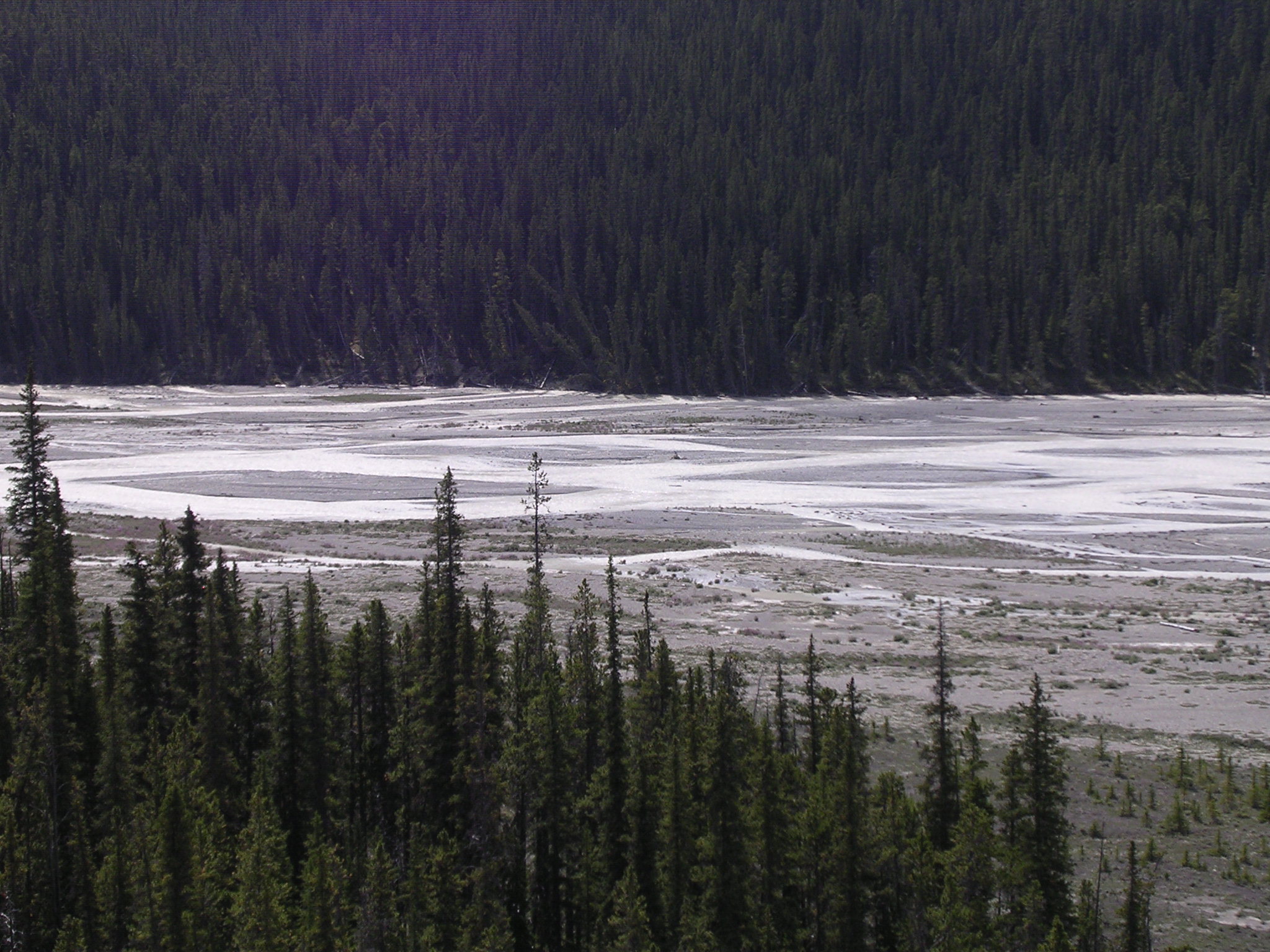
- Color: tan to gray
- Composition: primarily lithics, also quartz and feldspars
- Texture: gravel and sand, subangular to subrounded, poor to moderate sorting
- Sedimentary structures: asymmetric cross-beds
- Fossils: larger, robust fossils, commonly plants and vertebrates
- Other notes: gravel and sand bars (lenticular beds)
Meandering Rivers
A river with a single, sinuous channel characterized by large bends (meanders) that migrate laterally across the floodplain.

- Color: brown to reddish purple
- Composition: lithics and quartz
- Texture: sand to clay, subrounded, moderate sorting
- Sedimentary structures: unidirectional cross-beds, asymmetric ripples in channel; mudcracks, raindrop impressions on floodplain
- Fossils: terrestrial fish and other vertebrates, plants and roots
- Other notes: coarser sediment in the channel, finer-grained material in the floodplain (coarse lenses in finer sediments in outcrop scale)
Lakes/Lacustrine
A body of freshwater with little or no current.

- Color: gray to black
- Composition: siliciclastic minerals (quartz, clay minerals from weathering)
- Texture: clay to silt, well-sorted
- Sedimentary structures: laminations
- Fossils: fish, insects, plants leaves/flowers, pollen
- Other notes: some carbonate sediment may be possible (tufas)
Deserts/Aeolian
Landforms produced or transported by wind, such as sand dune deposits.

- Color: white to light pink or orange
- Composition: primarily quartz, hematite cements, evaporites
- Texture: sand, subrounded to rounded, well-sorted
- Sedimentary structures: large-scale asymmetrical ripples and cross-beds
- Fossils: vertebrates, some plants
- Other notes: sand grains may show some frosting from air abrasion
Transitional/Coastal Depositional Environments
Deltas
Wedge-shaped deposits of sediment formed at the mouth of a river where it enters a standing body of water, such as a lake or ocean.
 Figure \(\PageIndex{7}\): Yukon River Delta entering the Bering Sea, creating a lobe shaped protrusion formed from the sediments carried by the river. (Yukon Delta, Alaska by NASA Earth Observatory, CC BY 2.0)
- Color: brown to reddish purple
- Composition: lithics and quartz
- Texture:sand to clay, subrounded, moderate sorting
- Sedimentary structures: unidirectional cross-beds, asymmetric ripples in channel; mudcracks, raindrop impressions on floodplain
- Fossils: coastal plants (i.e. marsh grasses) and roots, marine fish, shells
- Other notes: coarser sediment in the channel, finer grained material in the floodplain, large foreset (incline beds) at outcrop scale
Beaches
Gently sloping shoreline environment composed of unconsolidated sediment (sand, gravel, or pebbles) shaped by waves, tides, and currents.

- Color: white to tan
- Composition: primarily quartz, heavy minerals OR calcite
- Texture: moderate to well sorted sand, subrounded to rounded, moderate to well-sorted
- Sedimentary structures: symmetrical ripples, bidirectional cross-beds
- Fossils: shells
- Other notes: may see abundant shells and ooids in carbonate settings
Tidal Flats
Low-lying coastal areas that are periodically flooded and exposed to tides; often composed of mud and sand.
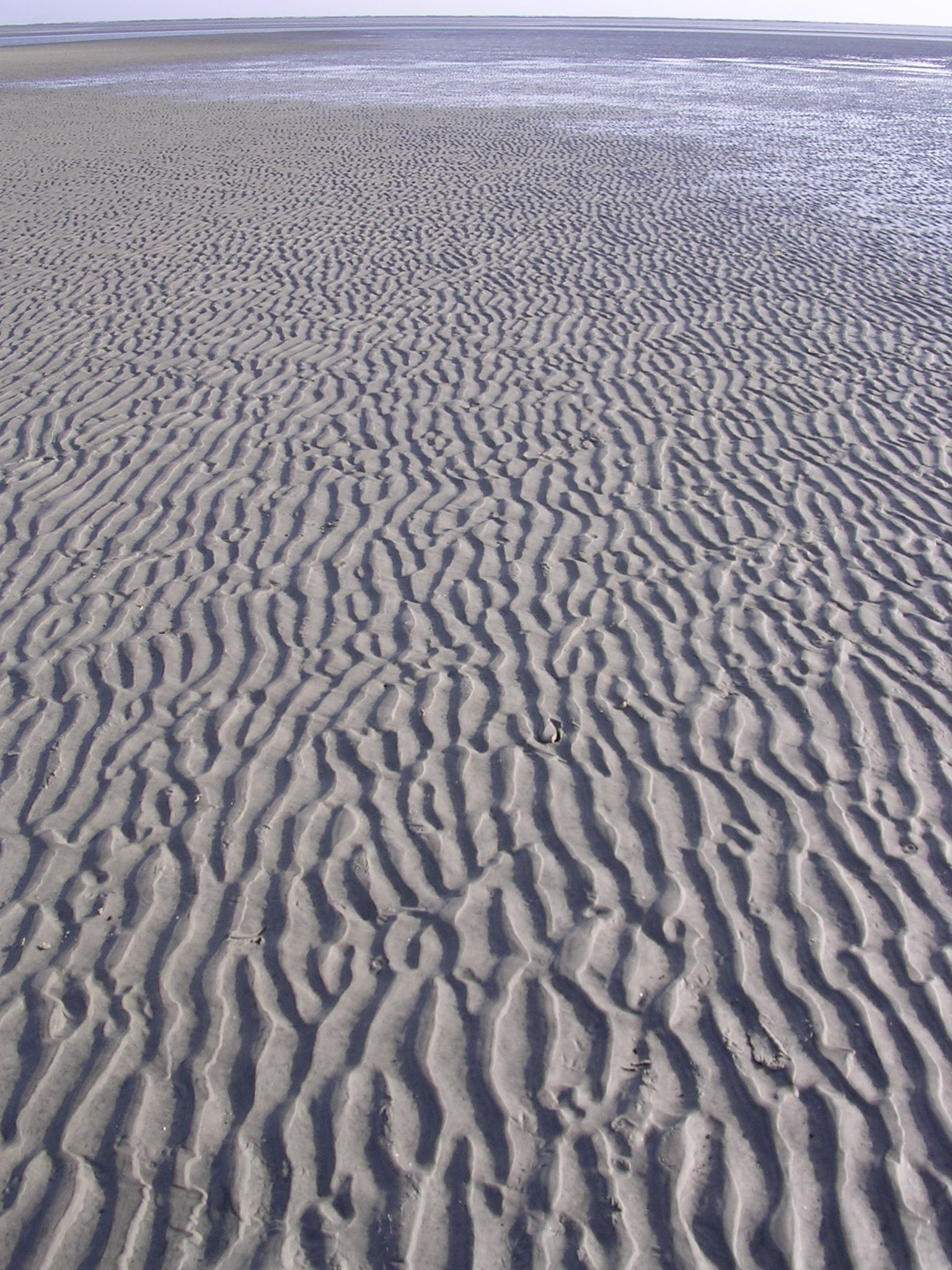
- Color: light gray to tan
- Composition: quartz and clay minerals OR calcite
- Texture: silt to clay, subrounded, well-sorted
- Sedimentary structures: mudcracks, symmetrical ripples
- Fossils: stromatolites, snails, crustaceans and burrows
- Other notes: may see laminations if burrows not present
Marine Depositional Environments
Shallow Subtidal (Upper Shoreface)
Shallow marine settings where sand to clay-sized terrestrial sediment along with biogeneous sediment is shaped by waves, tides, and currents.
 Figure \(\PageIndex{10}\): Symmetrical ripples in biogenic, aragonitic sands; shallow subtidal seafloor just offshore from Sand Dollar Beach, northwestern San Salvador Island, Bahamas. (Symmetrical ripples in biogenic, aragonitic sands 2 by James St. John, CC BY 2.0)
- Color: gray to tan
- Composition: quartz and clay minerals OR calcite
- Texture: subrounded sand, silt-clay, well-sorted
- Sedimentary structures: burrows, wave-formed ripples, crossbedding
- Fossils: wide variety of invertebrates, fish, reefs in carbonate marine settings
- Other notes: may produce massive beds due to bioturbation; area of shelf affected by fairweather waves
Deep Subtidal (Lower Shoreface)
A transition zone between the high-energy upper shoreface and low-energy offshore environments.
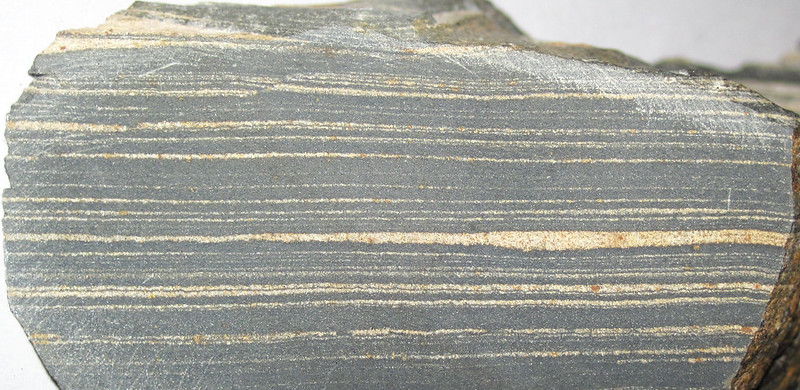 Figure \(\PageIndex{11}\): Laminated mudrock from the Kinzers Formation, Lower Cambrian, Pennsylvania. Well-preserved laminations indicate lack of post-depositional disturbance by burrowing organisms. (Laminated mudrock 2 by James St. John, CC BY 2.0)
- Color: dark gray to dark brown
- Composition: quartz and clay minerals OR calcite
- Texture: silt to clay
- Sedimentary structures: laminations, hummocky cross stratification
- Fossils: planktonic microfossils, ammonites, vertebrates
- Other notes: area of shelf below storm wavebase
Submarine Fan and Turbidites
Large, fan-shaped bodies of sediment deposited on the deep ocean floor by turbidity currents, usually at the base of continental slopes.
 Figure \(\PageIndex{12}\): A prominent submarine dune with large ripples, possible result of a turbidity current, Gulf of Mexico. (expn2486 by NOAA OKEANOS EXPLORER Program, Gulf of Mexico 2014 Expedition, CC BY 2.0)
- Color: dark gray
- Composition: quartz and clay minerals OR calcite
- Texture: silt to clay
- Sedimentary structures: Bouma sequences from turbidity currents
- Fossils: planktonic microfossils, ammonites, vertebrates
- Other notes: deposits will be thin as they are farther away (more distal) from sediment source
Abyssal plains
Vast, flat, and deep region of the ocean floor, typically found at depths of 3,000–6,000 meters, covered by fine-grained sediments.
 Figure \(\PageIndex{13}\): A pavement of manganese nodules on the deep sea floor; each nodule appears to be about 1 inch across (2.5 cm). Hawaii, West Northampton Seamount Ridge. (expn4910 by NOAA Office of Ocean Exploration and Research, 2015 Hohonu Moana, CC BY 2.0)
- Color: dark gray to black
- Composition: quartz (chert), calcite (chalk/micrite), clay minerals
- Texture: clay
- Sedimentary structures: laminations
- Fossils: planktonic microfossils, ammonites, vertebrates
- Other notes: deep sea sediments capping basalt of oceanic crust
- abyssal plain – the vast, flat, and deep region of the ocean floor, typically found at depths of 3,000–6,000 meters, covered by fine-grained sediments
- aeolian – refers to processes, sediments, or landforms produced or transported by wind, such as sand dunes deposits
- alluvial fan – a fan- or cone-shaped deposit of sediment that forms where a river or stream flows out of a mountainous area onto a flatter plain
- alpine glacier – a glacier that forms in mountainous regions and flows down valleys under the influence of gravity
- beach – a gently sloping shoreline environment composed of unconsolidated sediment (sand, gravel, or pebbles) shaped by waves, tides, and currents
- braided river – a river system with multiple intertwining channels separated by bars or islands of sediment, usually formed where sediment supply is high and water amount and velocity varies
- delta – a wedge-shaped deposit of sediment formed at the mouth of a river where it enters a standing body of water, such as a lake or ocean
- desert – a region that receives very little precipitation (typically less than 25 cm per year), characterized by sparse vegetation and dominance of wind and occasional water erosion
- lacustrine – pertaining to lakes; describes sediments, deposits, or environments associated with lake basins
- meandering river – a river with a single, sinuous channel characterized by large bends (meanders) that migrate laterally across the floodplain
- submarine fan – a large, fan-shaped body of sediment deposited on the deep ocean floor by turbidity currents, usually at the base of continental slopes
- tidal flat – a low-lying coastal area that is periodically flooded and exposed by tides, often composed of mud and sand
- turbidite – a sedimentary deposit formed by an underwater landslide, typically showing graded bedding with coarser material at the base and finer material at the top