

5.2: Metamorphic Rocks
- Page ID
- 33346
\( \newcommand{\vecs}[1]{\overset { \scriptstyle \rightharpoonup} {\mathbf{#1}} } \)
\( \newcommand{\vecd}[1]{\overset{-\!-\!\rightharpoonup}{\vphantom{a}\smash {#1}}} \)
\( \newcommand{\dsum}{\displaystyle\sum\limits} \)
\( \newcommand{\dint}{\displaystyle\int\limits} \)
\( \newcommand{\dlim}{\displaystyle\lim\limits} \)
\( \newcommand{\id}{\mathrm{id}}\) \( \newcommand{\Span}{\mathrm{span}}\)
( \newcommand{\kernel}{\mathrm{null}\,}\) \( \newcommand{\range}{\mathrm{range}\,}\)
\( \newcommand{\RealPart}{\mathrm{Re}}\) \( \newcommand{\ImaginaryPart}{\mathrm{Im}}\)
\( \newcommand{\Argument}{\mathrm{Arg}}\) \( \newcommand{\norm}[1]{\| #1 \|}\)
\( \newcommand{\inner}[2]{\langle #1, #2 \rangle}\)
\( \newcommand{\Span}{\mathrm{span}}\)
\( \newcommand{\id}{\mathrm{id}}\)
\( \newcommand{\Span}{\mathrm{span}}\)
\( \newcommand{\kernel}{\mathrm{null}\,}\)
\( \newcommand{\range}{\mathrm{range}\,}\)
\( \newcommand{\RealPart}{\mathrm{Re}}\)
\( \newcommand{\ImaginaryPart}{\mathrm{Im}}\)
\( \newcommand{\Argument}{\mathrm{Arg}}\)
\( \newcommand{\norm}[1]{\| #1 \|}\)
\( \newcommand{\inner}[2]{\langle #1, #2 \rangle}\)
\( \newcommand{\Span}{\mathrm{span}}\) \( \newcommand{\AA}{\unicode[.8,0]{x212B}}\)
\( \newcommand{\vectorA}[1]{\vec{#1}} % arrow\)
\( \newcommand{\vectorAt}[1]{\vec{\text{#1}}} % arrow\)
\( \newcommand{\vectorB}[1]{\overset { \scriptstyle \rightharpoonup} {\mathbf{#1}} } \)
\( \newcommand{\vectorC}[1]{\textbf{#1}} \)
\( \newcommand{\vectorD}[1]{\overrightarrow{#1}} \)
\( \newcommand{\vectorDt}[1]{\overrightarrow{\text{#1}}} \)
\( \newcommand{\vectE}[1]{\overset{-\!-\!\rightharpoonup}{\vphantom{a}\smash{\mathbf {#1}}}} \)
\( \newcommand{\vecs}[1]{\overset { \scriptstyle \rightharpoonup} {\mathbf{#1}} } \)
\(\newcommand{\longvect}{\overrightarrow}\)
\( \newcommand{\vecd}[1]{\overset{-\!-\!\rightharpoonup}{\vphantom{a}\smash {#1}}} \)
\(\newcommand{\avec}{\mathbf a}\) \(\newcommand{\bvec}{\mathbf b}\) \(\newcommand{\cvec}{\mathbf c}\) \(\newcommand{\dvec}{\mathbf d}\) \(\newcommand{\dtil}{\widetilde{\mathbf d}}\) \(\newcommand{\evec}{\mathbf e}\) \(\newcommand{\fvec}{\mathbf f}\) \(\newcommand{\nvec}{\mathbf n}\) \(\newcommand{\pvec}{\mathbf p}\) \(\newcommand{\qvec}{\mathbf q}\) \(\newcommand{\svec}{\mathbf s}\) \(\newcommand{\tvec}{\mathbf t}\) \(\newcommand{\uvec}{\mathbf u}\) \(\newcommand{\vvec}{\mathbf v}\) \(\newcommand{\wvec}{\mathbf w}\) \(\newcommand{\xvec}{\mathbf x}\) \(\newcommand{\yvec}{\mathbf y}\) \(\newcommand{\zvec}{\mathbf z}\) \(\newcommand{\rvec}{\mathbf r}\) \(\newcommand{\mvec}{\mathbf m}\) \(\newcommand{\zerovec}{\mathbf 0}\) \(\newcommand{\onevec}{\mathbf 1}\) \(\newcommand{\real}{\mathbb R}\) \(\newcommand{\twovec}[2]{\left[\begin{array}{r}#1 \\ #2 \end{array}\right]}\) \(\newcommand{\ctwovec}[2]{\left[\begin{array}{c}#1 \\ #2 \end{array}\right]}\) \(\newcommand{\threevec}[3]{\left[\begin{array}{r}#1 \\ #2 \\ #3 \end{array}\right]}\) \(\newcommand{\cthreevec}[3]{\left[\begin{array}{c}#1 \\ #2 \\ #3 \end{array}\right]}\) \(\newcommand{\fourvec}[4]{\left[\begin{array}{r}#1 \\ #2 \\ #3 \\ #4 \end{array}\right]}\) \(\newcommand{\cfourvec}[4]{\left[\begin{array}{c}#1 \\ #2 \\ #3 \\ #4 \end{array}\right]}\) \(\newcommand{\fivevec}[5]{\left[\begin{array}{r}#1 \\ #2 \\ #3 \\ #4 \\ #5 \\ \end{array}\right]}\) \(\newcommand{\cfivevec}[5]{\left[\begin{array}{c}#1 \\ #2 \\ #3 \\ #4 \\ #5 \\ \end{array}\right]}\) \(\newcommand{\mattwo}[4]{\left[\begin{array}{rr}#1 \amp #2 \\ #3 \amp #4 \\ \end{array}\right]}\) \(\newcommand{\laspan}[1]{\text{Span}\{#1\}}\) \(\newcommand{\bcal}{\cal B}\) \(\newcommand{\ccal}{\cal C}\) \(\newcommand{\scal}{\cal S}\) \(\newcommand{\wcal}{\cal W}\) \(\newcommand{\ecal}{\cal E}\) \(\newcommand{\coords}[2]{\left\{#1\right\}_{#2}}\) \(\newcommand{\gray}[1]{\color{gray}{#1}}\) \(\newcommand{\lgray}[1]{\color{lightgray}{#1}}\) \(\newcommand{\rank}{\operatorname{rank}}\) \(\newcommand{\row}{\text{Row}}\) \(\newcommand{\col}{\text{Col}}\) \(\renewcommand{\row}{\text{Row}}\) \(\newcommand{\nul}{\text{Nul}}\) \(\newcommand{\var}{\text{Var}}\) \(\newcommand{\corr}{\text{corr}}\) \(\newcommand{\len}[1]{\left|#1\right|}\) \(\newcommand{\bbar}{\overline{\bvec}}\) \(\newcommand{\bhat}{\widehat{\bvec}}\) \(\newcommand{\bperp}{\bvec^\perp}\) \(\newcommand{\xhat}{\widehat{\xvec}}\) \(\newcommand{\vhat}{\widehat{\vvec}}\) \(\newcommand{\uhat}{\widehat{\uvec}}\) \(\newcommand{\what}{\widehat{\wvec}}\) \(\newcommand{\Sighat}{\widehat{\Sigma}}\) \(\newcommand{\lt}{<}\) \(\newcommand{\gt}{>}\) \(\newcommand{\amp}{&}\) \(\definecolor{fillinmathshade}{gray}{0.9}\)Defined
Metamorphic rocks form when one rock changes, or "morphs", into another rock without going through the melt phase but instead through the recrystallization of minerals. This occurs when a body of rock is subjected to conditions that are different from those in which it formed. We call this process, metamorphism.
In most cases this involves the rock being deeply buried beneath other rocks, where it is subjected to higher temperatures and pressures and no longer in equilibrium as it was in its original environment of formation. Metamorphism typically includes the recrystallization of minerals plus the formation of new minerals and different textures though often retaining the same overall chemical composition of the parent, or source rock. This parent rock is referred to as the protolith, from the Greek proto- meaning first, and lithos- meaning rock.
Most metamorphism is the result of tectonic forces during mountain building (orogenic) episodes. Plate collisions, especially continent to continent collisions, introduce tremendous stress and heat, take place over vast areas and last millions of years. These are the primary factors, or conditions needed to allow the dramatic changes to occur from protolith to metamorphic rock product.
Types of Metamorphism
There are two primary environments that produce metamorphism that are important in geology:
Regional metamorphism occurs over a wide expanse of the crust, hundreds to more than a thousand kilometers across, resulting from the collision and compression of tectonic plates. Regional metamorphism can affect the pre-existing rock of the continental crust, any oceanic crust caught in the collision, plus the sedimentary rock cover that exists on each. Regional metamorphic processes can also affect the entire thickness of the lithosphere (crust and upper mantle) and produce tremendous change in the pre-existing rock occurring tens of kilometers to several hundred kilometers deep.
Contact metamorphism is much simpler and affects pre-existing rock by baking them through contact with molten rock material either by intrusion of magma or extrusion of lava on the surface. Intrusion can occur very deep in the crust and involve large areas affected by heat associated with vast magma chambers. Intrusion can also be much smaller and take place closer to the surface and result in the baking of the surface rock through the volcanic eruption of lava.

Metamorphic Processes
The main factors that control metamorphic change of pre-existing rock include:
- the mineral composition of the protolith (parent rock),
- the temperature at which metamorphism takes place,
- the amount and type of pressure during metamorphism,
- the types of fluids (mostly water) that are present during metamorphism, and
- the amount of time available for metamorphism.
Protolith (Parent Rock)
The protolith can be any type of rock including pre-existing metamorphic rock. The critical component of the parent rock is its mineral composition because it is the stability of each mineral that matters when metamorphism takes place. In other words, when a rock is subjected to increased temperatures, certain minerals may become unstable and begin to recrystallize in size, orientation, or into completely new minerals.
Temperature
As we learned in the previous discussions of Bowen’s Reaction Series, minerals gain stability as temperature cools. Minerals remain stable over a specific range of temperature. For example, quartz is stable under all surface environmental temperatures will remain stable all the way up to about 1800 \(^{\circ}\)C. On the other hand, most clay minerals are only stable up to about 150\(^{\circ}\) or 200 \(^{\circ}\)C; above that, they transform into micas. Feldspar, the most common mineral of the crust, is stable up to approximately 1200 \(^{\circ}\)C.
Pressure
Pressure is the force exerted on the protolith by burial and/or tectonic stresses. Like heat, pressure can affect the chemical equilibrium of minerals in a rock. The pressure that affects metamorphic rocks can be grouped into confining pressure or stress and directed stress. Stress is a scientific term indicating a force. Strain is the result of this stress, including metamorphic changes within minerals.
Confining Pressure
Pressure exerted on rocks under the surface is due to the simple fact that rocks lie on top of one another. When pressure is exerted from rocks above, it is balanced from below and sides, and is called confining pressure. Confining pressure results in equal pressure on all sides (see figure below) and is responsible for causing chemical reactions to occur just like heat. These chemical reactions will cause new minerals to form.

Differential Stress
Differential stress is an unequal balance of forces on the protolith in one or more directions (see figure above). Differential stress is most commonly associated with the tectonic movement of plates during mountain building. Differential stress modifies the parent rock at a mechanical level, changing the arrangement, size, and/or shape of the mineral crystals. This creates an identifying texture, known as foliation, which is the repetitive layering found in metamorphic rock. Sometimes foliation results in the banding you see in the figure below. Sometimes it is more subtle and results in the rock breaking into flat sheets as you will see further below.

Recrystallization can also lead to minerals increasing in grain size as atoms migrate from an area of rock experiencing high stress and precipitate or regrow in a location having lower stress. You can visualize this similar to the phenomenon that occurs with small, adjacent soap bubbles coalesce to form larger ones. A good example of this would be the recrystallization of calcite that occurs in the metamorphism of limestone to marble (below).
Fluids
Water is the main fluid present within rocks of the crust. Water facilitates the movement of ions within the protolith being subjected to metamorphic conditions. Water assists in metamorphic mineral growth and also acts as a catalyst that can increase the rate at which metamorphic reactions take place.
Time
Most metamorphic reactions take place at very slow rates. For example, the growth of new minerals within a rock during metamorphism has been estimated to be about 1 millimeter per million years. For this reason, it is very difficult to study metamorphic processes in a lab.
While the rate of metamorphism is slow, the tectonic processes that lead to metamorphism are also very slow, so in most cases, the chance for metamorphic reactions to be completed is high. A mountain range takes tens of millions of years to form, and tens to hundreds of millions of years to be eroded to the extent that we can see the rocks that were metamorphosed within the deep interior.
Classification of Metamorphic Rocks
Metamorphic rocks are classified based on two characteristics: texture and composition. Texture is the first characteristic observed in the identification process. There are two main types of metamorphic rocks, differentiated by texture:
Foliated: formed in an environment subjected to differential stress resulting in a distinct alignment of minerals. Foliated metamorphic rocks are named based on the style of their foliations. Each rock name has a specific texture that defines and distinguishes it. Simply put, it shows a preferred orientation.
Non-foliated: either not subjected to directed pressure or, the dominant mineral does not tend to display any alignment. Simply put, it does not show a preferred orientation.
Foliated Metamorphic Rocks

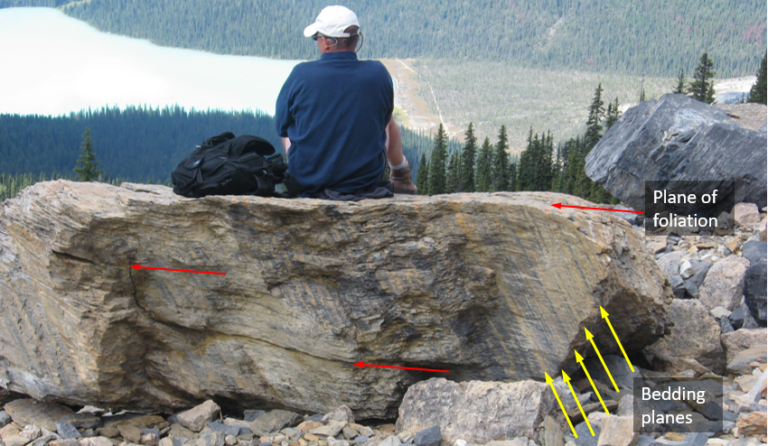
Slate is a fine-grained metamorphic rock that exhibits a foliation called slaty cleavage that is the flat orientation of the small platy crystals of mica and chlorite recrystallized perpendicular to the direction of stress. The minerals in slate are too small to see with the unaided eye. The thin layers in slate may resemble sedimentary bedding, but they are a result of differential stress and may lie at angles to the original strata (see photo immediately above). In fact, original sedimentary layering may be partially or completely obscured by the foliation. The protolith for slate was a shale-type sedimentary rock composed of clay. Slate represents low-grade (or a small amount of) metamorphism.
Phyllite is also a fine-grained foliated metamorphic rock in which the platy chlorite and mica minerals have grown larger and the surface of the foliation shows a sheen from light reflecting from the grains. The texture is “phylittic” where we can detect an increase in size of the minerals over slate however the individual minerals are still too small to be differentiated with the naked eye.
Schist is a metamorphic that displays a “schistose” foliation in which the minerals are now visible as individual crystals. Common minerals are muscovite, biotite, and porphyroblasts of garnets. A porphyroblast is a large crystal of a particular mineral surrounded by small grains. Varieties of schist are named for their dominant minerals such as mica schist (mostly micas like biotite and muscovite) or garnet mica schist (mica schist with garnets).
Gneiss is a metamorphic rock with mineral banding that produces a “gneissic” foliation in which visible silicate minerals separate into dark and light bands. The mineral grains tend to be coarse and the bands are often folded due to the extreme pressure and temperature conditions at which this type of metamorphic rock forms. Some gneisses may be subjected to temperatures at which partial melting can occur. This partially melted rock is a transition between metamorphic and igneous rocks called a migmatite. The melting will affect the minerals in the gneiss formed at the lowest temperatures on Bowen’s Reaction Series (quartz and potassium feldspar) and will collect in small lenses or pockets within the migmatite.
Non-foliated Metamorphic Rocks
Non-foliated textures do not display alignment of mineral grains. Non-foliated metamorphic rocks are typically composed of just one mineral, and therefore, usually show the effects of metamorphism with recrystallization in which crystals grow together, but with no preferred direction. The two most common examples of non-foliated rocks are quartzite and marble.
Quartzite and Marble
Marble and quartzite often look similar however there are simple tests that can distinguish the two. First, the quartz minerals that compose the quartzite are considerably harder than the calcite that composes the marble. A simple hardness test on a piece of glass will show that quartz will scratch the glass, however calcite will not. Another way to easily distinguish quartzite from marble is with a drop of dilute hydrochloric acid. Marble will effervesce (fizz) because it is made of calcite. Remember to scratch the sample to make a little powder and then use a drop of hydrochloric acid to test. It will slowly effervesce if it is a dolomite marble.
Other Non-foliated Rocks
Amphibolite is the result of metamorphism of a mafic igneous protolith. This may have originally been basalt or gabbro with olivine, pyroxene (augite) and calcium-rich plagioclase. The dominant mineral now is amphibole (hornblende). Zoom in on this sample and you will also see the green clay mineral chlorite.
Greenstone is a fine grained metamorphic rock that is largely composed of the green chlorite mineral plus other typically green metamorphic minerals, epidote and serpentine. The protolith of a greenstone is most commonly the mafic igneous rock, basalt. The original fine grained, iron and magnesium rich, minerals of olivine and pyroxene have recrystallized through metamorphic processes to form the greenstone rock. Greenstone is very important to Historical Geology, preserving some of the oldest slivers of early ocean crust. This is discussed in much more detail elsewhere in this text. The photo on the left, below is a hand sample of greenstone taken from the outcrop location on the right. Zoom into the sample on the left to see the fine-grained green minerals. Zoom into the photo on the right to get a feel for the metamorphic fabric and overall green color of the rock.
Metamorphic Rock Identification Chart
| 1. Identify Rock's Foliation | 1. Identify Rock's Foliation | 2. Textural Features | 3. Mineral Composition | 4. Rock Name | 5. Parent Rock |
|---|---|---|---|---|---|
|
FOLIATED layered texture |
Fine-grained or no visible grains |
Flat, slaty cleavage is well developed. Dense, microscopic grains, may exhibit slight sheen (or dull luster). Clanky sound when struck. Breaks into hard, flat sheets. |
Fine, microscopic clay or mica. |
SLATE |
Shale |
|
Finely crystalline; micas hardly discernible, but impart a sheen or luster. Breaks along wavy surfaces. |
Dark silicates and micas. |
PHYLLITE |
Siltstone or shale |
||
| Medium- to coarse-grained |
Schistose texture. Foliation formed by alignment of visible crystals. Rock breaks along scaly foliation surfaces. Medium to fine-grained. Sparkling appearance. |
Common minerals include chlorite, biotite, muscovite, garnet and hornblende. Recognizable minerals used as part of rock name. Porphyroblasts common. |
MICA SCHIST GARNET SCHIST |
Siltstone or shale |
|
|
Gneissic banding. Coarse-grained. Foliation present as minerals arranged into alternating light and dark layers giving the rock a banded texture in side view. Crystalline texture. No cleavage. |
Light-colored quartz and feldspar; dark ferromagnesian minerals. |
GNEISS |
Shale or granitic rocks | ||
|
NON-FOLIATED no layered texture |
Fine-grained or no visible grains |
Medium- to coarse-grained crystalline texture. |
Crystals of amphibole (hornblende) in blade-like crystals. |
AMPHIBOLITE |
Basalt, gabbro, or ultramafic igneous rocks |
|
Microcrystalline texture. Glassy black sheen. Conchoidal fracture. Low density. |
Fine, tar-like, organic makeup. |
ANTHRACITE COAL |
Coal |
||
|
Dense and dark-colored. Fine or microcrystalline texture. Very hard. Color can range from gray, gray-green to black. |
Microscopic dark silicates. |
HORNFELS |
Many rock types |
||
|
Microcrystalline or no visible grains with smooth, wavy surfaces. May be dull or glossy. Usually shades of green. |
Serpentine. May have fibrous asbestos visible. |
SERPENTINITE |
Ultramafic igneous rocks or peridotite |
||
| Fine- to coarse-grained |
Microcrystalline or no visible grains. Can be scratched with a fingernail. Shades of green, gray, brown or white. Soapy feel. |
Talc. |
SOAPSTONE OR TALC SCHIST |
Ultramafic igneous rocks |
|
|
Crystalline. Hard (scratches glass). Breaks across grains. Sandy or sugary texture. Color variable; can be white, pink, buff, brown, red, purple. |
Quartz grains fused together. Grains will not rub off like sandstone. |
QUARTZITE |
Quartz sandstone |
||
|
Finely crystalline (resembling a sugar cube) to medium or coarse texture. Color variable; white, pink, gray, among others. Fossils in some varieties. |
Calcite or dolomite crystals tightly fused together. Calcite effervesces with HCl; dolomite effervesces only when powdered. |
MARBLE |
Limestone or dolostone |
||
|
Texture of conglomerate, but breaks across clasts as easily as around them. Pebbles may be stretched (lineated) or cut by rock cleavage |
Granules or pebbles are commonly granitic or jasper, chert, quartz or quartzite. |
META-CONGLOMERATE |
Conglomerate |
- amphibolite - non-foliated metamorphic rock made of amphibole (hornblende) formed from a mafic igneous protolith
- confining pressure - pressure coming from all directions equally
- contact metamorphism - metamorphism that occurs in rock exposed to high temperatures resulting from the proximity to a magma body or lava flow
- differential stress - an unequal balance of forces in one or more directions
- foliated/foliation - the characteristic of a metamorphic rock by which there is a distinct alignment of minerals
- gneiss - a foliated metamorphic rock having minerals separated into light and dark bands
- greenstone - non-foliated metamorphic rock made of chlorite formed from a basalt protolith
- marble - non-foliated metamorphic rock made of calcite or dolomite formed as limestone was metamorphosed
- metamorphic rock - rock formed when elevated temperatures and pressures cause minerals to change into new minerals without going through the melting phase
- migmatite - a metamorphic rock that is partially melted showing the transition from metamorphic and igneous activity
- non-foliated - the characteristic of a metamorphic rock by which there is no alignment of minerals
- phyllite - a fine-grained foliated metamorphic rock in which the platy chlorite and mica minerals have grown larger and the surface of the foliation shows a sheen from light reflecting from the grains
- porphyroblast - a large crystal of a particular mineral in a metamorphic rock surrounded by small grains
- protolith - the parent rock or the rock from which the metamorphic rock forms
- quartzite - non-foliated metamorphic rock made of quartz formed as quartz sandstone was metamorphosed
- regional metamorphism - metamorphism that occurs over a wide area resulting from the collision and compression of tectonic plates
- schist - a foliated metamorphic rock where minerals are aligned and visible as individual crystals
- slate - a fine-grained foliated metamorphic rock which breaks into flat sheets
- strain - the changes in a object that occur as a result of the stress applied
- stress - force applied to an object