

1: What is Historical Geology?
- Page ID
- 33092

\( \newcommand{\vecs}[1]{\overset { \scriptstyle \rightharpoonup} {\mathbf{#1}} } \)
\( \newcommand{\vecd}[1]{\overset{-\!-\!\rightharpoonup}{\vphantom{a}\smash {#1}}} \)
\( \newcommand{\dsum}{\displaystyle\sum\limits} \)
\( \newcommand{\dint}{\displaystyle\int\limits} \)
\( \newcommand{\dlim}{\displaystyle\lim\limits} \)
\( \newcommand{\id}{\mathrm{id}}\) \( \newcommand{\Span}{\mathrm{span}}\)
( \newcommand{\kernel}{\mathrm{null}\,}\) \( \newcommand{\range}{\mathrm{range}\,}\)
\( \newcommand{\RealPart}{\mathrm{Re}}\) \( \newcommand{\ImaginaryPart}{\mathrm{Im}}\)
\( \newcommand{\Argument}{\mathrm{Arg}}\) \( \newcommand{\norm}[1]{\| #1 \|}\)
\( \newcommand{\inner}[2]{\langle #1, #2 \rangle}\)
\( \newcommand{\Span}{\mathrm{span}}\)
\( \newcommand{\id}{\mathrm{id}}\)
\( \newcommand{\Span}{\mathrm{span}}\)
\( \newcommand{\kernel}{\mathrm{null}\,}\)
\( \newcommand{\range}{\mathrm{range}\,}\)
\( \newcommand{\RealPart}{\mathrm{Re}}\)
\( \newcommand{\ImaginaryPart}{\mathrm{Im}}\)
\( \newcommand{\Argument}{\mathrm{Arg}}\)
\( \newcommand{\norm}[1]{\| #1 \|}\)
\( \newcommand{\inner}[2]{\langle #1, #2 \rangle}\)
\( \newcommand{\Span}{\mathrm{span}}\) \( \newcommand{\AA}{\unicode[.8,0]{x212B}}\)
\( \newcommand{\vectorA}[1]{\vec{#1}} % arrow\)
\( \newcommand{\vectorAt}[1]{\vec{\text{#1}}} % arrow\)
\( \newcommand{\vectorB}[1]{\overset { \scriptstyle \rightharpoonup} {\mathbf{#1}} } \)
\( \newcommand{\vectorC}[1]{\textbf{#1}} \)
\( \newcommand{\vectorD}[1]{\overrightarrow{#1}} \)
\( \newcommand{\vectorDt}[1]{\overrightarrow{\text{#1}}} \)
\( \newcommand{\vectE}[1]{\overset{-\!-\!\rightharpoonup}{\vphantom{a}\smash{\mathbf {#1}}}} \)
\( \newcommand{\vecs}[1]{\overset { \scriptstyle \rightharpoonup} {\mathbf{#1}} } \)
\(\newcommand{\longvect}{\overrightarrow}\)
\( \newcommand{\vecd}[1]{\overset{-\!-\!\rightharpoonup}{\vphantom{a}\smash {#1}}} \)
\(\newcommand{\avec}{\mathbf a}\) \(\newcommand{\bvec}{\mathbf b}\) \(\newcommand{\cvec}{\mathbf c}\) \(\newcommand{\dvec}{\mathbf d}\) \(\newcommand{\dtil}{\widetilde{\mathbf d}}\) \(\newcommand{\evec}{\mathbf e}\) \(\newcommand{\fvec}{\mathbf f}\) \(\newcommand{\nvec}{\mathbf n}\) \(\newcommand{\pvec}{\mathbf p}\) \(\newcommand{\qvec}{\mathbf q}\) \(\newcommand{\svec}{\mathbf s}\) \(\newcommand{\tvec}{\mathbf t}\) \(\newcommand{\uvec}{\mathbf u}\) \(\newcommand{\vvec}{\mathbf v}\) \(\newcommand{\wvec}{\mathbf w}\) \(\newcommand{\xvec}{\mathbf x}\) \(\newcommand{\yvec}{\mathbf y}\) \(\newcommand{\zvec}{\mathbf z}\) \(\newcommand{\rvec}{\mathbf r}\) \(\newcommand{\mvec}{\mathbf m}\) \(\newcommand{\zerovec}{\mathbf 0}\) \(\newcommand{\onevec}{\mathbf 1}\) \(\newcommand{\real}{\mathbb R}\) \(\newcommand{\twovec}[2]{\left[\begin{array}{r}#1 \\ #2 \end{array}\right]}\) \(\newcommand{\ctwovec}[2]{\left[\begin{array}{c}#1 \\ #2 \end{array}\right]}\) \(\newcommand{\threevec}[3]{\left[\begin{array}{r}#1 \\ #2 \\ #3 \end{array}\right]}\) \(\newcommand{\cthreevec}[3]{\left[\begin{array}{c}#1 \\ #2 \\ #3 \end{array}\right]}\) \(\newcommand{\fourvec}[4]{\left[\begin{array}{r}#1 \\ #2 \\ #3 \\ #4 \end{array}\right]}\) \(\newcommand{\cfourvec}[4]{\left[\begin{array}{c}#1 \\ #2 \\ #3 \\ #4 \end{array}\right]}\) \(\newcommand{\fivevec}[5]{\left[\begin{array}{r}#1 \\ #2 \\ #3 \\ #4 \\ #5 \\ \end{array}\right]}\) \(\newcommand{\cfivevec}[5]{\left[\begin{array}{c}#1 \\ #2 \\ #3 \\ #4 \\ #5 \\ \end{array}\right]}\) \(\newcommand{\mattwo}[4]{\left[\begin{array}{rr}#1 \amp #2 \\ #3 \amp #4 \\ \end{array}\right]}\) \(\newcommand{\laspan}[1]{\text{Span}\{#1\}}\) \(\newcommand{\bcal}{\cal B}\) \(\newcommand{\ccal}{\cal C}\) \(\newcommand{\scal}{\cal S}\) \(\newcommand{\wcal}{\cal W}\) \(\newcommand{\ecal}{\cal E}\) \(\newcommand{\coords}[2]{\left\{#1\right\}_{#2}}\) \(\newcommand{\gray}[1]{\color{gray}{#1}}\) \(\newcommand{\lgray}[1]{\color{lightgray}{#1}}\) \(\newcommand{\rank}{\operatorname{rank}}\) \(\newcommand{\row}{\text{Row}}\) \(\newcommand{\col}{\text{Col}}\) \(\renewcommand{\row}{\text{Row}}\) \(\newcommand{\nul}{\text{Nul}}\) \(\newcommand{\var}{\text{Var}}\) \(\newcommand{\corr}{\text{corr}}\) \(\newcommand{\len}[1]{\left|#1\right|}\) \(\newcommand{\bbar}{\overline{\bvec}}\) \(\newcommand{\bhat}{\widehat{\bvec}}\) \(\newcommand{\bperp}{\bvec^\perp}\) \(\newcommand{\xhat}{\widehat{\xvec}}\) \(\newcommand{\vhat}{\widehat{\vvec}}\) \(\newcommand{\uhat}{\widehat{\uvec}}\) \(\newcommand{\what}{\widehat{\wvec}}\) \(\newcommand{\Sighat}{\widehat{\Sigma}}\) \(\newcommand{\lt}{<}\) \(\newcommand{\gt}{>}\) \(\newcommand{\amp}{&}\) \(\definecolor{fillinmathshade}{gray}{0.9}\)Introduction
Historical geology seeks to tell the story of the earth. Recall some of your favorite stories. They may have been told through a movie, a show, a book, or by a person.
The planet you live on has some stories to tell. Earth has had 4.55 billion years to rack up experiences that range from ordinary to unimaginably violent. Through a variety of rock-forming processes, Earth has written her autobiography. Historical Geology is the science of reading that autobiography. But to read it, we first need to learn the language in which it is recorded. We must learn to “speak Rock.”
Stories from Stone
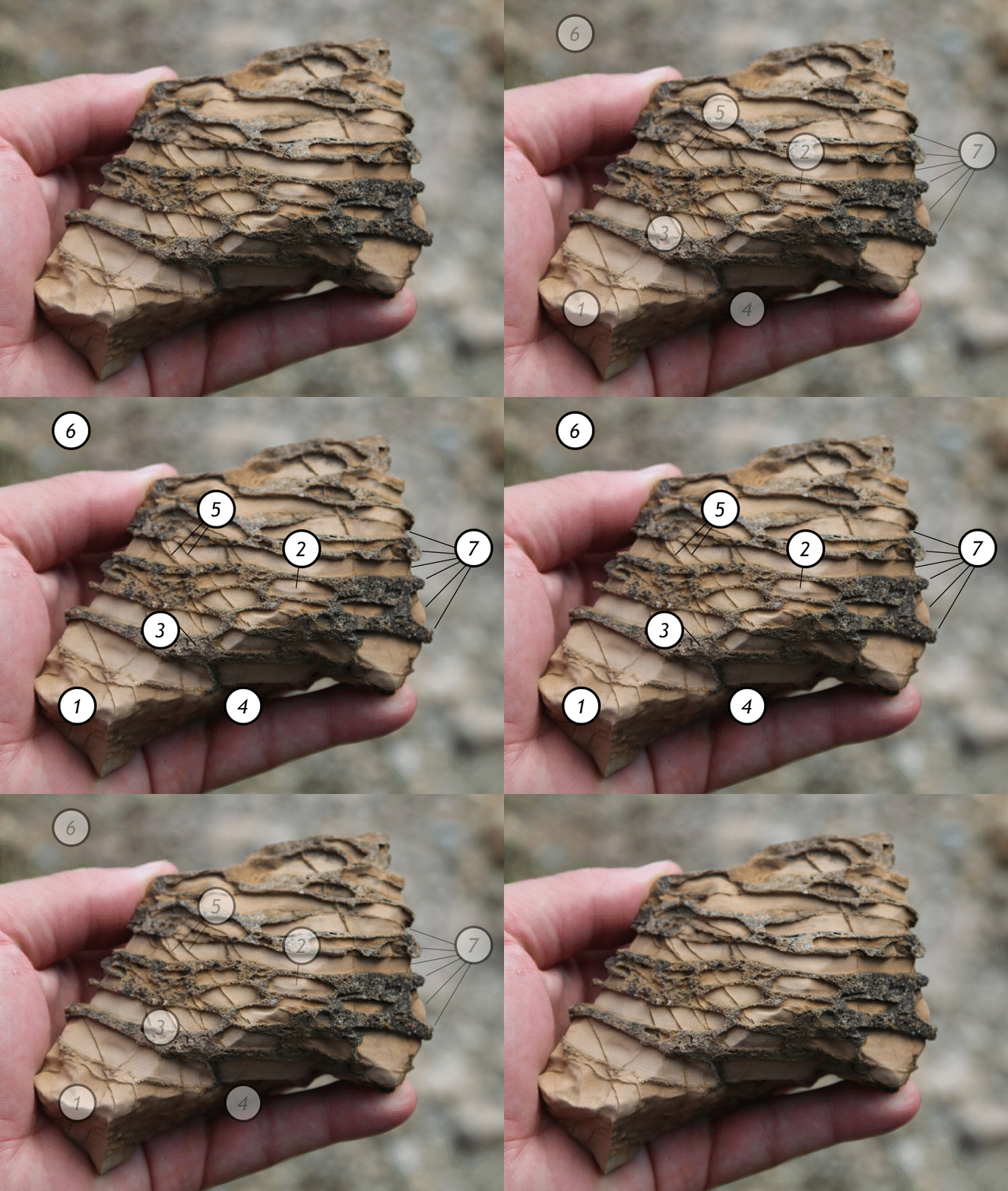
Earth has written countless stories in the language of Rock. This cobble from Montana provides a great example.

The texture of this rock contains features we can translate into information. The variety of materials it is made from, how those materials are arranged, other features that cut across them, and the shape of the sample all convey information about past processes and circumstances. What would it take to make a rock just like this one? Why does it exist in this particular way?
As an exercise in practicing decoding Rock, let’s translate: The smooth tan material is limestone. It initially formed as inorganic carbonate mud, laid down (1) in calm water, as evidenced by its very fine grain size. It sat still long enough to stick together into a semi-coherent mass. But then it must have been torn up to make (2) mud-chip pieces entombed in (3) quartz sand. The event was energetic enough to rip up the carbonate mud and transport coarse sand particles. Perhaps a hurricane provided the energy. Eventually, the sediment was buried and sank further underground, smothered beneath the crushing weight of thousands of feet of sediment piled atop it and was (4) lithified into rock: No longer loose sediment, it was transformed through compaction and cementation into solid, coherent rock: limestone clasts in quartz sandstone. After it was solid rock, it broke. Some stress, perhaps imparted by the wrenching compression of mountain building, snapped the bonds holding the rock together. This made fractures, but those fractures were soon healed by the precipitation of the mineral quartz, making (5) thin quartz veins. This is something that must have taken place deep underground, but for us to pick it up and hold it, we know it must have been (6) uplifted and brought up to Earth’s surface; this particular chunk was broken off from its source outcrop. Finally, it experienced (7) differential weathering, etching away the limestone more readily than the quartz sandstone. This gives the sample its distinctive texture.
The rock is no longer just a rock. By speaking its language, we have turned it into a book, with seven chapters.
This is the power of Historical Geology: it allows curious humans to interact with inert rock, and coax stories from that rock — vital tales of the planet’s ancient past. Being able to decode the stories of rocks, hidden in plain sight, is an ability akin to an acquired superpower. As Spiderman gained his powers after being bitten by a radioactive spider, you are about to be bitten by the Historical Geology bug. What you learn will change the way you look at your world.
Like the best stories from our favorite storytellers, what we learn resonates with us and changes us. The Earth’s many tales help us understand our present, live our lives more meaningfully, and prepare for a future we can better comprehend. The perspective granted by speaking Rock helps us live better lives and look to the future with hope and confidence.
Decoding the handful of past processes encoded into a single cobble is powerful. However, more power still comes from looking at sedimentary rock in outcrop (see figure below), and comparing the conditions of one layer with those below and above it. The common language of historical geology is sedimentary rock, and vast epic tales have been inscribed in the sequence the rock layers. Here is an example, from Inuyama, Japan:

Here, the strata are not in their original horizontal orientation. They have been rotated during tectonic accretion (adding) of these deep ocean strata to the Japanese mainland. The layers get younger to the right.
The important thing is to note that a distinctive color change occurs across the outcrop: the layers shift from black to red. This is a signature of changes in the amount of oxygen in the deep ocean: there was almost none (black), then plenty (red). This is interesting because a major mass extinction occurs just before this sequence at the end of a period of time called the Permian: the end-Permian mass extinction (also called “The Great Dying”). These strata are 247 to 242 Ma, early middle Triassic (i.e. the period after the Permian), showing recovery after the mass extinction. Evidence such as this sequence of strata suggests that ocean anoxia (low oxygen levels) was associated with this major die-off in animals, either as a cause or a consequence. And most everything on the planet died: 95% of species. It was the worst thing to ever happen to life on our planet, and this sequence of black layers transitioning into red layers is trying to tell us why it happened. As we see here, no single layer or rock tells the whole story – we must look at the succession of layers over time.
Why should you care about any of this?
You are an Earthling. You were born on this planet and will live your entire life on its surface. The atoms from which your body is constructed are atoms that have been on this planet for more than four billion years, repurposed endlessly before becoming part of you, and destined for continued eternal recycling after you die. The carbon that makes up your eyeballs, neurons, and fingertips was derived from food you ate, and the plants that captured that carbon pulled it from the atmosphere. It got there perhaps from volcanic emissions, the rotting of a dinosaur, or the combustion of ancient coal. You are literally made of Earth bits. When you eat or breathe or pee, you are connecting with the Earth.

Understanding Historical Geology deepens our appreciation of the planet we interact with throughout our lives. It provides a framework for the existence of all living things, an explanation for how life has evolved over time, and the ability to make predictions for our future Earth.