

12.3: Biostratigraphy
- Page ID
- 50124
\( \newcommand{\vecs}[1]{\overset { \scriptstyle \rightharpoonup} {\mathbf{#1}} } \)
\( \newcommand{\vecd}[1]{\overset{-\!-\!\rightharpoonup}{\vphantom{a}\smash {#1}}} \)
\( \newcommand{\dsum}{\displaystyle\sum\limits} \)
\( \newcommand{\dint}{\displaystyle\int\limits} \)
\( \newcommand{\dlim}{\displaystyle\lim\limits} \)
\( \newcommand{\id}{\mathrm{id}}\) \( \newcommand{\Span}{\mathrm{span}}\)
( \newcommand{\kernel}{\mathrm{null}\,}\) \( \newcommand{\range}{\mathrm{range}\,}\)
\( \newcommand{\RealPart}{\mathrm{Re}}\) \( \newcommand{\ImaginaryPart}{\mathrm{Im}}\)
\( \newcommand{\Argument}{\mathrm{Arg}}\) \( \newcommand{\norm}[1]{\| #1 \|}\)
\( \newcommand{\inner}[2]{\langle #1, #2 \rangle}\)
\( \newcommand{\Span}{\mathrm{span}}\)
\( \newcommand{\id}{\mathrm{id}}\)
\( \newcommand{\Span}{\mathrm{span}}\)
\( \newcommand{\kernel}{\mathrm{null}\,}\)
\( \newcommand{\range}{\mathrm{range}\,}\)
\( \newcommand{\RealPart}{\mathrm{Re}}\)
\( \newcommand{\ImaginaryPart}{\mathrm{Im}}\)
\( \newcommand{\Argument}{\mathrm{Arg}}\)
\( \newcommand{\norm}[1]{\| #1 \|}\)
\( \newcommand{\inner}[2]{\langle #1, #2 \rangle}\)
\( \newcommand{\Span}{\mathrm{span}}\) \( \newcommand{\AA}{\unicode[.8,0]{x212B}}\)
\( \newcommand{\vectorA}[1]{\vec{#1}} % arrow\)
\( \newcommand{\vectorAt}[1]{\vec{\text{#1}}} % arrow\)
\( \newcommand{\vectorB}[1]{\overset { \scriptstyle \rightharpoonup} {\mathbf{#1}} } \)
\( \newcommand{\vectorC}[1]{\textbf{#1}} \)
\( \newcommand{\vectorD}[1]{\overrightarrow{#1}} \)
\( \newcommand{\vectorDt}[1]{\overrightarrow{\text{#1}}} \)
\( \newcommand{\vectE}[1]{\overset{-\!-\!\rightharpoonup}{\vphantom{a}\smash{\mathbf {#1}}}} \)
\( \newcommand{\vecs}[1]{\overset { \scriptstyle \rightharpoonup} {\mathbf{#1}} } \)
\(\newcommand{\longvect}{\overrightarrow}\)
\( \newcommand{\vecd}[1]{\overset{-\!-\!\rightharpoonup}{\vphantom{a}\smash {#1}}} \)
\(\newcommand{\ket}[1]{\left| #1 \right>}\)
\(\newcommand{\bra}[1]{\left< #1 \right|}\)
\(\newcommand{\braket}[2]{\left< #1 \vphantom{#2} \right| \left. #2 \vphantom{#1} \right>}\)
\(\newcommand{\braopket}[3]{\left< #1 \vphantom{#2}\vphantom{#3} \right| #2 \vphantom{#1}\vphantom{#3} \left| #3 \vphantom{#1}\vphantom{#2} \right>}\)
\(\newcommand{\qmvec}[1]{\mathbf{\vec{#1}}}\)
\(\newcommand{\op}[1]{\hat{\mathbf{#1}}}\)
\(\newcommand{\expect}[1]{\langle #1 \rangle}\)
\(\newcommand{\dfn}[1]{\emph{\textbf{#1}}}\)
Overview
Biostratigraphy uses fossil content as a framework for understanding the spatial and temporal relationships between sedimentary rocks. Specifically, biostratigraphy uses the presence, absence, and/or distribution of fossils to determine stratigraphic relationships. Note things can get a bit confusing because, according to the North American Stratigraphic code, biostratigraphic units refer to the actual rock units themselves – not units of time. This goes back to the same confusion that can surround the terminology for rock versus time (upper versus late, lower vs early, etc. – respectively).
Biostratigraphy works because evolution is unique, irreversible, and non-repeatable because it builds upon random mutations and natural selection. The Principle of Faunal succession takes this one step further and states that fossils occur sedimentary rocks in a definite, predictable, and reliable order through geologic time. Because speciation is unique and extinction is forever, fossils (some more than others) can be used to correlate strata across wide geographic areas even when rock types vary.
Not all fossils are of equal biostratigraphic value; the most useful ones have a wide geographic range, a wide environmental range, are relatively short lived (confined to a narrow stratigraphic range), are abundant, are easily and confidently identified, and are readily preserved.
Biostratigraphic Units
The following features and principles are important concepts linked to biostratigraphic units:
- They are defined only by fossil content, not by lithology, thickness, or any other physical trait.
- They may cross lithostratigraphic boundaries, extending through multiple formations or rock types.
- They are independent of chronostratigraphic units and may be diachronous (a biostratigraphic unit may represent slightly different ages in different locations)
And it is also important to remember that biostratigraphic units can still be recognized in rocks that locally lack fossils provided that their position can be inferred by correlation with fossiliferous sections elsewhere.
Biozones
The biozone is the fundamental unit of biostratigraphy – it is to biostratigraphy what the formation is to lithostratigraphy. A biozone is a body of rock defined by a specific fossil taxon, group of taxa, or biologic event. They can vary in thickness, geographic extent, and duration depending on the dynamics of local environments and events. The North American Stratigraphic code recognizes the following types of biozones:
Range Biozones
A range biozone includes all strata between the first appearance datum (FAD; the oldest occurrence of a fossil) and last appearance datum (LAD; the youngest occurrence of a fossil) of a single fossil taxon. Remember that these datums might be influenced by local preservation or environmental exclusion, meaning the true speciation or extinction horizon may not always be captured in a given section.
Interval Biozones
Interval biozone are defined by two biostratigraphic events, such as the first appearance of one species and the first/last appearance of another. They are useful when no single fossil species has a continuous or reliable stratigraphic range.
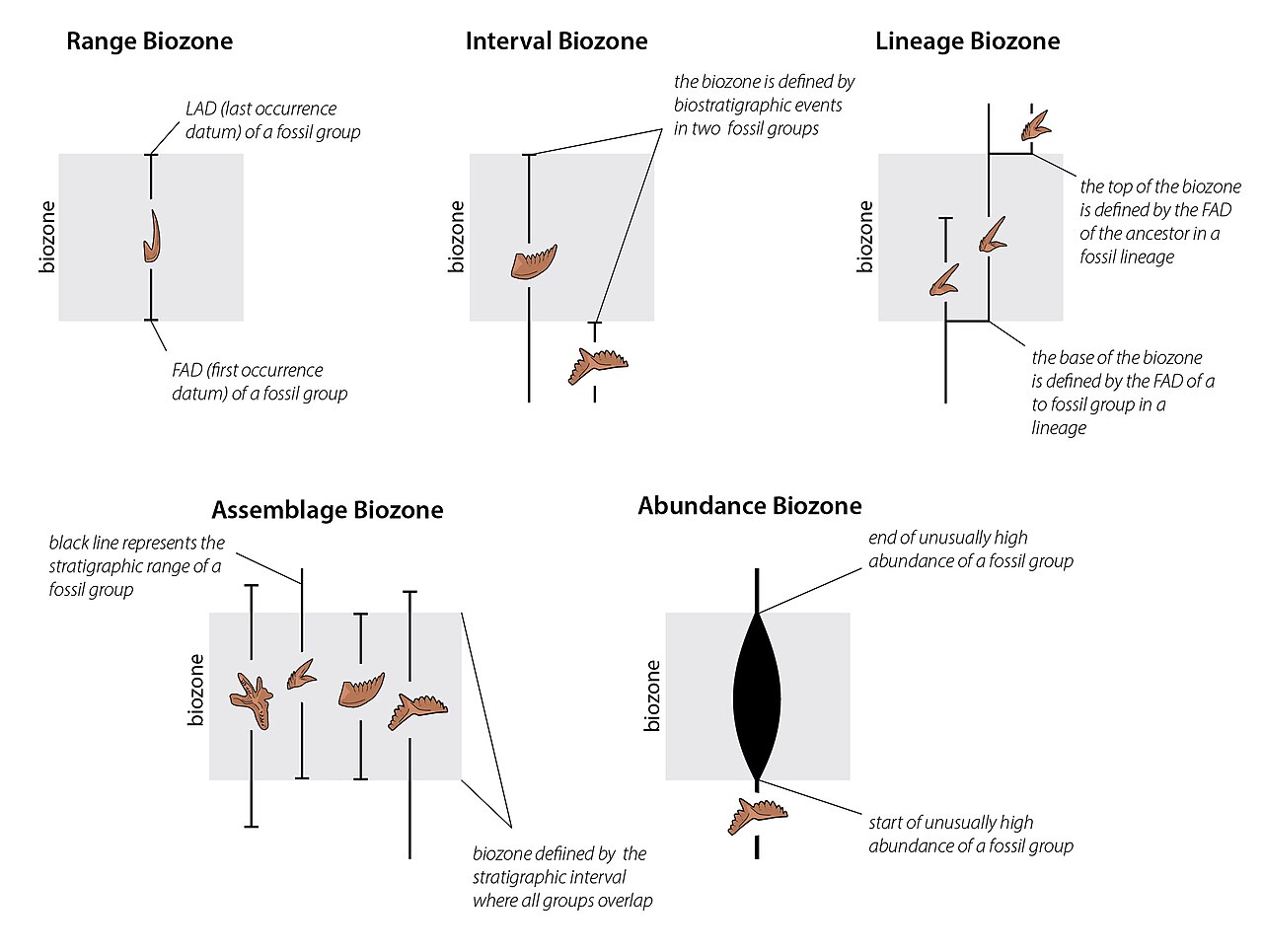
Figure \(\PageIndex{1}\): Diagram showing the major types of biozones (Page Quinton via Wikimedia Commons; CC BY-SA 4.0).
Lineage Biozones
Lineage biozone are based on evolutionary change within a single lineage. Instead of appearance or extinction, boundaries are defined by phyletic evolution. These biozones are important in microfossil groups with well-documented evolutionary successions.
Assemblage Biozones
Assemblage biozones are defined by the co-occurrence of three or more fossil taxa that together characterize a specific stratigraphic interval. Assemblage biozones are common in environmentally complex settings and are especially valuable for regional correlation.
Abundance Biozones
Abundance biozones are intervals with an unusually high abundance of a particular fossil taxon. These zones typically reflect favorable environmental conditions rather than evolutionary events and may represent only part of a taxon’s stratigraphic range.
Boundaries and Recognition
Biozone boundaries correspond to biological events, such as first appearances, last appearances, or evolutionary transitions. These boundaries are often gradational rather than sharp due to factors such as incomplete preservation, ecological controls, reworking, or sampling limitations. To identify a biozone, one must have:
- Accurate taxonomic identification
- Adequate sampling density
- Explicit documentation of defining fossils.
Rank, Naming, and Formalization
The biozone is the fundamental rank in biostratigraphy. Although they can be subdivided into sub-biozones when finer resolution is justified, they are not ranked in the same type of rigid hierarchy like lithostratigraphic or sequence stratigraphic units. Formal biozone names typically consist of the name of the defining fossil taxon and the type of biozone, such as an interval or assemblage biozone.
To formally establish a biostratigraphic unit, one must provide the following in a “recognized scientific medium” (typically a peer-reviewed publication in a reputable and widely available scientific publication):
- Provide a clear definition of the fossil criteria.
- Identify the defining taxa.
- Designate reference sections
- Demonstration of the unit’s utility
Summary
Biostratigraphy uses fossils to subdivide and correlate strata. It is possible because of evolution and biozones are generally defined using biological events such as speciation and extinction. Biozones can represent variable amounts of time and can cross lithologic boundaries. Biostratigraphy is important for determining the relative age of rock units, for regional and global correlations, and any application that requires detailed correlation of units (petroleum geology, etc.).