

6: Metamorphic Rocks
- Page ID
- 28243

\( \newcommand{\vecs}[1]{\overset { \scriptstyle \rightharpoonup} {\mathbf{#1}} } \)
\( \newcommand{\vecd}[1]{\overset{-\!-\!\rightharpoonup}{\vphantom{a}\smash {#1}}} \)
\( \newcommand{\dsum}{\displaystyle\sum\limits} \)
\( \newcommand{\dint}{\displaystyle\int\limits} \)
\( \newcommand{\dlim}{\displaystyle\lim\limits} \)
\( \newcommand{\id}{\mathrm{id}}\) \( \newcommand{\Span}{\mathrm{span}}\)
( \newcommand{\kernel}{\mathrm{null}\,}\) \( \newcommand{\range}{\mathrm{range}\,}\)
\( \newcommand{\RealPart}{\mathrm{Re}}\) \( \newcommand{\ImaginaryPart}{\mathrm{Im}}\)
\( \newcommand{\Argument}{\mathrm{Arg}}\) \( \newcommand{\norm}[1]{\| #1 \|}\)
\( \newcommand{\inner}[2]{\langle #1, #2 \rangle}\)
\( \newcommand{\Span}{\mathrm{span}}\)
\( \newcommand{\id}{\mathrm{id}}\)
\( \newcommand{\Span}{\mathrm{span}}\)
\( \newcommand{\kernel}{\mathrm{null}\,}\)
\( \newcommand{\range}{\mathrm{range}\,}\)
\( \newcommand{\RealPart}{\mathrm{Re}}\)
\( \newcommand{\ImaginaryPart}{\mathrm{Im}}\)
\( \newcommand{\Argument}{\mathrm{Arg}}\)
\( \newcommand{\norm}[1]{\| #1 \|}\)
\( \newcommand{\inner}[2]{\langle #1, #2 \rangle}\)
\( \newcommand{\Span}{\mathrm{span}}\) \( \newcommand{\AA}{\unicode[.8,0]{x212B}}\)
\( \newcommand{\vectorA}[1]{\vec{#1}} % arrow\)
\( \newcommand{\vectorAt}[1]{\vec{\text{#1}}} % arrow\)
\( \newcommand{\vectorB}[1]{\overset { \scriptstyle \rightharpoonup} {\mathbf{#1}} } \)
\( \newcommand{\vectorC}[1]{\textbf{#1}} \)
\( \newcommand{\vectorD}[1]{\overrightarrow{#1}} \)
\( \newcommand{\vectorDt}[1]{\overrightarrow{\text{#1}}} \)
\( \newcommand{\vectE}[1]{\overset{-\!-\!\rightharpoonup}{\vphantom{a}\smash{\mathbf {#1}}}} \)
\( \newcommand{\vecs}[1]{\overset { \scriptstyle \rightharpoonup} {\mathbf{#1}} } \)
\(\newcommand{\longvect}{\overrightarrow}\)
\( \newcommand{\vecd}[1]{\overset{-\!-\!\rightharpoonup}{\vphantom{a}\smash {#1}}} \)
\(\newcommand{\ket}[1]{\left| #1 \right>}\)
\(\newcommand{\bra}[1]{\left< #1 \right|}\)
\(\newcommand{\braket}[2]{\left< #1 \vphantom{#2} \right| \left. #2 \vphantom{#1} \right>}\)
\(\newcommand{\braopket}[3]{\left< #1 \vphantom{#2}\vphantom{#3} \right| #2 \vphantom{#1}\vphantom{#3} \left| #3 \vphantom{#1}\vphantom{#2} \right>}\)
\(\newcommand{\qmvec}[1]{\mathbf{\vec{#1}}}\)
\(\newcommand{\op}[1]{\hat{\mathbf{#1}}}\)
\(\newcommand{\expect}[1]{\langle #1 \rangle}\)
\(\newcommand{\dfn}[1]{\emph{\textbf{#1}}}\)
Metamorphic rocks, meta- meaning change and –morphos meaning form, is one of the three rock categories in the rock cycle. Metamorphic rock material has been changed by temperature, pressure, and/or fluids.
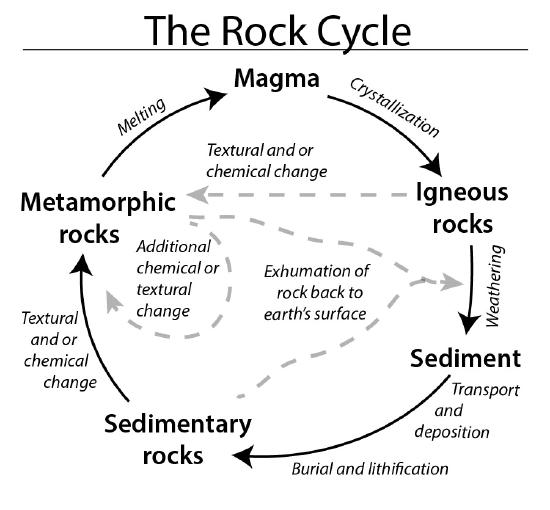
The rock cycle shows that both igneous and sedimentary rocks can become metamorphic rocks. And metamorphic rocks themselves can be re-metamorphosed. Because metamorphism is caused by plate motion, metamorphic rock provides geologists with a history book of how past tectonic processes shaped our planet [1].
Reference
1. Yardley BWD (1989) An introduction to metamorphic petrology. Prentice Hall
- 6.1: Metamorphic Processes
- Metamorphism occurs when solid rock changes in composition and/or texture without the mineral crystals melting. Metamorphic source rocks, the rocks that experience the metamorphism, are called the parent rock or protolith, from proto– meaning first, and lithos- meaning rock. Most metamorphic processes take place deep underground, inside the earth’s crust.
- 6.2: Metamorphic Textures
- Metamorphic rocks are either foliated or nonfoliated. Foliation is a term used that describes minerals lined up in planes. Foliated rocks typically appear as if the minerals are stacked like pages of a book, thus the use of the term ‘folia’, like a leaf. Nonfoliated rocks have minerals that do not show a preferred orientation.
- 6.3: Metamorphic Grade
- Metamorphic grade refers to the range of metamorphic change a rock undergoes, progressing from low (little metamorphic change) grade to high (significant metamorphic change) grade. Low-grade metamorphism begins at temperatures and pressures just above sedimentary rock conditions.
- 6.4: Metamorphic Environments
- As with igneous processes, metamorphic rocks form at different zones of pressure (depth) and temperature as shown on the pressure-temperature (P-T) diagram.
Thumbnail: Folded foliation in a metamorphic rock from near Geirangerfjord, Norway. (CC-SA-BY 3.0; Siim);