

15.4: Rocky Intertidal Communities
- Page ID
- 45643
\( \newcommand{\vecs}[1]{\overset { \scriptstyle \rightharpoonup} {\mathbf{#1}} } \)
\( \newcommand{\vecd}[1]{\overset{-\!-\!\rightharpoonup}{\vphantom{a}\smash {#1}}} \)
\( \newcommand{\dsum}{\displaystyle\sum\limits} \)
\( \newcommand{\dint}{\displaystyle\int\limits} \)
\( \newcommand{\dlim}{\displaystyle\lim\limits} \)
\( \newcommand{\id}{\mathrm{id}}\) \( \newcommand{\Span}{\mathrm{span}}\)
( \newcommand{\kernel}{\mathrm{null}\,}\) \( \newcommand{\range}{\mathrm{range}\,}\)
\( \newcommand{\RealPart}{\mathrm{Re}}\) \( \newcommand{\ImaginaryPart}{\mathrm{Im}}\)
\( \newcommand{\Argument}{\mathrm{Arg}}\) \( \newcommand{\norm}[1]{\| #1 \|}\)
\( \newcommand{\inner}[2]{\langle #1, #2 \rangle}\)
\( \newcommand{\Span}{\mathrm{span}}\)
\( \newcommand{\id}{\mathrm{id}}\)
\( \newcommand{\Span}{\mathrm{span}}\)
\( \newcommand{\kernel}{\mathrm{null}\,}\)
\( \newcommand{\range}{\mathrm{range}\,}\)
\( \newcommand{\RealPart}{\mathrm{Re}}\)
\( \newcommand{\ImaginaryPart}{\mathrm{Im}}\)
\( \newcommand{\Argument}{\mathrm{Arg}}\)
\( \newcommand{\norm}[1]{\| #1 \|}\)
\( \newcommand{\inner}[2]{\langle #1, #2 \rangle}\)
\( \newcommand{\Span}{\mathrm{span}}\) \( \newcommand{\AA}{\unicode[.8,0]{x212B}}\)
\( \newcommand{\vectorA}[1]{\vec{#1}} % arrow\)
\( \newcommand{\vectorAt}[1]{\vec{\text{#1}}} % arrow\)
\( \newcommand{\vectorB}[1]{\overset { \scriptstyle \rightharpoonup} {\mathbf{#1}} } \)
\( \newcommand{\vectorC}[1]{\textbf{#1}} \)
\( \newcommand{\vectorD}[1]{\overrightarrow{#1}} \)
\( \newcommand{\vectorDt}[1]{\overrightarrow{\text{#1}}} \)
\( \newcommand{\vectE}[1]{\overset{-\!-\!\rightharpoonup}{\vphantom{a}\smash{\mathbf {#1}}}} \)
\( \newcommand{\vecs}[1]{\overset { \scriptstyle \rightharpoonup} {\mathbf{#1}} } \)
\(\newcommand{\longvect}{\overrightarrow}\)
\( \newcommand{\vecd}[1]{\overset{-\!-\!\rightharpoonup}{\vphantom{a}\smash {#1}}} \)
\(\newcommand{\avec}{\mathbf a}\) \(\newcommand{\bvec}{\mathbf b}\) \(\newcommand{\cvec}{\mathbf c}\) \(\newcommand{\dvec}{\mathbf d}\) \(\newcommand{\dtil}{\widetilde{\mathbf d}}\) \(\newcommand{\evec}{\mathbf e}\) \(\newcommand{\fvec}{\mathbf f}\) \(\newcommand{\nvec}{\mathbf n}\) \(\newcommand{\pvec}{\mathbf p}\) \(\newcommand{\qvec}{\mathbf q}\) \(\newcommand{\svec}{\mathbf s}\) \(\newcommand{\tvec}{\mathbf t}\) \(\newcommand{\uvec}{\mathbf u}\) \(\newcommand{\vvec}{\mathbf v}\) \(\newcommand{\wvec}{\mathbf w}\) \(\newcommand{\xvec}{\mathbf x}\) \(\newcommand{\yvec}{\mathbf y}\) \(\newcommand{\zvec}{\mathbf z}\) \(\newcommand{\rvec}{\mathbf r}\) \(\newcommand{\mvec}{\mathbf m}\) \(\newcommand{\zerovec}{\mathbf 0}\) \(\newcommand{\onevec}{\mathbf 1}\) \(\newcommand{\real}{\mathbb R}\) \(\newcommand{\twovec}[2]{\left[\begin{array}{r}#1 \\ #2 \end{array}\right]}\) \(\newcommand{\ctwovec}[2]{\left[\begin{array}{c}#1 \\ #2 \end{array}\right]}\) \(\newcommand{\threevec}[3]{\left[\begin{array}{r}#1 \\ #2 \\ #3 \end{array}\right]}\) \(\newcommand{\cthreevec}[3]{\left[\begin{array}{c}#1 \\ #2 \\ #3 \end{array}\right]}\) \(\newcommand{\fourvec}[4]{\left[\begin{array}{r}#1 \\ #2 \\ #3 \\ #4 \end{array}\right]}\) \(\newcommand{\cfourvec}[4]{\left[\begin{array}{c}#1 \\ #2 \\ #3 \\ #4 \end{array}\right]}\) \(\newcommand{\fivevec}[5]{\left[\begin{array}{r}#1 \\ #2 \\ #3 \\ #4 \\ #5 \\ \end{array}\right]}\) \(\newcommand{\cfivevec}[5]{\left[\begin{array}{c}#1 \\ #2 \\ #3 \\ #4 \\ #5 \\ \end{array}\right]}\) \(\newcommand{\mattwo}[4]{\left[\begin{array}{rr}#1 \amp #2 \\ #3 \amp #4 \\ \end{array}\right]}\) \(\newcommand{\laspan}[1]{\text{Span}\{#1\}}\) \(\newcommand{\bcal}{\cal B}\) \(\newcommand{\ccal}{\cal C}\) \(\newcommand{\scal}{\cal S}\) \(\newcommand{\wcal}{\cal W}\) \(\newcommand{\ecal}{\cal E}\) \(\newcommand{\coords}[2]{\left\{#1\right\}_{#2}}\) \(\newcommand{\gray}[1]{\color{gray}{#1}}\) \(\newcommand{\lgray}[1]{\color{lightgray}{#1}}\) \(\newcommand{\rank}{\operatorname{rank}}\) \(\newcommand{\row}{\text{Row}}\) \(\newcommand{\col}{\text{Col}}\) \(\renewcommand{\row}{\text{Row}}\) \(\newcommand{\nul}{\text{Nul}}\) \(\newcommand{\var}{\text{Var}}\) \(\newcommand{\corr}{\text{corr}}\) \(\newcommand{\len}[1]{\left|#1\right|}\) \(\newcommand{\bbar}{\overline{\bvec}}\) \(\newcommand{\bhat}{\widehat{\bvec}}\) \(\newcommand{\bperp}{\bvec^\perp}\) \(\newcommand{\xhat}{\widehat{\xvec}}\) \(\newcommand{\vhat}{\widehat{\vvec}}\) \(\newcommand{\uhat}{\widehat{\uvec}}\) \(\newcommand{\what}{\widehat{\wvec}}\) \(\newcommand{\Sighat}{\widehat{\Sigma}}\) \(\newcommand{\lt}{<}\) \(\newcommand{\gt}{>}\) \(\newcommand{\amp}{&}\) \(\definecolor{fillinmathshade}{gray}{0.9}\)The rocky intertidal community that lives between the high-tide line and the low-tide line on rocky coasts is unique in two important respects. First, this community can be easily observed and studied by anyone who visits a rocky coast at low tide. Second, the community is normally arranged in well-defined depth zones that run parallel to the shore at different heights above the low-tide line. Each zone is populated by different species. Species that live in each zone are determined by a combination of physical conditions of the environment and competition among species that have different tolerances to these conditions.
The most important characteristic of the rocky intertidal zone is the degree of exposure of the substrate to the atmosphere when the tide recedes. Unlike organisms that inhabit sandy beaches or mudflats, most rocky intertidal species cannot bury themselves in the rocky substrate to survive periods when they are exposed by the tide. Once exposed to the atmosphere, organisms are subjected to a number of stresses, such as:
- Temperature variations and extremes that far exceed those in seawater
- Variable water exposure (spray or rain) and humidity, and the consequent variable tendency to lose body fluids by evaporation
- Variable salinity because the remaining pockets or pools of water may be subject to evaporation and/or dilution with rainwater or snow
- Variable oxygen concentrations and pH because physical and biological processes quickly alter these conditions in the small volume of seawater that remains in contact with the organism, and this water is not renewed until the water level rises again
- Predation by birds and terrestrial animals
Zonation of communities on a rocky intertidal shore is critically dependent on the frequency and duration of their exposure to the atmosphere and, therefore, to these stresses (Fig. 15-11).

The shore can be divided into four zones on the basis of atmospheric exposure time (Fig. 15-12). The highest zone, the supralittoral zone, is above mean higher high water (Chap. 10) and thus essentially permanently out of the water, but it is frequently wet with seawater spray from breaking waves, at least during high tides. Below the supralittoral zone, the high-tide zone is covered with water for parts of the tidal cycle but remains exposed to the atmosphere most of the time. The middle-tide zone is usually covered by water, but it is exposed to the atmosphere during all or most low tides. Finally, the low-tide zone is water-covered almost permanently and exposed to the atmosphere only briefly during the lowest low tides. The boundaries between these zones are sometimes sharp, as revealed by abrupt changes in the biological communities that they support.

Even when covered by water, the zones of the rocky shore are subject to different physical conditions, particularly wave-induced turbulence and scour. Wave-induced turbulence decreases with depth but can still be substantial well below the low-tide zone.
Rocky coasts are present throughout the oceans, and each has its own unique communities with different species and species interactions. Consequently, only the general types of flora and fauna in rocky intertidal zones are described here. For most coastal areas, easy-to-read guides to shore and tide pool creatures can be found in local bookstores.
Supralittoral Zone
The supralittoral zone is either permanently exposed to the atmosphere or covered by water only during occasional extreme high tides or storm surges. Hence, this zone can be considered land and not part of the ocean ecosystem. Nevertheless, the continuous or frequent spray of seawater that reaches this zone provides moisture and nutrients that support the growth of lichens, encrusting blue-green algae, and small tufts of various green algae. These autotroph communities are sparse but provide food for a variety of animals, including species of periwinkles (marine snails), other marine snails, limpets, isopods, and crabs (Fig. 15-12).
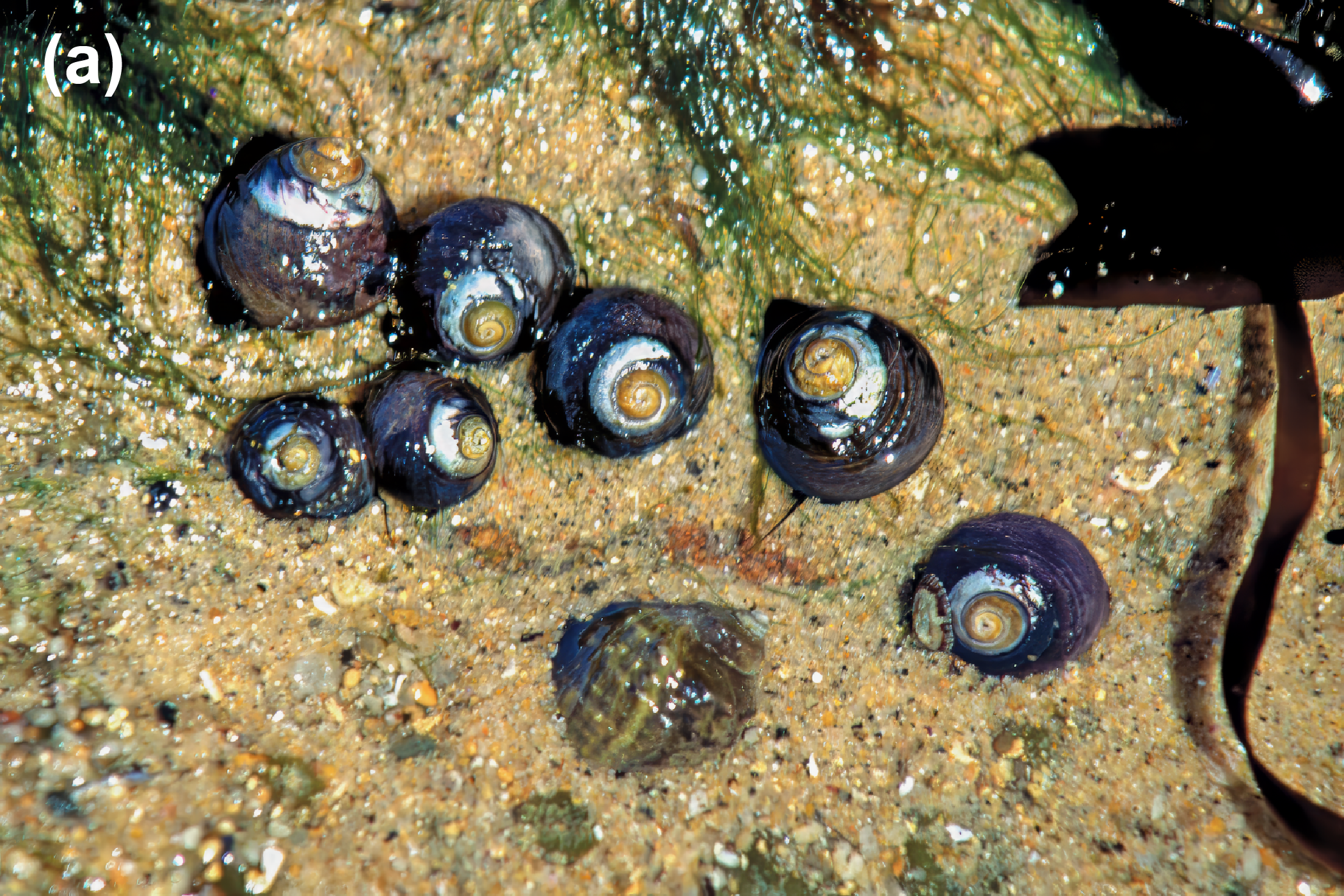
Periwinkles, other snails (Fig. 15-13a), and limpets are grazers that feed on algae encrusting the rocks. The periwinkles are often species of the genus Littorina. Many Littorina species are well adapted to life in the supralittoral zone. Some “breathe” air and may even drown if fully immersed in water for long periods. Supralittoral species of Littorina are viviparous, giving birth to live young. In contrast, the marine species of this genus that live completely submerged deposit eggs on the rocks or release them to the water. Periwinkles can completely withdraw into their shell and seal off the opening with an operculum, a rigid disk of hornlike material. This seal is watertight and provides protection from predators and especially from dehydration during long periods of exposure to the atmosphere.
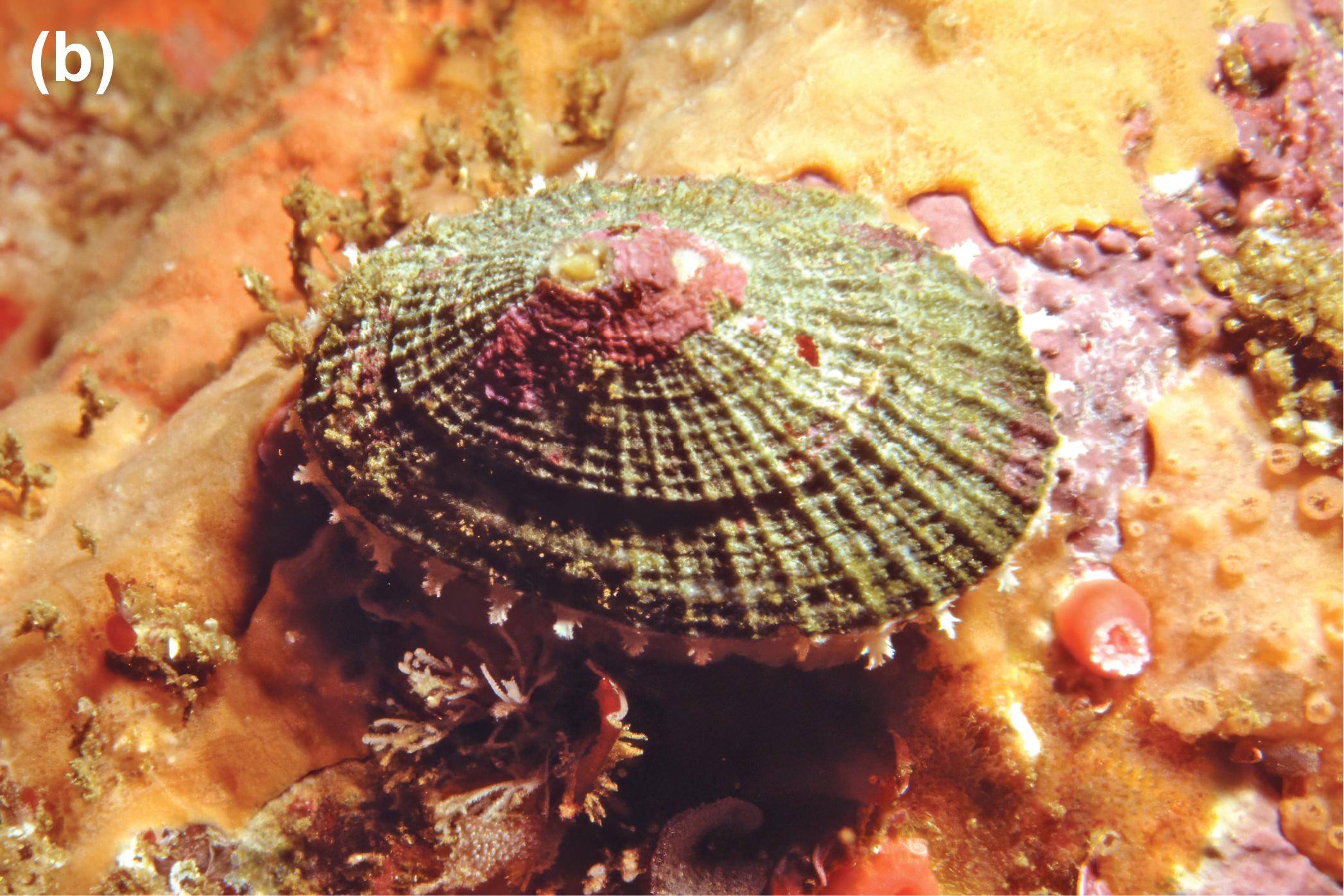


Limpets (Fig. 15-13b) are not able to withdraw entirely into their shell. Instead, they cling to the rocks with their bodies and pull their shells tightly down on top of them. If the shell edge fits well with the surrounding rock, the animal is sealed inside, where it is protected from predators and desiccation. Some limpets rasp the rock away or release acidic secretions to create a perfectly fitted platform for their shell. When immersed or wet, limpets may move over the rocks to graze, but they return to their prepared location during periods of prolonged exposure to the atmosphere. The limpet’s bond to the rock is so strong that it cannot easily be turned over, and thus its soft body is protected from predators such as birds. The limpet’s defensive action of clinging tightly to the rock is easy to observe. Limpets can be surprised and easily removed from their rock location by a quick sideways stroke of a chisel or blade. However, if the limpet is warned, perhaps by a light tap from a finger, it clamps down and is impossible to remove without breaking the shell.
Isopods often live in the supralittoral zone in great numbers. These animals are scavengers that feed on organic debris. They are rarely seen by most visitors to the shore because they remain in hiding places within the rocks by day and emerge to feed only at night. Various species of crabs also inhabit the supralittoral zone. Many are scavengers, but some are grazing herbivores or predatory carnivores.
Each zone of the rocky intertidal ecosystem varies in width according to factors that include the slope of the rocks and the tidal range. The width of the supralittoral zone is also affected by factors that determine the degree of wetness of the rocks, including the intensity of wave action, the average air temperature and humidity, and the location, roughness, and orientation of the shore (which control the degree of shading from the sun). For example, the supralittoral zone is wide in areas such as central California and Maine, where cool, damp, and foggy days are common.
High-Tide Zone
In the high-tide zone, organisms are exposed to the atmosphere for long periods and, like inhabitants of the supralittoral zone, must be able to withstand extremes of temperature and salinity and must be protected from dehydration. In addition, these organisms must be able to withstand severe wave-induced turbulence. To offset these disadvantages, a reliable supply of nutrients, plankton, and suspended organic particles becomes available each time the rocks are covered by ocean water. Consequently, the high-tide zone can support species that cannot tolerate the limited nutrient supply and prolonged dry periods of the supralittoral zone.
Rocks of the high-tide zone support many species of encrusting algae, particularly in the upper parts of the zone. In contrast to the supralittoral zone, the high-tide zone has several species of macroalgae. All these species have thick cell walls, which give them a leathery feel and protect them from excessive loss of water by evaporation when exposed to the atmosphere (Fig. 15-13f). They are firmly attached to the rocks by holdfasts, and their stipes (branches) are extremely flexible, enabling them to withstand wave turbulence. Although they are eaten by some species of snails, crabs, and other animals, these algae are tough and difficult to digest, and they contribute to the food web primarily in the form of detritus. The detritus is formed when parts or all of the algae are first broken loose from the rocks by waves or grazers and then broken down or modified by decomposers.
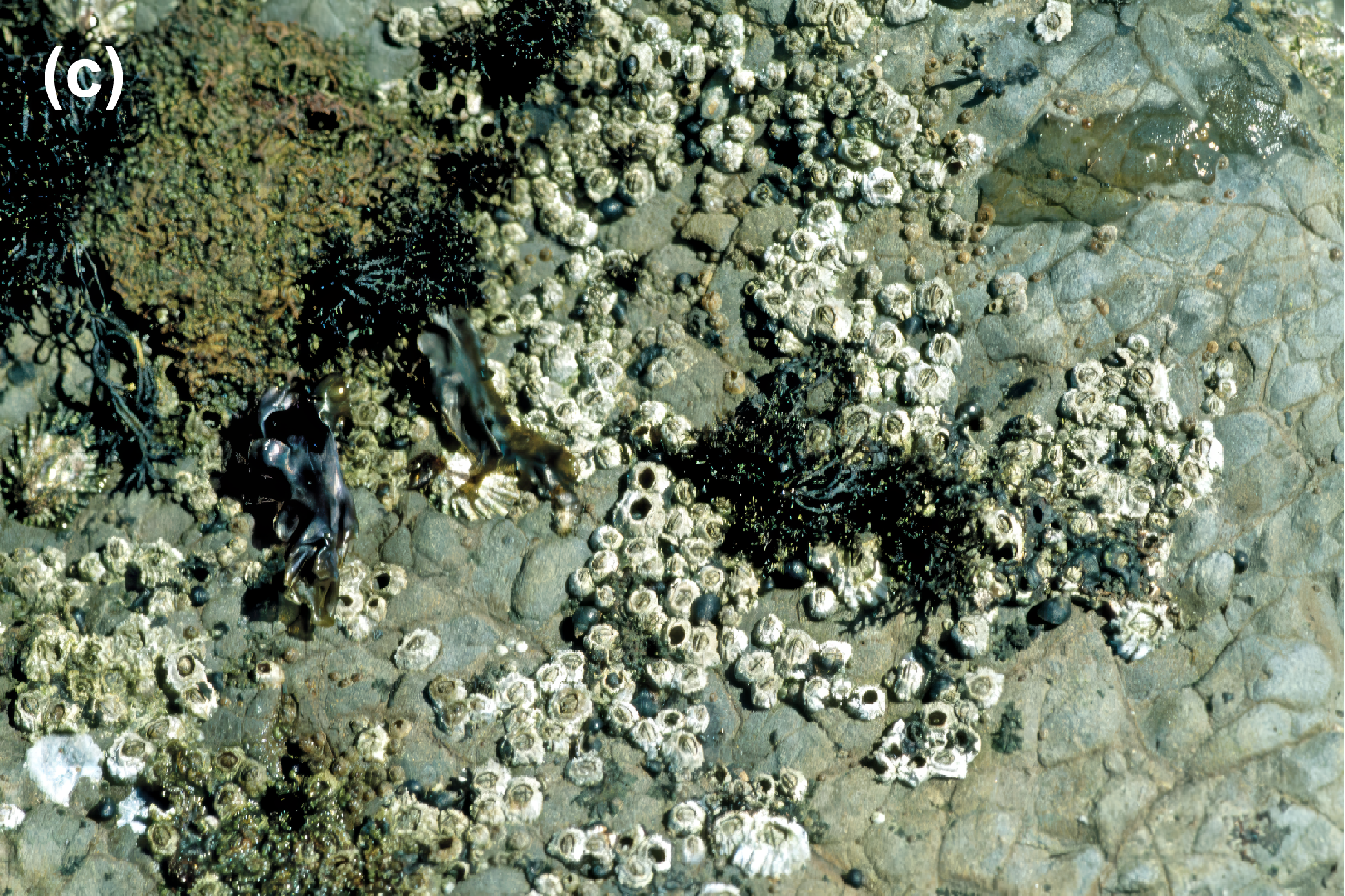
In many areas, the top of the high-tide zone is marked by a band dominated by small barnacles called “buckshot barnacles” (Fig. 15-13c). Several larger species of barnacles are present lower on the shore in the middle-tide zone. Because barnacles are suspension feeders, they cannot live above the highest high-tide line. However, they can survive in locations where they are able to feed for only a few hours on the few days of spring tides each month when they are immersed in water. When exposed to the atmosphere, the barnacle withdraws into its hard shell, which protects it from dehydration, predators, wave impacts, and wave-induced turbulence.
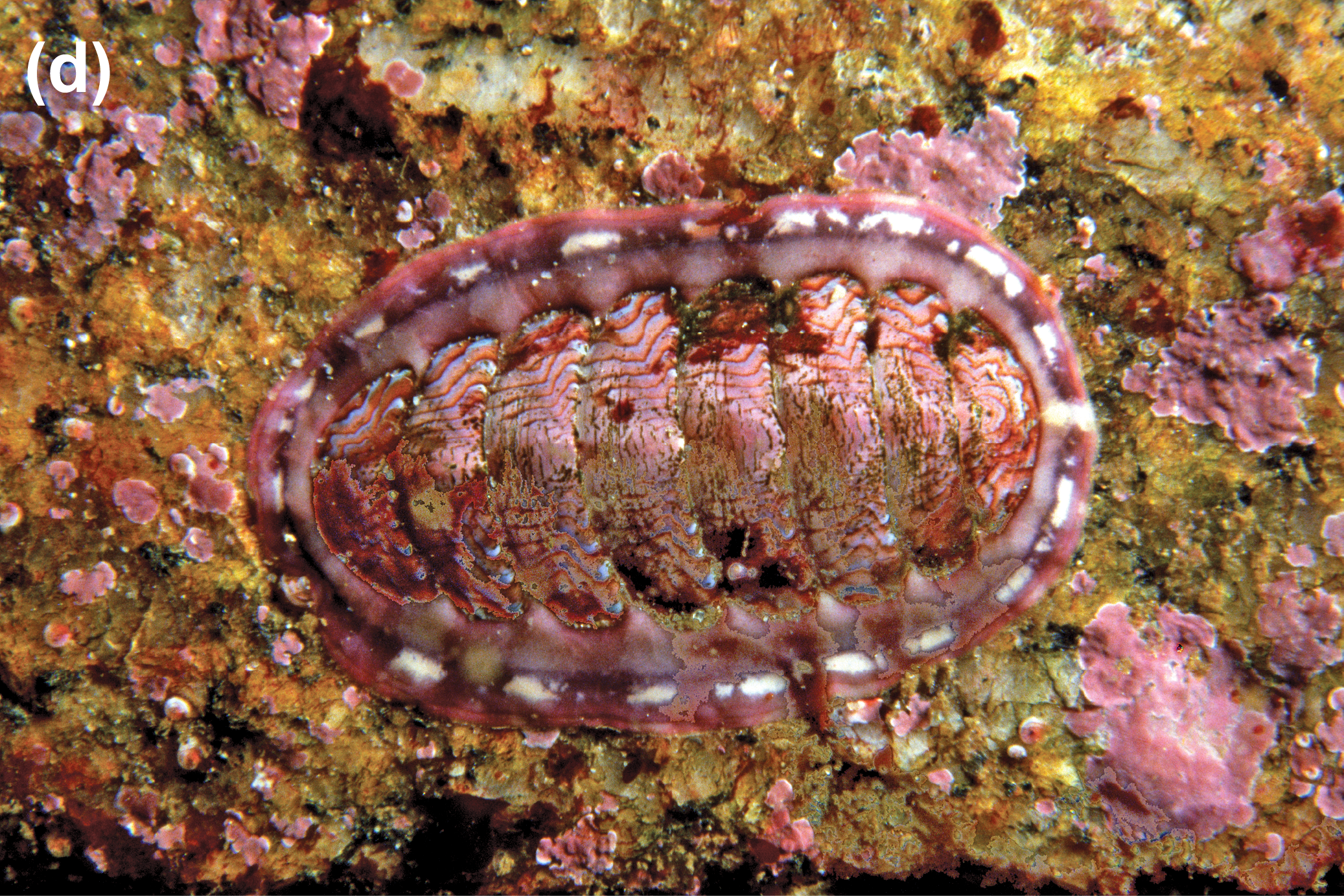
Because organisms of the high-tide zone, like species in the supralittoral zone, must withstand extended exposure to the atmosphere, the two zones sustain many similar species, including periwinkles and limpets. Toward the lower end of the high-tide zone, periwinkles and limpets become less abundant, whereas chitons and mussels become more abundant. This change marks the transition from the high-tide zone to the middle-tide zone. Chitons (Fig. 15-13d) feed and attach themselves to the rocks in the same way as limpets, but they have shells made up of eight separate connected plates. Mussels (Fig. 15-13e) are suspension feeders like barnacles, but they have a two-piece shell attached to the rocks by a network of strong threads called “byssal threads.” These threads are formed by a liquid secreted from the mussel’s foot that hardens in seawater. The threads are attached between the mussel shell and the rocks or, in dense mussel beds, between one shell and another. Periwinkles, barnacles, limpets, mussels, and other species living attached to rocks of the high- and middle-tide zones tend to have rounded shells, which can best withstand and dissipate the turbulent impacts of waves.
The lower limit of the zone inhabited by a rocky intertidal species is determined for many species by competition from other species. In contrast, the upper limit of the inhabited zone is normally determined by the tolerance limits of the species’ fundamental niche.
Middle-Tide Zone
Macroalgae are generally less abundant or absent in the middle-tide zone because of competition by mussels and barnacles. In a middle-tide zone newly formed by vertical movements of the coast during earthquakes or by lava flows, or in a middle-tide zone partially denuded by extreme storms, macroalgae quickly establish themselves and cover the rocks. However, as mussel and barnacle larvae settle and grow into new colonies, the macroalgae are steadily overcome and eventually disappear from the zone.
Within the middle-tide zone, the lower limit of mussel beds is determined by competition from predatory sea stars, which can grip and slowly pull open a mussel with the many tube feet on their undersides. As you can see in Figure 15-14, mussel beds terminate abruptly at their lower limit on many shores, almost as though the mussels were incapable of growing below that depth. However, this limit is simply the depth at which recolonization by mussels is less effective than predation by sea stars (whose fundamental niche does not extend as high up the middle-tide zone as the fundamental niche of the mussels does). Although some sea stars do prey on mussels within the mussel bed zone, they must withstand stresses associated with being at the limits of their fundamental niche (e.g., atmosphere exposure and turbulence), or they must migrate up and down the shore’s zones with the tides. Hence, mussels are able to outcompete the predatory sea stars in this upper zone.

The mussel beds on many rocky intertidal shores are ideal habitat for a variety of algae and animals that include hydroids, worms, snails, clams and other mollusks, and crabs and other crustaceans. Acorn barnacles are interspersed in the mussel beds. These barnacles, and to a lesser extent the mussels, are eaten by snails that drill through the barnacle plates or mussel shell or force the mussel shell open to get to their prey. The middle-tide zone is also populated by numerous species of hermit crabs (Fig. 15-13g) and a number of species of anemones that can withstand periodic exposure to the atmosphere.
Low-Tide Zone
The low-tide zone sustains a variety of macroalgae and encrusting algae nourished by nutrients brought to them with each tide. In this shallow zone, algae have ample light, even when turbidity is relatively high. In addition, because they are exposed to the atmosphere for only short periods at low tides, they do not need the protection against desiccation that algae in higher zones require. Although the low-tide zone, unlike zones higher on the shore, is dominated by algae, it sustains numerous species of animals, many of which use the abundant mats of algae for shelter. Animals in the low-tide zone are similar to those of the kelp community (Fig. 15-9) and include anemones, sponges, sea urchins, nudibranchs, shrimp, sea stars, crabs, sea cucumbers, and fishes. These organisms are infrequently exposed to the atmosphere, so they include delicate forms that would be dehydrated or thermally shocked if exposed for more extended periods.
The principal physical hazard in the low-tide zone is wave-induced turbulence. Some species withstand this turbulence by attaching themselves to the rocks. Other species are active swimmers or simply use macroalgae or cracks and holes in the rock as protection from wave action. Because the low-tide zone has abundant macroalgae and a continuous supply of suspended detritus and plankton, the low-tide community comprises many species of filter feeders, detritus eaters, scavengers, grazers, and carnivores.
Tide Pools
On many coasts, the rocky shore is convoluted or pitted sufficiently that seawater remains in many depressions, even when the tide recedes. These depressions are called “tide pools.” Depending on the size, location, and permanence of the tide pool, any of the species of any part of the rocky shore, from the high-tide zone to the low-tide zone, may be present.
Each tide pool is unique because evaporation, rainfall, solar heating, winter cooling, and other factors affect the physical properties (e.g., salinity, temperature, pH, oxygen concentration) of the water in each tide pool differently. Tide pools high on the shore are isolated for long periods between tides and are subject to the greatest changes. Deep tide pools have a greater volume of seawater per unit area than shallow ones and are less affected by evaporation, rainfall, heating, and cooling. Consequently, small tide pools tend to support only microscopic algae and highly tolerant copepods and other microscopic animals. In contrast, large tide pools may contain many species of algae, sea urchins, anemones, crabs, shrimp, small fishes, and other animals that are tolerant to relatively small changes in salinity, temperature, and other physical characteristics of the tide pool water. The next time you visit a shore with tide pools, you can see which species are more tolerant by simply examining several different tide pools.