

11.4: Proterozoic Life
- Page ID
- 34000
\( \newcommand{\vecs}[1]{\overset { \scriptstyle \rightharpoonup} {\mathbf{#1}} } \)
\( \newcommand{\vecd}[1]{\overset{-\!-\!\rightharpoonup}{\vphantom{a}\smash {#1}}} \)
\( \newcommand{\dsum}{\displaystyle\sum\limits} \)
\( \newcommand{\dint}{\displaystyle\int\limits} \)
\( \newcommand{\dlim}{\displaystyle\lim\limits} \)
\( \newcommand{\id}{\mathrm{id}}\) \( \newcommand{\Span}{\mathrm{span}}\)
( \newcommand{\kernel}{\mathrm{null}\,}\) \( \newcommand{\range}{\mathrm{range}\,}\)
\( \newcommand{\RealPart}{\mathrm{Re}}\) \( \newcommand{\ImaginaryPart}{\mathrm{Im}}\)
\( \newcommand{\Argument}{\mathrm{Arg}}\) \( \newcommand{\norm}[1]{\| #1 \|}\)
\( \newcommand{\inner}[2]{\langle #1, #2 \rangle}\)
\( \newcommand{\Span}{\mathrm{span}}\)
\( \newcommand{\id}{\mathrm{id}}\)
\( \newcommand{\Span}{\mathrm{span}}\)
\( \newcommand{\kernel}{\mathrm{null}\,}\)
\( \newcommand{\range}{\mathrm{range}\,}\)
\( \newcommand{\RealPart}{\mathrm{Re}}\)
\( \newcommand{\ImaginaryPart}{\mathrm{Im}}\)
\( \newcommand{\Argument}{\mathrm{Arg}}\)
\( \newcommand{\norm}[1]{\| #1 \|}\)
\( \newcommand{\inner}[2]{\langle #1, #2 \rangle}\)
\( \newcommand{\Span}{\mathrm{span}}\) \( \newcommand{\AA}{\unicode[.8,0]{x212B}}\)
\( \newcommand{\vectorA}[1]{\vec{#1}} % arrow\)
\( \newcommand{\vectorAt}[1]{\vec{\text{#1}}} % arrow\)
\( \newcommand{\vectorB}[1]{\overset { \scriptstyle \rightharpoonup} {\mathbf{#1}} } \)
\( \newcommand{\vectorC}[1]{\textbf{#1}} \)
\( \newcommand{\vectorD}[1]{\overrightarrow{#1}} \)
\( \newcommand{\vectorDt}[1]{\overrightarrow{\text{#1}}} \)
\( \newcommand{\vectE}[1]{\overset{-\!-\!\rightharpoonup}{\vphantom{a}\smash{\mathbf {#1}}}} \)
\( \newcommand{\vecs}[1]{\overset { \scriptstyle \rightharpoonup} {\mathbf{#1}} } \)
\(\newcommand{\longvect}{\overrightarrow}\)
\( \newcommand{\vecd}[1]{\overset{-\!-\!\rightharpoonup}{\vphantom{a}\smash {#1}}} \)
\(\newcommand{\avec}{\mathbf a}\) \(\newcommand{\bvec}{\mathbf b}\) \(\newcommand{\cvec}{\mathbf c}\) \(\newcommand{\dvec}{\mathbf d}\) \(\newcommand{\dtil}{\widetilde{\mathbf d}}\) \(\newcommand{\evec}{\mathbf e}\) \(\newcommand{\fvec}{\mathbf f}\) \(\newcommand{\nvec}{\mathbf n}\) \(\newcommand{\pvec}{\mathbf p}\) \(\newcommand{\qvec}{\mathbf q}\) \(\newcommand{\svec}{\mathbf s}\) \(\newcommand{\tvec}{\mathbf t}\) \(\newcommand{\uvec}{\mathbf u}\) \(\newcommand{\vvec}{\mathbf v}\) \(\newcommand{\wvec}{\mathbf w}\) \(\newcommand{\xvec}{\mathbf x}\) \(\newcommand{\yvec}{\mathbf y}\) \(\newcommand{\zvec}{\mathbf z}\) \(\newcommand{\rvec}{\mathbf r}\) \(\newcommand{\mvec}{\mathbf m}\) \(\newcommand{\zerovec}{\mathbf 0}\) \(\newcommand{\onevec}{\mathbf 1}\) \(\newcommand{\real}{\mathbb R}\) \(\newcommand{\twovec}[2]{\left[\begin{array}{r}#1 \\ #2 \end{array}\right]}\) \(\newcommand{\ctwovec}[2]{\left[\begin{array}{c}#1 \\ #2 \end{array}\right]}\) \(\newcommand{\threevec}[3]{\left[\begin{array}{r}#1 \\ #2 \\ #3 \end{array}\right]}\) \(\newcommand{\cthreevec}[3]{\left[\begin{array}{c}#1 \\ #2 \\ #3 \end{array}\right]}\) \(\newcommand{\fourvec}[4]{\left[\begin{array}{r}#1 \\ #2 \\ #3 \\ #4 \end{array}\right]}\) \(\newcommand{\cfourvec}[4]{\left[\begin{array}{c}#1 \\ #2 \\ #3 \\ #4 \end{array}\right]}\) \(\newcommand{\fivevec}[5]{\left[\begin{array}{r}#1 \\ #2 \\ #3 \\ #4 \\ #5 \\ \end{array}\right]}\) \(\newcommand{\cfivevec}[5]{\left[\begin{array}{c}#1 \\ #2 \\ #3 \\ #4 \\ #5 \\ \end{array}\right]}\) \(\newcommand{\mattwo}[4]{\left[\begin{array}{rr}#1 \amp #2 \\ #3 \amp #4 \\ \end{array}\right]}\) \(\newcommand{\laspan}[1]{\text{Span}\{#1\}}\) \(\newcommand{\bcal}{\cal B}\) \(\newcommand{\ccal}{\cal C}\) \(\newcommand{\scal}{\cal S}\) \(\newcommand{\wcal}{\cal W}\) \(\newcommand{\ecal}{\cal E}\) \(\newcommand{\coords}[2]{\left\{#1\right\}_{#2}}\) \(\newcommand{\gray}[1]{\color{gray}{#1}}\) \(\newcommand{\lgray}[1]{\color{lightgray}{#1}}\) \(\newcommand{\rank}{\operatorname{rank}}\) \(\newcommand{\row}{\text{Row}}\) \(\newcommand{\col}{\text{Col}}\) \(\renewcommand{\row}{\text{Row}}\) \(\newcommand{\nul}{\text{Nul}}\) \(\newcommand{\var}{\text{Var}}\) \(\newcommand{\corr}{\text{corr}}\) \(\newcommand{\len}[1]{\left|#1\right|}\) \(\newcommand{\bbar}{\overline{\bvec}}\) \(\newcommand{\bhat}{\widehat{\bvec}}\) \(\newcommand{\bperp}{\bvec^\perp}\) \(\newcommand{\xhat}{\widehat{\xvec}}\) \(\newcommand{\vhat}{\widehat{\vvec}}\) \(\newcommand{\uhat}{\widehat{\uvec}}\) \(\newcommand{\what}{\widehat{\wvec}}\) \(\newcommand{\Sighat}{\widehat{\Sigma}}\) \(\newcommand{\lt}{<}\) \(\newcommand{\gt}{>}\) \(\newcommand{\amp}{&}\) \(\definecolor{fillinmathshade}{gray}{0.9}\)Eukaryotes: Evolution through Endosymbiosis
A large evolutionary step occurred during the Proterozoic Eon, with the appearance of eukaryotes around 1.8 billion years ago in the Paleoproterozoic. Eukaryotic cells are more complex, having nuclei and organelles. The nuclear DNA is capable of more complex replication and regulation than that of prokaryotes. The organelles include mitochondria for producing energy and chloroplasts for photosynthesis which is the processes where plants take in carbon dioxide to convert sunlight into chemical energy which fuels their metabolism and releases oxygen to their surroundings. The eukaryote branch in the tree of life gave rise to fungi, plants, and animals.
The accumulation of oxygen in the atmosphere due to prokaryotic photosynthesis created a new resource that life could exploit as a source of energy. The new complex eukaryotic cells were equipped with a new method of making energy for cellular function: aerobic respiration. Aerobic respiration requires oxygen to produce molecules of ATP which can then be stored and metabolized when needed to power a cell.

Eukaryotic cells contain a membrane-bound nucleus that houses the cell’s DNA and a variety of other organelles that assist with cell activities. In particular, mitochondria are important organelles because they are associated with ATP production within all eukaryotic cells. In plants, chloroplasts are also necessary as the sites where photosynthesis occurs within the cell. Because they contain a variety of organelles, eukaryotic cells are generally one to two orders of magnitude larger than prokaryotic cells (eukaryotes are typically 10 – 100 \(\mu\)m).

So, how did eukaryotic cells first evolve? Current science supports endosymbiosis theory (ET), which states that eukaryotic cells arose due to a mutually beneficial relationship where one prokaryote lives inside another. For example, one prokaryote engulfed another but did not digest it, allowing both cells to persist. The host cell offered protection, and the ingested cell provided energy to allow both cells to function. Over time, the cells co-evolved, and became reliant on each other as a single system: a cell with energy-producing organelles, mitochondria and chloroplasts. ET was first championed by Lynn Margulis in the 1960s, but took decades to be more widely accepted. One of the major lines of evidence in support of ET is that both mitochondria and chloroplasts possess their own DNA, with genetic signatures very similar to modern prokaryotes. Additionally, organisms without mitochondria, like the amoeba Pelomyxa, instead host symbiotic bacteria that serve the same function as mitochondria, but are not yet so wedded to their host that they cannot survive on their own.
Today, eukaryotes include a wide variety of single-celled organisms, both with and without shells, like amoeba, foraminifera, coccolithophores, radiolaria, and diatoms. These are called protists. We classify them within the Kingdom Protista. All multicellular organisms are also eukaryotes, including all fungi, plants, and animals (Kingdoms Fungi, Plantae, and Animalia, respectively). The most widely accepted fossils that are interpreted as representing the first eukaryotes are acritarchs, a group of single-celled organisms that appear in the record about 1.8 billion years ago (Paleoproterozoic), well into the prokaryotic-driven Great Oxidation Event.
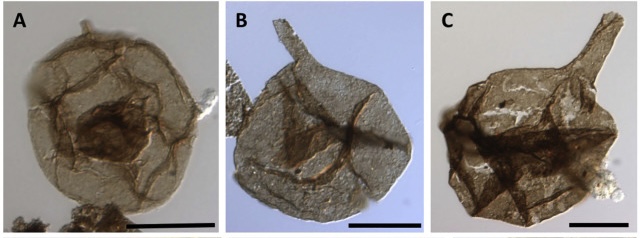 Figure \(\PageIndex{3}\): Selected Neoproterozoic acritarchs (Germinosphaera cf. G. bispinosa) from the Mingolsheim core (Germany). All scale bars 20 μm. (B. van de Schootbrugge via Wikimedia, CC BY 4.0)
Acritarchs are of unknown affinity, which means there is uncertainty as to where they fit on the tree of life. Acritarchs consist of a spherical sac-shaped cell ranging in size from 1.0 – 1000.0 \(\mu\)m, making them significantly larger than prokaryotes. The oldest forms are most commonly thought to be related to marine algae or dinoflagellates (a protist group). Also around 1.8 billion years ago (Paleoproterozoic), another fossil, Grypania spiralis, appears in the fossil record. This filamentous, spiral shaped fossil is commonly considered to be eukaryotic, primarily due to its size, leading some researchers adamantly debate that Grypania may also represent one of the first multicellular organisms on Earth.

Another important event in Earth’s biological history occurred about 1.2 billion years ago when eukaryotes invented sexual reproduction. Sharing genetic material from two reproducing individuals, male and female, greatly increased genetic variability in their offspring. This genetic mixing accelerated evolutionary change, contributing to more complexity among individual organisms and within ecosystems.
Multicellular Life: The Ediacaran Biota
As with other forms of early life, the origins of multicellular life are difficult to pinpoint given the lack of hard parts available for preservation. The fossil record of the Ediacaran Period (635-541 million years ago) at the end of Neoproterozoic best captures this next major innovation of life. The Ediacaran biota are a diverse assemblage of complex, macroscopic multicellular body and trace fossils. This significant increase in diversity follows an extensive period of glaciation (Snowball Earth) during the Cryogenian (Neoproterozoic). Prokaryotes likely contributed to eukaryotic success; this biota would have originated during a time when oxygen levels in the surface oceans were still increasing due to photosynthesizing cyanobacteria which are bacteria that use chlorophyll to absorb energy from light. Recent geochemical research (Bekker et al., 2017) also indicates bacteria levels were high in the Ediacaran seas, creating higher concentrations of dissolved organic matter as a food resource for these organisms. The warmer, oxygen- and food-rich seas of the Ediacaran may have set the conditions necessary for multicellular life to globally flourish.

Ediacaran fossils have been found on every continent except Antarctica. They are typically preserved within sandstones of shallow marine settings, like the famous deposits from the White Sea Coast of Russia, the Flinders Range of Australia, and Namibia. In a few places, however, fossils of the biota have been found in finer-grained sediments of deeper waters, such as the ash beds at Mistaken Point in southeastern Newfoundland. The biota primarily consists of impressions (both casts and external molds) of soft-bodied organisms that do not usually preserve well in coarser, sandy sediments, and many are even found underlying turbidity current deposits, effectively smothered by the rapid burial. Some research suggests that the fine texture of pervasive microbial mats would aid in preservation of the fossil impressions.

The fossils reveal a few common shapes (also known as morphologies). Many are described as disc-shaped (Cyclomedusa, Mawsonites). Others, known as rangeomorphs, have a frond-like shape (Rangea, Charnia). Still others exhibit the first clear examples of bilateral symmetry (Kimberella). There are even some odd forms that have an apparent trilateral symmetry (Tribrachidium), which is unlike anything alive today. The coarse sediment in which these fossils are preserved has hidden much of their anatomic detail, thus where these organisms should be placed on the tree of life has been widely debated. Some researchers suggest the Ediacaran biota represents basal members of some certain invertebrate animal groups that take off in diversity during the subsequent Cambrian Explosion, such as cnidarians and mollusks. Others have argued for identification of various Ediacaran forms as giant protists, algae, worms, fungi, or in a phylum of their own, the Vendozoa. Recent chemical analyses of Dickinsonia fossils showed evidence of cholesteroids, molecular fossils of the compound cholesterol, which is only found in animal cells (Bobrovskiy et al., 2018). When compared to molecular analyses of the surrounding sediments, only stigmasteroids, molecular fossils indicative of the green algae of the microbial mats was found. This study supports the interpretation that at least some of the Ediacaran biota are some of the first true animals on Earth.
While many ichnotaxa from this time have been re-evaluated in recent years to be sedimentary structures or microbially related, most Ediacaran burrows are simple, horizontal trails and burrows, or rasping traces made in association with microbial mats. Rasping is a mode of feeding by scratching at a surface. Snails and sea urchins eat algae this way today. Toward the end of the Ediacaran, burrows begin to increase in complexity, with a shift to more vertical and branching shapes, suggesting animal motility was on the rise.
- aerobic - involving requiring oxygen
- Ediacaran biota - plants and animals that evolved in the late Proterozoic and represent the earliest known complex multicellular organisms
- endosymbiosis - the process of two organisms merging into one to form a mutually beneficial relationship
- eukaryotes - organisms with membrane-bound nuclei and include all animals, plants, fungi, seaweeds, and many unicellular organisms
- photosynthesis - a system of biological processes where plants take in CO2 to convert sunlight into chemical energy which fuels their metabolism and releases oxygen to their surroundings
- prokaryotes - single-celled organisms that lack nuclei and predate eukaryotes