

9.3: A Modern View of Evolution
- Page ID
- 33500
\( \newcommand{\vecs}[1]{\overset { \scriptstyle \rightharpoonup} {\mathbf{#1}} } \)
\( \newcommand{\vecd}[1]{\overset{-\!-\!\rightharpoonup}{\vphantom{a}\smash {#1}}} \)
\( \newcommand{\dsum}{\displaystyle\sum\limits} \)
\( \newcommand{\dint}{\displaystyle\int\limits} \)
\( \newcommand{\dlim}{\displaystyle\lim\limits} \)
\( \newcommand{\id}{\mathrm{id}}\) \( \newcommand{\Span}{\mathrm{span}}\)
( \newcommand{\kernel}{\mathrm{null}\,}\) \( \newcommand{\range}{\mathrm{range}\,}\)
\( \newcommand{\RealPart}{\mathrm{Re}}\) \( \newcommand{\ImaginaryPart}{\mathrm{Im}}\)
\( \newcommand{\Argument}{\mathrm{Arg}}\) \( \newcommand{\norm}[1]{\| #1 \|}\)
\( \newcommand{\inner}[2]{\langle #1, #2 \rangle}\)
\( \newcommand{\Span}{\mathrm{span}}\)
\( \newcommand{\id}{\mathrm{id}}\)
\( \newcommand{\Span}{\mathrm{span}}\)
\( \newcommand{\kernel}{\mathrm{null}\,}\)
\( \newcommand{\range}{\mathrm{range}\,}\)
\( \newcommand{\RealPart}{\mathrm{Re}}\)
\( \newcommand{\ImaginaryPart}{\mathrm{Im}}\)
\( \newcommand{\Argument}{\mathrm{Arg}}\)
\( \newcommand{\norm}[1]{\| #1 \|}\)
\( \newcommand{\inner}[2]{\langle #1, #2 \rangle}\)
\( \newcommand{\Span}{\mathrm{span}}\) \( \newcommand{\AA}{\unicode[.8,0]{x212B}}\)
\( \newcommand{\vectorA}[1]{\vec{#1}} % arrow\)
\( \newcommand{\vectorAt}[1]{\vec{\text{#1}}} % arrow\)
\( \newcommand{\vectorB}[1]{\overset { \scriptstyle \rightharpoonup} {\mathbf{#1}} } \)
\( \newcommand{\vectorC}[1]{\textbf{#1}} \)
\( \newcommand{\vectorD}[1]{\overrightarrow{#1}} \)
\( \newcommand{\vectorDt}[1]{\overrightarrow{\text{#1}}} \)
\( \newcommand{\vectE}[1]{\overset{-\!-\!\rightharpoonup}{\vphantom{a}\smash{\mathbf {#1}}}} \)
\( \newcommand{\vecs}[1]{\overset { \scriptstyle \rightharpoonup} {\mathbf{#1}} } \)
\(\newcommand{\longvect}{\overrightarrow}\)
\( \newcommand{\vecd}[1]{\overset{-\!-\!\rightharpoonup}{\vphantom{a}\smash {#1}}} \)
\(\newcommand{\avec}{\mathbf a}\) \(\newcommand{\bvec}{\mathbf b}\) \(\newcommand{\cvec}{\mathbf c}\) \(\newcommand{\dvec}{\mathbf d}\) \(\newcommand{\dtil}{\widetilde{\mathbf d}}\) \(\newcommand{\evec}{\mathbf e}\) \(\newcommand{\fvec}{\mathbf f}\) \(\newcommand{\nvec}{\mathbf n}\) \(\newcommand{\pvec}{\mathbf p}\) \(\newcommand{\qvec}{\mathbf q}\) \(\newcommand{\svec}{\mathbf s}\) \(\newcommand{\tvec}{\mathbf t}\) \(\newcommand{\uvec}{\mathbf u}\) \(\newcommand{\vvec}{\mathbf v}\) \(\newcommand{\wvec}{\mathbf w}\) \(\newcommand{\xvec}{\mathbf x}\) \(\newcommand{\yvec}{\mathbf y}\) \(\newcommand{\zvec}{\mathbf z}\) \(\newcommand{\rvec}{\mathbf r}\) \(\newcommand{\mvec}{\mathbf m}\) \(\newcommand{\zerovec}{\mathbf 0}\) \(\newcommand{\onevec}{\mathbf 1}\) \(\newcommand{\real}{\mathbb R}\) \(\newcommand{\twovec}[2]{\left[\begin{array}{r}#1 \\ #2 \end{array}\right]}\) \(\newcommand{\ctwovec}[2]{\left[\begin{array}{c}#1 \\ #2 \end{array}\right]}\) \(\newcommand{\threevec}[3]{\left[\begin{array}{r}#1 \\ #2 \\ #3 \end{array}\right]}\) \(\newcommand{\cthreevec}[3]{\left[\begin{array}{c}#1 \\ #2 \\ #3 \end{array}\right]}\) \(\newcommand{\fourvec}[4]{\left[\begin{array}{r}#1 \\ #2 \\ #3 \\ #4 \end{array}\right]}\) \(\newcommand{\cfourvec}[4]{\left[\begin{array}{c}#1 \\ #2 \\ #3 \\ #4 \end{array}\right]}\) \(\newcommand{\fivevec}[5]{\left[\begin{array}{r}#1 \\ #2 \\ #3 \\ #4 \\ #5 \\ \end{array}\right]}\) \(\newcommand{\cfivevec}[5]{\left[\begin{array}{c}#1 \\ #2 \\ #3 \\ #4 \\ #5 \\ \end{array}\right]}\) \(\newcommand{\mattwo}[4]{\left[\begin{array}{rr}#1 \amp #2 \\ #3 \amp #4 \\ \end{array}\right]}\) \(\newcommand{\laspan}[1]{\text{Span}\{#1\}}\) \(\newcommand{\bcal}{\cal B}\) \(\newcommand{\ccal}{\cal C}\) \(\newcommand{\scal}{\cal S}\) \(\newcommand{\wcal}{\cal W}\) \(\newcommand{\ecal}{\cal E}\) \(\newcommand{\coords}[2]{\left\{#1\right\}_{#2}}\) \(\newcommand{\gray}[1]{\color{gray}{#1}}\) \(\newcommand{\lgray}[1]{\color{lightgray}{#1}}\) \(\newcommand{\rank}{\operatorname{rank}}\) \(\newcommand{\row}{\text{Row}}\) \(\newcommand{\col}{\text{Col}}\) \(\renewcommand{\row}{\text{Row}}\) \(\newcommand{\nul}{\text{Nul}}\) \(\newcommand{\var}{\text{Var}}\) \(\newcommand{\corr}{\text{corr}}\) \(\newcommand{\len}[1]{\left|#1\right|}\) \(\newcommand{\bbar}{\overline{\bvec}}\) \(\newcommand{\bhat}{\widehat{\bvec}}\) \(\newcommand{\bperp}{\bvec^\perp}\) \(\newcommand{\xhat}{\widehat{\xvec}}\) \(\newcommand{\vhat}{\widehat{\vvec}}\) \(\newcommand{\uhat}{\widehat{\uvec}}\) \(\newcommand{\what}{\widehat{\wvec}}\) \(\newcommand{\Sighat}{\widehat{\Sigma}}\) \(\newcommand{\lt}{<}\) \(\newcommand{\gt}{>}\) \(\newcommand{\amp}{&}\) \(\definecolor{fillinmathshade}{gray}{0.9}\)Modern Evolutionary Theory: “The Modern Synthesis”
The combination of Darwinian ideas with Mendel’s genetics is referred to as the “Modern Synthesis”. This term was coined by Julian Huxley in his 1942 book, “Evolution: The Modern Synthesis”. Tying in Malthusian ideas about population genetics with evolutionary theory, Huxley provided a framework that effectively brings together the macroevolutionary changes seen in the fossil record with the microevolutionary changes observed in nature and laboratories. This revolutionary model also provided the foundation for the rapid biological advances that would occur during the latter half of the 20th and into the 21st centuries. Some of these later developments and discoveries, such as horizontal gene transfer, developmental biology and embryology, etc. have yet to be fully integrated within this framework. Rather than totally replacing the modern synthesis with something new, work continues to discover ways to integrate such new fields and discoveries, ultimately towards finding a way to unite these ideas into a unified, single model. This can be referred to as neo-Darwinian evolutionary theory.

Mutation, Migration, Drift, and Natural Selection
There are several key processes that drive evolutionary change at all scales. These are genetic mutation, gene migration, genetic drift, horizontal gene transfer, and natural selection.
Genetic mutations are simply changes in the sequence of nucleic bases in the coding portion of a DNA molecule. These can be caused by errors in replication or repair of a sequence as it is passed on to the next generation.
Gene migration, or gene flow, works differently. Sometimes, a new, sexually reproducing, individual from a separate population is introduced into a new population of the same species. Introduced traits can include many things, such as new varieties of colors within an insect population. This new and unique genetic material mixes into the descendant populations and can then lead to unique and novel down-generation changes. Genetic material can also be exchanged with the donor population in the same manner as populations subject to gene migration are not necessarily isolated.

Genetic drift does not lead to adaptational changes in a population. Rather, it is the result of chance, most commonly because some individuals have left behind more offspring than others. It is a change in the frequency of an allele over time, and is completely independent of environmental changes. The genes of the following generations were passed on by those of the individuals fortunate enough to reproduce successfully, and not necessarily of the “fittest”. One simple example comes in populations reduced to small numbers that then recover, such as the American Bison, which was nearly hunted to extinction. While its population is much larger than in the past, its genetic variation is much lower than it was 200 years ago (Ungerer et al., 2012). A simpler example might come among a human couple, each with different eye colors, say brown and blue, but where brown represents the dominant allele. Even if the chance of having brown eyes is 50%, all children may statistically end up with blue eyes, thereby eventually erasing that dominant allele. Such cases provide excellent examples of where phrases like “survival of the fittest” are at best an oversimplification of evolutionary processes.

Two other important evolutionary mechanisms that also occur at the genetic level, but in different ways, are horizontal gene migration and genetic symbiosis. Gene transfer, as we usually think of it, is vertical. This means that genetic material is transferred from parent to offspring. Horizontal gene migration occurs sideways, as with viral transfer. It also occurs among bacteria and archaea that have no means of sexual reproduction. Most of us are familiar with viruses, as we suffer from them frequently and, if so inclined, have been vaccinated against them wherever possible. Bacteriophages are a kind of virus that replicates within bacteria and holds promise toward fighting antibiotic resistance (Bragg et al., 2014). Because they inject their genome into host cells where it can replicate, viruses are able to transfer DNA from related and unrelated organisms. This method of transfer is called transduction. Plasmids, which most often are transferred horizontally via a process called transformation, are genetic material that exists in a cell independent of chromosomal interaction. Transformation is the transfer of genetic material between cells. The final method of horizontal transfer, which can occur via the transfer of plasmids or transposons (a chromosomal segment that can undergo a change of location), is conjugation, which occurs through direct physical contact between cells. Genes can also be transferred horizontally through gene symbiosis, which results from close ecosystem interactions between, at times, species that are evolutionarily separated a great deal. Endosymbiosis is thought to be the origin of key eukaryotic organelles such as mitochondria and chloroplasts (each of which brought its own DNA with it into the host cell). Fungi may transfer genetic material to an arthropod, such as an aphid, through exchanges of cellular material from close physical interactions. In any of these situations, horizontal gene transfer is very difficult to measure, but is also a key evolutionary mechanism that maintains diversity and novel mutation.
.svg.png?revision=1)
So far, all of the mechanisms of evolution discussed have been random in nature. Our final mechanism, natural selection, is very much not random. The genetic mutations produced by drift, horizontal migration, and others simply make an organism fit into its environment differently, which can lead to being passing such genes along or not. For natural selection to work, there are a number of important requirements that must be met. Within a population, there must be enough genetic variation to provide the flexibility necessary for advantageous mutations. There must also be a system of heredity that allow offspring to inherit the genes of the parents. Ultimately, a population will necessarily experience differential reproduction, where not all individuals will survive to reproduce due to environmental pressures. These can be everyday pressures, such as predation, that exist in periods of environmental calm, or stasis. They can also occur as a result of rapid environmental change, such as a local volcanic eruption, an extinction-triggering asteroid impact, or our modern episode of anthropogenic climate change. Natural Selection assures that the individuals who survive are more likely to pass on their genes.
Forms of Natural Selection
Some of the most amazing, flamboyant, and beautiful things in the biological world are the result of sexual selection. Sexual selection is where a species uses physical features or physical prowess to gain the opportunity to mate with another and pass on their genetic material. Peacock tails, colorful feathers on many male birds, and even dancing among fruit flies can inspire attraction of the opposite gender. Such things grab attention! Sexual selection can also produce situations that are very detrimental to a long life. Organism can become more susceptible to predation. Such selection can require the organism to give up its life in order to pass on these genes. Examples of the latter include sexual cannibalism in male black widow spiders or in some species of mantids where sperm is not released until the male’s head has been removed. In these mantids, this form of sexual selection may even be the main driver in the evolutionary change observed in their genitalia (Jensen et al., 2008).
Artificial Selection has been used for agriculture for thousands of years, as our species has continued to select for what are seen as favorable attributes. A classic example is the development of corn, or maize. Today, it is such a staple grain in our diet that you can find a corn product in nearly any food you purchase that has been processed. This includes meats, as many livestock are fed corn-based diets, even if they are not evolved to consume it well, such as with cattle. Native to Mesoamerica, the teosinte grass was used for its kernel and, over time, plants with plumper kernels were selected, eventually leading to the corn we see today. This form of plant domestication, an indigenous American export to the world, is now a staple everywhere.
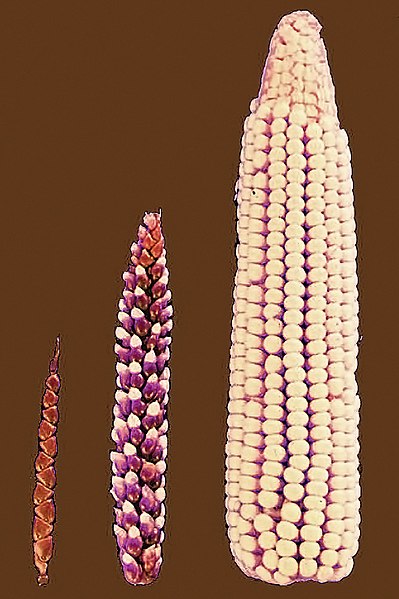
Another critical example of artificial selection, or domestication, that has shaped the modern world in particular came from Normal Borlaug’s work on wheat. Where ancient mesoamericans were selecting for corn based simply upon the appearance of a kernel, Borlaug, as a microbiologist, would select wheat strains based upon their DNA. The problems he was addressing with wheat were directly related to a need to increase yield, shorten the stem of the grain to improve its ability to hold up until harvest, and to make it more disease resistant. Through the use of genetics, this work addressed these problems in the short span of 20 years. The results are still being experienced by people around the world today, through their ability to feed many more people than would have been possible otherwise (nobelprize.org, 2019). There are myriad examples of human-driven artificial selection that have resulted in the food we eat today. Artificial selection works by humans purposefully choosing individuals that will reproduce, based on which ones have characteristics valued by the farmer or researcher.
Who are the "Fittest"?
Genetic change within populations acts randomly. Natural selection makes it more probable that individuals who are genetically prepared for current or new environmental realities will survive. They are the ones most likely to pass on the genes coded for the traits which permit survival. While genetic changes are random, natural selection is most definitely not random. Adaptations that make an organism fit for a cold climate, such as fur on a polar bear, will not likely be advantageous when that climate warms again at some point in the future. Staphylococcus aureus, a purveyor of infection throughout the human body, was famously stopped by the antibiotic Penicillin, developed by Alexander Fleming early in the last century. S. aureus roared back rapidly with resistance a few short years later and has now become so resistant to antibiotic treatment that some strains, such as “Methicillin-resistant S. aureus” (MRSA) are now feared in hospitals, where community infections can spread rapidly among healthy individuals (Chambers and DeLeo, 2010).
Evolution of a bacteria on a “Mega-Plate” petri dish, Koshony Lab, Harvard Medical School
Fitness is a situational circumstance, dependent upon being “good enough” for the environmental conditions of the moment, not the ability of an individual to “pull themselves up by their bootstraps”, or run a marathon, or win in a fight, providing themselves some kind of position of advantage through their own will. Ultimately the fitness of an individual is expressed by adaptations, or features that provide some improved function in an environment that is produced through natural selection. There are many features, it should be noted, that are not adaptations. These include vestigial structures, non-functional adaptations left over from an ancestor. Another example of a non-adaptive trait includes the red color of your own blood, which is a result of its chemistry and not due to some kind of selection. Exaptations make up another category. These are features that may have formerly had an adaptive purpose, but was not produced by natural selection for its current use. These can also be both physical and behavioral. One behavioral exaptation example might be domesticated dogs licking the mouths of their mothers. Interpreted as a means to get a parent to regurgitate food for them, this same behavior in wild wolves toward a lead wolf is interpreted as showing submissiveness (Bauer and Smuts, 2007).
Some traits can also be maladaptive, or harmful to a species fitness. A 2019 study released by Pagano et al. suggests that the eustachian tube construction in Neanderthal humans, Homo sapien neanderthalensis, made it susceptible to ear infections. Their reconstruction of the neanderthal eustachian tube suggests that its horizontal construction, very similar to human infants, may very well have even contributed to their eventual extinction. Human infants are notoriously susceptible to ear infections because of this construction of the tube, which can lead to pneumonia and, if left untreated, even death. As infants grow toward adolescence and adulthood, the eustachian tube does not remain horizontal, allowing drainage to occur and less likelihood of infections. Interestingly, while many of us (particularly of European descent) carry neanderthal genetic variants within our genome, given that our our two sub-species are known to have interbred thousands of years ago, it is likely that this eustachian tube, arguably maladaptive in neanderthals, is a trait derived from a common ancestor. Ultimately, this trait may have reduced fitness for our nearest human cousins while remaining a relatively benign feature for our own species.
- artificial selection - the process by which humans deliberately breed organisms for specific and preferred traits
- gene migration - the movement of genetic material from one population to another through the migration of individuals into a new area
- genetic drift - a change in the frequency of an allele over time caused by some individuals reproducing more successfully than others
- genetic mutations - changes in the sequence of nucleic bases in the coding portion of a DNA molecule
- genetic symbiosis - the transfer of genetic material from one species to another due to close physical interactions
- horizontal gene migration - the movement of genetic material between organisms that are not parent and offspring
- neo-Darwinian evolutionary theory - the theory that combines Charles Darwin's concept of natural selection with modern genetics, including Mendelian inheritance and the understanding of mutations