

16.2: Marine Vertebrates
- Page ID
- 10417

\( \newcommand{\vecs}[1]{\overset { \scriptstyle \rightharpoonup} {\mathbf{#1}} } \)
\( \newcommand{\vecd}[1]{\overset{-\!-\!\rightharpoonup}{\vphantom{a}\smash {#1}}} \)
\( \newcommand{\dsum}{\displaystyle\sum\limits} \)
\( \newcommand{\dint}{\displaystyle\int\limits} \)
\( \newcommand{\dlim}{\displaystyle\lim\limits} \)
\( \newcommand{\id}{\mathrm{id}}\) \( \newcommand{\Span}{\mathrm{span}}\)
( \newcommand{\kernel}{\mathrm{null}\,}\) \( \newcommand{\range}{\mathrm{range}\,}\)
\( \newcommand{\RealPart}{\mathrm{Re}}\) \( \newcommand{\ImaginaryPart}{\mathrm{Im}}\)
\( \newcommand{\Argument}{\mathrm{Arg}}\) \( \newcommand{\norm}[1]{\| #1 \|}\)
\( \newcommand{\inner}[2]{\langle #1, #2 \rangle}\)
\( \newcommand{\Span}{\mathrm{span}}\)
\( \newcommand{\id}{\mathrm{id}}\)
\( \newcommand{\Span}{\mathrm{span}}\)
\( \newcommand{\kernel}{\mathrm{null}\,}\)
\( \newcommand{\range}{\mathrm{range}\,}\)
\( \newcommand{\RealPart}{\mathrm{Re}}\)
\( \newcommand{\ImaginaryPart}{\mathrm{Im}}\)
\( \newcommand{\Argument}{\mathrm{Arg}}\)
\( \newcommand{\norm}[1]{\| #1 \|}\)
\( \newcommand{\inner}[2]{\langle #1, #2 \rangle}\)
\( \newcommand{\Span}{\mathrm{span}}\) \( \newcommand{\AA}{\unicode[.8,0]{x212B}}\)
\( \newcommand{\vectorA}[1]{\vec{#1}} % arrow\)
\( \newcommand{\vectorAt}[1]{\vec{\text{#1}}} % arrow\)
\( \newcommand{\vectorB}[1]{\overset { \scriptstyle \rightharpoonup} {\mathbf{#1}} } \)
\( \newcommand{\vectorC}[1]{\textbf{#1}} \)
\( \newcommand{\vectorD}[1]{\overrightarrow{#1}} \)
\( \newcommand{\vectorDt}[1]{\overrightarrow{\text{#1}}} \)
\( \newcommand{\vectE}[1]{\overset{-\!-\!\rightharpoonup}{\vphantom{a}\smash{\mathbf {#1}}}} \)
\( \newcommand{\vecs}[1]{\overset { \scriptstyle \rightharpoonup} {\mathbf{#1}} } \)
\(\newcommand{\longvect}{\overrightarrow}\)
\( \newcommand{\vecd}[1]{\overset{-\!-\!\rightharpoonup}{\vphantom{a}\smash {#1}}} \)
\(\newcommand{\ket}[1]{\left| #1 \right>}\)
\(\newcommand{\bra}[1]{\left< #1 \right|}\)
\(\newcommand{\braket}[2]{\left< #1 \vphantom{#2} \right| \left. #2 \vphantom{#1} \right>}\)
\(\newcommand{\braopket}[3]{\left< #1 \vphantom{#2}\vphantom{#3} \right| #2 \vphantom{#1}\vphantom{#3} \left| #3 \vphantom{#1}\vphantom{#2} \right>}\)
\(\newcommand{\qmvec}[1]{\mathbf{\vec{#1}}}\)
\(\newcommand{\op}[1]{\hat{\mathbf{#1}}}\)
\(\newcommand{\expect}[1]{\langle #1 \rangle}\)
\(\newcommand{\dfn}[1]{\emph{\textbf{#1}}}\)
Taxonomy of marine vertebrates include:
| ORDER |
Carnivora |
(have prominent canine teeth) | ||
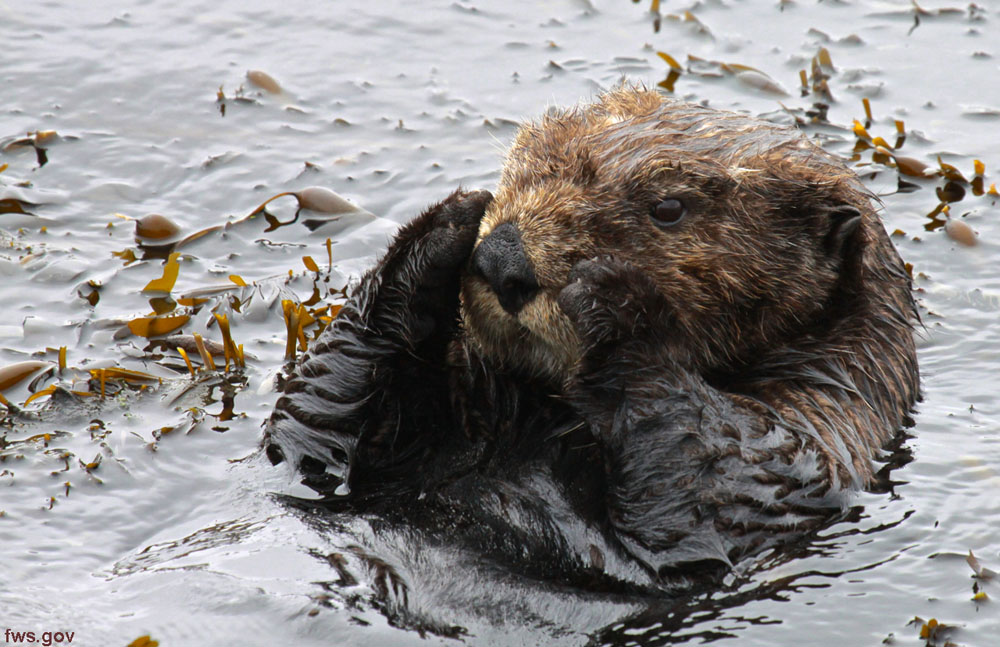
| FAMILY | Mustelidea | • Sea otters | Among the smallest of marine mammals, range: North Pacific, largest member of the weasel family. Each carries a pebble tool to break open shells. | |
| FAMILY | Ursus | • Polar bears | Live in the arctic circle, primary diet of seals, lives on ice, snow, open ocean. | |
| FAMILY | Pinnipeds | |||
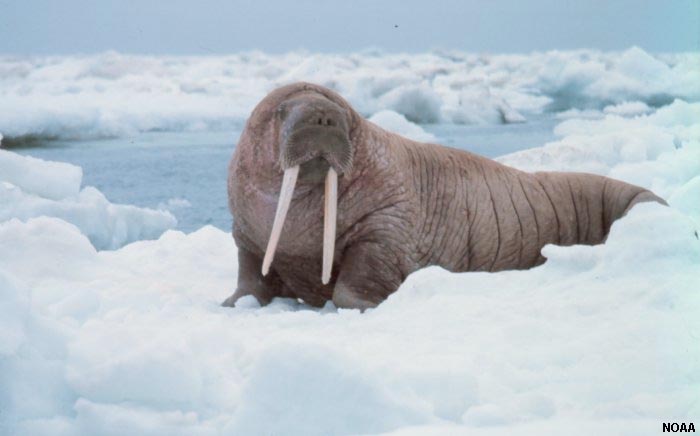
| GENUS | • Walruses | Range is in the Arctic and subarctic in Northern Hemisphere on continental shelves. Large tusks and whiskers used for foraging for bivalves on seabed. | ||
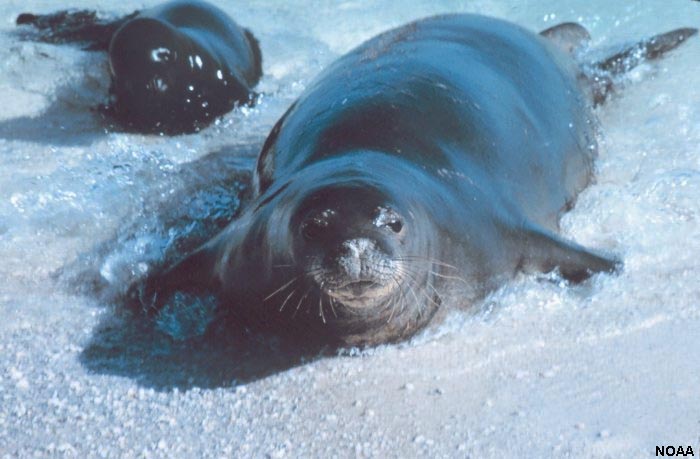
| GENUS | • Seals | Fin-footed ( flippers ), semi-aquatic marine mammals, 33 extant species worldwide. | ||
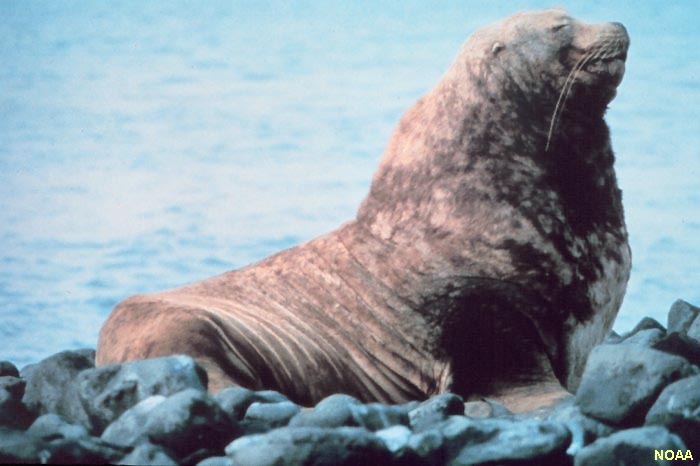
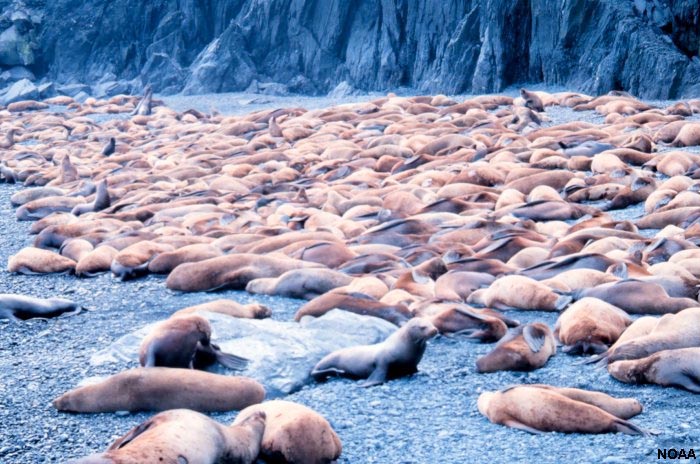
| GENUS | • Sea lions | Sea lion have external ear flaps, long fore flippers, the ability to walk on all fours, and are voracious eaters. Six species worldwide, except N. Atlantic. | ||
| GENUS | • Fur seals |
Similar to sea lions (smaller), 1 species in North Pacific, 7 species in S. Hemisphere; have external ear flaps, long fore flippers, ability to walk on all fours. |
||
| Examples of Marine Carnivores | |||
 |
 |
 |
 |
| Figure 16.3. Sea otter | Figure 16.4. Polar bears | Figure 16.5. Walrus | Figure 16.6. Walruses on ice. |
 |
 |
 |
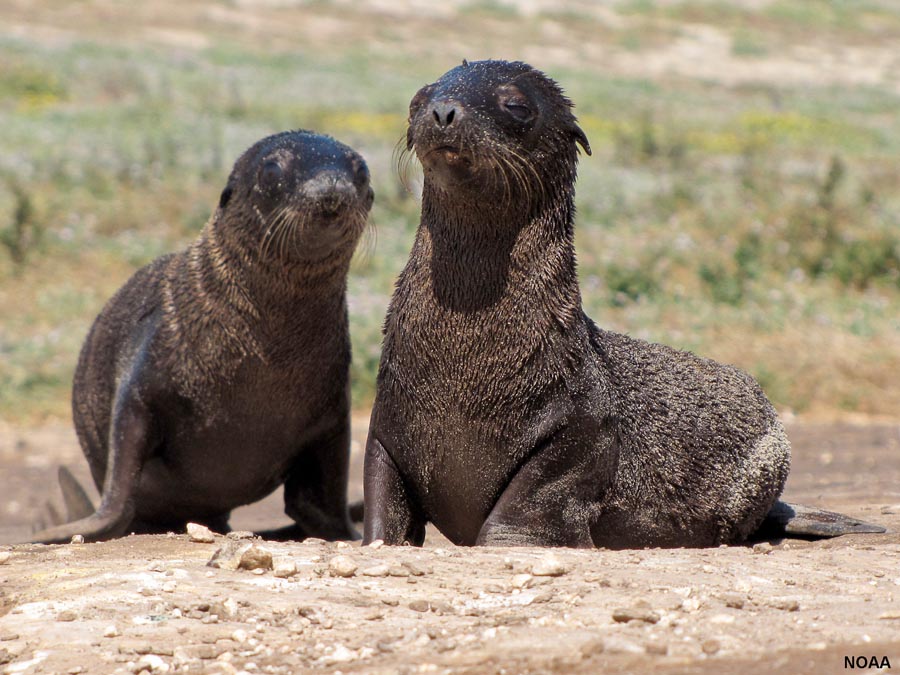 |
| Figure 16.7. Monk seal | Figure 16.8. Steller sea lion | Figure 16.9. Steller sea lion colony | Figure 16.10. Fur seals |
| ORDER |
Sirenia |
(Aquatic herbivores living in coastal areas) |
| FAMILY | • Manatees (tropical Atlantic Ocean) | |
| FAMILY | • Dugongs (Indian and western Pacific Oceans) |
| Examples of Sirenia | |
 |
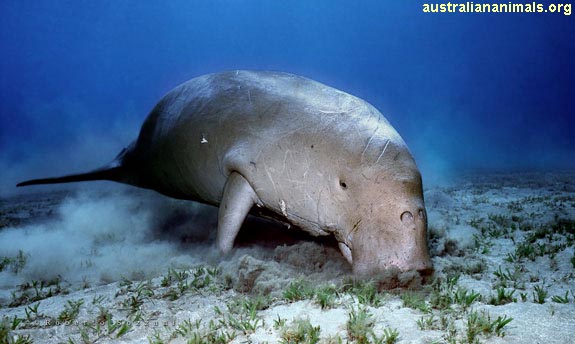 |
| Figure 16.11. Manatees | Figure 16.12. Dugong |
| ORDER | Cetacea | Cetaceans have elongated skull with blowholes on top, use echolocation: they emit click-like noises and get return—used to detect fish, and can be used to stun fish. Cetacea have large brains relative to body size; can communicate with each other, many are considered trainable. |
|
| SUB ORDER |
Odontocetes |
Toothed whales: | |
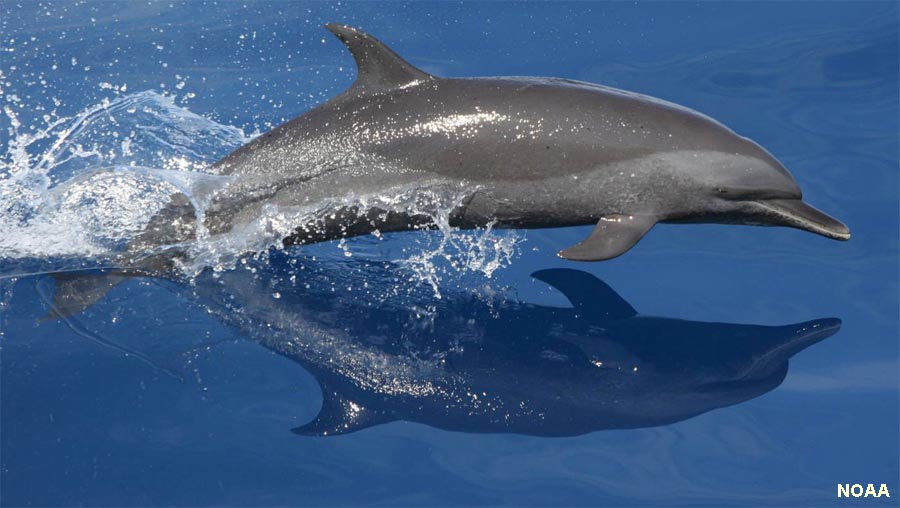
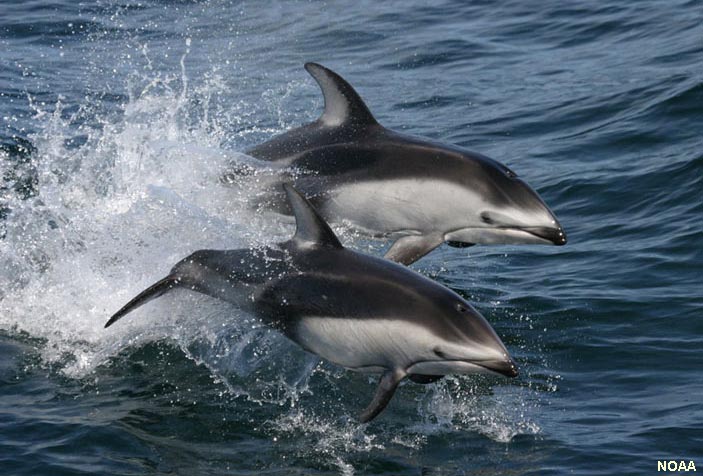
| FAMILY | • dolphins (Delphinidae) - seven genera with about 40 species, worldwide | ||
| FAMILY | • porpoises (Phocoenidae) - Compared with dolphins, porpoises have shorter beaks and flattened, spade-shaped teeth. | ||
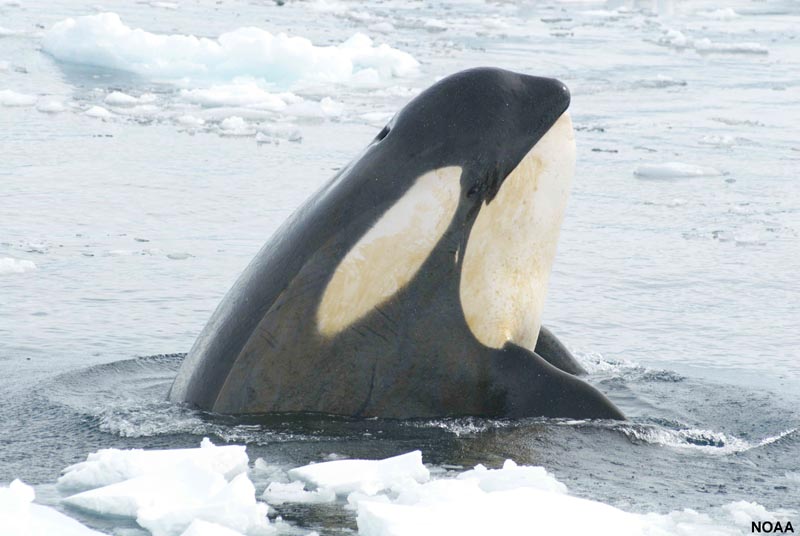
| FAMILY | • killer whales (technically a subfamily of dolphins, called "blackfish" or orcas - 6 species) | ||
| FAMILY | • beaked whales (have prominent noses [or nose -like features] - 22 species) | ||
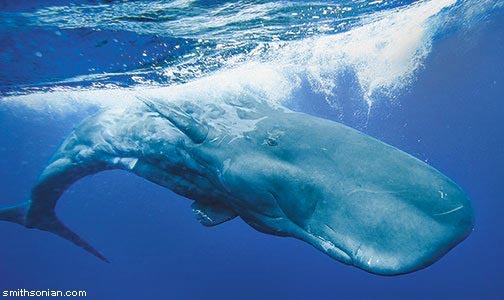
| FAMILY | • Sperm whales - largest of the toothed whales, 3 species, (They use echolocation to hunt giant squid.) | ||
| SUBORDER |
Mysticeti |
Baleen whales (Baleen is fibrous plates in whale mouths used to sieve prey items.) | |
| FAMILY | • Right whales (Balaenidae): 4 species live in northern oceans, mostly North Atlantic | ||
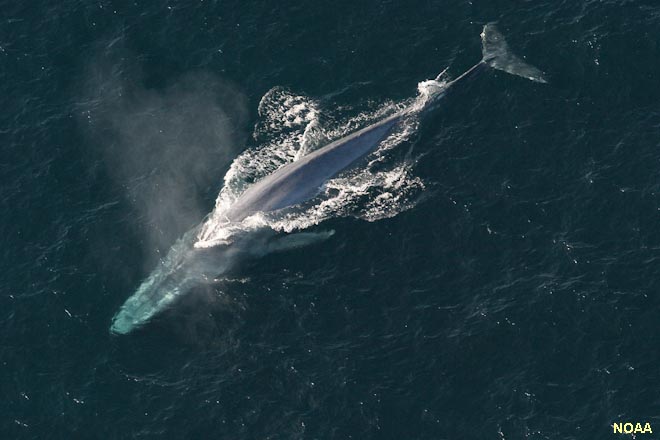
| FAMILY (1species) | • Rorquals whales (9 species, worldwide), includes: * Blue whale - largest of all mammal species - up to 30 m (98 ft), 180 tons |
||
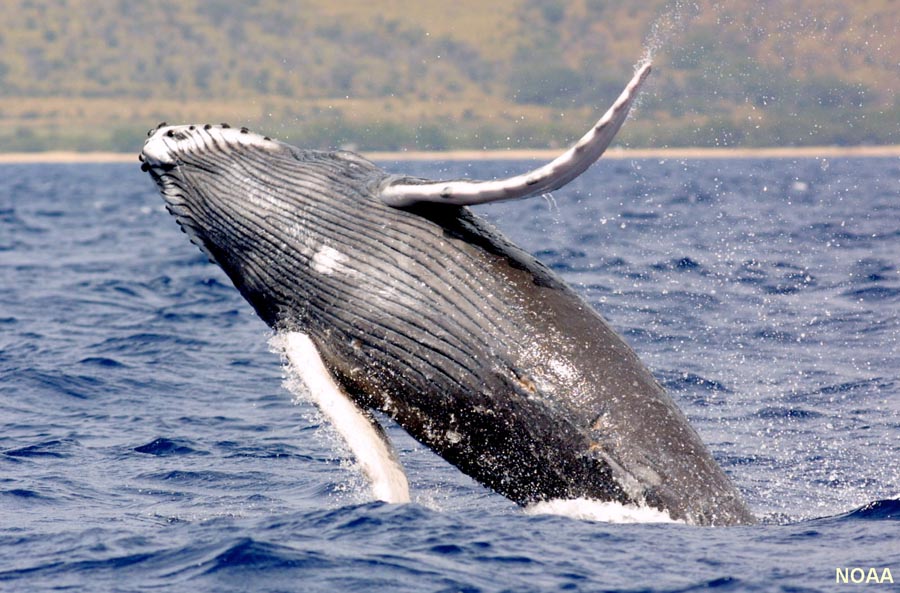
| FAMILY | • Humpback whales (1 species) - found in all oceans | ||
| FAMILY | • Gray whales (1 species) - live in coastal waters of the Northern Pacific only | ||
| Examples of Cetaceans | |||
 |
 |
 |
 |
| Figure 16.13. Dolphin | Figure 16.14. Porpoises | Figure 16.15. Killer whale | Figure 16.16. Narwhales |
 |
 |
 |
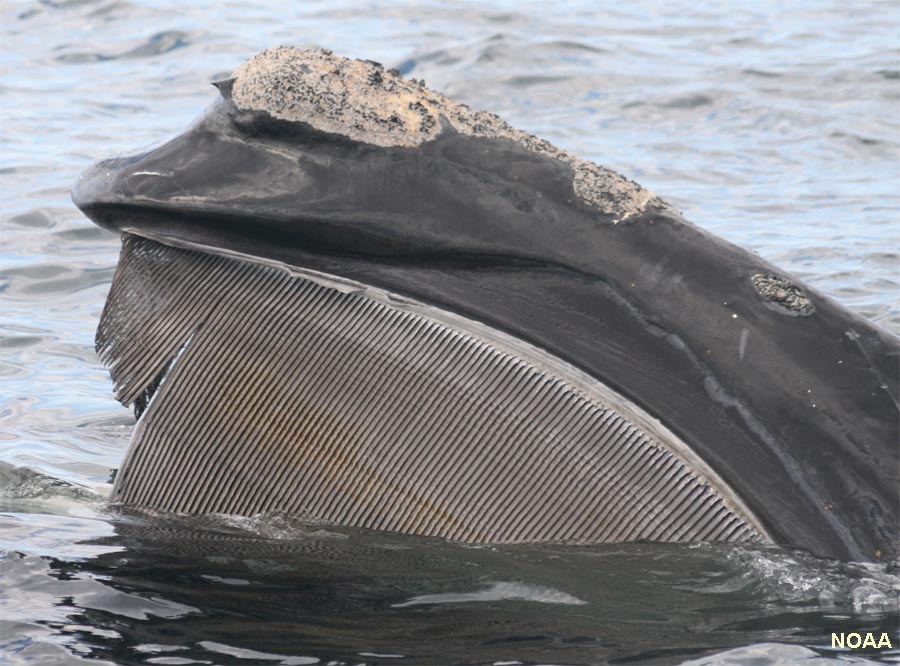 |
| Figure 16.17. Sperm whale | Figure 16.18. Blue whale | Figure 16.29. Humpback whale | Figure 16.20. Atlantic right whale (baleen showing) |