

14.3: Cenozoic Biology
- Page ID
- 42966
\( \newcommand{\vecs}[1]{\overset { \scriptstyle \rightharpoonup} {\mathbf{#1}} } \)
\( \newcommand{\vecd}[1]{\overset{-\!-\!\rightharpoonup}{\vphantom{a}\smash {#1}}} \)
\( \newcommand{\dsum}{\displaystyle\sum\limits} \)
\( \newcommand{\dint}{\displaystyle\int\limits} \)
\( \newcommand{\dlim}{\displaystyle\lim\limits} \)
\( \newcommand{\id}{\mathrm{id}}\) \( \newcommand{\Span}{\mathrm{span}}\)
( \newcommand{\kernel}{\mathrm{null}\,}\) \( \newcommand{\range}{\mathrm{range}\,}\)
\( \newcommand{\RealPart}{\mathrm{Re}}\) \( \newcommand{\ImaginaryPart}{\mathrm{Im}}\)
\( \newcommand{\Argument}{\mathrm{Arg}}\) \( \newcommand{\norm}[1]{\| #1 \|}\)
\( \newcommand{\inner}[2]{\langle #1, #2 \rangle}\)
\( \newcommand{\Span}{\mathrm{span}}\)
\( \newcommand{\id}{\mathrm{id}}\)
\( \newcommand{\Span}{\mathrm{span}}\)
\( \newcommand{\kernel}{\mathrm{null}\,}\)
\( \newcommand{\range}{\mathrm{range}\,}\)
\( \newcommand{\RealPart}{\mathrm{Re}}\)
\( \newcommand{\ImaginaryPart}{\mathrm{Im}}\)
\( \newcommand{\Argument}{\mathrm{Arg}}\)
\( \newcommand{\norm}[1]{\| #1 \|}\)
\( \newcommand{\inner}[2]{\langle #1, #2 \rangle}\)
\( \newcommand{\Span}{\mathrm{span}}\) \( \newcommand{\AA}{\unicode[.8,0]{x212B}}\)
\( \newcommand{\vectorA}[1]{\vec{#1}} % arrow\)
\( \newcommand{\vectorAt}[1]{\vec{\text{#1}}} % arrow\)
\( \newcommand{\vectorB}[1]{\overset { \scriptstyle \rightharpoonup} {\mathbf{#1}} } \)
\( \newcommand{\vectorC}[1]{\textbf{#1}} \)
\( \newcommand{\vectorD}[1]{\overrightarrow{#1}} \)
\( \newcommand{\vectorDt}[1]{\overrightarrow{\text{#1}}} \)
\( \newcommand{\vectE}[1]{\overset{-\!-\!\rightharpoonup}{\vphantom{a}\smash{\mathbf {#1}}}} \)
\( \newcommand{\vecs}[1]{\overset { \scriptstyle \rightharpoonup} {\mathbf{#1}} } \)
\(\newcommand{\longvect}{\overrightarrow}\)
\( \newcommand{\vecd}[1]{\overset{-\!-\!\rightharpoonup}{\vphantom{a}\smash {#1}}} \)
\(\newcommand{\avec}{\mathbf a}\) \(\newcommand{\bvec}{\mathbf b}\) \(\newcommand{\cvec}{\mathbf c}\) \(\newcommand{\dvec}{\mathbf d}\) \(\newcommand{\dtil}{\widetilde{\mathbf d}}\) \(\newcommand{\evec}{\mathbf e}\) \(\newcommand{\fvec}{\mathbf f}\) \(\newcommand{\nvec}{\mathbf n}\) \(\newcommand{\pvec}{\mathbf p}\) \(\newcommand{\qvec}{\mathbf q}\) \(\newcommand{\svec}{\mathbf s}\) \(\newcommand{\tvec}{\mathbf t}\) \(\newcommand{\uvec}{\mathbf u}\) \(\newcommand{\vvec}{\mathbf v}\) \(\newcommand{\wvec}{\mathbf w}\) \(\newcommand{\xvec}{\mathbf x}\) \(\newcommand{\yvec}{\mathbf y}\) \(\newcommand{\zvec}{\mathbf z}\) \(\newcommand{\rvec}{\mathbf r}\) \(\newcommand{\mvec}{\mathbf m}\) \(\newcommand{\zerovec}{\mathbf 0}\) \(\newcommand{\onevec}{\mathbf 1}\) \(\newcommand{\real}{\mathbb R}\) \(\newcommand{\twovec}[2]{\left[\begin{array}{r}#1 \\ #2 \end{array}\right]}\) \(\newcommand{\ctwovec}[2]{\left[\begin{array}{c}#1 \\ #2 \end{array}\right]}\) \(\newcommand{\threevec}[3]{\left[\begin{array}{r}#1 \\ #2 \\ #3 \end{array}\right]}\) \(\newcommand{\cthreevec}[3]{\left[\begin{array}{c}#1 \\ #2 \\ #3 \end{array}\right]}\) \(\newcommand{\fourvec}[4]{\left[\begin{array}{r}#1 \\ #2 \\ #3 \\ #4 \end{array}\right]}\) \(\newcommand{\cfourvec}[4]{\left[\begin{array}{c}#1 \\ #2 \\ #3 \\ #4 \end{array}\right]}\) \(\newcommand{\fivevec}[5]{\left[\begin{array}{r}#1 \\ #2 \\ #3 \\ #4 \\ #5 \\ \end{array}\right]}\) \(\newcommand{\cfivevec}[5]{\left[\begin{array}{c}#1 \\ #2 \\ #3 \\ #4 \\ #5 \\ \end{array}\right]}\) \(\newcommand{\mattwo}[4]{\left[\begin{array}{rr}#1 \amp #2 \\ #3 \amp #4 \\ \end{array}\right]}\) \(\newcommand{\laspan}[1]{\text{Span}\{#1\}}\) \(\newcommand{\bcal}{\cal B}\) \(\newcommand{\ccal}{\cal C}\) \(\newcommand{\scal}{\cal S}\) \(\newcommand{\wcal}{\cal W}\) \(\newcommand{\ecal}{\cal E}\) \(\newcommand{\coords}[2]{\left\{#1\right\}_{#2}}\) \(\newcommand{\gray}[1]{\color{gray}{#1}}\) \(\newcommand{\lgray}[1]{\color{lightgray}{#1}}\) \(\newcommand{\rank}{\operatorname{rank}}\) \(\newcommand{\row}{\text{Row}}\) \(\newcommand{\col}{\text{Col}}\) \(\renewcommand{\row}{\text{Row}}\) \(\newcommand{\nul}{\text{Nul}}\) \(\newcommand{\var}{\text{Var}}\) \(\newcommand{\corr}{\text{corr}}\) \(\newcommand{\len}[1]{\left|#1\right|}\) \(\newcommand{\bbar}{\overline{\bvec}}\) \(\newcommand{\bhat}{\widehat{\bvec}}\) \(\newcommand{\bperp}{\bvec^\perp}\) \(\newcommand{\xhat}{\widehat{\xvec}}\) \(\newcommand{\vhat}{\widehat{\vvec}}\) \(\newcommand{\uhat}{\widehat{\uvec}}\) \(\newcommand{\what}{\widehat{\wvec}}\) \(\newcommand{\Sighat}{\widehat{\Sigma}}\) \(\newcommand{\lt}{<}\) \(\newcommand{\gt}{>}\) \(\newcommand{\amp}{&}\) \(\definecolor{fillinmathshade}{gray}{0.9}\)Introduction
The extinction of all non-avian dinosaurs at the end of the Mesozoic created numerous ecological niches at the start of the Cenozoic. This, along with the absence of predators, enabled the rapid diversification of mammals through adaptive radiation. Before long, however, an early order of carnivorous species evolved: the creodonts, whose anatomy was similar to that of today’s predators. These types of "hypercarnivores" are described in detail in the video, "When Giant Hypercarnivores Prowled Africa". At the same time, small primate-like mammals evolved to live in trees: the plesiadapiforms (pic).
.jpg?revision=1) Figure \(\PageIndex{1}\): Simbakubwa, a type of creodont, is compared to a human. Image from: Mauricio Anton, CC BY-SA 4.0 <https://creativecommons.org/licenses/by-sa/4.0>, via Wikimedia Commons.
Figure \(\PageIndex{1}\): Simbakubwa, a type of creodont, is compared to a human. Image from: Mauricio Anton, CC BY-SA 4.0 <https://creativecommons.org/licenses/by-sa/4.0>, via Wikimedia Commons.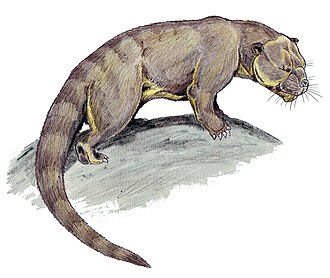 Figure \(\PageIndex{2}\): Patriofelis, a type of creodont. Image from: Dmitry Bogdanov, CC BY 3.0 <https://creativecommons.org/licenses/by/3.0>, via Wikimedia Commons.
At the start of the Cenozoic Era, the climate was relatively warm, and by the end of the Paleogene Epoch, Earth was experiencing greenhouse conditions, with no continental glaciers anywhere on the planet. This rapid global warming, known as the Paleocene-Eocene Thermal Maximum, may have been driven by greenhouse gases released into the atmosphere through increased volcanic activity or the melting of methane ice. The heat was great for reptiles, allowing them to diversify and grow larger. For example, this time saw the world’s largest snake, Titanoboa, which grew to 43 feet long, nearly the length of a school bus!
Around 49 million years ago, in the mid-Eocene, the planet began to cool. This gradual shift from greenhouse conditions to eventually icehouse conditions may have been triggered by the widespread growth of the CO2-capturing “micro-fern” in Antarctica, azolla. Through photosynthesis, the azolla may have captured as much 50% of the atmosphere’s CO2. The changing climate conditions led to the extinction of many ancient mammal groups, which were eventually replaced by the ancestors of today’s rodents, rhinos, horses, and primates. As the climate cooled and dried, a new biome, the grassland, developed. This significant development drove evolution as animals needed to adapt to eat the new, fibrous grass. In particular, mammals evolved a second stomach, which enabled fermentation of grass and subsequent rechewing to facilitate proper digestion.
 Figure \(\PageIndex{3}\): Photograph of azolla from Kurt Stüber [1], CC BY-SA 3.0 <http://creativecommons.org/licenses/by-sa/3.0/>, via Wikimedia Commons.
New World monkeys first appear in the fossil record approximately 26 million years ago. The New World monkeys flourished in the trees, whereas the Old World monkeys adapted to life on the ground. The first apes evolved from Old World monkeys around the beginning of the Miocene Epoch, characterized by the absence of a tail, more flexible shoulders, and shorter spines: traits that eventually helped them to walk upright on two legs. As the climate cooled, grasslands expanded, as did grazing mammals. By the end of the Miocene, approximately 5 million years ago, the lineage of primates that would become humans had diverged from species such as orangutans and gorillas. Our earliest ancestors, Australopithecus, inhabited expanding grasslands and may have been able to digest grass. By 2.8 million years ago, a new genus, Homo (as in Homo sapiens), appeared. More detail is given in the following video: From the Fall of Dinos to the Rise of Humans.
The Ice Age and Mega Fauna
Earth has experienced at least five ages: periods during which continental ice sheets covered continents, like Greenland and Antarctica today. The ice age we're currently in began 2.6 million years ago, marking the start of the Pleistocene Epoch. During ice ages, Earth naturally cools and warms: glacial and interglacial periods. Currently, we're experiencing an interglacial period that has been exacerbated by human-caused global warming. The glacial and interglacial periods are the result of changes to Earth’s axial tilt (22-24.5 degrees) called obliquity, changes to the direction the axis is pointing (think of a wobbly spinning top) known as precession, and changes in the eccentricity (how much the orbital path varies from a perfect circle) of Earth’s orbital path. Combined, these factors can cause more extreme or milder seasons - glacial and interglacial periods.
 Figure \(\PageIndex{4}\): Eccentricity, Obliquity, and Precession. Image from BBC Science Focus (https://c01.purpledshub.com/bbcscien...ffect-climate/).
The glaciation associated with this ice age significantly shaped Earth’s current landscapes. In mountain ranges such as the Sierra Nevada, mountain peaks and intervening valleys are clearly shaped by glacial erosion, whereas in low-lying areas throughout the Midwest and eastern North America, glacial deposits predominate. What brought on this latest ice age is debatable, but it seems that the closure of the Tethys Sea and the equatorial passage between the Atlantic and Pacific oceans were likely contributors, as these events would have disrupted the warm and cold ocean currents, making it more likely that there would be extreme temperature gradients in equatorial vs arctic oceans. In turn, high latitude continents would experience colder winters, and the formation of glaciers would be more likely.
This video discusses the erosional landforms created by glaciers at Long Lake in the Sierra Nevada Mountains in California.
During the Pleistocene ice age, some mammal populations grew significantly larger than they do today, including the famous Woolly Mammoths, saber-toothed cats, and the Megalodon. The increase in body size was an adaptation to cool climates. Larger bodies retain heat more effectively, use energy more efficiently, and are more difficult for predators to kill. Additionally, animals continued to fill ecological niches vacated by the dinosaurs, allowing them to reach sizes larger than those of today.

.png?revision=1&size=bestfit&width=663&height=348) Figure \(\PageIndex{5}\): Smilodon fatalis, a type of saber-toothed cat, and size comparison of commons smildons relative to a human. Images from: Dantheman9758 at English Wikipedia, CC BY 3.0 <https://creativecommons.org/licenses/by/3.0>, via Wikimedia Commons, and Vectorization: Alhadis, CC BY-SA 4.0 <https://creativecommons.org/licenses/by-sa/4.0>, via Wikimedia Commons, respectively.
Figure \(\PageIndex{5}\): Smilodon fatalis, a type of saber-toothed cat, and size comparison of commons smildons relative to a human. Images from: Dantheman9758 at English Wikipedia, CC BY 3.0 <https://creativecommons.org/licenses/by/3.0>, via Wikimedia Commons, and Vectorization: Alhadis, CC BY-SA 4.0 <https://creativecommons.org/licenses/by-sa/4.0>, via Wikimedia Commons, respectively. Cenozoic Evolution
There are five groups of early mammals in the fossil record, based primarily on fossil teeth, the hardest bone in vertebrate skeletons, and therefore most likely to fossilize. For the purposes of this text, the most important group is the Eupantotheres, which diverged into the two main mammalian lineages, marsupials (e.g., Sinodelphys) and placentals (eutherians; e.g., Eomaia), in the Cretaceous and then diversified in the Cenozoic. The marsupials dominated on the isolated island continents of South America and Australia, and many went extinct in South America with the introduction of placental mammals. Modern-day examples include kangaroos, opossums, and koalas.
Some well-known placental mammal groups have been extensively studied and exhibit interesting evolutionary histories in the Cenozoic. For example, horses began with four toes and evolved into larger forms with a single toe. Cetaceans (marine mammals such as whales and dolphins) originated on land from small bear-like (Mesonychidae) creatures in the early Cenozoic and gradually transitioned to aquatic life. Some of the largest terrestrial animals also evolved, including Paraceratherium, a distant relative of rhinoceros.
 Figure \(\PageIndex{6}\): A comparison of Paraceratherium to other mammals. Image from: Steveoc 86 (original silhouettes and diagram) Hemiauchenia (modified version), CC BY 4.0 <https://creativecommons.org/licenses/by/4.0>, via Wikimedia Commons.
However, no evolutionary process has been studied more than human evolution. Hominids, the name for human-like primates, started in eastern Africa several million years ago.
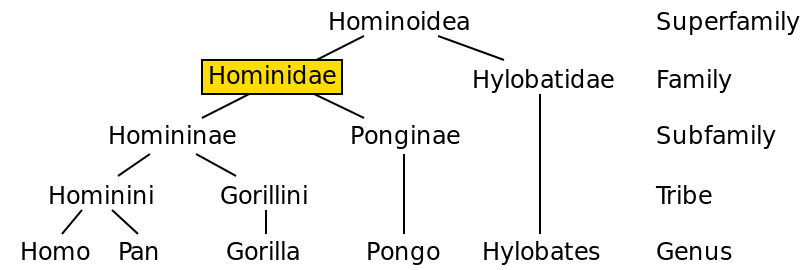
The first critical event in this story is an environmental change from the jungle to the grasslands or savanna biomes. This was probably caused by changes to the Indian Ocean circulation as the Tethys Ocean closed. While bipedalism is known to have evolved before this shift, it is generally believed that our bipedal ancestors, such as Australopithecus, had an advantage in covering ground more easily in open environments than their non-bipedal evolutionary cousins. There is also a growing body of evidence, including the famous “Lucy” Australopithecine fossil, that our early ancestors lived in trees. Arboreal animals (tree-living) usually demand a high intelligence to navigate through a three-dimensional world. It is from this lineage that humans evolved, using endurance running to acquire more resources and hunt down prey. This can explain many uniquely human features, from our long legs, strong achilles, lack of lower gut protection, and our wide range of running efficiencies.

One advantage that hominids have over other animals is the ability to walk upright, which frees the hands for activities such as tool and weapon use. Another is a large brain. There have been arguments that this increase in brain size can be explained by shifts toward greater meat consumption and the use of fire for cooking, which made meat more nutritious, tool use, and even the emergence of society itself. Regardless of how, this increased cognitive power enabled humans to expand beyond Africa and explore the world, ultimately reaching the Americas via land bridges such as the Bering Land Bridge. Human evolution is a fascinating topic that is covered extensively in anthropology and related textbooks.

Anthropocene and Extinction
Humans have influenced Earth, its ecosystems, and its climate. Yet human activity cannot explain all of the changes that have occurred in the recent past. The Quaternary Period, the last and current period of the Cenozoic, began 2.58 million years ago with the onset of the current ice age. During this period, ice sheets advanced and retreated, most likely driven by Milankovitch cycles. At this time, various cold-adapted megafauna emerged (e.g., giant sloths, saber-toothed cats, and woolly mammoths), and most of them went extinct as the Earth warmed following the most recent glacial maximum. A long-standing debate concerns the causes of these and other extinctions. Is climate warming to blame, or were they caused by humans? Certainly, we know of recent human-caused extinctions of animals such as the dodo and the passenger pigeon. Can we connect modern extinctions to extinctions in the recent past? If so, there are several possible explanations for how this happened. Possibly the most widely accepted and oldest is the hunting/overkill hypothesis. This hypothesis is that, as humans hunted large herbivores for food, carnivores were unable to find prey, and human arrival times at locations have been shown to be associated with increased extinction rates in many cases.

Modern human impact on the environment and the Earth as a whole is unquestioned. In fact, many scientists are starting to suggest that the rise of human civilization ended and/or replaced the Holocene epoch and defines a new geologic time interval: the Anthropocene. Evidence for this change includes extinctions, increased tritium (hydrogen with two neutrons) due to nuclear testing, rising pollutants like carbon dioxide, more than 200 never-before-seen mineral species that have occurred only in this epoch, materials such as plastic and metals, which will be long-lasting “fossils” in the geologic record, and large amounts of earth material moved. The biggest scientific debate on this topic is the starting point. Some argue that the human invention of agriculture would be recognized in geologic strata, and that this should be the starting point, around 12,000 years ago. Others link the start of the Industrial Revolution to the subsequent increase in atmospheric carbon dioxide. Either way, the idea is that alien geologists visiting Earth in the distant future would easily recognize the impact of humans on the Earth as the beginning of a new geologic period.

- adaptive radiation - the diversification of a group of organisms into forms filling different ecological niches
- Anthropocene - a proposed geological epoch defined by humanity's significant, transformative impact on Earth's climate, ecosystems, and geology
- glacial - time interval cold enough to support widespread glaciation
- hominids - a group of large-bodied primates that includes modern humans and the great apes
- interglacial - time interval between glacials that does not support widespread glaciation
- Paleocene-Eocene Thermal Maximum - rapid global warming occurring part way through the Cenozoic Era