

14.12: Review and Additional Resources
- Page ID
- 42742

\( \newcommand{\vecs}[1]{\overset { \scriptstyle \rightharpoonup} {\mathbf{#1}} } \)
\( \newcommand{\vecd}[1]{\overset{-\!-\!\rightharpoonup}{\vphantom{a}\smash {#1}}} \)
\( \newcommand{\dsum}{\displaystyle\sum\limits} \)
\( \newcommand{\dint}{\displaystyle\int\limits} \)
\( \newcommand{\dlim}{\displaystyle\lim\limits} \)
\( \newcommand{\id}{\mathrm{id}}\) \( \newcommand{\Span}{\mathrm{span}}\)
( \newcommand{\kernel}{\mathrm{null}\,}\) \( \newcommand{\range}{\mathrm{range}\,}\)
\( \newcommand{\RealPart}{\mathrm{Re}}\) \( \newcommand{\ImaginaryPart}{\mathrm{Im}}\)
\( \newcommand{\Argument}{\mathrm{Arg}}\) \( \newcommand{\norm}[1]{\| #1 \|}\)
\( \newcommand{\inner}[2]{\langle #1, #2 \rangle}\)
\( \newcommand{\Span}{\mathrm{span}}\)
\( \newcommand{\id}{\mathrm{id}}\)
\( \newcommand{\Span}{\mathrm{span}}\)
\( \newcommand{\kernel}{\mathrm{null}\,}\)
\( \newcommand{\range}{\mathrm{range}\,}\)
\( \newcommand{\RealPart}{\mathrm{Re}}\)
\( \newcommand{\ImaginaryPart}{\mathrm{Im}}\)
\( \newcommand{\Argument}{\mathrm{Arg}}\)
\( \newcommand{\norm}[1]{\| #1 \|}\)
\( \newcommand{\inner}[2]{\langle #1, #2 \rangle}\)
\( \newcommand{\Span}{\mathrm{span}}\) \( \newcommand{\AA}{\unicode[.8,0]{x212B}}\)
\( \newcommand{\vectorA}[1]{\vec{#1}} % arrow\)
\( \newcommand{\vectorAt}[1]{\vec{\text{#1}}} % arrow\)
\( \newcommand{\vectorB}[1]{\overset { \scriptstyle \rightharpoonup} {\mathbf{#1}} } \)
\( \newcommand{\vectorC}[1]{\textbf{#1}} \)
\( \newcommand{\vectorD}[1]{\overrightarrow{#1}} \)
\( \newcommand{\vectorDt}[1]{\overrightarrow{\text{#1}}} \)
\( \newcommand{\vectE}[1]{\overset{-\!-\!\rightharpoonup}{\vphantom{a}\smash{\mathbf {#1}}}} \)
\( \newcommand{\vecs}[1]{\overset { \scriptstyle \rightharpoonup} {\mathbf{#1}} } \)
\(\newcommand{\longvect}{\overrightarrow}\)
\( \newcommand{\vecd}[1]{\overset{-\!-\!\rightharpoonup}{\vphantom{a}\smash {#1}}} \)
\(\newcommand{\ket}[1]{\left| #1 \right>}\)
\(\newcommand{\bra}[1]{\left< #1 \right|}\)
\(\newcommand{\braket}[2]{\left< #1 \vphantom{#2} \right| \left. #2 \vphantom{#1} \right>}\)
\(\newcommand{\braopket}[3]{\left< #1 \vphantom{#2}\vphantom{#3} \right| #2 \vphantom{#1}\vphantom{#3} \left| #3 \vphantom{#1}\vphantom{#2} \right>}\)
\(\newcommand{\qmvec}[1]{\mathbf{\vec{#1}}}\)
\(\newcommand{\op}[1]{\hat{\mathbf{#1}}}\)
\(\newcommand{\expect}[1]{\langle #1 \rangle}\)
\(\newcommand{\dfn}[1]{\emph{\textbf{#1}}}\)
Summary
Review and assess your learning. Start with the "Important Terms and Concepts" to ensure you know the terminology related to the topic of the chapter and concepts discussed. Move on to the "Review Questions" to answer critical thinking questions about concepts and processes discussed in the chapter. Finally, test your overall understanding by taking the "Self-assessment quiz".
-
- Biogeography
- the study of the geographical patterns of plant and animal species
-
- Ecology
- the study of the interactions among organisms
-
- ecosystem
- a functioning entity of all the organisms in a biological system generally in equilibrium with the inputs and outputs of energy and materials in a particular environment
-
- habitat
- the natural environment in which an organism lives
-
- niche
- the function or occupation, of a life-form within a community. An organism's niche incorporates the physical (habitat), chemical, and biological factors that maintains the health and vitality of the organism.
-
- photosynthesis
- the process of converting solar energy, water, and carbon dioxide into carbohydrates and oxygen
-
- transpiration
- the loss of water from plant leaves
-
- respiration
- the process of "burning" stored chemical energy, basically through oxidation, for maintaining plant metabolism
-
- net biomass productivity
- the difference between gross productivity (production of plant material by photosynthesis) and respiration
-
- trophic level
- an organism's position in a food chain
-
- primary producer
- the bottom of the food chain; They convert solar energy into organic energy.
-
- decomposer
- make use of energy stored in already dead plant and animal tissues
-
- food chain
- the sequence of consumption and energy transfer through the environment
-
- First law of thermodynamics
- energy cannot be created or destroyed
-
- Second law of thermodynamics
- whenever energy is transformed, there is a loss energy through the release of heat
-
- plant succession
- evolution of natural vegetation of a particular location
-
- open forest
- lack of light for understory growth allows you to see into for some distance
-
- closed forest
- canopy density is low, more light filters to the surface creating a thick ground cover; nearly impossible to see more than a few meters into it
-
- biogeographical realm
- geographical regions out of which assemblages of plants and animals evolved and dispersed
-
- Palaearctic realm
- stretched across Europe, most of Asia, the Mediterranean, North Africa. It is very similar to the Nearctic in terms of the diversity of biomes including tundra, grassland, deciduous and coniferous forest, chaparral, and desert biomes
-
- Nearctic realm
- includes most of North America and Greenland. The Nearctic realm possesses a great diversity of biomes including the tundra, grassland, deciduous and coniferous forest, chaparral, and desert biomes
-
- Neotropical realm
- found throughout most of central and South America is dominated by tropical forests, savannas, and deserts.
-
- Afrotropical realm
- inhabited by tropical forests, savannas, and deserts and is found in Africa south of the Sahara
-
- Australian realm
- has a desert core, surrounded by tropical forest and savanna. The Australian realm boasts a unique variety of plants and animals as they have evolved in isolation from outside influence
-
- Indomalayan realm
- includes much of southeast Asia and is nearly exclusively tropical forest
-
- Antarctic realm
- exhibits a diverse set of ecosystems from temperate forest and grassland in New Zealand to tundra and ice sheets in Antarctica.
-
- Oceanian realm
- includes tropical islands of the Pacific ocean and dominated by tropical forests
-
- biome
- a large stable terrestrial ecosystem
-
- Forest biome
- consists of close growing trees with leaf canopies that generally overlap
-
- Tropical rain forest
- contains trees standing 30 to 55 meters in height, creating a continuous canopy of foliage. The enclosed canopy shades the forest floor, creating an open forest formation
-
- Tropical Monsoon/Seasonal Forest and Scrub
- contains trees of smaller stature than those found in the rain forest; open canopy that creats a dense, closed forest at the floor, or what we think of as a "tropical jungle".
-
- Mediterranean Sclerophyllus Woodland
- consists of low branching trees with small hard leaves and gnarled thick bark
-
- Midlatitude Broadleaf Deciduous and Mixed Forest
- contains evergreen and/or deciduous trees reaching heights of 15 to 25 meters. The broadleaf forest dominates equatorward, while toward the north, conifers intermingle to create a mixed forest. In most cases the forest is an open forest with little under story growth, though some shade tolerant annual species occupy the ground.
-
- Broadleaf evergreen forest
- mild maritime air masses keep conditions moist enough to suppress any summer drought and provide temperatures warm enough to prevent a threat of frost.
-
- Temperate rain forest (Marine west coast forest)
- known for its lush vegetation occurring along narrow margins of the Pacific Northwest in North America. Composed of a few species of broadleaf and needle leaf trees, huge ferns, and a thick undergrowth.
-
- Northern Coniferous forest
- aka boreal forest; dominated by coniferous trees, with hardy deciduous trees like birch mixed in
-
- Boreal forest
- aka northern coniferous forest; dominated by coniferous trees, with hardy deciduous trees like birch mixed in
-
- Taiga
- a more open form of boreal forest with low growing conifers
-
- Savanna biome
- characterized by an extensive cover of grasses with scattered trees. It is a transitional biome between those dominated by forests and those dominated by grasses
-
- Tropical savanna
- An extensive cover of tall grasses, sometimes reaching a height of 3 meters; Most savanna grass is coarse and grows in tufts with intervening patches of bare ground. Scattered, individual trees or small groves of trees are common.
-
- Thorntree and tropical scrub
- characterized by short, thorny trees and shrubs
-
- Midlatitude savanna (Parkland)
- grasses are broken by patches or ribbons of broadleaf trees
-
- Grassland biome
- dominated by grasses of a variety of species, all having adapted to the summer drought common to their semiarid habitat. The broad expanse of the grasslands is occasionally broken by stands of trees.
-
- Prairie
- found on the humid side of the grassland biome and are often referred to as the tall-grass prairie. A favorable annual moisture balance supports a dense ground cover of tall grasses. Grasses range in height between .6 to 1.2 meters (2 to 4 ft.), with some as tall as 8 feet or more
-
- Steppe grassland
- grasses smaller than a half meter (2 ft); toward the drier portions the ground cover becomes sparse with patches of open ground found between clumps of grass.
-
- Desert biome
- has the lightest cover of plants of any biome. Lack of moisture prevents plants from establishing themselves in this harsh climate. Many unique adaptations to the extreme heat and lack of moisture enable some plants to survive
-
- Dry desert
- Extremely dry regions, some places hardly receiving any measurable precipitation during the year. Plant cover is non-existent over much of the dry desert.
-
- Shrub desert
- supports a more diverse community of plants and animals; more precipitation and cooler temperatures help support a more complete ground cover
-
- oasis
- created where the water table is near the surface. Groundwater can be easily extracted to support vegetation and wildlife.
-
- xerophyte
- Plants adapted to drought
-
- deflation
- when wind dislodges particles and transports them away
-
- desertification
- the expansion of dry lands due to poor agricultural practices (e.g. overgrazing, degradation of soil fertility and structure), improper soil moisture management, salinization and erosion, forest removal, and climate change.
-
- Tundra biome
- found at high elevations in mountainous terrain
-
- Arctic tundra
- Short grasses, flowers, and grass-like sedges, along with covers of mosses and lichens are the dominate forms of vegetation in the tundra. Seasonal frost heave disrupts root systems preventing support for tall vegetation; looks like a treeless plain, interrupted by patterned ground and an occasional tree in selected microenvironments
-
- Alpine tundra
- landscape is dotted with small cushion plants, lichens and mosses. Willows are found where moisture is abundant; Vegetation consists of low growing shrubs, cushion plants, small forbs exploding with colorful flowers and lush meadows of sedges and grasses. These plants cover gentle slopes and rock crevices. Rock surfaces are dotted with a cover of lichens and mosses.
How do plants and animals differ in their ability to occupy habitats?
- Answer
-
The effectiveness of habitat occupation depends in part on the means of transportation. Animals must use their own locomotion, while plants disperse by wind, running water, ocean currents, and animals. Thus, climate and topographic barriers are more of an impediment to animals than plants. For either, continental drift poses a significant barrier to diffusion. The separation of continents has isolated plants and animals in the past thus preventing their complete occupation of a suitable habitat.
What is photosynthesis, respiration, and transpiration?
- Answer
-
Photosynthesis is the process where by green plants convert carbon dioxide and energy into oxygen and stored carbohydrates. Respiration is the burning of stored chemical energy. Transpiration is the loss of water through the stomata of plant leaves.
What is the difference between a habitat and niche?
- Answer
-
A habitat is the specific, physical location of an organism. Habitats can be identified at different spatial scales. A niche is the function or occupation, of a life-form within a community. An organism's niche incorporates the physical (habitat), chemical, and biological factors that maintains the health and vitality of the organism. An organism's interaction with the abiotic factors of its environment (heat and moisture) defines its niche.
Which biome has the largest annual amount of net primary production?
- Answer
-
The tropical rain forest has the largest net primary production of all biomes.
How do plants adapt to extreme aridity?
- Answer
-
Plants have adapted to dry conditions by evolving deep roots to extract water held deep beneath the surface. Some plants have extensive near surface root systems to catch infiltrating water, or thick fleshy leaves. Others have thick bark and or short waxy leaves to reduce transpiration. Plants go dormant during dry periods, drop their leaves, or have no leaves at all. They instead have thick moisture retentive, photosynthetic skin.
Describe the concpet of "plant succession".
- Answer
-
Is the evolutionary process that tends toward a stable, diverse plant community (climax community). Each community prepares the environment for that which succeeds it.
What are the limiting factors to growth in the low latitudes? High Latitudes?
- Answer
-
The limiting factor to growth in low latitudes is moisture. The limiting factor to growth in high latitudes is energy (solar radiation).
Explain what a food chain is. Your answer must include the concepts of trophic level, primary producer, consumer and decomposer.
- Answer
-
A food chain is the sequence of consumption and energy transfer through an ecosystem. A food chain consists consists of different trophic levels which are the position of an organism in a food chain. At the base is the primary producers that convert solar energy into organic energy. Above the producers are the consumers that ingest live plants (primary consumer) or prey on other consumers (secondary consumer). Decomposers such as, bacteria, molds, and fungi make use of energy stored in already dead plant and animal tissues.
How do plant communities affect the local environment in which they are found?
- Answer
-
Plant communities affect soil type when organic material decomposes into the soil altering soil moisture retention, infiltration capacity, soil structure and soil chemistry. Trees shade the forest floor, reducing incident solar radiation and lowering temperatures of both the soil and the air. Reduced incident light decreases evaporation keeping soils moister beneath the forest canopy. These impacts affect animal habitats and the diversity of animal species which are associated with these plant communities.
What is net biomass productivity and determines it? What types of environments produce high and low amounts of biomass productivity?
- Answer
-
Net biomass productivity is the difference between gross productivity (production of plant material by photosynthesis) and respiration. Net productivity is closely related to a number of environmental factors like climate, soils, and available nutrients. Net biomass production will be highest where there is an ample supply of moisture to meet the needs of plants. Biomass productivity is also high where soils are rich in nutrients and have a positive soil moisture balance. Forest, especially tropical forest have high net biomass productivity while deserts have low productivity.
Compare and contrast the canopy and forest floors of the tropical rain forests and the tropical monsoon forests.
- Answer
-
The tropical rain forests are considered an open forest while the tropical monsoon is considered a closed forest. The crowns of tropical rain forest trees intermingle creating a dense canopy that inhibits the penetration of light to the surface. This prevents much dense undergrowth to develop on the forest floor. The tropical monsoon forest has a dense undergrowth as the canopy is more open allowing light to the surface.
Describe how the vegetation and climate change going from the Arctic coast of Canada to the Gulf Coast of the United States along the 90th meridian.
- Answer
-
Arctic Tundra (Tundra Climate) -> Northern Coniferous Forest (Subarctic Climate) -> Midlatitude Broadleaf and Mixed Deciduous Forest (Humid Continental) ->Tall Grass Prairie (Humid Continental) ->Southern Coniferous Forest (Humid Subtropical Climate)
Describe how the vegetation and climate change going from the west coast to the east coast of the United States along the 35N parallel.
- Answer
-
Sclerophyllus Woodland (Dry Summer Subtropical Climate) ->Mountain ( Undifferentiated Mountain Climate)-> Cool Shrub Desert (Midlatitude Desert Climate) Short Grass Prairie (Midlatitude Steppe Climate) -> Tall Grass Prairie (Humid Continental Climate) Midlatitude Deciduous Forest (Humid Continental Climate) -> Southern Coniferous Forest (Humid Subtropical Climate).
What is a savanna and which climate(s) is a savanna usually associated with?
- Answer
-
The savanna biome is characterized by drought tolerant grasses with scattered trees. The tropical savanna is associate with the wet/dry tropical climate.
Compare and contrast the vegetation and climate conditions associated with short and tall grass prairies.
- Answer
-
The short and tall grass prairies reflect the climate the flourish under. Short grass prairie, as its name implies, is comprised of short grasses (e.g., little bluestem grasses, generally less than 2 feet tall and will appear in clumps or patches, especially where the climate (midlatitude steppe) is drier. The tall grass prairie lying on the drier side of the humid continental and moist side of the midlatitude steppe has grasses that stand 2 to 4 feet and sometimes taller. Big bluestem grasses and Black-eyed Susans are common plants.
Permafrost is common to the tundra. What is permafrost and how does it influence the habitability of the tundra for both vegetation and humans?
- Answer
-
Permafrost refers to permanently frozen ground. Actually, the ground has two layers which freeze. A surface layer, called the active layer, thaws during the short "summer" and often subsides. Beneath the active layer is the inactive layer which stays frozen throughout the year. Permafrost creates a barrier to the root development. Larger trees can grow along better drained river valleys where the depth to permafrost is greater. The annual freezing and thawing disrupts root systems inhibiting the growth of very tall vegetation. Permafrost creates an unstable surface for the construction of buildings and other structures.
Explain how the vegetation of the Mediterranean woodland has adapted to the dry summer subtropical climate.
- Answer
-
Thick bark and small, waxy leaves are two adaptations to prevent excessive loss of moisture during the severe summer drought experienced in the dry summer subtropical climate.
How does desertification occur?
- Answer
-
Desertification is the expansion of dry lands due to poor agricultural practices (e.g. overgrazing, degradation of soil fertility and structure), improper soil moisture management, salinization and erosion, forest removal, and climate change.
Describe the characteristics of the temperate rain forest (marine west coast forest) and explain what is responsible for them.
- Answer
-
The temperate rain forest is comprised of lush vegetation and home to some of the largest trees on earth, the coast redwoods. It lacks the diversity of species that the tropical rain forest has made up mostly of a few species of broadleaf and needle leaf trees, huge ferns, and thick undergrowth. The lush vegetation is due to its location on the windward slopes of the Cascade and Coast ranges in North America that receive over 100 inches of rainfall.
Describe the characteristics of the Northern Coniferous Forest (boreal forest) and explain how it has adapted to the subarctic climate in which it is found.
- Answer
-
The Northern Coniferous forest is dominated by coniferous trees, with hardy deciduous trees mixed in. Trees in the northern coniferous forest primarily possess pine needles instead of broad leaves like those of the temperate forests to the south. Being dark in color they absorb what little light falls on their surfaces. Retaining their needles at the end of each growing season gives the tree a head start at growth during the spring as they do not have to waste their energy in producing new foliage. The sloping sides of the conical canopy helps catch the low angle sun rays typical of high latitude locations.
- Desert plants have adapted to drought by having
- deep tap roots
- extensive near-surface root systems
- thick fleshy leaves
- all the above
- "Energy cannot be created or destroyed" is a statement of the
- First Law of Thermodynamics
- Second Law of Thermodynamics
- Third Law of Thermodynamics
- The Adiabatic Law
- none of the above
- Plant transpiration
- depends on the amount of water held in the soil
- cools the plant
- depends on the humidity of the air
- All of the above
- A ______ is the natural environment in which an organism lives.
- habitat
- niche
- ecotone
- formation class
- The function of a life-form within a community is called
- a niche
- an ecotone
- a habitat
- none of the above
- The process of converting solar energy, water and carbon dioxide into carbohydrates and oxygen is called
- photosynthesis
- respiration
- transpiration
- none of the above
- Climate and topographic barriers are more of an impediment to ___ than ____.
- plants; animals
- animals; plants
- Deserts generally have ___ potential evapotranspiration and ___ moisture index.
- high; high
- high; low
- low; low
- low; high
- Which biome can be thought of as a "global-scale" ecotone?
- Tundra
- Forest
- Grassland
- Savanna
- The multi-layered canpopy of the rain forest creates a(n) ____ forest structure.
- open
- closed
- Lianas and epiphytes are typically found in
- the tall grass prairie.
- the southern coniferous forest
- taiga.
- tropical rain forest.
- Chaparral vegetation is closely associated with the
- humid continental climate.
- midlatitude steppe climate.
- dry summer subtropical (Mediterranean) climate .
- northern coniferous forest.
- Taiga is found on the poleward limits of the
- Midlatitude Steppe
- Broadleaf Evergreen forest
- Midlatitude Broadleaf Deciduous Forest
- Northern Coniferous Forest
- Which of the following biogeographical realms is dominated nearly exclusively by tropical forest?
- Neotropical
- Nearctic
- Afrotropical
- Indomalayan
Use this map to answer the following questions.
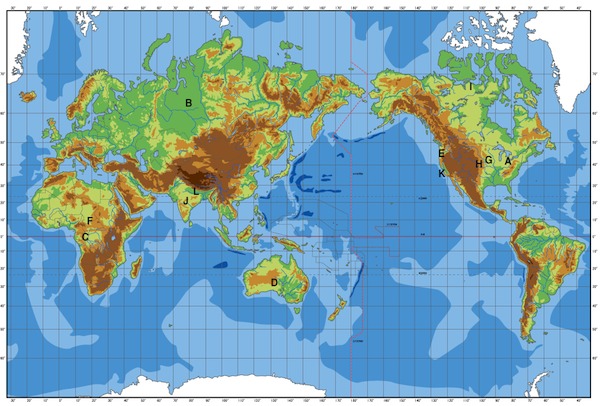
Figure \(\PageIndex{1}\) is a world map that uses color shading to show elevation and landforms. Green areas represent lower elevations, while brown and orange areas indicate higher elevations, including major mountain ranges and plateaus. Prominent high-elevation regions include the Rocky Mountains in North America, the Andes in South America, the Alps in Europe, the Ethiopian Highlands in Africa, and the Himalayas and Tibetan Plateau in Asia. Australia is shown as a relatively low-relief continent. Several locations labeled A through K identify specific geographic features discussed in the accompanying text. The map illustrates the global distribution of major landforms and elevation patterns across Earth's continents.
- The most likely location to find a tall grass prairie is
- A (Eastern United States, near the Appalachian region)
- G (Central United States, just south of the Great Lakes)
- J (Southern Asia, on the Indian peninsula)
- D (Oceania, in central Australia)
- Xerophytic vegetation is most likely found at
- B (Northern Eurasia, in the West Siberian Plain)
- C (Central Africa, in the equatorial Congo Basin)
- D (Oceania, in the interior desert of Australia)
- none of the above
- A temperate rain forest is most likely found at
- C (Central Africa, along the equator)
- F (West Africa, just south of the Sahara Desert)
- H (North America, in the interior Great Plains)
- E (North America, along the Pacific Northwest coast)
- A Mediterranean woodland is most likely located at
- F (West Africa, north of the Gulf of Guinea)
- K (North America, along the coastal California region)
- J (Southern Asia, in interior India)
- H (North America, east of the Rocky Mountains)
- Which of the following would I most likely find at location H (North America, located in the interior Great Plains region east of the Rocky Mountains)
- Midlatitude Steppe
- Southern Coniferous Forest
- Midlatitude Broadleaf Deciduous Forest
- Northern Coniferous Forest
- Which of the following would I most likely find at location I (Northern North America, located in high-latitude northern Canada near the Arctic Circle)?
- Midlatitude Steppe
- Midlatitude broadleaf deciduous and mixed forest
- Tundra
- Northern Coniferous Forest
- Answer
-
- D
- A
- D
- A
- A
- A
- B
- B
- D
- A
- D
- C
- D
- D
- B
- C
- D
- B
- A
- C
Additional Resources
Use these resources to further explore the world of geography
- OpenAI. (2026). ChatGPT (GPT-4o version) [Large language model]. https://chatgpt.com
- Google. (2026). Gemini (Gemini 1.5 Pro version) [Large language model]. google.com
- National Aeronautics and Space Administration. (2026, May 29). A holistic perspective on Florida’s wetland emissions. NASA Science: Notes from the Field.
- National Center for Science Education. (2010, May 20). The breadth of biogeography.
- Ritter, M. E. (2020). The physical environment: An introduction to physical geography. (L. Pitts, Ed.).
- Bailey, R. (2023, April 5). The biomes of the world. ThoughtCo.
- Conservation International. (n.d.). Biodiversity hotspots.
- Visit Scientific American frontiers, a long-running PBS science series that explores discoveries and innovations across a wide range of scientific fields. Through documentaries and field reports, the program highlights scientific research, environmental issues, technology, and the processes scientists use to investigate the natural world.
- Listen to NPR's World's biggest tiger reserve (2004) to learn about efforts to protect tiger populations and conserve habitat in one of the world's largest wildlife reserves. The report highlights the challenges of balancing biodiversity conservation, human activities, and the long-term survival of endangered species.
- Watch Invasion of the giant pythons: Introduction. WNET (PBS, 2010) to learn how invasive Burmese pythons have affected ecosystems in the Florida Everglades. This short introduction explains the environmental impact of invasive species and the challenges of managing them.
- Listen to NPR’s The Last American rain forest (1998), an audio report about one of the last remaining temperate rain forests in the United States. The broadcast explores the ecological importance of the forest and the environmental challenges affecting its long-term protection.
- Listen to NPR’s Drugs and bugs (2000), an audio report that explores the relationship between medicine, microbes, and public health. The broadcast examines how drugs are used to treat disease and how microorganisms can adapt or create new health challenges.
- Connections: Listen to NPR's Talk of the Nation report, "Monitoring Monarchs" (2013), which explores how habitat loss in Mexico and declining milkweed populations in the United States have contributed to population declines in monarch butterflies. The report highlights the interconnected nature of ecosystems across North America and the conservation challenges facing this iconic migratory species.
- World of Change: Explore NASA Earth Observatory's “Amazon Deforestation” interactive feature to examine how satellite imagery reveals the extent and impacts of forest loss in the Amazon rainforest over time. The resource highlights the environmental consequences of deforestation, including habitat loss, biodiversity decline, and changes to the global carbon cycle.
- Connections: Read NPR's “Vietnam's Appetite For Rhino Horn Drives Poaching In Africa” (2013) to explore how global demand for wildlife products can contribute to species decline. The article examines the link between consumer demand for rhino horn in Asia and increased poaching pressure on rhino populations in Africa, highlighting the challenges of international wildlife conservation.
- World of Change: Explore NASA Earth Observatory's “Global Biosphere” feature to examine satellite observations of Earth's vegetation and seasonal plant growth. The interactive resource shows how climate, weather, and environmental change influence ecosystems and the global distribution of plant life over time.