

14.4: Ecology of Vegetation and Plant Succession
- Page ID
- 42730

\( \newcommand{\vecs}[1]{\overset { \scriptstyle \rightharpoonup} {\mathbf{#1}} } \)
\( \newcommand{\vecd}[1]{\overset{-\!-\!\rightharpoonup}{\vphantom{a}\smash {#1}}} \)
\( \newcommand{\dsum}{\displaystyle\sum\limits} \)
\( \newcommand{\dint}{\displaystyle\int\limits} \)
\( \newcommand{\dlim}{\displaystyle\lim\limits} \)
\( \newcommand{\id}{\mathrm{id}}\) \( \newcommand{\Span}{\mathrm{span}}\)
( \newcommand{\kernel}{\mathrm{null}\,}\) \( \newcommand{\range}{\mathrm{range}\,}\)
\( \newcommand{\RealPart}{\mathrm{Re}}\) \( \newcommand{\ImaginaryPart}{\mathrm{Im}}\)
\( \newcommand{\Argument}{\mathrm{Arg}}\) \( \newcommand{\norm}[1]{\| #1 \|}\)
\( \newcommand{\inner}[2]{\langle #1, #2 \rangle}\)
\( \newcommand{\Span}{\mathrm{span}}\)
\( \newcommand{\id}{\mathrm{id}}\)
\( \newcommand{\Span}{\mathrm{span}}\)
\( \newcommand{\kernel}{\mathrm{null}\,}\)
\( \newcommand{\range}{\mathrm{range}\,}\)
\( \newcommand{\RealPart}{\mathrm{Re}}\)
\( \newcommand{\ImaginaryPart}{\mathrm{Im}}\)
\( \newcommand{\Argument}{\mathrm{Arg}}\)
\( \newcommand{\norm}[1]{\| #1 \|}\)
\( \newcommand{\inner}[2]{\langle #1, #2 \rangle}\)
\( \newcommand{\Span}{\mathrm{span}}\) \( \newcommand{\AA}{\unicode[.8,0]{x212B}}\)
\( \newcommand{\vectorA}[1]{\vec{#1}} % arrow\)
\( \newcommand{\vectorAt}[1]{\vec{\text{#1}}} % arrow\)
\( \newcommand{\vectorB}[1]{\overset { \scriptstyle \rightharpoonup} {\mathbf{#1}} } \)
\( \newcommand{\vectorC}[1]{\textbf{#1}} \)
\( \newcommand{\vectorD}[1]{\overrightarrow{#1}} \)
\( \newcommand{\vectorDt}[1]{\overrightarrow{\text{#1}}} \)
\( \newcommand{\vectE}[1]{\overset{-\!-\!\rightharpoonup}{\vphantom{a}\smash{\mathbf {#1}}}} \)
\( \newcommand{\vecs}[1]{\overset { \scriptstyle \rightharpoonup} {\mathbf{#1}} } \)
\(\newcommand{\longvect}{\overrightarrow}\)
\( \newcommand{\vecd}[1]{\overset{-\!-\!\rightharpoonup}{\vphantom{a}\smash {#1}}} \)
\(\newcommand{\ket}[1]{\left| #1 \right>}\)
\(\newcommand{\bra}[1]{\left< #1 \right|}\)
\(\newcommand{\braket}[2]{\left< #1 \vphantom{#2} \right| \left. #2 \vphantom{#1} \right>}\)
\(\newcommand{\braopket}[3]{\left< #1 \vphantom{#2}\vphantom{#3} \right| #2 \vphantom{#1}\vphantom{#3} \left| #3 \vphantom{#1}\vphantom{#2} \right>}\)
\(\newcommand{\qmvec}[1]{\mathbf{\vec{#1}}}\)
\(\newcommand{\op}[1]{\hat{\mathbf{#1}}}\)
\(\newcommand{\expect}[1]{\langle #1 \rangle}\)
\(\newcommand{\dfn}[1]{\emph{\textbf{#1}}}\)
Principal Adaptive Strategies of Vegetation
Plants evolve a variety of adaptations to the light and moisture availability within a particular environment in order to flourish. Plants adaptations include those of leaf form and canopy structure (the roof of foliage formed by the crowns of trees). For instance, a hard, needle leaf structure is an adaptation to extreme temperatures and low moisture status in winter. The leaves of some rain forest trees have a special joint at the bottom of their stalk that enables them to twist and turn to follow the light as the sun passes from east to west over head. Deciduous trees drop their leaves to cut transpiration loss during dry periods and when temperatures are very cold.
Conifer needles are an important adaptation to the extreme conditions present in the climate of the boreal forest. Pine needles contain very little sap, so freezing is not much of a problem. Conifer needles have a unique structure which limits the loss of water, a precious commodity in this environment. Pine needles have fewer stomata than broadleaf tree leaves. The stomata are recessed into pits on the needle and aligned in a groove on its underside. The groove in the needle creates a small layer of still air which slows the loss of water vapor by diffusion. Water loss is further reduced by the thick waxy coating common to pine needles. Water is "shut off" from the tree when the ground completely freezes. Under these circumstances the stomata close-up to prevent loss of water from the tree.
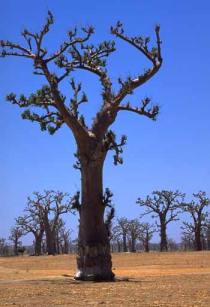
Figure \(\PageIndex{1}\): Baobab trees are adapted to seasonal drought and are characteristic vegetation of African savannas. (CC BY-SA 4.0; Courtesy Michael E. Ritter via The Physical Environment).

Fleshy "leaves", like those of desert succulents or thick skin like that of the giant Saguaro cactus helps retain moisture. The Baobab tree (shown in Figure \(\PageIndex{1}\)), found in the wet/dry tropical (savanna) climate stores water in its trunk to combat the long drought period experienced in that climate.
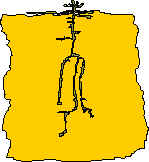

Plants have adapted particular root structures to live in arid regions. Deep tap roots draw moisture hidden deep below the surface while extensive near - surface root systems catch moisture as it infiltrates into soil. The Havard Oak is a shrub found in the semi-arid southwestern United States. It is well adapted to the dry conditions having an extensive root system and tap roots that extend 15 to 20 feet deep. Above ground, thick waxy leaves reduce water loss through transpiration.Some desert grasses have rolled surfaces to reduce water loss from the inner surface and hairs which reduce air movement.

Canopy structures reflect the environmental conditions vegetation grows in. The conical canopies of conifers help shed snow and catch low angle sun rays during the long winters where they grow. The rain forest displays a multi-layered canopy. Each layer possesses organisms adapted to the environmental conditions found in it. A canopy can be so thick and dense, like that found in the rain forest, that little light penetrates to the surface. The lack of light for understory growth creates an open forest structure that you can see into for some distance. Where canopy density is low, more light filters to the surface creating a thick ground cover and a closed forest structure. Standing on the floor of a closed forest, it's nearly impossible to see more than a few meters into it.
Plant Communities
Rarely is any location dominated by a single specie of plant. A plant community refers to the associated plant species that form the natural vegetation of any place. For instance, a midlatitude forest is comprised of a community of trees, shrubs, ferns, grasses, and flowering herbs. Plant communities provide a habitat for animals and significantly modify the local environment. Plant communities affect soil type when organic material decomposes into the soil altering soil moisture retention, infiltration capacity, soil structure and soil chemistry. Trees shade the forest floor, reducing incident solar radiation and lowering temperatures of both the soil and the air. Reduced incident light decreases evaporation keeping soils moister beneath the forest canopy. These impacts affect animal habitats and the diversity of animal species which are associated with these plant communities.
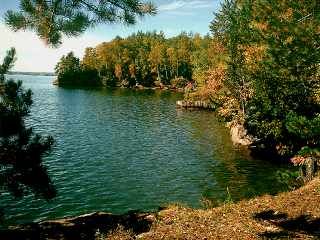
An ecotone is a plant community in a distinct zone of transition between other more extensive communities. Ecotones vary in scale, from local (between forest and field) to global (savannas). Within an ecotone plants of different environmental tolerances often intermingle. For instance, grasses adapted to low moisture conditions intermingle with deciduous trees within a prairie - forest ecotone.
Plant Succession
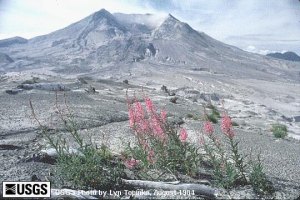
Natural vegetation of a particular location evolves in a sequence of steps involving different plant communities. The evolutionary process is known as plant succession. Plant succession usually begins with a fairly simple community known as a pioneer community. The pioneer community and each successive community alter the environment in such a way to permit new communities to occupy a site. These alterations of the environment include changes in site microclimate and soil conditions.
A climax community is the result of a long period of plant succession. Climax communities usually exhibit a good deal of species diversity and thus are relatively stable systems. Disturbance renews a successional sequence. Plant succession was renewed after the explosion of Mt. St. Helens, with the subsequent disruption of biotic communities that inhabited the region. Human disturbance related to tropical deforestation has renewed the successional sequence of plant communities in the tropical rain forest.