

14.2: Habitat Occupation
- Page ID
- 42728

\( \newcommand{\vecs}[1]{\overset { \scriptstyle \rightharpoonup} {\mathbf{#1}} } \)
\( \newcommand{\vecd}[1]{\overset{-\!-\!\rightharpoonup}{\vphantom{a}\smash {#1}}} \)
\( \newcommand{\dsum}{\displaystyle\sum\limits} \)
\( \newcommand{\dint}{\displaystyle\int\limits} \)
\( \newcommand{\dlim}{\displaystyle\lim\limits} \)
\( \newcommand{\id}{\mathrm{id}}\) \( \newcommand{\Span}{\mathrm{span}}\)
( \newcommand{\kernel}{\mathrm{null}\,}\) \( \newcommand{\range}{\mathrm{range}\,}\)
\( \newcommand{\RealPart}{\mathrm{Re}}\) \( \newcommand{\ImaginaryPart}{\mathrm{Im}}\)
\( \newcommand{\Argument}{\mathrm{Arg}}\) \( \newcommand{\norm}[1]{\| #1 \|}\)
\( \newcommand{\inner}[2]{\langle #1, #2 \rangle}\)
\( \newcommand{\Span}{\mathrm{span}}\)
\( \newcommand{\id}{\mathrm{id}}\)
\( \newcommand{\Span}{\mathrm{span}}\)
\( \newcommand{\kernel}{\mathrm{null}\,}\)
\( \newcommand{\range}{\mathrm{range}\,}\)
\( \newcommand{\RealPart}{\mathrm{Re}}\)
\( \newcommand{\ImaginaryPart}{\mathrm{Im}}\)
\( \newcommand{\Argument}{\mathrm{Arg}}\)
\( \newcommand{\norm}[1]{\| #1 \|}\)
\( \newcommand{\inner}[2]{\langle #1, #2 \rangle}\)
\( \newcommand{\Span}{\mathrm{span}}\) \( \newcommand{\AA}{\unicode[.8,0]{x212B}}\)
\( \newcommand{\vectorA}[1]{\vec{#1}} % arrow\)
\( \newcommand{\vectorAt}[1]{\vec{\text{#1}}} % arrow\)
\( \newcommand{\vectorB}[1]{\overset { \scriptstyle \rightharpoonup} {\mathbf{#1}} } \)
\( \newcommand{\vectorC}[1]{\textbf{#1}} \)
\( \newcommand{\vectorD}[1]{\overrightarrow{#1}} \)
\( \newcommand{\vectorDt}[1]{\overrightarrow{\text{#1}}} \)
\( \newcommand{\vectE}[1]{\overset{-\!-\!\rightharpoonup}{\vphantom{a}\smash{\mathbf {#1}}}} \)
\( \newcommand{\vecs}[1]{\overset { \scriptstyle \rightharpoonup} {\mathbf{#1}} } \)
\(\newcommand{\longvect}{\overrightarrow}\)
\( \newcommand{\vecd}[1]{\overset{-\!-\!\rightharpoonup}{\vphantom{a}\smash {#1}}} \)
\(\newcommand{\ket}[1]{\left| #1 \right>}\)
\(\newcommand{\bra}[1]{\left< #1 \right|}\)
\(\newcommand{\braket}[2]{\left< #1 \vphantom{#2} \right| \left. #2 \vphantom{#1} \right>}\)
\(\newcommand{\braopket}[3]{\left< #1 \vphantom{#2}\vphantom{#3} \right| #2 \vphantom{#1}\vphantom{#3} \left| #3 \vphantom{#1}\vphantom{#2} \right>}\)
\(\newcommand{\qmvec}[1]{\mathbf{\vec{#1}}}\)
\(\newcommand{\op}[1]{\hat{\mathbf{#1}}}\)
\(\newcommand{\expect}[1]{\langle #1 \rangle}\)
\(\newcommand{\dfn}[1]{\emph{\textbf{#1}}}\)
Dispersal of Species and Habitat Change
The effectiveness of an organism to occupy a habitat depends in part on its means of transportation. Animals must use their own locomotion, while plants disperse by wind, running water, ocean currents, and animals. Thus, climate and topographic barriers are more of an impediment to animals than plants. For either, continental drift poses a significant barrier to diffusion. The separation of continents has isolated plants and animals in the past thus preventing their complete occupation of a suitable habitat. Continental collisions have opened land bridges for habitat occupation. Sea level changes have similarly affected plant and animal distributions. Lowered sea level, as what occurred during the last ice ages, resulted in chains of islands being connected opening migration routes for animal and plant species. Sea level rise during post-glacial times isolated habitats. Isolation thus prevented plant and animal migration. Presently, trends in global warming are affecting the distribution of parasites carrying infectious diseases.

Figure \(\PageIndex{1}\) is an infographic that explains three forms of species dispersal in biogeography. First, corridors are continuous land connections that allow organisms to move freely between regions. The example shown is the Panamanian Isthmus, where North and South American species can disperse across connected land, leading to greater biological similarity. Second, filter bridges are selective pathways that permit some species to cross while preventing others. The example shown is the Bering Land Bridge (Beringia), which allowed certain cold-adapted animals to move between Asia and North America. Third, sweepstakes dispersal occurs through rare chance events such as floating on vegetation mats, ocean currents, or wind. An example shows organisms crossing the Atlantic Ocean between Africa and South America despite major geographic barriers. The infographic contrasts connected mainland regions, which facilitate dispersal, with isolated oceanic islands, where deep water limits movement and helps maintain biodiversity.
Sometimes humans aid in the dispersal of plants and animals. Humans have intentionally or unintentionally introduced species into habitats that they would otherwise not have been able to on their own, sometimes with disastrous effects. The inadvertent introduction of the African Honey Bee in South America is a notable example. Imported to spur production of honey by mating with other native species, this aggressive bee was accidentally released. With few natural predators, populations exploded and has migrated to the southern United States. People have been attacked by swarms of these "killer bees" when disturbing them. Hawaii's biota evolved in relative isolation. But after its discovery by white culture, the inadvertent, and the sometimes purposeful introduction of alien plant and animal species, have endangered Hawaii's native organisms. Human activities have profound effects on habitats.
Habitat Encroachment
Habitat encroachment, fragmentation, and destruction has produced a plethora of problems. Habitat destruction is a leading cause of species endangerment. Habitat encroachment increases the contact between human populations and animal populations. Shrinking habitat and accessible sources of food from expanding urban and suburban land use have brought animals and humans into conflict. The loss of tiger prey and presence of livestock have increased attacks on villagers living near tiger habitat in India. Alligators in homeowners backyards is becoming a more frequent site in Florida as urban sprawl invades the state's wetlands. Deer are a nuisance in many suburban areas, destroying gardens and posing a threat to motorists.
Habitat encroachment is responsible for the recent emergence of diseases like Ebola as a threat to humans. Intact habitats tend to inhibit the spread of infectious agents. Damaged, altered, and degraded habitats trigger the spread of new and existing diseases to humans. A 2005 United Nations Global Environment Outlook Year Book 2004/5 reported that the deadly Nipah virus, normally found in Asian fruit bats, is believed to have passed over to humans. Land clearance for palm plantations brought bats in contact with swine, and then humans as their habitat shrunk. The geographic range and seasonality of mosquito-borne diseases like malaria and dengue fever, are very sensitive to changes in climate.
Illegal logging is the greatest threat to the survival of the orangutan. Native to the Indian Ocean islands of Sumatra, it is estimated that no more that 60,000 wild orangutans are left worldwide, half the population that existed a mere 10 years ago.
Forest fires, poaching and conversion of jungles to palm plantations have also decimated their populations. Living in trees, the great apes feed on insects and fruits, and in turn, disperse seeds that regenerate the tropical forests. In spite of government declarations to curb illegal logging, environmental activists blame political corruption, and of will and insufficient resources to halt the multi billion dollar illegal logging activity.
Human conflict has deviated habitats and threatened biodiversity in many regions, especially Africa. But remarkably, some have managed to survive.
Wildlife Corridors
Wildlife require large areas to seek out food, mates, and nesting sites. Habitat fragmentation restricts wildlife movement resulting in overcrowding, over exploitation of resources and species endangerment. Scientists are attempting to preserve wildlife by creating corridors between fragmented portions of habitat. Wildlife corridors allow young animals to seek new territory and maintain gene flow between individual habitats, thus improving species fitness. Only recently have scientists been able to show that wildlife corridors work.
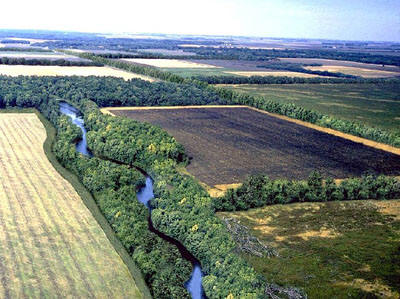
Wildlife corridors like those seen here in Iowa permit animals to exploit a variety of resources without having to cross unfriendly terrain like roads, lawns, or barren farm fields.
The Terai Arc is a fifty year plan to reconnect 11 national parks in India and Nepal with one continuous corridor of protected areas. Preliminary data from the Khata corridor between Nepal's Royal Bardia National Park and the Katarniaghat Wildlife Sanctuary of India show use by tigers and elephants. The presence of Spotted Deer and Wild Boar hoof prints provide additional evidence of corridor use.