

14.1: Biogeography and Ecological Systems
- Page ID
- 42727

\( \newcommand{\vecs}[1]{\overset { \scriptstyle \rightharpoonup} {\mathbf{#1}} } \)
\( \newcommand{\vecd}[1]{\overset{-\!-\!\rightharpoonup}{\vphantom{a}\smash {#1}}} \)
\( \newcommand{\dsum}{\displaystyle\sum\limits} \)
\( \newcommand{\dint}{\displaystyle\int\limits} \)
\( \newcommand{\dlim}{\displaystyle\lim\limits} \)
\( \newcommand{\id}{\mathrm{id}}\) \( \newcommand{\Span}{\mathrm{span}}\)
( \newcommand{\kernel}{\mathrm{null}\,}\) \( \newcommand{\range}{\mathrm{range}\,}\)
\( \newcommand{\RealPart}{\mathrm{Re}}\) \( \newcommand{\ImaginaryPart}{\mathrm{Im}}\)
\( \newcommand{\Argument}{\mathrm{Arg}}\) \( \newcommand{\norm}[1]{\| #1 \|}\)
\( \newcommand{\inner}[2]{\langle #1, #2 \rangle}\)
\( \newcommand{\Span}{\mathrm{span}}\)
\( \newcommand{\id}{\mathrm{id}}\)
\( \newcommand{\Span}{\mathrm{span}}\)
\( \newcommand{\kernel}{\mathrm{null}\,}\)
\( \newcommand{\range}{\mathrm{range}\,}\)
\( \newcommand{\RealPart}{\mathrm{Re}}\)
\( \newcommand{\ImaginaryPart}{\mathrm{Im}}\)
\( \newcommand{\Argument}{\mathrm{Arg}}\)
\( \newcommand{\norm}[1]{\| #1 \|}\)
\( \newcommand{\inner}[2]{\langle #1, #2 \rangle}\)
\( \newcommand{\Span}{\mathrm{span}}\) \( \newcommand{\AA}{\unicode[.8,0]{x212B}}\)
\( \newcommand{\vectorA}[1]{\vec{#1}} % arrow\)
\( \newcommand{\vectorAt}[1]{\vec{\text{#1}}} % arrow\)
\( \newcommand{\vectorB}[1]{\overset { \scriptstyle \rightharpoonup} {\mathbf{#1}} } \)
\( \newcommand{\vectorC}[1]{\textbf{#1}} \)
\( \newcommand{\vectorD}[1]{\overrightarrow{#1}} \)
\( \newcommand{\vectorDt}[1]{\overrightarrow{\text{#1}}} \)
\( \newcommand{\vectE}[1]{\overset{-\!-\!\rightharpoonup}{\vphantom{a}\smash{\mathbf {#1}}}} \)
\( \newcommand{\vecs}[1]{\overset { \scriptstyle \rightharpoonup} {\mathbf{#1}} } \)
\(\newcommand{\longvect}{\overrightarrow}\)
\( \newcommand{\vecd}[1]{\overset{-\!-\!\rightharpoonup}{\vphantom{a}\smash {#1}}} \)
\(\newcommand{\ket}[1]{\left| #1 \right>}\)
\(\newcommand{\bra}[1]{\left< #1 \right|}\)
\(\newcommand{\braket}[2]{\left< #1 \vphantom{#2} \right| \left. #2 \vphantom{#1} \right>}\)
\(\newcommand{\braopket}[3]{\left< #1 \vphantom{#2}\vphantom{#3} \right| #2 \vphantom{#1}\vphantom{#3} \left| #3 \vphantom{#1}\vphantom{#2} \right>}\)
\(\newcommand{\qmvec}[1]{\mathbf{\vec{#1}}}\)
\(\newcommand{\op}[1]{\hat{\mathbf{#1}}}\)
\(\newcommand{\expect}[1]{\langle #1 \rangle}\)
\(\newcommand{\dfn}[1]{\emph{\textbf{#1}}}\)
The Geography of Life
Biogeography is the study of the geographical patterns of plant and animal species. To understand the distribution of plant and animal species on Earth, a fundamental knowledge of ecology and ecosystem dynamics is required. Ecology is the study of the interactions among organisms. An ecosystem is a functioning entity of all the organisms in a biological system generally in equilibrium with the inputs and outputs of energy and materials in a particular environment. It is the basic ecological unit of study. There are two kinds of ecosystems, aquatic and terrestrial. An ecosystem is comprised of habitats, biological communities, and ecotones.
A biome is often referred to as a global-scale community of plants and animals and is the largest subdivision of the biosphere. A biome may contain many different kinds of smaller ecosystems. Biomes are typically distinguished on the basis of the characteristics of their vegetation because it makes up the largest portion of biomass. Biomes are subdivided by formation class, vegetation units of a dominant species.

A habitat is the natural environment in which an organism lives. Most African elephants live on savannas and in dry woodlands. Bass prefer a habitat of warm, calm, clear water and are usually found in slow-moving streams, ponds, lakes, and reservoirs. Habitats can be identified at different spatial scales. Macrohabitats are delineated by climate and subdivided on the basis of their vegetation. Microhabitats are smaller in size, such as the habitat along a stream channel or a layer within the canopy of a rain forest. Each species has specific habitat parameters (temperature, moisture, and nutrient availability).
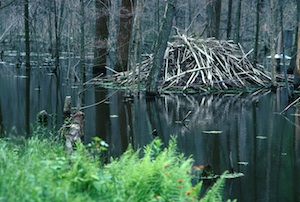
Within a habitat, organisms "occupy" a niche. A niche is the function or occupation of a life-form within a community. An organism's niche incorporates the physical (habitat), chemical, and biological factors that maintain the health and vitality of the organism. An organism's interaction with the abiotic factors of its environment (heat and moisture) defines its niche. The food requirements and those that prey on it are part of the organism's niche. A niche, therefore, is the sum of an organism's physiological adaptation to, and interaction with, its physical environment.
The variation of life determines the biodiversity of an ecosystem. The biodiversity of an ecosystem reflects the variety and abundance of plant and animal species within it. It includes the variety of habitat types with a landscape that support life.