

13.2: Geologic Work of Glaciers
- Page ID
- 42719

\( \newcommand{\vecs}[1]{\overset { \scriptstyle \rightharpoonup} {\mathbf{#1}} } \)
\( \newcommand{\vecd}[1]{\overset{-\!-\!\rightharpoonup}{\vphantom{a}\smash {#1}}} \)
\( \newcommand{\dsum}{\displaystyle\sum\limits} \)
\( \newcommand{\dint}{\displaystyle\int\limits} \)
\( \newcommand{\dlim}{\displaystyle\lim\limits} \)
\( \newcommand{\id}{\mathrm{id}}\) \( \newcommand{\Span}{\mathrm{span}}\)
( \newcommand{\kernel}{\mathrm{null}\,}\) \( \newcommand{\range}{\mathrm{range}\,}\)
\( \newcommand{\RealPart}{\mathrm{Re}}\) \( \newcommand{\ImaginaryPart}{\mathrm{Im}}\)
\( \newcommand{\Argument}{\mathrm{Arg}}\) \( \newcommand{\norm}[1]{\| #1 \|}\)
\( \newcommand{\inner}[2]{\langle #1, #2 \rangle}\)
\( \newcommand{\Span}{\mathrm{span}}\)
\( \newcommand{\id}{\mathrm{id}}\)
\( \newcommand{\Span}{\mathrm{span}}\)
\( \newcommand{\kernel}{\mathrm{null}\,}\)
\( \newcommand{\range}{\mathrm{range}\,}\)
\( \newcommand{\RealPart}{\mathrm{Re}}\)
\( \newcommand{\ImaginaryPart}{\mathrm{Im}}\)
\( \newcommand{\Argument}{\mathrm{Arg}}\)
\( \newcommand{\norm}[1]{\| #1 \|}\)
\( \newcommand{\inner}[2]{\langle #1, #2 \rangle}\)
\( \newcommand{\Span}{\mathrm{span}}\) \( \newcommand{\AA}{\unicode[.8,0]{x212B}}\)
\( \newcommand{\vectorA}[1]{\vec{#1}} % arrow\)
\( \newcommand{\vectorAt}[1]{\vec{\text{#1}}} % arrow\)
\( \newcommand{\vectorB}[1]{\overset { \scriptstyle \rightharpoonup} {\mathbf{#1}} } \)
\( \newcommand{\vectorC}[1]{\textbf{#1}} \)
\( \newcommand{\vectorD}[1]{\overrightarrow{#1}} \)
\( \newcommand{\vectorDt}[1]{\overrightarrow{\text{#1}}} \)
\( \newcommand{\vectE}[1]{\overset{-\!-\!\rightharpoonup}{\vphantom{a}\smash{\mathbf {#1}}}} \)
\( \newcommand{\vecs}[1]{\overset { \scriptstyle \rightharpoonup} {\mathbf{#1}} } \)
\(\newcommand{\longvect}{\overrightarrow}\)
\( \newcommand{\vecd}[1]{\overset{-\!-\!\rightharpoonup}{\vphantom{a}\smash {#1}}} \)
\(\newcommand{\ket}[1]{\left| #1 \right>}\)
\(\newcommand{\bra}[1]{\left< #1 \right|}\)
\(\newcommand{\braket}[2]{\left< #1 \vphantom{#2} \right| \left. #2 \vphantom{#1} \right>}\)
\(\newcommand{\braopket}[3]{\left< #1 \vphantom{#2}\vphantom{#3} \right| #2 \vphantom{#1}\vphantom{#3} \left| #3 \vphantom{#1}\vphantom{#2} \right>}\)
\(\newcommand{\qmvec}[1]{\mathbf{\vec{#1}}}\)
\(\newcommand{\op}[1]{\hat{\mathbf{#1}}}\)
\(\newcommand{\expect}[1]{\langle #1 \rangle}\)
\(\newcommand{\dfn}[1]{\emph{\textbf{#1}}}\)
Glacial Erosion
Glacier erodes valley in two methods :
- Plucking: The glacier frees the joints and beds of underlying rocks, tears out individual blocks and drags them away
- Abrasion : The glacier scratches, scrapes, polishes and scours the valley floor with debris frozen into it
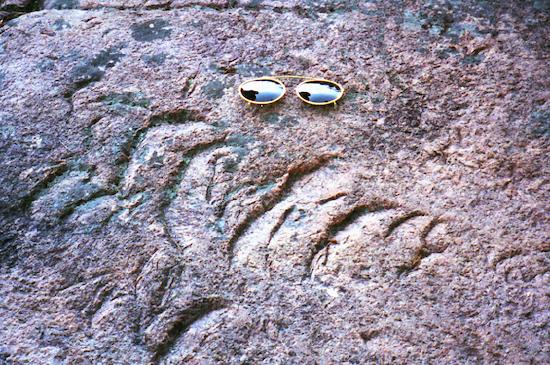
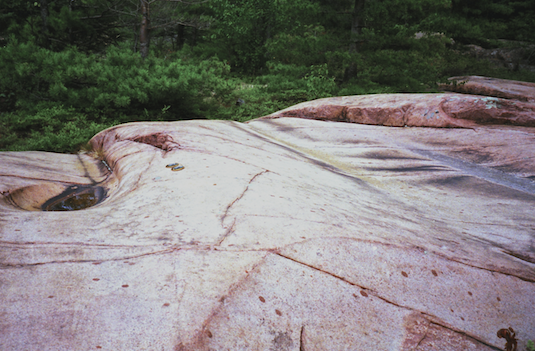
Glaciers themselves do relatively little significant erosion because ice is so soft. Under the weight of an ice sheet thousands of feet thick continental glaciers detach material from the surface by crushing the underlying bedrock. Once the material is loosened from the surface, ice can quarry (also known as plucking) the rock by freezing around and into fractures, then lifting it from the surface. The rock embedded in the ice gouges and smoothens bedrock surfaces by abrasion. Striations are fine scratches left in bedrock by abrasion. At a larger scale, linear grooves are ground into the bedrock in the direction of ice movement. Chipping of bedrock leaves crescent-shaped marks called chatter marks gouged into the bedrock. The constant abrasion of exposed rock also creates polished bedrock.
Glacier Transportation
Material transported by a glacier, termed glacial drift, is carried via the ice's immense weight and continuous down slope flow, which facilitates movement analogous to a massive, slow-operating conveyor system. There are multiple ways in which materials are transported by a glacier. Rock debris sometimes collect on top of the glacier as a result of weathering and mass wasting. The freeze-thaw method results in weathered material that is transported by a glacier. Due to mass wasting, loose rocks and materials fall into a glacier and are carried on the glacial surface. Often materials are carried within a glacier as the material gets buried into a glacier by fresh snowfall. Often a glacier erodes material from its base and this material is lifted, frozen by the glacier and carried by it. Rock is included into the basal ice layer by erosional methods like plucking and abrasion. Meltwater streams that flow away from a glacier transport and modify the glacial drift. The water sorts, stratifies and deposits the materials transported by a glacier.
Glacier Deposition
A glacier deposits it materials when
- Ice melts
- Its energy reduces
When the ice mass is lost as a result of melting, sublimation or calving the material carried by it is deposited. Calving is when a glacier breaks along a crevasse and often leads to the formation of icebergs in the case of tidewater glaciers. The unsorted and unstratified material that is deposited is called till. Deposition can also occur when the ice flow dynamics change due to overloading and stagnation. Meltwater released by a glacier often redistribute and reshape the deposited material.
Glacial Till
Glacial drift deposited directly by a glacier is called till. Unlike sediment deposited by running water, till is not sorted by sediment size. Till looks like a jumbled mixture of fine and coarse textured material as shown in Figure \(\PageIndex{3}\). Fragments of rock encased in ice tend to retain their angular shape, though occasionally the edges are knocked off when rubbing against the bedrock beneath. Rocks that tumble and roll through a stream are more rounded from striking the bed of a stream channel.
