
11.3: Types of Coasts
- Page ID
- 42715

\( \newcommand{\vecs}[1]{\overset { \scriptstyle \rightharpoonup} {\mathbf{#1}} } \)
\( \newcommand{\vecd}[1]{\overset{-\!-\!\rightharpoonup}{\vphantom{a}\smash {#1}}} \)
\( \newcommand{\dsum}{\displaystyle\sum\limits} \)
\( \newcommand{\dint}{\displaystyle\int\limits} \)
\( \newcommand{\dlim}{\displaystyle\lim\limits} \)
\( \newcommand{\id}{\mathrm{id}}\) \( \newcommand{\Span}{\mathrm{span}}\)
( \newcommand{\kernel}{\mathrm{null}\,}\) \( \newcommand{\range}{\mathrm{range}\,}\)
\( \newcommand{\RealPart}{\mathrm{Re}}\) \( \newcommand{\ImaginaryPart}{\mathrm{Im}}\)
\( \newcommand{\Argument}{\mathrm{Arg}}\) \( \newcommand{\norm}[1]{\| #1 \|}\)
\( \newcommand{\inner}[2]{\langle #1, #2 \rangle}\)
\( \newcommand{\Span}{\mathrm{span}}\)
\( \newcommand{\id}{\mathrm{id}}\)
\( \newcommand{\Span}{\mathrm{span}}\)
\( \newcommand{\kernel}{\mathrm{null}\,}\)
\( \newcommand{\range}{\mathrm{range}\,}\)
\( \newcommand{\RealPart}{\mathrm{Re}}\)
\( \newcommand{\ImaginaryPart}{\mathrm{Im}}\)
\( \newcommand{\Argument}{\mathrm{Arg}}\)
\( \newcommand{\norm}[1]{\| #1 \|}\)
\( \newcommand{\inner}[2]{\langle #1, #2 \rangle}\)
\( \newcommand{\Span}{\mathrm{span}}\) \( \newcommand{\AA}{\unicode[.8,0]{x212B}}\)
\( \newcommand{\vectorA}[1]{\vec{#1}} % arrow\)
\( \newcommand{\vectorAt}[1]{\vec{\text{#1}}} % arrow\)
\( \newcommand{\vectorB}[1]{\overset { \scriptstyle \rightharpoonup} {\mathbf{#1}} } \)
\( \newcommand{\vectorC}[1]{\textbf{#1}} \)
\( \newcommand{\vectorD}[1]{\overrightarrow{#1}} \)
\( \newcommand{\vectorDt}[1]{\overrightarrow{\text{#1}}} \)
\( \newcommand{\vectE}[1]{\overset{-\!-\!\rightharpoonup}{\vphantom{a}\smash{\mathbf {#1}}}} \)
\( \newcommand{\vecs}[1]{\overset { \scriptstyle \rightharpoonup} {\mathbf{#1}} } \)
\(\newcommand{\longvect}{\overrightarrow}\)
\( \newcommand{\vecd}[1]{\overset{-\!-\!\rightharpoonup}{\vphantom{a}\smash {#1}}} \)
\(\newcommand{\ket}[1]{\left| #1 \right>}\)
\(\newcommand{\bra}[1]{\left< #1 \right|}\)
\(\newcommand{\braket}[2]{\left< #1 \vphantom{#2} \right| \left. #2 \vphantom{#1} \right>}\)
\(\newcommand{\braopket}[3]{\left< #1 \vphantom{#2}\vphantom{#3} \right| #2 \vphantom{#1}\vphantom{#3} \left| #3 \vphantom{#1}\vphantom{#2} \right>}\)
\(\newcommand{\qmvec}[1]{\mathbf{\vec{#1}}}\)
\(\newcommand{\op}[1]{\hat{\mathbf{#1}}}\)
\(\newcommand{\expect}[1]{\langle #1 \rangle}\)
\(\newcommand{\dfn}[1]{\emph{\textbf{#1}}}\)
Submerged Coasts
The characteristics of a coast depend on its geologic structure, initial topographic configuration, and shoreline process that shape it. There are several ways and varying scales one can classify these complex systems. Submerged coasts form when river mouths are flooded due to rising sea level or subsidence of land. A drop in sea level or rise in the land surface creates an emergent coast. Depositional coasts have abundant depositional features like deltas, bars, spits and reefs where new land has been built. Coral coasts are formed by biological rather than physical processes.
Ria coasts are formed by the submergence of river valleys emptying into the ocean. "Ria" is a Spanish term for coasts with prominent headlands and embayments typical of these coasts. Wave action turns the smooth valley sides into receding cliffs with sand spits and tombolos common. Examples of ria coasts are found in New England and the Atlantic coast of Europe, especially France.

Fjord (fiord) coasts are form when glacial troughs are flooded due to a rise in sea level. Fiord coasts are deeply indented, with steep-walled valleys. Sandy beaches are rare as sediment eroded from valley walls collects on the floor. Fjords are common in Scandinavia, British Columbia, Alaska, and Patagonia.
Emergent Coasts
Emergent coasts are a result of forces acting to raise the land surface or drop sea level. The incredible weight of massive ice sheets during the the Pleistocene depressed the continental surfaces beneath them. The continents began to rebound as the ice melted and released the overlying pressure. The rising surface lifted the shoreline above sea level forming glacial uplift coasts along continental margins.
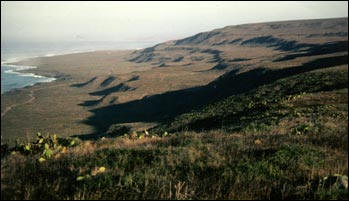
Raised shorelines and erosional features like wave cut terraces are also found along tectonic coasts where endogenic forces have uplifted the surface. Such coasts are common along the mountain and island arcs of the Pacific Ocean.
Depositional Coasts
Barrier island coasts are those paralleled by deposits of sand separated from land by a lagoon. There is some controversy over how barrier island coasts form. They begin as offshore bars of submerged sediment that migrate landward unless stabilized. Barrier islands are often cut by tidal inlets, openings that allow water to move landward and seaward with the tides. Barrier islands border the Atlantic coastal plain of North America.
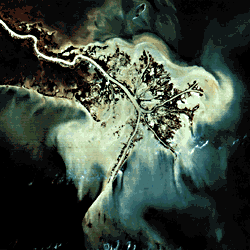
Delta coasts are those formed by the deposition of sediment at the mouth of a river that enters the ocean. Deposition is caused by the rapid decrease in water velocity as it enters the ocean. Sand and silt are the first to deposit while the mixing of fresh and salt water cause clay particles to bind together forming larger particles that settle to the bottom.
Reefs
Coral reefs represent some of the most complex, biodiverse, and vital ecosystems on the planet, thriving in both shallow tropical waters and dark, cold ocean depths. At their core, these massive physical formations are constructed by colonies of tiny marine animals called coral polyps. These organisms extract calcium carbonate from the surrounding ocean water to build hard, protective external skeletons. Over vast periods of time, as successive generations of polyps grow, die, and leave their structures behind, these accumulated skeletons form the durable rock foundations that characterize coastal reef systems.
The biological success of shallow-water reefs depends heavily on a symbiotic partnership between the coral polyps and microscopic algae called zooxanthellae that live directly within the coral tissues. Through photosynthesis, these algae harness sunlight to produce essential nutrients and energy that sustain the corals, while simultaneously providing reefs with their brilliant, distinct coloration. Because these algae require sunlight to manufacture food, tropical reefs are strictly confined to clear, shallow waters where sunlight easily penetrates the water column. In stark contrast, deep-sea corals have adapted to live hundreds or thousands of feet below the surface in complete darkness. Lacking access to sunlight, these deep-water corals cannot support photosynthetic algae; instead, they survive entirely by capturing organic matter and tiny organisms drifting through the deep ocean currents.
Corals thrive in warm tropical water at depths of 10 - 55 m (30 - 18 ft) from about 30o N to 30o S. Warm, east coasts encourage their development while few are found in cooler, western coastal environments. Water temperatures range from 18o to 29o C (64o - 85o F) 27% to 40% salinity. Bleaching and death result when water temperatures rise to high. There are cool water corals found deep, dark ocean water at temperatures as low as 4o C (39o F). Corals also require sediment-free water thus few are found near the mouths of rivers discharging in the ocean.
Beyond their ecological beauty, these systems play a crucial role in maintaining coastal stability and supporting marine biodiversity. Tropical reefs function as natural underwater barriers, absorbing the immense kinetic energy of incoming ocean waves, which significantly mitigates shoreline erosion and protects coastal communities from storm damage. Furthermore, reefs serve as essential habitats, breeding grounds, and nurseries for a vast array of marine organisms, supporting roughly a quarter of all ocean life. Despite their resilience and structural strength, coral reefs remain highly sensitive to environmental fluctuations. Shifts in ocean temperatures, rising acidity from carbon dioxide absorption, and human activities pose significant stressors to these habitats. When stressed by excessively warm or acidic water, shallow corals expel their internal algae, leading to bleaching events that threaten the survival of these critical marine sanctuaries.

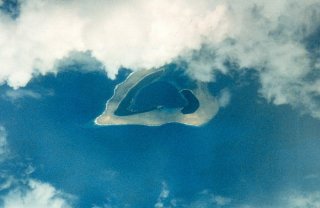
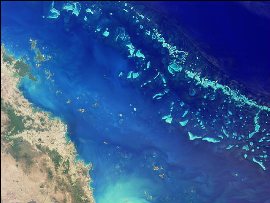
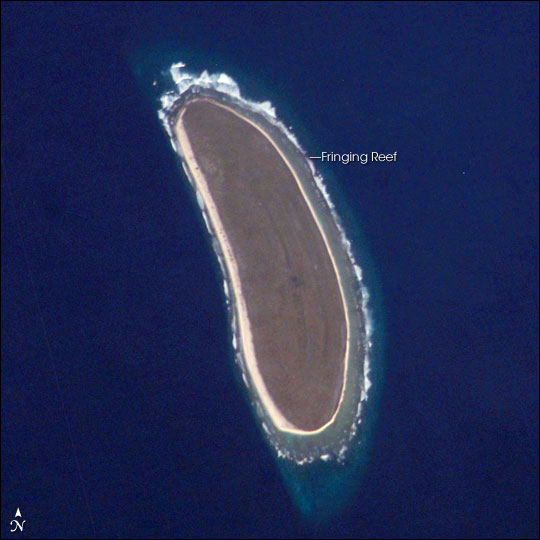
There are three kinds of coral reefs. Fringing reefs are platforms of coral attached to land. They tend to be wider where wave action is prominent and the water well aerated. Barrier reefs form offshore with lagoon in between. Many form along slowing subsiding islands, growing at a rate that keeps them near sea level. Others form on continental shelves. The largest and one of the most well known is the Great Barrier Reef of Australia at over 2025 km long ( 1260 m) and 16 - 145 km (10-90 mi) wide. Atolls are circular reefs enclosing a lagoon formed from the subsidence and disappearance of a volcanic island cone.