

10.3: Geologic Work of Streams
- Page ID
- 42703

\( \newcommand{\vecs}[1]{\overset { \scriptstyle \rightharpoonup} {\mathbf{#1}} } \)
\( \newcommand{\vecd}[1]{\overset{-\!-\!\rightharpoonup}{\vphantom{a}\smash {#1}}} \)
\( \newcommand{\dsum}{\displaystyle\sum\limits} \)
\( \newcommand{\dint}{\displaystyle\int\limits} \)
\( \newcommand{\dlim}{\displaystyle\lim\limits} \)
\( \newcommand{\id}{\mathrm{id}}\) \( \newcommand{\Span}{\mathrm{span}}\)
( \newcommand{\kernel}{\mathrm{null}\,}\) \( \newcommand{\range}{\mathrm{range}\,}\)
\( \newcommand{\RealPart}{\mathrm{Re}}\) \( \newcommand{\ImaginaryPart}{\mathrm{Im}}\)
\( \newcommand{\Argument}{\mathrm{Arg}}\) \( \newcommand{\norm}[1]{\| #1 \|}\)
\( \newcommand{\inner}[2]{\langle #1, #2 \rangle}\)
\( \newcommand{\Span}{\mathrm{span}}\)
\( \newcommand{\id}{\mathrm{id}}\)
\( \newcommand{\Span}{\mathrm{span}}\)
\( \newcommand{\kernel}{\mathrm{null}\,}\)
\( \newcommand{\range}{\mathrm{range}\,}\)
\( \newcommand{\RealPart}{\mathrm{Re}}\)
\( \newcommand{\ImaginaryPart}{\mathrm{Im}}\)
\( \newcommand{\Argument}{\mathrm{Arg}}\)
\( \newcommand{\norm}[1]{\| #1 \|}\)
\( \newcommand{\inner}[2]{\langle #1, #2 \rangle}\)
\( \newcommand{\Span}{\mathrm{span}}\) \( \newcommand{\AA}{\unicode[.8,0]{x212B}}\)
\( \newcommand{\vectorA}[1]{\vec{#1}} % arrow\)
\( \newcommand{\vectorAt}[1]{\vec{\text{#1}}} % arrow\)
\( \newcommand{\vectorB}[1]{\overset { \scriptstyle \rightharpoonup} {\mathbf{#1}} } \)
\( \newcommand{\vectorC}[1]{\textbf{#1}} \)
\( \newcommand{\vectorD}[1]{\overrightarrow{#1}} \)
\( \newcommand{\vectorDt}[1]{\overrightarrow{\text{#1}}} \)
\( \newcommand{\vectE}[1]{\overset{-\!-\!\rightharpoonup}{\vphantom{a}\smash{\mathbf {#1}}}} \)
\( \newcommand{\vecs}[1]{\overset { \scriptstyle \rightharpoonup} {\mathbf{#1}} } \)
\(\newcommand{\longvect}{\overrightarrow}\)
\( \newcommand{\vecd}[1]{\overset{-\!-\!\rightharpoonup}{\vphantom{a}\smash {#1}}} \)
\(\newcommand{\ket}[1]{\left| #1 \right>}\)
\(\newcommand{\bra}[1]{\left< #1 \right|}\)
\(\newcommand{\braket}[2]{\left< #1 \vphantom{#2} \right| \left. #2 \vphantom{#1} \right>}\)
\(\newcommand{\braopket}[3]{\left< #1 \vphantom{#2}\vphantom{#3} \right| #2 \vphantom{#1}\vphantom{#3} \left| #3 \vphantom{#1}\vphantom{#2} \right>}\)
\(\newcommand{\qmvec}[1]{\mathbf{\vec{#1}}}\)
\(\newcommand{\op}[1]{\hat{\mathbf{#1}}}\)
\(\newcommand{\expect}[1]{\langle #1 \rangle}\)
\(\newcommand{\dfn}[1]{\emph{\textbf{#1}}}\)
Erosion
Water flowing through a stream performs three kinds of geologic work. Moving water erodes material from the bed and sides of the channel, it transports the eroded material to a new location, and then deposits it. Material deposited by streams is called alluvium. The ability of a stream to do work is a function of stream velocity and discharge.
Stream erosion is the detachment of material from the bed or sides of the channel. Approximately 95% of a stream's energy is used to overcome frictional effects imposed by the channel and internal molecular friction. This leaves only 5% of the stream's energy for vertical and lateral cutting. Flowing water erodes in four ways which are solution, hydraulic plucking, abrasion and attrition. Figure \(\PageIndex{1}\) illustrates these four methods which have been explained in detail in this section.

Figure \(\PageIndex{1}\) illustrates the major methods by which a river erodes and transports rock and sediment within a stream channel.
The image is a cross-sectional view of a river flowing between two rocky banks. Four erosion processes are labeled: hydraulic plucking, solution, attrition, and abrasion.
Hydraulic Plucking - Along the left bank, cracked rock is shown adjacent to the river channel and labeled Hydraulic Plucking. Water enters fractures and weaknesses in the rock. The force of flowing water loosens and removes rock fragments from the channel banks and bed. Hydraulic plucking breaks rock loose and enlarges the channel by removing material directly from the river banks and bed.
Solution - Near the water surface, small particles are shown dispersed throughout the water and labeled Solution. These particles represent dissolved minerals that have been chemically weathered and dissolved into the water. Solution transports soluble minerals, such as limestone-derived materials, in dissolved form rather than as visible sediment.
Attrition - Near the center of the channel, several sediment particles are shown colliding with one another and are labeled Attrition. Arrows indicate the particles striking each other as they move with the current. Attrition gradually breaks sediment into smaller, smoother, and more rounded particles as they collide during transport.
Abrasion - Along the channel bottom, larger sediment particles are shown rolling and sliding across the bed. This process is labeled Abrasion. The moving sediment scrapes, grinds, and wears away the river bed and channel banks. Abrasion acts like sandpaper, eroding the channel through the repeated impact and grinding of transported sediment.
Solution
Solution or corrosion is a chemical process by which slightly acidic river water dissolves certain types of rock like limestone and chalk. When the river water flows over these rocks it dissolves the materials and carries them away.
Hydraulic Action
This method of erosion is carried out by a river through its force. The channel dislodges materials from the sides of its bed by its force and makes them available for transportation. As the water moves past it can force air and water into cracks in the river bank and bed. When the water fills the cracks it compresses the trapped air. As the water recedes , it expands and weakens the rock and eventually dislodges it. The powerful force of water is capable of significant erosion specially in its upper course where the river energy and velocity is high aided by steep slope.
Abrasion
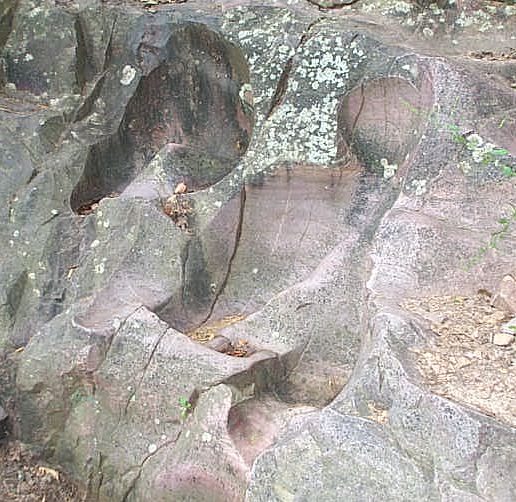
Abrasion is sometimes also called corrasion is a process by which the river's sediments scrape and scour its riverbed and banks. It is similar to the exfoliating effect of sand paper that smoothens surfaces. The river uses rocks, pebbles and sand grains as tools resulting in vertical and lateral erosion that makes the channel deeper and wider. Size and roughness of sediments and velocity of the river influence the rate of abrasion. Potholes shown in Figure \(\PageIndex{2}\) are a direct result of abrasion and are deepened as a result of rocks and pebbles being caught in an eddy. When such circular depressions created by abrasion get connected the river valley deepens.
Attrition
Attrition is often not considered a direct form of erosion on the channel itself however it contributed to modification of the sediment load. It is an internal process where the rocks and pebbles carried by a river collide with each other and end up breaking the rocks making them smaller, smoother or more rounded while they are being transported downstream by the river.
Transportation
Once material is detached from the channel it can be transported. Transportation is the movement of earth material, in this case, by water. As particle size increases, so too does the velocity needed to transport it. The material transported through the stream is it's stream load. Stream load is composed of dissolved or solution load, suspended load, and bed load. The dissolved load comes primarily from groundwater seepage into the stream. Ions in solution also come from the solution of materials that line the channel.
Suspended load is comprised of sediment suspended and transported through the stream. Turbulent flow suspends clay and silt in the stream. Suspended load comes from material eroded from the surface bordering the channel and deposited in the stream, as well as, erosion of the channel itself. The different methods of transportation of sediments by a river are illustrated in Figure \(\PageIndex{3}\).

Figure \(\PageIndex{3}\) is a cross-sectional view of a river channel illustrating the four primary methods by which a river transports sediment: traction, saltation, suspension, and solution.
Traction - Along the river bed, the largest sediment particles are shown resting on the channel bottom. Arrows indicate these particles are being pushed, rolled, or dragged downstream. Traction transports the largest and heaviest materials, such as cobbles and boulders, by rolling or sliding them along the stream bed. It occurs when water velocity is strong enough to move coarse sediment.
Saltation - Near the right side of the channel, smaller particles are shown bouncing intermittently above the bed. Upward and downward arrows indicate repeated lifting and dropping. Saltation moves sand-sized and small gravel particles in a series of short hops or skips along the channel bottom. It is one of the most common forms of sediment transport in streams.
Suspension - Near the upper part of the water column, small particles are shown floating within the water and are labeled Suspension. Suspension transports fine sediment, such as silt and clay, by holding it within the moving water. Turbulent flow keeps these particles from settling to the bottom.
Solution - Small dots dispersed throughout the water are labeled Solution. Solution transports dissolved minerals that have been chemically weathered from rocks and soils. These materials are carried as invisible dissolved ions rather than solid particles.
The stream capacity is the maximum load of sediment a stream can carry for a given discharge. As one might expect, stream capacity increases with increasing flow velocity. Increased water velocity imparts a greater frictional drag on bed to erode it. Turbulent flow occurs under higher velocity thus increasing the water's ability to dislodge material from the bed or sides of the stream. Stream competence is the largest size material the stream can move under a given discharge. Bed load is that which is moved across the bed of the channel.
Solution
When a river flows over soluble rocks like limestone or chalk, slightly acidic water dissolves the minerals. These dissolved minerals are carried invisibly as dissolved load. Unlike the three other methods, this form of transport does not rely on river velocity. Material carried in this way is called dissolved load.
Suspension
Fine light materials like silt and clay float on the turbulent flow of water. These materials do not touch the river bed. Materials lying afloat make a river appear muddy specially after torrential rainfall. Sediment that is carried in this manner is called the suspended load.
Saltation
Small pebbles and sand grains are carried by a river in a bouncing or hopping movement. These materials are too heavy to be carried in suspension but can by lifted when the river is turbulent. When the fluvial energy reduces gravity pulls then down causing them to bounce along the river bed. Medium sized sediment carried in this manner make up a river's bed load.
Traction
Heaviest material is transported by a river in this manner. Boulders, large rocks and gravels are rolled or dragged along the river bed by the strong currents. Material carried in this manner make up the bed load of a river along with material carried by saltation.
Deposition
As velocity and discharge decreases, the ability of the stream to move sediment through it decreases. The heaviest particles deposit on the bed first, with the smaller and lighter particles transported much further before accumulating. Aggradation raises the elevation of the bed by the accumulation of sediment in the channel. Deposits of sand and gravel as bars can separate the channel into numerous smaller channels resulting in a braided channel.
Stream flow and work
Figure \(\PageIndex{4}\) shows the relationship between particle size and minimum flow velocity for the three types of geologic work performed by water. Examine the minimum flow velocity for erosion. Note that it is much more difficult to erode materials from the channel than it is to transport or deposit them. For the finest particles like clay, a very high velocity of flow is required to dislodge them from the bed of the channel due to their strong molecular bonding. Small particle don't protrude above the bed of the channel so moving water slips over them more easily than larger particle that stand above the bed more. At the other end of the spectrum, the largest particle require high flow velocities to erode them.

Figure \(\PageIndex{4}\) is a graph showing the relationship between stream velocity, particle size, and whether sediment is eroded, transported, or deposited. This type of graph is commonly known as the Hjulström diagram.
Axes
- The horizontal axis represents particle size in millimeters, ranging from very fine clay on the left to large gravel and cobbles on the right.
- The vertical axis represents water velocity on a logarithmic scale, increasing upward from slow-moving water at the bottom to fast-moving water at the top.
Three zones - The graph is divided into three colored regions:
Erosion Zone (blue, upper region) - The upper portion of the graph is labeled Erosion. This region represents combinations of water velocity and particle size where flowing water has enough energy to pick up and remove sediment from the channel bed. The erosion boundary is curved:
- Fine clay particles require surprisingly high velocities to begin erosion because cohesive forces bind them together.
- Medium-sized sand particles are the easiest to erode and require the lowest velocity.
- Large gravel and cobbles require increasingly higher velocities because of their greater weight.
Transportation Zone (red, middle region) - The middle region is labeled Transportation. In this zone, sediment is already moving and can continue to be carried by the stream, but the flow is not energetic enough to erode additional particles from the bed. Sediment may be transported:
- In suspension
- By saltation
- By traction
- In solution
depending on particle size and flow conditions.
Deposition Zone (yellow, lower region) - The lower region is labeled Deposition. This zone represents conditions where water velocity is too low to keep sediment moving. As velocity decreases:
- Gravel is deposited first.
- Sand is deposited next.
- Fine silt and clay remain suspended longer and require extremely low velocities before settling out.
The graph demonstrates two important principles:
- Erosion and deposition do not occur at the same velocity.
- Once sediment is moving, it can be transported at lower velocities than were required to initially erode it.
- Clay behaves differently from sand and gravel.
- Clay particles are difficult to erode because they are cohesive.
- Once suspended, however, clay particles are very easy to transport and difficult to deposit.
Examine the area of the graph labeled "Transportation". Note that once clays have been eroded they can be transported over a wide range of velocities, even very slow ones before being deposited. The area of the graph for transportation narrows as you move to larger particle sizes. Larger sized material is harder to transport due to their weight.
Take a look at the area of the graph labeled " Deposition". Notice deposition doesn't extend over to the very smallest size on the left. The very smallest particles are easily transported even under low flow velocity and will not settle out. The minimum velocity for deposition (the line that separates transportation and deposition) climbs steadily to the right. This indicates that as particle size and weight increases, it is more difficult to transport material and deposition will occur with a slight drop in stream velocity.