

9.1: Distribution of water in the hydrosphere
- Page ID
- 42694

\( \newcommand{\vecs}[1]{\overset { \scriptstyle \rightharpoonup} {\mathbf{#1}} } \)
\( \newcommand{\vecd}[1]{\overset{-\!-\!\rightharpoonup}{\vphantom{a}\smash {#1}}} \)
\( \newcommand{\dsum}{\displaystyle\sum\limits} \)
\( \newcommand{\dint}{\displaystyle\int\limits} \)
\( \newcommand{\dlim}{\displaystyle\lim\limits} \)
\( \newcommand{\id}{\mathrm{id}}\) \( \newcommand{\Span}{\mathrm{span}}\)
( \newcommand{\kernel}{\mathrm{null}\,}\) \( \newcommand{\range}{\mathrm{range}\,}\)
\( \newcommand{\RealPart}{\mathrm{Re}}\) \( \newcommand{\ImaginaryPart}{\mathrm{Im}}\)
\( \newcommand{\Argument}{\mathrm{Arg}}\) \( \newcommand{\norm}[1]{\| #1 \|}\)
\( \newcommand{\inner}[2]{\langle #1, #2 \rangle}\)
\( \newcommand{\Span}{\mathrm{span}}\)
\( \newcommand{\id}{\mathrm{id}}\)
\( \newcommand{\Span}{\mathrm{span}}\)
\( \newcommand{\kernel}{\mathrm{null}\,}\)
\( \newcommand{\range}{\mathrm{range}\,}\)
\( \newcommand{\RealPart}{\mathrm{Re}}\)
\( \newcommand{\ImaginaryPart}{\mathrm{Im}}\)
\( \newcommand{\Argument}{\mathrm{Arg}}\)
\( \newcommand{\norm}[1]{\| #1 \|}\)
\( \newcommand{\inner}[2]{\langle #1, #2 \rangle}\)
\( \newcommand{\Span}{\mathrm{span}}\) \( \newcommand{\AA}{\unicode[.8,0]{x212B}}\)
\( \newcommand{\vectorA}[1]{\vec{#1}} % arrow\)
\( \newcommand{\vectorAt}[1]{\vec{\text{#1}}} % arrow\)
\( \newcommand{\vectorB}[1]{\overset { \scriptstyle \rightharpoonup} {\mathbf{#1}} } \)
\( \newcommand{\vectorC}[1]{\textbf{#1}} \)
\( \newcommand{\vectorD}[1]{\overrightarrow{#1}} \)
\( \newcommand{\vectorDt}[1]{\overrightarrow{\text{#1}}} \)
\( \newcommand{\vectE}[1]{\overset{-\!-\!\rightharpoonup}{\vphantom{a}\smash{\mathbf {#1}}}} \)
\( \newcommand{\vecs}[1]{\overset { \scriptstyle \rightharpoonup} {\mathbf{#1}} } \)
\(\newcommand{\longvect}{\overrightarrow}\)
\( \newcommand{\vecd}[1]{\overset{-\!-\!\rightharpoonup}{\vphantom{a}\smash {#1}}} \)
\(\newcommand{\ket}[1]{\left| #1 \right>}\)
\(\newcommand{\bra}[1]{\left< #1 \right|}\)
\(\newcommand{\braket}[2]{\left< #1 \vphantom{#2} \right| \left. #2 \vphantom{#1} \right>}\)
\(\newcommand{\braopket}[3]{\left< #1 \vphantom{#2}\vphantom{#3} \right| #2 \vphantom{#1}\vphantom{#3} \left| #3 \vphantom{#1}\vphantom{#2} \right>}\)
\(\newcommand{\qmvec}[1]{\mathbf{\vec{#1}}}\)
\(\newcommand{\op}[1]{\hat{\mathbf{#1}}}\)
\(\newcommand{\expect}[1]{\langle #1 \rangle}\)
\(\newcommand{\dfn}[1]{\emph{\textbf{#1}}}\)
Water in Earth’s Systems
Figure \(\PageIndex{1}\) shows the four Earth spheres which are atmosphere, hydrosphere, lithosphere and biosphere. In this chapter we will primarily be talking about the hydrosphere. The hydrosphere is often called the "water sphere" as it includes all the Earth's water found in the oceans, glaciers, streams, lakes, the soil, groundwater, and in the air. The hydrosphere interacts with, and is influenced by, all the other Earth spheres. The water of the hydrosphere is distributed among several different stores found in the other spheres. Water is held in oceans, lakes and streams at the surface of the Earth. Water is found in vapor, liquid and solid states in the atmosphere. The biosphere serves as an interface between the spheres enabling water to move between the hydrosphere, lithosphere and atmosphere as is accomplished by plant transpiration. The hydrologic cycle traces the movement of water and energy between these various stores and spheres. The solar energy provides the energy requires for water to transform itself or to go from one stage of the hydrological cycle to another.
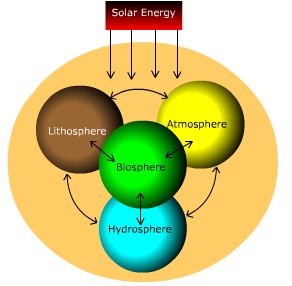
Figure \(\PageIndex{1}\) shows the interaction of the four major Earth systems and the role of solar energy in driving processes within and between them.
At the center is a green sphere labeled Biosphere, representing all living organisms and ecosystems. Surrounding it are three overlapping spheres:
- Lithosphere (brown), representing Earth's solid surface, rocks, and soils.
- Atmosphere (yellow), representing the layer of gases surrounding Earth.
- Hydrosphere (blue), representing all water in liquid, solid, and gaseous forms.
The four spheres overlap one another, emphasizing that they are interconnected rather than independent systems.
Above the spheres is a box labeled Solar Energy. Several downward arrows extend from the box toward the Earth systems, indicating that energy from the Sun powers many of the processes occurring within and among them.
Curved arrows between the spheres show two-way exchanges of matter and energy:
- Between the lithosphere and biosphere
- Between the biosphere and atmosphere
- Between the biosphere and hydrosphere
- Between the atmosphere and hydrosphere
These arrows indicate continuous interactions, such as the exchange of water, gases, nutrients, and energy among Earth's systems.
The diagram illustrates Earth as an interconnected system in which the lithosphere, atmosphere, hydrosphere, and biosphere continuously interact. Solar energy acts as the primary external energy source, driving processes such as weather, climate, photosynthesis, water movement, and biological activity. The figure emphasizes that changes in one Earth system can influence the others through the ongoing exchange of matter and energy.
The cryosphere is the part of Earth's hydrosphere comprised of frozen water. It plays a integral role in the global climate system through its influence on surface energy budgets, atmospheric moisture, hydrology, and atmospheric and oceanic circulation. The cyrosphere is a sensitive element of the climate system providing a key indicator of climate change. The increasing loss of Arctic sea ice and breakup of Antarctic ice shelves are two harbingers of changes to the future physical geography of Earth.
Distribution of water
The various stores of water in the hydrosphere are diagrammatically mentioned in Figure \(\PageIndex{2}\). The world's oceans contain 97% of the water in the hydrosphere, most of which is salt water. Only 2.8% is freshwater of which most is stored in ice sheets and glaciers. Ice caps, like that found covering Antarctica, and glaciers that occupy high alpine locations, compose a little more than 2% of all water found on Earth. Seemingly a small amount, the water stored as ice in glaciers would have a great impact on the environment if it were to melt into a liquid. Ice sheets and glaciers are a very significant store of freshwater available on the Earth. Rising sea levels from melting ice sheets and glaciers due to global warming could devastate coastal cities, displace millions of people, and wreak havoc on freshwater systems and habitats.

Figure \(\PageIndex{2}\) consists of three connected pie charts that show how Earth's water is distributed among major reservoirs.
Left pie chart: All water on Earth - The largest pie chart shows the distribution of all water on Earth. The chart emphasizes that nearly all of Earth's water is contained in the oceans, while only a small fraction is freshwater.
- Oceans: 97.2% of Earth's water
- Freshwater: 2.8% of Earth's water
Middle pie chart: Freshwater distribution - The freshwater portion is expanded into a second pie chart showing how freshwater is stored.
This chart shows that most freshwater is locked in ice or stored underground rather than being readily available at the surface.
- Ice sheets and glaciers: 2.15% of Earth's total water (the largest freshwater reservoir)
- Groundwater: 0.63% of Earth's total water
- A very small remaining fraction is divided among surface water and other freshwater sources.
Right pie chart: Surface freshwater distribution - The smallest remaining freshwater fraction is expanded into a third pie chart showing surface and near-surface freshwater reservoirs. These percentages are expressed relative to Earth's total water supply.
- Saline lakes and inland seas: 0.008%
- Freshwater lakes: 0.009%
- Soil water: 0.005%
- Atmosphere: 0.001%
- Streams: 0.0001%
The figure illustrates that although water covers much of Earth's surface, only a small percentage is freshwater, and most of that freshwater is stored in glaciers, ice sheets, or groundwater. Only a tiny fraction exists in lakes, rivers, soil moisture, and the atmosphere, which are the water sources most readily available to ecosystems and human use. The diagram highlights the limited accessibility of Earth's freshwater resources despite the planet's abundant total water supply.
Water beneath the surface comprises the next largest store. Groundwater and soil water make up about 0.63% and 0.005% of all water (by volume). Soil water is the water held in pore spaces between soil particles. Soil pore spaces usually are partially void of water most of the time but fill with water after a rain storm. Groundwater is found where Earth materials are saturated throughout the year. That is, the pore spaces are always occupied with water. Both soil and groundwater are very important sources of water. Soil water is available for plants to extract and use. Groundwater is an important source of water for irrigation and drinking water supplies.
Above the surface water is found stored in streams, rivers and lakes. One might expect that given the large rivers that flow across the Earth and the huge numbers of lakes that this store would be rather large. Instead, freshwater streams, rivers and lakes, and saline lakes and inlands seas comprise just under .03% of all water in the Earth system. In the atmosphere, only about 0.0001 % of the water in the hydrosphere is found.