

8.2: Mass Movement
- Page ID
- 42689

\( \newcommand{\vecs}[1]{\overset { \scriptstyle \rightharpoonup} {\mathbf{#1}} } \)
\( \newcommand{\vecd}[1]{\overset{-\!-\!\rightharpoonup}{\vphantom{a}\smash {#1}}} \)
\( \newcommand{\dsum}{\displaystyle\sum\limits} \)
\( \newcommand{\dint}{\displaystyle\int\limits} \)
\( \newcommand{\dlim}{\displaystyle\lim\limits} \)
\( \newcommand{\id}{\mathrm{id}}\) \( \newcommand{\Span}{\mathrm{span}}\)
( \newcommand{\kernel}{\mathrm{null}\,}\) \( \newcommand{\range}{\mathrm{range}\,}\)
\( \newcommand{\RealPart}{\mathrm{Re}}\) \( \newcommand{\ImaginaryPart}{\mathrm{Im}}\)
\( \newcommand{\Argument}{\mathrm{Arg}}\) \( \newcommand{\norm}[1]{\| #1 \|}\)
\( \newcommand{\inner}[2]{\langle #1, #2 \rangle}\)
\( \newcommand{\Span}{\mathrm{span}}\)
\( \newcommand{\id}{\mathrm{id}}\)
\( \newcommand{\Span}{\mathrm{span}}\)
\( \newcommand{\kernel}{\mathrm{null}\,}\)
\( \newcommand{\range}{\mathrm{range}\,}\)
\( \newcommand{\RealPart}{\mathrm{Re}}\)
\( \newcommand{\ImaginaryPart}{\mathrm{Im}}\)
\( \newcommand{\Argument}{\mathrm{Arg}}\)
\( \newcommand{\norm}[1]{\| #1 \|}\)
\( \newcommand{\inner}[2]{\langle #1, #2 \rangle}\)
\( \newcommand{\Span}{\mathrm{span}}\) \( \newcommand{\AA}{\unicode[.8,0]{x212B}}\)
\( \newcommand{\vectorA}[1]{\vec{#1}} % arrow\)
\( \newcommand{\vectorAt}[1]{\vec{\text{#1}}} % arrow\)
\( \newcommand{\vectorB}[1]{\overset { \scriptstyle \rightharpoonup} {\mathbf{#1}} } \)
\( \newcommand{\vectorC}[1]{\textbf{#1}} \)
\( \newcommand{\vectorD}[1]{\overrightarrow{#1}} \)
\( \newcommand{\vectorDt}[1]{\overrightarrow{\text{#1}}} \)
\( \newcommand{\vectE}[1]{\overset{-\!-\!\rightharpoonup}{\vphantom{a}\smash{\mathbf {#1}}}} \)
\( \newcommand{\vecs}[1]{\overset { \scriptstyle \rightharpoonup} {\mathbf{#1}} } \)
\(\newcommand{\longvect}{\overrightarrow}\)
\( \newcommand{\vecd}[1]{\overset{-\!-\!\rightharpoonup}{\vphantom{a}\smash {#1}}} \)
\(\newcommand{\ket}[1]{\left| #1 \right>}\)
\(\newcommand{\bra}[1]{\left< #1 \right|}\)
\(\newcommand{\braket}[2]{\left< #1 \vphantom{#2} \right| \left. #2 \vphantom{#1} \right>}\)
\(\newcommand{\braopket}[3]{\left< #1 \vphantom{#2}\vphantom{#3} \right| #2 \vphantom{#1}\vphantom{#3} \left| #3 \vphantom{#1}\vphantom{#2} \right>}\)
\(\newcommand{\qmvec}[1]{\mathbf{\vec{#1}}}\)
\(\newcommand{\op}[1]{\hat{\mathbf{#1}}}\)
\(\newcommand{\expect}[1]{\langle #1 \rangle}\)
\(\newcommand{\dfn}[1]{\emph{\textbf{#1}}}\)
The Mechanics of Mass Movement
Mass movement is defined as the down slope movement of earth materials under the direct influence of gravity. This detachment and mobilization occur when the shear stress—primarily a function of the material's weight acting down slope—exceeds the material's shear strength, or its resistance to being moved. Shear strength is enhanced by the interlocking of soil particles and the binding action of plant roots. Water is a major destabilizing agent: when it infiltrates and saturates the earth materials, the water filling the pore spaces increases the weight of the material and creates pore pressure. This pressure forces soil particles apart, lessening the friction between them and enabling them to slip past one another. Movement is often concentrated along a failure plane, which may be a distinct layer of clay or rock. Humans frequently induce mass movement by placing excessive loads on slopes (such as building houses) or by undercutting hillsides during construction (like road building), actions that increase shear stress and make slopes prone to failure.
Slopes
A slope is an inclined ground surface. Most slopes are mantled with unconsolidated regolith, the product of weathering. Regolith serves as parent material for soil above and grades downward into unaltered bedrock below. Loose regolith serves as a source of colluvium, sediment that has been eroded, transported and deposited down slope. In order to do so, the erosional forces must overcome the forces of resistance: friction, inertia (the resistance to movement), and particle cohesion.
The land surface constantly responds to endogenic and exogenic forces that shape the Earth. Being an open system, a slope seeks a state of balance between the forces of resistance and those of change. The surface attains a state of dynamic equilibrium, a condition where the system constantly adjusts to processes that raise the surface (e.g. tectonic uplift) and those that wear it down (e.g. erosion by water). The system fluctuates around a stable average state unless the driving forces of change exceed a geomorphic threshold, such as a massive earthquake, tsunami, volcanism. Once this occurs, a period of system adjustment occurs, finally ending in a new stable state.
Angle of repose
The angle of repose is the steepest possible angle at which any loose, granular material can be piled without beginning to move downslope under the influence of gravity, initiating slumping or sliding; this maximum stable slope is governed by three primary factors. Loose fallen materials that collect at the bottom of a slope or a cliff in a cone shaped pile are called talus or screes.
First, particle size and shape are crucial: larger, angular, and irregular particles interlock effectively, increasing friction and resulting in a higher (steeper) angle of repose, while smaller, smoother, and rounded particles create less friction and thus a lower, shallower angle.
Second, particle roughness contributes to frictional resistance, further allowing rougher material to maintain a steeper slope.
Third, moisture content introduces the force of cohesion: while dry material relies solely on friction, slightly damp material gains stability from the surface tension of water films, allowing it to stand in significantly steeper piles (like a sandcastle). Conversely, when material becomes fully saturated, the water fills all pore spaces, eliminating friction and internal strength, causing the material to behave like a fluid and resulting in a very low angle of repose, which frequently triggers landslides and mudflows.

Figure \(\PageIndex{1}\) shows a pile of loose sand piled up naturally on a flat, horizontal surface. Angle of Repose is shown between the horizontal base line and the steepest slope of the side of the material pile. The figure visually demonstrates the Angle of Repose as the maximum slope at which the material can stand without experiencing downslope movement (slumping or sliding). If the sides of the pile were to be made steeper than this angle, the gravitational force (shear stress) would overcome the friction between the particles (shear strength), causing the material to tumble down until the slope returned to the angle of repose.
Types of mass movement
Soil creep is nearly imperceptible to the naked eye as it is the slowest of all types of mass movement. Soil creep generally occurs in the top few meters of the surface and is accomplished by expansion and contraction of the soil. For instance, when water in the soil freezes the ice pushes soil particles outward perpendicular to the slope. Upon warming, the ice melts and the soil is pulled down slope under the influence of gravity. Over many freeze-thaw cycles soil moves slowly down slope. In many cases one might not be able to tell that soil creep is occurring by just examining the surface. However, trees growing on surfaces undergoing creep will have curved trunks or roots that are curved. Broken retaining walls and curved railroad tracks also indicate creep in action.
A slide is a type of mass movement where a cohesive sheet of material slips along a defined failure plane, often traveling distances ranging from a meter to a kilometer down slope . The movement produces a characteristic concave scar at the point of origin, while the leading edge of the slide can break and bend trees, and bury the soil downhill. Analysis of these buried soils can provide valuable information about the age and environment present when the slide occurred. Landslides are often triggered by human activities, especially deforestation for agriculture or urban expansion. The removal of natural plant cover makes the soil more vulnerable by decreasing its shear strength and allowing more water to quickly infiltrate the soil and underlying rock, destabilizing the slope.

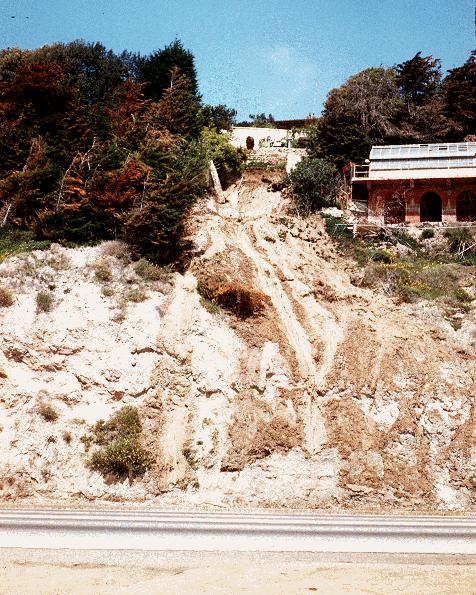
La Conchita, California has experienced devastating landslides in recent years. Unstable slopes mobilized by rain water caused a landslide and debris flow seen in Figure \(\PageIndex{2}\). The city lies on a narrow strip of coast 250m (800ft) wide between the shoreline and a 180 m (600ft) bluff above it. Extraordinary rains and rising groundwater levels caused the slope to fail, fortunately no one was killed. However, in 2005, another year of abnormally high rain fall caused the slope to fail again, this time burying structures and killing 10 people.
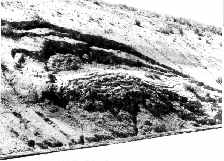
Slumps (shown in Figure \(\PageIndex{3}\)) are characterized by a backward rotation of the earth material as it moves along a curved failure plane resulting in a reverse slope. Slumps take place as an intermittent movement of earth or rock material, often as several independent units, creating a number of step-like "terracettes." Undercutting of slopes by stream erosion, waves, and road building are common causes of slumping.
Solifluction is a slow, down slope movement of waterlogged soil that occurs over a permanently frozen subsurface, or permafrost . This process is common in high-latitude or high-altitude regions. During the warmer summer months, the top layer of the permafrost—known as the active layer—thaws. Because the underlying frozen ground prevents the water from draining away, this active layer becomes saturated and highly mobile, allowing the heavy, waterlogged soil mass to slowly creep down slope, forming distinct features known as solifluction lobes or terraces.

A flow is the down slope movement of water-saturated soil, regolith, weak shale, or weak clay layers. Earth flows are fairly slow, occurring over a few hours or so slow that they are almost imperceptible. Earth flows are accompanied with slumping, but unlike slumping, there is no backward rotation. Earth flows differ from mudflows in that they (1) tend to be slower, (2) are not confined to channels, (3) are more common in humid areas than dry, and (4) have a lower water content.
A mudflow is the rapid down slope movement of water-saturated water- saturated soil, regolith. The higher water content creates a flow rapid enough to be perceptible to the eye. Conditions favorable for the development of mudflows are: (1) unconsolidated surface materials, (2) steep slopes abundant but intermittent precipitation, and (3) sparse cover of vegetation. Mudflows tend to be more prevalent in dry regions where vegetation is sparse and heavy rains may form. When set in motion, they occupy stream-cut channels rushing along in a torrential flow of mud.

A lahar is a destructive type of mudflow or debris flow that originates on the slopes of a volcano. These flows are dense, fast-moving slurries composed primarily of volcanic material—including tephra, ash, pumice, and rocks—mixed with a large volume of water. The water needed to mobilize this volcanic debris typically comes from three main sources: the rapid melting of a volcano's snow and ice during an eruption, the breach or emptying of crater lakes, or intense, heavy rainfall. Lahars can travel a great distance from the volcano, following existing river valleys and growing in mass and destructive power as they incorporate loose material along their path.

Rock fall is one of the most sudden forms of mass movement. Rock fall occurs when blocks of rock shed from a cliff face and collect at the base. Talus is a term that is applied to an accumulation of rock by rock fall.