

8.1: Weathering
- Page ID
- 42688

\( \newcommand{\vecs}[1]{\overset { \scriptstyle \rightharpoonup} {\mathbf{#1}} } \)
\( \newcommand{\vecd}[1]{\overset{-\!-\!\rightharpoonup}{\vphantom{a}\smash {#1}}} \)
\( \newcommand{\dsum}{\displaystyle\sum\limits} \)
\( \newcommand{\dint}{\displaystyle\int\limits} \)
\( \newcommand{\dlim}{\displaystyle\lim\limits} \)
\( \newcommand{\id}{\mathrm{id}}\) \( \newcommand{\Span}{\mathrm{span}}\)
( \newcommand{\kernel}{\mathrm{null}\,}\) \( \newcommand{\range}{\mathrm{range}\,}\)
\( \newcommand{\RealPart}{\mathrm{Re}}\) \( \newcommand{\ImaginaryPart}{\mathrm{Im}}\)
\( \newcommand{\Argument}{\mathrm{Arg}}\) \( \newcommand{\norm}[1]{\| #1 \|}\)
\( \newcommand{\inner}[2]{\langle #1, #2 \rangle}\)
\( \newcommand{\Span}{\mathrm{span}}\)
\( \newcommand{\id}{\mathrm{id}}\)
\( \newcommand{\Span}{\mathrm{span}}\)
\( \newcommand{\kernel}{\mathrm{null}\,}\)
\( \newcommand{\range}{\mathrm{range}\,}\)
\( \newcommand{\RealPart}{\mathrm{Re}}\)
\( \newcommand{\ImaginaryPart}{\mathrm{Im}}\)
\( \newcommand{\Argument}{\mathrm{Arg}}\)
\( \newcommand{\norm}[1]{\| #1 \|}\)
\( \newcommand{\inner}[2]{\langle #1, #2 \rangle}\)
\( \newcommand{\Span}{\mathrm{span}}\) \( \newcommand{\AA}{\unicode[.8,0]{x212B}}\)
\( \newcommand{\vectorA}[1]{\vec{#1}} % arrow\)
\( \newcommand{\vectorAt}[1]{\vec{\text{#1}}} % arrow\)
\( \newcommand{\vectorB}[1]{\overset { \scriptstyle \rightharpoonup} {\mathbf{#1}} } \)
\( \newcommand{\vectorC}[1]{\textbf{#1}} \)
\( \newcommand{\vectorD}[1]{\overrightarrow{#1}} \)
\( \newcommand{\vectorDt}[1]{\overrightarrow{\text{#1}}} \)
\( \newcommand{\vectE}[1]{\overset{-\!-\!\rightharpoonup}{\vphantom{a}\smash{\mathbf {#1}}}} \)
\( \newcommand{\vecs}[1]{\overset { \scriptstyle \rightharpoonup} {\mathbf{#1}} } \)
\(\newcommand{\longvect}{\overrightarrow}\)
\( \newcommand{\vecd}[1]{\overset{-\!-\!\rightharpoonup}{\vphantom{a}\smash {#1}}} \)
\(\newcommand{\ket}[1]{\left| #1 \right>}\)
\(\newcommand{\bra}[1]{\left< #1 \right|}\)
\(\newcommand{\braket}[2]{\left< #1 \vphantom{#2} \right| \left. #2 \vphantom{#1} \right>}\)
\(\newcommand{\braopket}[3]{\left< #1 \vphantom{#2}\vphantom{#3} \right| #2 \vphantom{#1}\vphantom{#3} \left| #3 \vphantom{#1}\vphantom{#2} \right>}\)
\(\newcommand{\qmvec}[1]{\mathbf{\vec{#1}}}\)
\(\newcommand{\op}[1]{\hat{\mathbf{#1}}}\)
\(\newcommand{\expect}[1]{\langle #1 \rangle}\)
\(\newcommand{\dfn}[1]{\emph{\textbf{#1}}}\)
Endogenic and Exogenic Forces
The earth's crust is dynamic and is constantly under a process of change. Endogenic forces create new relief features. Mountain building, uplift, subsidence, folding, faulting, volcanic eruptions are all internal forces that change the landscape. Exogenic forces like weathering and erosion wear away the surfaces. The present day landforms are a result of constant impact of constructive and destructive forces.
Denudation
Wearing away of the earth leads to lowering of the surface which is also known as denudation. There are 4 phases of denudation which occur simultaneously in different parts of the world.
Weathering
The gradual disintegration of rocks occurring in situ by atmospheric forces, weather forces, or biological agents.
Erosion
The wearing away of the Earth's surface by agents such as running water, wind, sea waves, and glaciers.
Transportation
The movement of eroded material to a new location by agents such as running water, wind, sea waves, and glaciers.
Deposition
The dropping off of sediments by the agents of transportation when they undergo a loss of energy.
Denudation depends on nature of the relief, structure of the rocks, local climate and influence of biological agents including humans.
Bedrock and Regolith
The bedrock, illustrated in Figure \(\PageIndex{1}\), is the dense, solid, and continuous rock layer that constitutes the stable, unweathered foundation of the landmass. It is considered the original parent material of the landscape. Because it is consolidated—meaning its components are firmly held together—it is inherently difficult to excavate. Regardless of its rock type (igneous, sedimentary, or metamorphic), the bedrock generally lies beneath the ground surface, but it may become visible in high-relief areas like cliffs or canyon walls, where it is formally known as a rock outcrop. Essentially, bedrock serves as the deep, structural floor upon which all subsequent loose surface materials ultimately rest.
Regolith is the layer of loose, weathered, and unconsolidated material that lies directly atop the solid bedrock. The term itself originates from the Greek words rhegos (blanket) and lithos (rock). Regolith is primarily formed through the various processes of weathering—both physical and chemical—which break the underlying rock into smaller pieces. As this material is exposed closer to the surface, weathering intensifies, eventually leading to the formation of the topsoil layer that is essential for plant growth and the biosphere. Fundamentally, the regolith is a dynamic zone of interaction between the lithosphere (rock), the atmosphere, and the biosphere (life).

Figure \(\PageIndex{1}\) is a vertical cross-section of a soil profile, showing the major soil horizons from the ground surface down to solid bedrock.
At the top, a plant is shown growing on the surface, with roots extending downward through several soil layers. The layers are labeled on the right side.
The uppermost layer is labeled Humus. This thin, dark organic layer consists of decomposed plant and animal material. It contains nutrients that support plant growth and contributes organic matter to the soil.
Below the humus is the Topsoil layer. Topsoil is dark in color and contains a mixture of mineral particles, organic matter, air, and water. Numerous plant roots extend through this layer because it provides most of the nutrients and biological activity needed for plant growth.
Beneath the topsoil is the Subsoil. This layer contains less organic material and is lighter in color. It often accumulates minerals and materials that have been leached downward from the topsoil. Some roots penetrate into this layer, but they are less abundant than in the topsoil.
Below the subsoil is a layer labeled Weathered rock fragments. This zone contains partially weathered rock mixed with loose mineral material. The rock is beginning to break down through physical and chemical weathering processes but has not yet become solid soil.
The lowest layer is labeled Bedrock. Bedrock consists of solid, unweathered rock that forms the foundation beneath the soil profile. Over time, weathering of the bedrock supplies mineral material to the layers above.
The diagram illustrates how soil develops from weathered rock and organic matter. It shows the vertical organization of soil horizons, the movement of plant roots through the profile, and the relationship between surface biological processes and the underlying geologic material.
Overall, the figure demonstrates that soil forms through the combined effects of weathering, organic matter accumulation, and biological activity, resulting in distinct layers that support plant growth and ecosystem processes.
What is Weathering?
Weathering is the fundamental process responsible for the breakdown and chemical decomposition of Earth's surface materials. It primarily affects rocks and occurs in situ (in place), initiated by atmospheric processes, weather, or biological agents.
The Critical Roles of Weathering
Weathering serves several essential functions in our ecosystem:
- Destabilization: It weakens and fragments surface rocks. This prepares the material for eventual removal and transport by erosive forces such as wind, water, and ice.
- Creation of New Products: The chemical alteration of rock-forming minerals leads to the creation of new materials. For example, the formation of clays is a vital byproduct of this process.
- Soil and Texture: The physical disintegration of rocks produces sediment particles. These particles directly contribute to the texture and structure of soil, which makes agriculture possible.
- Chemical Release: This process releases vital chemical compounds and nutrients trapped within rocks, making them available for biological and ecosystem processes.
- Atmospheric Impact: The breakdown of certain minerals (particularly carbonates) releases carbon dioxide (CO2) into the atmosphere, influencing global temperatures and atmospheric chemistry.

Types of Weathering: Physical vs. Chemical
Weathering primarily occurs through two distinct processes:
Physical Weathering (Mechanical)
Physical weathering, also known as mechanical weathering, involves the disintegration of rock material.
How it Works
It is a purely mechanical process that breaks larger rocks into smaller fragments without changing the chemical composition of the material.
Result:
You end up with the same rock, just in many smaller pieces (e.g., a boulder broken into pebbles).
Dominated by Climate
This process is typically dominant in dry and cold environments where freeze-thaw cycles or extreme temperature changes are common.
Chemical Weathering
Chemical weathering involves the decomposition of rocks and sediment.
How it Works
In this case, a chemical reaction occurs between the rock material and substances like water, oxygen, or acids. The original minerals are fundamentally altered.
Result:
A new product is created from the pre-existing material (e.g., granite minerals turning into clay).
Dominated by Climate
This process is generally dominant in warm and moist environments, as water is the key agent for most chemical reactions.
Joints and Pores
The presence of joints (cracks) and pores (tiny holes) fundamentally governs the speed and efficiency of rock weathering because they are primary areas of weakness that significantly increase the rock's surface area exposed to the environment. These flaws function as entry points and pathways for water, air, and ice, which are the main agents of weathering. Specifically, joints allow water to seep deep inside, acting as channels for frost wedging and root wedging that lead to block disintegration, and providing access for chemical dissolution far beneath the surface. Meanwhile, pores attract mineral-rich water, and in the case of salt weathering, the collected salt crystals exert pressure upon evaporation or hydration, eventually leading to the granular disintegration of the rock. Ultimately, this dense network of pores and joints ensures that weathering occurs uniformly deeper into the bedrock, creating a thick layer of fragmented, chemically altered material known as regolith—the foundation of soil—causing rocks with these flaws to weather much faster than solid, impermeable rock.

Physical weathering
Physical weathering is just the process of breaking a big rock into smaller pieces (like using a hammer, but nature does it). This happens because water and ice push against the cracks (joints) and tiny holes (pores) inside the rock. The main reason this is important is that breaking one big rock creates a lot more surfaces for water and chemicals to touch. For example, if you split a small box, the total outside area that can be touched instantly gets bigger. This extra surface area lets chemical changes happen much faster and makes it easy for wind and water to carry away the debris. Examine Figure \(\PageIndex{4}\). On the left is a block whose length, width and height is equal to one centimeter. This means that the volume of the block is equal to 1 cubic centimeter and the total surface area is equal to 6 square centimeters. If we split the block in length and width wise (dashed lines) we create eight smaller pieces, each with a height, width, and depth of .5 centimeters. Though the volume of all eight pieces taken together is still 1 cubic centimeter, the total amount of surface area is greatly increased to 12 cm2.
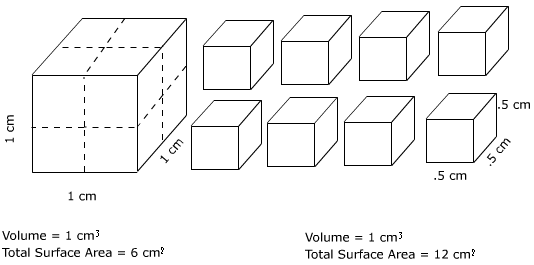
Figure \(\PageIndex{4}\) compares a single large rock fragment with several smaller rock fragments that together occupy the same total volume.
On the left is a cube measuring 1 centimeter on each side. The labels indicate:
- Volume = 1 cm³
- Total Surface Area = 6 cm²
Dashed lines show how the cube could be divided into smaller pieces.
On the right, the original cube has been divided into eight smaller cubes, each measuring 0.5 centimeters on each side. Together, these eight cubes still have:
- Volume = 1 cm³
However, because more surfaces are exposed, the combined:
- Total Surface Area = 12 cm²
The smaller cubes are arranged in two rows to show the increase in the number of exposed faces.
The diagram illustrates that breaking a rock into smaller pieces increases its surface area without changing its volume. The total volume remains the same, but the amount of exposed surface doubles from 6 cm² to 12 cm².
This principle is important in weathering and erosion because rocks with greater surface area have more material exposed to water, air, temperature changes, and chemical reactions. As a result, smaller rock fragments generally weather more rapidly than larger ones.
Physical weathering processes
Frost Wedging (or Freeze Thaw)
This process, known as Frost Wedging or Freeze-Thaw, occurs primarily in mountainous or high-latitude areas characterized by cold climates where the temperature frequently cycles above and below the freezing point of water. Water penetrates and fills existing cracks and fissures within the rock. When the temperature drops, the water turns to ice, expanding its volume by approximately 9%. This volumetric increase exerts intense pressure on the rock walls, gradually widening the cracks. Through the repetition of many freezing and thawing cycles, the sustained pressure eventually overcomes the rock's tensile strength, causing the rock to break apart..
Salt Crystal Growth (or Salt Wedging)
This method of physical weathering is known as Salt Crystal Growth (or Salt Wedging) and is especially common in arid climates and along coastal environments. Salty water penetrates the existing pores and fine cracks within the rock. When the water evaporates, it leaves behind dissolved salt minerals that begin to crystallize. As this process is repeated over time, the accumulating salt crystals join together and grow larger. These expanding crystals exert significant pressure and stress against the surrounding rock material, eventually causing the rock to fragment and break apart.
Exfoliation (or Sheeting)
Exfoliation, also commonly known as sheeting or "onion weathering," occurs when large masses of intrusive igneous rock, such as granite, are exposed at the Earth's surface due to the erosion of overlying material. The removal of this overburden relieves the confining pressure previously exerted on the rock. As the pressure is released, the underlying rock mass expands, particularly in a horizontal direction. This expansion causes concentric, onion-like layers of rock to fracture and peel away from the main rock body. This impressive form of physical weathering is famously exhibited by features like Half Dome in Yosemite National Park, California.
Thermal Expansion and Contraction
This form of weathering, known as Thermal Expansion and Contraction, is common in areas like deserts that experience an extreme diurnal temperature range (very hot days and very cold nights). Rocks are composite materials, meaning they are composed of different minerals, each of which expands and contracts at a unique rate in response to temperature change. This differential expansion and contraction creates internal stresses within the rock structure. Over long periods, the sustained fatigue from these repeated stresses can cause the outer layers of the rock to crack and eventually flake off.
Abrasion
Abrasion is a form of physical weathering that involves the mechanical scraping, grinding, or wearing away of rocks due to friction and impact with moving agents. The "tools" used for abrasion are other rock fragments and sediments carried by these agents. For example, running water and waves smooth and round pebbles and boulders, while wind carrying sand particles sculpts and polishes exposed rock faces, creating features called ventifacts. Furthermore, the powerful movement of glaciers is responsible for scouring the underlying bedrock, leaving behind characteristic striation marks that serve as evidence of past glacial presence.
Biological Weathering
Biological activity involves the actions of living organisms that contribute to both physical (mechanical) and chemical weathering. Because the processes are often interlinked, biological weathering is sometimes treated as a separate category of complex rock breakdown.
Biological Physical Weathering Processes
These actions physically break apart rock masses:
Root Wedging (or Root Action)
Illustrated in Figure \(\PageIndex{5}\), this mechanical process occurs when plant roots enter existing cracks and joints in the rock. As the roots expand and grow, they exert immense outward pressure on the fractures. This sustained pressure acts like a wedge, widening the cracks and eventually breaking the rock apart. This is a common issue for homeowners, as tree roots can force their way into and damage concrete foundations.
Burrowing Animals
Animals such as gophers, worms, and groundhogs contribute to physical weathering by burrowing. They often target less resistant portions of the rock or soil, creating and expanding burrows. In doing so, they physically break up the soil and rock material. Crucially, their activity exposes more rock surface area, making it vulnerable to other types of weathering.
Human Activity (Anthropogenic Physical Weathering)
Humans significantly accelerate physical weathering by using tools and explosives to break apart rock masses for construction, road building, and various mining techniques (e.g., quarrying and mountaintop removal). Furthermore, practices like deforestation and intensive agriculture (plowing) remove stabilizing vegetation, leaving the soil and subsoil exposed to greatly accelerated erosion by wind and water.
Biological Chemical Weathering Processes
These actions alter the chemical composition of rock minerals:
Organic Acid Secretion (Moss and Lichen)
Pioneer organisms like moss and lichens attach to rock surfaces and secrete potent organic acids, such as oxalic acid. These acids bind with and remove metal ions like iron, aluminum, and magnesium from the mineral structure, effectively dissolving the rock in a process called chelation.
Chemical Weathering by Plant Roots and Microbes
Growing tree roots release acidic compounds, including carbonic acid, into the soil water, increasing its acidity. This acidic water accelerates the speed of hydrolysis and dissolution of minerals like feldspars and mica. Similarly, the decomposition of dead organic matter by bacteria, fungi, and other microbes releases humic acids and carbonic acid, which lower the soil's pH and hasten the chemical breakdown of minerals.
Respiration
Respiration by all plants and animals releases carbon dioxide directly into the soil atmosphere. This carbon di oxide readily dissolves in water to form carbonic acid, which is a fundamental agent in the dissolution of carbonate and silicate rocks.
Animal waste
Animal waste (feces and urine) contains various nitrogen compounds. These chemicals mix with soil water to produce weak acids that contribute to the chemical alteration and breakdown of rock and mineral surfaces
Human Activity (Anthropogenic Chemical Weathering)
Humans drive chemical weathering by burning fossil fuels (coal, oil, and gas), which releases sulfur dioxide and nitrogen oxides into the atmosphere. These gases react with water vapor to form strong acids, primarily sulfuric acid and nitric acid, which fall as acid rain, drastically increasing the rate of dissolution of vulnerable minerals, notably those in limestone and marble.
Chemical weathering
The minerals in rocks formed beneath the surface are in equilibrium with the temperature and pressure conditions at time of their formation and thus are quite stable. However, many minerals are no longer in equilibrium with their environmental conditions when exposed at the surface and are susceptible to weathering. Chemical weathering results in the formation and retention of minerals in equilibrium with environmental conditions at the Earth's surface. The least stable minerals in igneous and metamorphic rocks are olivine and plagioclase, the most stable is quartz.
The interlocking and spacing of mineral grains controls the tendency towards weathering. Rocks with loosely interlocking mineral grains allow agents of chemical weathering to penetrate, thus speeding their decomposition. Limestone is primarily composed of calcite, a mineral that is quite soluble under surface conditions and easily dissolves in humid environments. In dry regions, the tight texture of limestone prevents it from disintegration and thus is a relatively resistant rock when found in deserts.
The process of chemical weathering tends to:
- increase bulk creating stress within rocks
- lower the density minerals
- decreased particle size resulting in increased surface area
- creates more mobile materials
- creates more stable minerals
Chemical weathering processes
Oxidation
Oxidation takes place when oxygen reacts with earth materials. Oxygen dissolved in water combines with atoms of metallic elements abundant in silicate minerals. Attacking metals in the soil, oxidation causes them to rust, leaving the soil a brownish-red to red color. When oxygen combines with iron, the reddish iron oxide hematite (Fe2O3) is formed.
The Reaction:
$$\text{4Fe} + \text{3O}_2 \to \text{2Fe}_2\text{O}_3$$
Hydrolysis
Hydrolysis is an exchange reaction involving minerals and water. Free hydrogen (H+) and hydroxide (OH-) ions in water are able to replace mineral ions and drive them into solution. As a result, the mineral's atomic structure is changed into a new form. It is a process whereby silicate minerals like potassium feldspar (KAlSi3O8) are weathered and a clay mineral is formed.
The Reaction (Weathering of Potassium Feldspar to Kaolinite):
$$\text{2KAlSi}_3\text{O}_8 + \text{2H}^+ + \text{9H}_2\text{O} \to \text{Al}_2\text{Si}_2\text{O}_5(\text{OH})_4 + \text{4H}_4\text{SiO}_4 + \text{2K}^+$$
Hydration
Hydration involves the absorption of water, like that which occurs during the conversion of hematite to limonite (a hydrated iron oxide). Some geoscientists question whether hydration is a true chemical weathering process because the process is readily reversible and the new product is not chemically different from its precursor. Some would rather call hydration a physical weathering process.
The Reaction (Formation of Limonite):
$$\text{2Fe}_2\text{O}_3 + \text{3H}_2\text{O} \to \text{2Fe}_2\text{O}_3 \cdot \text{3H}_2\text{O}$$
Carbonic Acid Action
Carbonic acid action involves the combination of carbon dioxide and water. Carbon dioxide (CO2) in the atmosphere combines with rainwater (H2O) to form carbonic acid (H2CO3).
The Reaction (Formation of Carbonic Acid):
$$\text{H}_2\text{O} + \text{CO}_2 \to \text{H}_2\text{CO}_3$$
Though weak, when carbonic acid is combined with a mineral like calcite (CaCO3), common to limestone, calcium (Ca2+) and bicarbonate (HCO3-) ions are released and carried off by groundwater, leading to the dissolution of the rock.
The Reaction (Dissolution of Calcite):
$$\text{CaCO}_3 + \text{H}_2\text{CO}_3 \to \text{Ca}^{2+} + \text{2HCO}_3^-$$
Rock resistance to weathering
Rocks exhibit varying resistance to weathering primarily due to differences in their mineral content and structure. Minerals that are inherently unstable under surface conditions, such as those that are highly soluble, will readily decompose, while stable minerals strongly resist the agents of weathering. In terms of structure, the hardness of the rock-forming minerals influences physical breakdown, with softer minerals being easily crushed or split. Furthermore, the arrangement and size of the mineral grains are crucial: water and chemical agents have difficulty penetrating intricately interlocked and closely-spaced grains, whereas rocks with larger, poorly-joined, or loosely-cemented minerals (such as those arranged in weak sheets) will disintegrate and decompose much more readily.

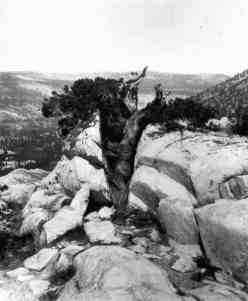
Granite, shown in Figure \(\PageIndex{6}\), is a coarse-grained igneous rock, is primarily composed of the minerals quartz and feldspar . Both quartz and feldspar are hard minerals, but feldspar is significantly less stable under Earth's surface conditions than quartz. In humid climates, the feldspar readily undergoes hydrolysis to weather into clay minerals. Even in dry climates, the somewhat porous nature of granite allows moisture to penetrate, which enables the feldspar to decompose. As the feldspar mineral grains weather and break down, they weaken the bonds holding the entire rock mass together, ultimately causing the granite to disintegrate.
Karst Landscapes
Karst is a distinctive topography that develops in regions underlain by carbonate-rich rocks, primarily limestone and, to a lesser extent, dolomite. The term originates from a strip of limestone plateau in Yugoslavia noted for its unique landforms. Karst landscapes are created by the extensive chemical dissolution of the bedrock, especially where the rock is highly fractured. This intense chemical solution wears away the bedrock, resulting in a unique assemblage of surface landforms such as fissures, sinkholes, and disappearing streams, often culminating in the undermining of the surface to form caves and spectacular underground complexes. Significant karst regions exhibiting these features are found globally, including areas like Jamaica, the northern Yucatán Peninsula, and in the United States, regions such as central Kentucky, central Florida, and the Great Valley region spanning Pennsylvania, Maryland, Virginia, and Tennessee.
The development of extensive Karst topography generally requires four specific conditions. First, limestone must be present at or near the surface, as it is highly soluble; although karst can form in dolomite, it is a less soluble alternative. Second, the limestone should be dense and highly jointed but not overly porous; high porosity causes water to be rapidly absorbed throughout the entire rock mass rather than concentrated along specific flow paths like joints. Third, the landscape must include entrenched valleys below soluble uplands to ensure the downward movement of groundwater, which drives the dissolution process. Finally, the region must receive at least moderate precipitation, as significant karst features require a continuous supply of water; consequently, few arid or semi-arid regions exhibit true, actively forming karst.
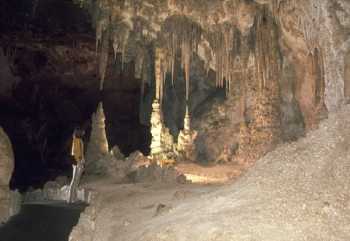
Cavern systems, such as the one illustrated by Carlsbad Caverns in New Mexico in Figure \(\PageIndex{7}\), are large, underground voids carved out by the dissolving action of water in soluble rock. These active geological systems feature distinctive depositional features formed where dissolved material is redeposited. Stalactites are the sharp, downward-growing pinnacles that hang from cave roofs, formed as water containing dissolved calcium carbonate slowly drips and evaporates, leaving behind solidified calcium carbonate crystals. When this water trickles down the stalactite and drops onto the cave floor, the continued evaporation deposits more calcium carbonate, forming stalagmites, which are typically shorter, fatter, and more rounded. When a growing stalactite and stalagmite eventually join together, they form a pillar or column.
Karst Landforms
Karst landscapes are characterized by a general absence of surface drainage, as water quickly sinks underground through highly jointed limestone bedrock. Surface streams that originate on less porous rocks may flow across the limestone for a limited distance before disappearing into the subsurface to become "disappearing streams." Water only reemerges on the surface as a spring when it encounters non-porous rock layers. The intense dissolution of the limestone enlarges the joints, creating trenches known as grikes, which separate rectangular blocks called clints, forming what is sometimes termed a limestone pavement . Small depressions where rainwater first sinks into the rock's weaknesses are called swallow holes (or ponors). The most common karst feature is the sinkhole (or doline), a depression formed either from the surface down (by dissolution widening fissures) or from below (by the collapse of a cave ceiling, creating a more dangerous collapse sinkhole). When multiple sinkholes or dolines merge, they form a large, complex depression known as an uvala.
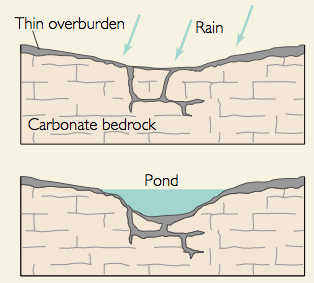
Figure \(\PageIndex{8}\) shows the early stages of sinkhole formation in a karst landscape underlain by carbonate bedrock such as limestone.
Top panel - The upper diagram shows a thin layer of soil, labeled thin overburden, resting on carbonate bedrock. Arrows labeled rain point downward toward the surface. Rainwater infiltrates through cracks and fractures in the soil and bedrock. As the slightly acidic water moves downward, it dissolves the carbonate rock, enlarging fractures and forming underground cavities and channels.
Bottom panel - The lower diagram shows a depression that has formed at the ground surface and filled with water, creating a pond. Beneath the pond, the enlarged cavity and solution channels within the carbonate bedrock are visible. Continued dissolution and collapse of the overlying material have caused the surface to subside, creating a sinkhole-like depression.
The diagram illustrates how karst topography develops through the dissolution of carbonate bedrock by infiltrating rainwater. As underground cavities enlarge, the overlying soil may collapse or settle, forming depressions that can collect water and become ponds. The figure demonstrates the connection between groundwater movement, bedrock dissolution, and sinkhole formation.
Sinkholes are commonly funnel-shaped and broadly open upward. They may be a few feet to more than 100 feet in depth, though usually ranging from 10 to 30 feet. Sinkhole diameter sizes range from a few square yards to several acres in area. Figure \(\PageIndex{8}\) depicts a sinkhole formed by dissolution (also called dolines). These form when water infiltrates the surface and slowly dissolves the rock around a fissure, gradually widening the depression into a characteristic bowl or funnel shape. These are generally less dramatic and more widespread than collapse sinkholes.

Figure \(\PageIndex{9}\) shows a sequence of four cross-sectional panels illustrating the development of a sinkhole by collapse in a karst landscape underlain by carbonate bedrock such as limestone.
Panel 1: Initial conditions - The left panel shows a layer of overburden (mostly clay) resting above carbonate bedrock. Beneath the surface, groundwater has dissolved portions of the carbonate rock, creating underground cavities and channels. The overlying clay remains intact, bridging the void below.
Panel 2: Enlargement of the cavity - In the second panel, continued dissolution enlarges the underground cavity. Fractures and blocks of material begin to break away from the roof of the cavity. The overlying clay layer starts to sag downward as support from below is lost.
Panel 3: Progressive collapse - The third panel shows additional collapse of the cavity roof. Rock fragments fall into the void, enlarging the collapse zone upward toward the surface. The overburden becomes increasingly unstable as the underground cavity grows.
Panel 4: Sinkhole formation - In the final panel, the roof collapses completely, creating an open depression at the surface. The overburden drops into the underground void, producing a sinkhole. The remaining cavity and collapsed material are visible beneath the depression.
Figure \(\PageIndex{9}\) shows a collapse sinkhole, which is a form of sinkhole created when the roof of an underground cave or void completely fails. These sinkholes are typically characterized by vertical or undercut walls and can be particularly dangerous because they form suddenly removing the surface support without prior warning.
Cenote Ik Kil in the Yucatan area of Mexico, shown in Figure \(\PageIndex{10}\), is an example of a collapse sinkhole that characterizes the karst topography of the Yucatán Peninsula. The region's limestone bedrock is highly vulverable to karstification, where slightly acidic groundwater slowly dissolves the rock carving out extensive cave systems beneath the surface. Ik Kil was formed when the ceiling of one of these large, underlying limestone caves could no longer sustain its own weight and suddenly collapsed. This collapse created the open-air, circular depression with sheer vertical walls, exposing the clear groundwater that collects at the bottom. While cenote is the regional Maya term for any water-filled sinkhole, the specific mechanism that created Ik Kil classifies it as a bedrock collapse sinkhole.

Streams flowing along the surface may enter a sinkhole as a "disappearing stream" and flow underground for some distance to reappear at the surface. A karst window forms when the roof above the underground stream collapses in. Cavern systems are carved by these underground streams over time.