

7.4.3: Volcanic Hazards
- Page ID
- 42685

\( \newcommand{\vecs}[1]{\overset { \scriptstyle \rightharpoonup} {\mathbf{#1}} } \)
\( \newcommand{\vecd}[1]{\overset{-\!-\!\rightharpoonup}{\vphantom{a}\smash {#1}}} \)
\( \newcommand{\dsum}{\displaystyle\sum\limits} \)
\( \newcommand{\dint}{\displaystyle\int\limits} \)
\( \newcommand{\dlim}{\displaystyle\lim\limits} \)
\( \newcommand{\id}{\mathrm{id}}\) \( \newcommand{\Span}{\mathrm{span}}\)
( \newcommand{\kernel}{\mathrm{null}\,}\) \( \newcommand{\range}{\mathrm{range}\,}\)
\( \newcommand{\RealPart}{\mathrm{Re}}\) \( \newcommand{\ImaginaryPart}{\mathrm{Im}}\)
\( \newcommand{\Argument}{\mathrm{Arg}}\) \( \newcommand{\norm}[1]{\| #1 \|}\)
\( \newcommand{\inner}[2]{\langle #1, #2 \rangle}\)
\( \newcommand{\Span}{\mathrm{span}}\)
\( \newcommand{\id}{\mathrm{id}}\)
\( \newcommand{\Span}{\mathrm{span}}\)
\( \newcommand{\kernel}{\mathrm{null}\,}\)
\( \newcommand{\range}{\mathrm{range}\,}\)
\( \newcommand{\RealPart}{\mathrm{Re}}\)
\( \newcommand{\ImaginaryPart}{\mathrm{Im}}\)
\( \newcommand{\Argument}{\mathrm{Arg}}\)
\( \newcommand{\norm}[1]{\| #1 \|}\)
\( \newcommand{\inner}[2]{\langle #1, #2 \rangle}\)
\( \newcommand{\Span}{\mathrm{span}}\) \( \newcommand{\AA}{\unicode[.8,0]{x212B}}\)
\( \newcommand{\vectorA}[1]{\vec{#1}} % arrow\)
\( \newcommand{\vectorAt}[1]{\vec{\text{#1}}} % arrow\)
\( \newcommand{\vectorB}[1]{\overset { \scriptstyle \rightharpoonup} {\mathbf{#1}} } \)
\( \newcommand{\vectorC}[1]{\textbf{#1}} \)
\( \newcommand{\vectorD}[1]{\overrightarrow{#1}} \)
\( \newcommand{\vectorDt}[1]{\overrightarrow{\text{#1}}} \)
\( \newcommand{\vectE}[1]{\overset{-\!-\!\rightharpoonup}{\vphantom{a}\smash{\mathbf {#1}}}} \)
\( \newcommand{\vecs}[1]{\overset { \scriptstyle \rightharpoonup} {\mathbf{#1}} } \)
\(\newcommand{\longvect}{\overrightarrow}\)
\( \newcommand{\vecd}[1]{\overset{-\!-\!\rightharpoonup}{\vphantom{a}\smash {#1}}} \)
\(\newcommand{\ket}[1]{\left| #1 \right>}\)
\(\newcommand{\bra}[1]{\left< #1 \right|}\)
\(\newcommand{\braket}[2]{\left< #1 \vphantom{#2} \right| \left. #2 \vphantom{#1} \right>}\)
\(\newcommand{\braopket}[3]{\left< #1 \vphantom{#2}\vphantom{#3} \right| #2 \vphantom{#1}\vphantom{#3} \left| #3 \vphantom{#1}\vphantom{#2} \right>}\)
\(\newcommand{\qmvec}[1]{\mathbf{\vec{#1}}}\)
\(\newcommand{\op}[1]{\hat{\mathbf{#1}}}\)
\(\newcommand{\expect}[1]{\langle #1 \rangle}\)
\(\newcommand{\dfn}[1]{\emph{\textbf{#1}}}\)
Natural Hazards of Volcanism
Volcanic activity and the landscape that results are both part of a natural and rejuvenating process in which lava flows build new land. Ash becomes the parent material for soil. However, volcanic activity can be a hazard to humans. Figure \(\PageIndex{1}\) illustrates several volcanic hazards described here.
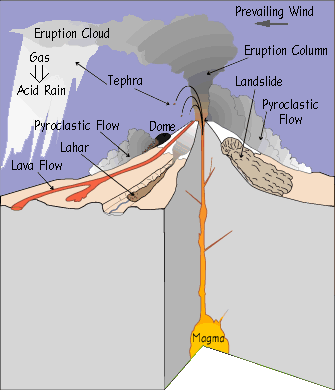
Figure \(\PageIndex{1}\) is a cross-sectional view of a composite volcano (stratovolcano) illustrating the internal pathways of magma and the various volcanic hazards produced during an eruption.
At the base of the volcano is a reservoir labeled magma, representing molten rock stored beneath the surface. A vertical conduit extends upward from the magma source to the summit, providing a pathway for magma and volcanic gases to reach the surface.
At the summit is an opening that feeds an eruption column, a tall plume of ash, gas, and volcanic debris rising high into the atmosphere. A broad eruption cloud spreads outward from the top of the column. An arrow labeled prevailing wind indicates that winds carry volcanic ash and debris away from the volcano. Material labeled tephra falls from the eruption cloud and accumulates on the surrounding landscape. Volcanic gases released during the eruption are labeled gas, and acid rain is shown forming downwind as volcanic emissions mix with atmospheric moisture.
Near the summit, a mound labeled dome has formed from the accumulation of viscous lava. On one side of the volcano, a landslide is shown where part of the volcanic slope has collapsed.
Several volcanic hazards extend down the flanks of the volcano:
- A lava flow moves downslope from an eruptive vent, following the surface of the volcano.
- A pyroclastic flow descends rapidly down one flank as a dense mixture of hot gas, ash, and rock fragments.
- A lahar flows down a valley on another side of the volcano. This volcanic mudflow consists of water mixed with ash and volcanic debris.
- Additional pyroclastic flows are shown moving away from the eruption column and down the volcano's slopes.
The diagram illustrates the major components of a volcanic system and the variety of hazards associated with explosive eruptions. It shows how magma rises from a subsurface magma source to produce eruption columns, ash clouds, lava flows, pyroclastic flows, lahars, landslides, volcanic gases, and tephra fall. The figure emphasizes that volcanic hazards can affect areas both near and far from the volcano through ash dispersal, fast-moving flows, and volcanic mudflows.
During intense explosive eruptions, a mixture of superheated gas and ash is propelled high into the atmosphere, forming what is known as an eruption column as shown in Figure \(\PageIndex{2}\). In particularly powerful events, this column can reach the stratosphere, where the dispersal of particulates and aerosols can lead to significant changes in global weather patterns. If the eruption column becomes too dense to remain buoyant, it may collapse, triggering a pyroclastic flow. This hazardous phenomenon—which can also be caused by the failure of a volcanic dome—consists of gas and rock fragments rushing down slope at speeds up to 700 kilometers per hour.
These flows are incredibly lethal, with internal temperatures often reaching 1500 degrees Fahrenheit. A specific type of glowing, incandescent pyroclastic flow is sometimes called a nuee ardente, a French term meaning burning cloud. While the heaviest material stays near the volcano, the lighter ash within the eruption cloud can be carried by winds for hundreds of kilometers, blanketing vast areas in tephra.

While lava flows typically move at speeds that allow for safe human evacuation, they remain highly destructive to infrastructure and personal property. These flows can bury major roadways and incinerate any buildings in their path, leaving only charred remains (illustrated in Figure \(\PageIndex{3}\)). To mitigate these effects, engineers have sometimes successfully utilized diversion barriers to steer fluid lava away from populated areas. Another method that has been used involves spraying large volumes of seawater directly onto the advancing front to cool the molten rock and force it to solidify, creating a natural dam to halt further progress.

Mudflows or debris flows called lahars result when hot pyroclastic material melts snowpacks, or fresh pyroclastic deposits are mobilized by heavy rains. Having the consistency of wet cement, a lahar can rush down mountain slopes or along a river valley at speeds of 22 mph or more. Sadly, nearly 22,000 people lost their lives when a lahar, produced by the melting of a summit glacier, buried the town of Aremero on the slopes of Nevado del Ruiz. Nearly 220 kilometers (135 miles) of river channels surrounding Mt. Saint. Helens were affected by the lahars from the May 18, 1980 (Figure \(\PageIndex{4}\)).

Volcanic ash consists of small, sharp fragments that are both durable and abrasive. Brief contact with this material can lead to eye irritation and breathing difficulties, particularly for individuals with pre-existing conditions such as asthma. When ash accumulation becomes heavy, especially if it absorbs moisture and becomes weighted, it can lead to the structural failure of buildings. To ensure safety, flight paths are adjusted during eruptions to prevent ash from entering and damaging jet engines. A notable instance occurred in April 2010, when the eruption of the Eyjafjallajokull volcano in Iceland resulted in the closure of airspace across much of Europe for more than a week.
Beyond solid debris, volcanoes frequently emit sulfur dioxide gas. When this gas reacts with atmospheric moisture, it creates acid rain or a type of volcanic smog commonly known as vog. Acid rain has the potential to kill plant life and pollute water sources, while vog poses a risk to human respiratory health and can be devastating to agricultural crops.