

6.5.3: Metamorphic Rocks
- Page ID
- 42671

\( \newcommand{\vecs}[1]{\overset { \scriptstyle \rightharpoonup} {\mathbf{#1}} } \)
\( \newcommand{\vecd}[1]{\overset{-\!-\!\rightharpoonup}{\vphantom{a}\smash {#1}}} \)
\( \newcommand{\dsum}{\displaystyle\sum\limits} \)
\( \newcommand{\dint}{\displaystyle\int\limits} \)
\( \newcommand{\dlim}{\displaystyle\lim\limits} \)
\( \newcommand{\id}{\mathrm{id}}\) \( \newcommand{\Span}{\mathrm{span}}\)
( \newcommand{\kernel}{\mathrm{null}\,}\) \( \newcommand{\range}{\mathrm{range}\,}\)
\( \newcommand{\RealPart}{\mathrm{Re}}\) \( \newcommand{\ImaginaryPart}{\mathrm{Im}}\)
\( \newcommand{\Argument}{\mathrm{Arg}}\) \( \newcommand{\norm}[1]{\| #1 \|}\)
\( \newcommand{\inner}[2]{\langle #1, #2 \rangle}\)
\( \newcommand{\Span}{\mathrm{span}}\)
\( \newcommand{\id}{\mathrm{id}}\)
\( \newcommand{\Span}{\mathrm{span}}\)
\( \newcommand{\kernel}{\mathrm{null}\,}\)
\( \newcommand{\range}{\mathrm{range}\,}\)
\( \newcommand{\RealPart}{\mathrm{Re}}\)
\( \newcommand{\ImaginaryPart}{\mathrm{Im}}\)
\( \newcommand{\Argument}{\mathrm{Arg}}\)
\( \newcommand{\norm}[1]{\| #1 \|}\)
\( \newcommand{\inner}[2]{\langle #1, #2 \rangle}\)
\( \newcommand{\Span}{\mathrm{span}}\) \( \newcommand{\AA}{\unicode[.8,0]{x212B}}\)
\( \newcommand{\vectorA}[1]{\vec{#1}} % arrow\)
\( \newcommand{\vectorAt}[1]{\vec{\text{#1}}} % arrow\)
\( \newcommand{\vectorB}[1]{\overset { \scriptstyle \rightharpoonup} {\mathbf{#1}} } \)
\( \newcommand{\vectorC}[1]{\textbf{#1}} \)
\( \newcommand{\vectorD}[1]{\overrightarrow{#1}} \)
\( \newcommand{\vectorDt}[1]{\overrightarrow{\text{#1}}} \)
\( \newcommand{\vectE}[1]{\overset{-\!-\!\rightharpoonup}{\vphantom{a}\smash{\mathbf {#1}}}} \)
\( \newcommand{\vecs}[1]{\overset { \scriptstyle \rightharpoonup} {\mathbf{#1}} } \)
\(\newcommand{\longvect}{\overrightarrow}\)
\( \newcommand{\vecd}[1]{\overset{-\!-\!\rightharpoonup}{\vphantom{a}\smash {#1}}} \)
\(\newcommand{\ket}[1]{\left| #1 \right>}\)
\(\newcommand{\bra}[1]{\left< #1 \right|}\)
\(\newcommand{\braket}[2]{\left< #1 \vphantom{#2} \right| \left. #2 \vphantom{#1} \right>}\)
\(\newcommand{\braopket}[3]{\left< #1 \vphantom{#2}\vphantom{#3} \right| #2 \vphantom{#1}\vphantom{#3} \left| #3 \vphantom{#1}\vphantom{#2} \right>}\)
\(\newcommand{\qmvec}[1]{\mathbf{\vec{#1}}}\)
\(\newcommand{\op}[1]{\hat{\mathbf{#1}}}\)
\(\newcommand{\expect}[1]{\langle #1 \rangle}\)
\(\newcommand{\dfn}[1]{\emph{\textbf{#1}}}\)
Formation and Classification of Metamorphic Rocks
Metamorphic rocks form through the alteration of pre-existing rocks when they are exposed to intense heat and pressure while remaining in a solid state. This transformation occurs as chemical bonds between atoms in a mineral break, allowing those atoms to rearrange into new, more stable mineral structures. Because only some bonds are broken, the rock does not melt; if all bonds were severed, the material would transition into a liquid state. During this process, freed atoms and ions migrate within the mineral or bond with different elements to create minerals that can better withstand their current environmental conditions.
Metamorphism significantly changes both the mineral content and the texture of the parent rock. While unstable minerals like clays may break down and recombine into entirely new forms, more stable minerals like quartz often retain their identity but change in size or shape to achieve a new configuration. Although the mineral types and textures evolve, the overall chemical composition of the rock typically remains the same.
Rocks buried deep within the Earth are subjected to lithostatic pressure, a confining force created by the weight of the overlying material. This pressure is exerted equally from all directions, compressing the rock into a much denser form. At the points where mineral grains touch, this intense pressure breaks atomic bonds, enabling atoms to migrate toward areas of lower pressure where they rebind into more stable orientations.
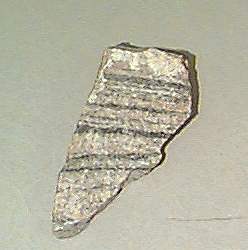
Along tectonic plate boundaries where collision or subduction occurs, rocks are subjected to directed pressure, which is force applied primarily from a specific direction. Unlike confining pressure, directed pressure flattens and elongates the rock, primarily affecting the physical shape and arrangement of its minerals. While this pressure alone may not always trigger new mineralization, it causes mineral grains to smear or partially recrystallize into distinct bands. These bands align perpendicularly to the direction of the greatest pressure, creating what geologists call foliated metamorphic rocks.
In contrast, when rocks undergo metamorphism without the influence of directed pressure—such as during deep burial or contact with hot magma—nonfoliated metamorphic rocks are formed. These rocks lack the characteristic mineral banding seen in foliated varieties because the pressure is either equal in all directions or absent during the crystallization process.

| Rock Type |
Rock |
Parent Rock |
Key Minerals |
Metamorphic Environment |
|---|---|---|---|---|
|
Foliated |
Slate |
Shale |
Clay minerals, micas. chlorite. graphite |
Relatively low temperature and pressure |
|
Foliated |
Schist |
Shale, basalt, graywacke sandstone, impure limestone |
Mica, chlorite, garnet, talc, epdiodte, hornblende, graphite, staurite, kyanite |
Intermediate - to - high temperature and pressure |
|
Foliated |
Gneiss |
Shale, felsic igneous rocks, graywacke, sandstone, granite, impure limestone |
Garnet, mica, augite, hornblende, staurolite, kyanite, sillimanite |
High Temperature and pressure |
|
Nonfoliated |
Marble |
Pure limestone |
calcite, dolomite |
Contact with hot magma, or confining pressure from deep burial |
|
Nonfoliated |
Quartzite |
Pure sandstone, chert |
Quartz |
Contact with hot magma, or confining pressure from deep burial |
Occurrence of metamorphism
Metamorphism occurs under various conditions that determine the geographic distribution and physical characteristics of the resulting rocks. Contact metamorphism occurs locally when magma intrudes into host (country) rock, forming a metamorphic zone called an aureole . This process is primarily driven by heat from the cooling pluton, with temperatures ranging from 400°C to 1000°C, while pressure remains relatively low. The extent of the transformation depends on the temperature difference between the magma and the host rock, their heat capacity, and the presence of hydrothermal fluids that transport heat. Because contact metamorphism typically happens at shallow crustal depths without directed stress, it often produces fine-grained, nonfoliated rocks.
Regional metamorphism affects vast areas of the crust and is generally categorized into two types: dynamothermal and burial metamorphism. Dynamothermal metamorphism is associated with mountain-building (orogeny) at convergent plate boundaries. It is driven by differential stress from plate subduction or collision, which causes compression, folding, and thrusting. This results in linear belts of foliated metamorphic rocks that are eventually exposed through erosion.
In contrast, burial metamorphism occurs in deep sedimentary basins where accumulations reach depths of approximately 10 kilometers. At these depths, the combination of lithostatic (confining) pressure and the geothermal gradient provides sufficient energy for transformation. Because burial metamorphism involves uniform confining pressure rather than directed stress, the resulting rocks are typically nonfoliated.