

6.5.2: Sedimentary Rocks
- Page ID
- 42670

\( \newcommand{\vecs}[1]{\overset { \scriptstyle \rightharpoonup} {\mathbf{#1}} } \)
\( \newcommand{\vecd}[1]{\overset{-\!-\!\rightharpoonup}{\vphantom{a}\smash {#1}}} \)
\( \newcommand{\dsum}{\displaystyle\sum\limits} \)
\( \newcommand{\dint}{\displaystyle\int\limits} \)
\( \newcommand{\dlim}{\displaystyle\lim\limits} \)
\( \newcommand{\id}{\mathrm{id}}\) \( \newcommand{\Span}{\mathrm{span}}\)
( \newcommand{\kernel}{\mathrm{null}\,}\) \( \newcommand{\range}{\mathrm{range}\,}\)
\( \newcommand{\RealPart}{\mathrm{Re}}\) \( \newcommand{\ImaginaryPart}{\mathrm{Im}}\)
\( \newcommand{\Argument}{\mathrm{Arg}}\) \( \newcommand{\norm}[1]{\| #1 \|}\)
\( \newcommand{\inner}[2]{\langle #1, #2 \rangle}\)
\( \newcommand{\Span}{\mathrm{span}}\)
\( \newcommand{\id}{\mathrm{id}}\)
\( \newcommand{\Span}{\mathrm{span}}\)
\( \newcommand{\kernel}{\mathrm{null}\,}\)
\( \newcommand{\range}{\mathrm{range}\,}\)
\( \newcommand{\RealPart}{\mathrm{Re}}\)
\( \newcommand{\ImaginaryPart}{\mathrm{Im}}\)
\( \newcommand{\Argument}{\mathrm{Arg}}\)
\( \newcommand{\norm}[1]{\| #1 \|}\)
\( \newcommand{\inner}[2]{\langle #1, #2 \rangle}\)
\( \newcommand{\Span}{\mathrm{span}}\) \( \newcommand{\AA}{\unicode[.8,0]{x212B}}\)
\( \newcommand{\vectorA}[1]{\vec{#1}} % arrow\)
\( \newcommand{\vectorAt}[1]{\vec{\text{#1}}} % arrow\)
\( \newcommand{\vectorB}[1]{\overset { \scriptstyle \rightharpoonup} {\mathbf{#1}} } \)
\( \newcommand{\vectorC}[1]{\textbf{#1}} \)
\( \newcommand{\vectorD}[1]{\overrightarrow{#1}} \)
\( \newcommand{\vectorDt}[1]{\overrightarrow{\text{#1}}} \)
\( \newcommand{\vectE}[1]{\overset{-\!-\!\rightharpoonup}{\vphantom{a}\smash{\mathbf {#1}}}} \)
\( \newcommand{\vecs}[1]{\overset { \scriptstyle \rightharpoonup} {\mathbf{#1}} } \)
\(\newcommand{\longvect}{\overrightarrow}\)
\( \newcommand{\vecd}[1]{\overset{-\!-\!\rightharpoonup}{\vphantom{a}\smash {#1}}} \)
\(\newcommand{\ket}[1]{\left| #1 \right>}\)
\(\newcommand{\bra}[1]{\left< #1 \right|}\)
\(\newcommand{\braket}[2]{\left< #1 \vphantom{#2} \right| \left. #2 \vphantom{#1} \right>}\)
\(\newcommand{\braopket}[3]{\left< #1 \vphantom{#2}\vphantom{#3} \right| #2 \vphantom{#1}\vphantom{#3} \left| #3 \vphantom{#1}\vphantom{#2} \right>}\)
\(\newcommand{\qmvec}[1]{\mathbf{\vec{#1}}}\)
\(\newcommand{\op}[1]{\hat{\mathbf{#1}}}\)
\(\newcommand{\expect}[1]{\langle #1 \rangle}\)
\(\newcommand{\dfn}[1]{\emph{\textbf{#1}}}\)
Overview
Sedimentary rocks originate through exogenic processes like weathering and erosion, which loosen and transport Earth materials from higher to lower elevations. These fragments, known as clasts, along with organic plant and animal remains, are moved by agents such as wind, water, or gravity until they lose energy and deposit the sediment in environments like floodplains, lakes, or oceans. While terrestrial deposits typically consist of larger boulders, gravel, sand, and silt, marine environments on continental shelves primarily accumulate sand, silt, and clay. In the deep ocean and outer shelves, the accumulation of fine clays, chemically precipitated calcium carbonate, and microscopic marine remains eventually undergoes compaction and cementation to form solid sedimentary rock. Figure \(\PageIndex{1}\) shows an image of Natural Bridge in Bryce Canyon National Park. The arch was created by frost wedging and is made up of limestone, sandstone, siltstone and mudstone.

As sediment accumulates into thick sequences, the weight of the overlying material causes compaction and, often with the help of a mineral cementing agent, lithification into solid rock. This process creates distinct horizontal layers known as beds or strata, a phenomenon referred to as stratification. The boundary between these layers, called a bedding plane, marks a pause in deposition at that specific location. Individual beds can exhibit horizontal variations in texture—such as transitioning from coarse conglomerate to fine-grained siltstone or shale—which reflects the diminishing energy of the transporting medium as it moves further from its source. Following the Law of Superposition, these layers remain arranged with the oldest at the base unless disturbed by tectonic forces. Because they are comprised of cemented fragments rather than interlocking crystals, sedimentary rocks are noncrystalline and generally possess less structural strength than their igneous or metamorphic counterparts. These rocks often contain fossils, which are preserved clues from the past representing organisms that existed at least 10,000 years ago. Fossils (shown in Figure \(\PageIndex{2}\)) form when an organism is buried quickly by sediment like sand or clay, preventing decay; over time, minerals may replace the original bone or wood to create a stone copy called a body fossil. Additionally, fossils can exist as trace evidence, such as footprints or burrows, which provide insight into how ancient animals lived and moved.

Types of sedimentary rocks
Sedimentary rocks are categorized into three primary types based on their origin, though they are often simplified into two main groups: clastic (or detrital) and nonclastic (or chemical). Clastic rocks form from the accumulation and lithification of weathered mineral fragments, such as quartz-rich sandstones and shale, which forms from the compaction of clays. Within this group, conglomerates are identified by their rounded pebbles and cobbles, while breccias consist of sharp, angular fragments that indicate a shorter transport distance from their source. Nonclastic rocks include both chemical and biological origins; chemical sedimentary rocks, known as evaporites, precipitate directly from mineral-rich solutions as water evaporates, creating deposits like rock salt (halite) and gypsum. Biological or organic sedimentary rocks arise from the remains of living things, such as calcareous limestone and chalk created from marine shells, or carbonaceous rocks like peat, lignite, and coal formed from vegetation compacted under intense pressure in swampy environments.

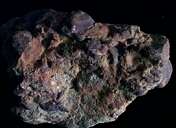

You are probably familiar with several of the nonclastic sedimentary rocks. Limestone, shown in Figure \(\PageIndex{3c}\), is composed of precipitated calcium carbonate. Limestone sometimes contains visible shells of marine organisms that have accumulates on the ocean floor. Dolomite is a calcium-magnesium carbonate rock that forms as a chemical precipitate or from the alteration of limestone. Limestone is very easily weathered in warm and moist climates to create karst topography.

Coal is classified as a sedimentary rock, specifically a biological or organic variety, because it originates from the compaction and chemical alteration of ancient plant matter. Its classification depends on its level of development, progressing through three primary stages. Lignite, a soft brown substance, represents the least developed form and serves as an intermediate stage between peat and true coal. Further burial and intense compaction transform this material into bituminous coal, often referred to as soft coal despite being significantly harder than lignite. The final and most pure stage is anthracite, which forms when bituminous coal undergoes metamorphism in areas of active mountain building. Anthracite is the most highly valued variety due to its superior heat-generating capacity and notably low sulfur content.
