

6.5.1: Igneous Rocks
- Page ID
- 42669

\( \newcommand{\vecs}[1]{\overset { \scriptstyle \rightharpoonup} {\mathbf{#1}} } \)
\( \newcommand{\vecd}[1]{\overset{-\!-\!\rightharpoonup}{\vphantom{a}\smash {#1}}} \)
\( \newcommand{\dsum}{\displaystyle\sum\limits} \)
\( \newcommand{\dint}{\displaystyle\int\limits} \)
\( \newcommand{\dlim}{\displaystyle\lim\limits} \)
\( \newcommand{\id}{\mathrm{id}}\) \( \newcommand{\Span}{\mathrm{span}}\)
( \newcommand{\kernel}{\mathrm{null}\,}\) \( \newcommand{\range}{\mathrm{range}\,}\)
\( \newcommand{\RealPart}{\mathrm{Re}}\) \( \newcommand{\ImaginaryPart}{\mathrm{Im}}\)
\( \newcommand{\Argument}{\mathrm{Arg}}\) \( \newcommand{\norm}[1]{\| #1 \|}\)
\( \newcommand{\inner}[2]{\langle #1, #2 \rangle}\)
\( \newcommand{\Span}{\mathrm{span}}\)
\( \newcommand{\id}{\mathrm{id}}\)
\( \newcommand{\Span}{\mathrm{span}}\)
\( \newcommand{\kernel}{\mathrm{null}\,}\)
\( \newcommand{\range}{\mathrm{range}\,}\)
\( \newcommand{\RealPart}{\mathrm{Re}}\)
\( \newcommand{\ImaginaryPart}{\mathrm{Im}}\)
\( \newcommand{\Argument}{\mathrm{Arg}}\)
\( \newcommand{\norm}[1]{\| #1 \|}\)
\( \newcommand{\inner}[2]{\langle #1, #2 \rangle}\)
\( \newcommand{\Span}{\mathrm{span}}\) \( \newcommand{\AA}{\unicode[.8,0]{x212B}}\)
\( \newcommand{\vectorA}[1]{\vec{#1}} % arrow\)
\( \newcommand{\vectorAt}[1]{\vec{\text{#1}}} % arrow\)
\( \newcommand{\vectorB}[1]{\overset { \scriptstyle \rightharpoonup} {\mathbf{#1}} } \)
\( \newcommand{\vectorC}[1]{\textbf{#1}} \)
\( \newcommand{\vectorD}[1]{\overrightarrow{#1}} \)
\( \newcommand{\vectorDt}[1]{\overrightarrow{\text{#1}}} \)
\( \newcommand{\vectE}[1]{\overset{-\!-\!\rightharpoonup}{\vphantom{a}\smash{\mathbf {#1}}}} \)
\( \newcommand{\vecs}[1]{\overset { \scriptstyle \rightharpoonup} {\mathbf{#1}} } \)
\(\newcommand{\longvect}{\overrightarrow}\)
\( \newcommand{\vecd}[1]{\overset{-\!-\!\rightharpoonup}{\vphantom{a}\smash {#1}}} \)
\(\newcommand{\ket}[1]{\left| #1 \right>}\)
\(\newcommand{\bra}[1]{\left< #1 \right|}\)
\(\newcommand{\braket}[2]{\left< #1 \vphantom{#2} \right| \left. #2 \vphantom{#1} \right>}\)
\(\newcommand{\braopket}[3]{\left< #1 \vphantom{#2}\vphantom{#3} \right| #2 \vphantom{#1}\vphantom{#3} \left| #3 \vphantom{#1}\vphantom{#2} \right>}\)
\(\newcommand{\qmvec}[1]{\mathbf{\vec{#1}}}\)
\(\newcommand{\op}[1]{\hat{\mathbf{#1}}}\)
\(\newcommand{\expect}[1]{\langle #1 \rangle}\)
\(\newcommand{\dfn}[1]{\emph{\textbf{#1}}}\)
Intrusive Igneous Rock
Igneous rocks are created through the cooling and crystallization of molten rock, categorized as either magma when trapped beneath the crust or lava once it reaches the surface. Originating at depths as great as 200 km within the Earth, this molten material consists primarily of silicate elements and dissolved gases, such as water vapor. Due to its lower density compared to the surrounding solid rock, the buoyant magma migrates upward; if it breaches the surface, it extrudes as lava, eventually solidifying into various volcanic landforms.
Cooling of the magma initiates the crystallization of elements contained within the molten rock. Usually, cooling does not take place at the same rate throughout the entire mass. As it cools, numerous small crystal develop and then ions are added around these centers of growth. Once the crystals grow enough for their edges to meet, growth ceases and crystallization commences in another part of the mass. Over time the magma cools into a solidified rock of interlocking crystals. The rate of cooling determines the degree to which crystals can grow. Those that form by slow cooling have large crystals and are described as being coarse-grained. Fine-gained igneous rocks form by more rapidly cooling when the molten material is exposed at the surface. As a result, crystals don't have a chance to grow very large.
When magma intrudes into pre-existing "country rock," it is insulated from the surface, causing it to cool and solidify very slowly. This extended cooling period allows minerals to organize into large, well-developed crystals, resulting in a course grained or phaneritic texture where individual grains are visible to the naked eye. These rock bodies, known as plutons, are characterized as intrusive (plutonic) igneous rocks. Because the surrounding rock acts as a thermal blanket, the slow loss of heat ensures that the resulting rock is entirely crystalline and structurally dense. Some examples of intrusive igneous rocks are granite (felsic), diorite, gabbro (mafic), and peridotite. Figure \(\PageIndex{1}\) shows an image of granite, which is a classic example of an intrusive (plutonic) igneous rock. It illustrates a coarse-grained texture. Because this rock formed from magma that cooled slowly deep beneath the Earth's surface, the individual mineral crystals had ample time to grow large enough to be seen with the naked eye. The interlocking crystals visible in the image are a direct result of this slow cooling process within a pluton
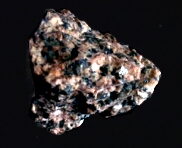
Figure \(\PageIndex{1}\) is a schematic diagram provides the spatial context for how magma interacts with country rock. It illustrates several key structures:
- Batholiths: Large, massive plutons.
- Sills: Magma that intruded horizontally between rock layers.
- Dikes: Magma that cooled in near-vertical fractures.
- Laccoliths: Lens-shaped bodies that arch the overlying strata into a dome.
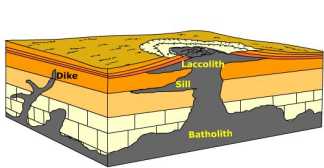
Figure \(\PageIndex{2}\) is a cross-sectional block model showing several types of intrusive igneous rock formations, which form when magma cools and solidifies below Earth’s surface.
Overall layout - The image shows layered rock strata viewed from the side and above. Dark-colored igneous intrusions cut through or spread between the surrounding sedimentary rock layers. Four intrusive features are labeled: dike, sill, laccolith, and batholith.
Dike - On the left side, a narrow, steeply inclined sheet of igneous rock is labeled dike. It cuts across the existing rock layers rather than following them. A dike forms when magma forces its way through fractures in rock and solidifies. Because it cuts across layers, it indicates magma movement through the crust.
Sill - Near the center, a thin horizontal intrusion labeled sill lies parallel to the surrounding rock layers. A sill forms when magma intrudes between existing layers of rock and spreads laterally before cooling. Unlike a dike, it follows the layering of the surrounding rocks.
Laccolith - Above the sill is a rounded, dome-shaped intrusion labeled laccolith. The overlying rock layers have been pushed upward into a dome shape. A laccolith forms when viscous magma accumulates between rock layers, causing the layers above to arch upward. This creates a localized dome in the crust.
Batholith - The largest feature, occupying the lower portion of the diagram, is labeled batholith. It is a massive, irregularly shaped body of igneous rock extending deep beneath the surface. A batholith forms from large volumes of magma that cool slowly underground. Batholiths are the largest intrusive igneous bodies and often form the cores of mountain ranges after erosion exposes them.
Physical geographers find deep-seated intrusive rocks particularly significant once they are revealed at the surface through the erosion of overlying "host" rock. Among these features, the batholith is the most formidable, representing a massive igneous body or pluton that frequently forms the rugged, high-elevation cores of mountain ranges. A prime example is the Idaho Batholith, which spans approximately 16,000 square miles. Characterized by their immense, monolithic nature, these landforms typically lack the organized patterns of linear ridges and valleys found in sedimentary landscapes, instead presenting a sprawling, massive terrain.
This photograph of the iconic Half Dome in Figure \(\PageIndex{3}\), illustrates a batholith that has been exposed at the surface. Contextually, while these rocks formed miles underground, subsequent erosion of the overlying host rock has revealed this massive igneous body. It demonstrates how batholiths create topographic highs and massive mountain features that lack the linear ridges typically found in sedimentary mountain ranges.

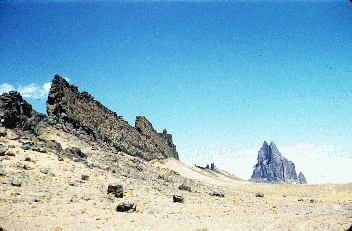
When magma intrudes between the layers or rock and solidifies it creates a feature called a sill. Sills form a hogback or cuesta when the layer of rock is dipping, or the tops of mesas when lying horizontal. If the magma solidifies as a pocket of igneous rock that warps the overlying rock it will form a dome or laccolith. The Black Hills of South Dakota is such a domal feature. If magma cools in near vertical fractures a dike is formed. Dikes often form on the flanks of volcanoes. When exposed by erosion they take the form of a linear ridge. Shiprock, New Mexico a volcanic neck (Figure \(\PageIndex{4}\)), has several dikes radiating away from it.
Extrusive Igneous Rocks
Fine-grained rocks form if molten rock cools rapidly when it is extruded onto the surface. These are formed by the molten material that comes out of a volcano as lava. They solidify fast on the earth's surface and have small crystals. Some fine grained rocks forming at the edge of a lava flow have small holes or vesicles which are void spaces left by escaping gasses. Basalt is a common extrusive igneous rock. Deccan plateau in India is a plateau made of basalt. Sometimes it solidifies forming olygonal columns. The Giant's Causeway in Northern Island shown in Figure \(\PageIndex{5}\) is made up of about 40,000 interlocking basalt columns.

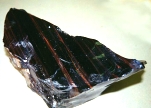
Very rapid cooling of silica-rich volcanic lava produces rocks with a glassy texture, such as obsidian (shown in Figure \(\PageIndex{5}\)). Obsidian is a naturally occurring volcanic glass that is dark and shiny. It lacks an organized mineral structure because of extremely rapid cooling, which often occurs when lava comes into contact with water or air. This cooling process happens so quickly that crystals do not have time to form, resulting in a smooth, glass-like texture rather than the crystalline structure seen in intrusive rocks. Due to its razor-sharp edges, obsidian has been used for tools, the creation of reflective mirrors by the Aztecs, and blades for modern surgery.
Pumice shown in Figure \(\PageIndex{6}\) is a form of extrusive igneous rock. It is volcanic foam which is so light that it can float in water. Pumice forms when silica-rich magma, packed with dissolved gases like water vapor and carbon dioxide, is violently ejected from a volcano during an explosive eruption. As the magma shoots into the atmosphere, the sudden drop in pressure causes these trapped gases to expand rapidly, much like the fizz escaping a shaken soda bottle, which transforms the molten rock into a frothy, liquid foam. Because the surrounding air is significantly cooler, this volcanic foam "flash-freezes" almost instantly, trapping the gas bubbles inside a glassy structure and leaving behind the millions of tiny holes, or vesicles, that give pumice its signature lightweight, sponge-like texture.
