

6.1: The Earth's Interior
- Page ID
- 42663

\( \newcommand{\vecs}[1]{\overset { \scriptstyle \rightharpoonup} {\mathbf{#1}} } \)
\( \newcommand{\vecd}[1]{\overset{-\!-\!\rightharpoonup}{\vphantom{a}\smash {#1}}} \)
\( \newcommand{\dsum}{\displaystyle\sum\limits} \)
\( \newcommand{\dint}{\displaystyle\int\limits} \)
\( \newcommand{\dlim}{\displaystyle\lim\limits} \)
\( \newcommand{\id}{\mathrm{id}}\) \( \newcommand{\Span}{\mathrm{span}}\)
( \newcommand{\kernel}{\mathrm{null}\,}\) \( \newcommand{\range}{\mathrm{range}\,}\)
\( \newcommand{\RealPart}{\mathrm{Re}}\) \( \newcommand{\ImaginaryPart}{\mathrm{Im}}\)
\( \newcommand{\Argument}{\mathrm{Arg}}\) \( \newcommand{\norm}[1]{\| #1 \|}\)
\( \newcommand{\inner}[2]{\langle #1, #2 \rangle}\)
\( \newcommand{\Span}{\mathrm{span}}\)
\( \newcommand{\id}{\mathrm{id}}\)
\( \newcommand{\Span}{\mathrm{span}}\)
\( \newcommand{\kernel}{\mathrm{null}\,}\)
\( \newcommand{\range}{\mathrm{range}\,}\)
\( \newcommand{\RealPart}{\mathrm{Re}}\)
\( \newcommand{\ImaginaryPart}{\mathrm{Im}}\)
\( \newcommand{\Argument}{\mathrm{Arg}}\)
\( \newcommand{\norm}[1]{\| #1 \|}\)
\( \newcommand{\inner}[2]{\langle #1, #2 \rangle}\)
\( \newcommand{\Span}{\mathrm{span}}\) \( \newcommand{\AA}{\unicode[.8,0]{x212B}}\)
\( \newcommand{\vectorA}[1]{\vec{#1}} % arrow\)
\( \newcommand{\vectorAt}[1]{\vec{\text{#1}}} % arrow\)
\( \newcommand{\vectorB}[1]{\overset { \scriptstyle \rightharpoonup} {\mathbf{#1}} } \)
\( \newcommand{\vectorC}[1]{\textbf{#1}} \)
\( \newcommand{\vectorD}[1]{\overrightarrow{#1}} \)
\( \newcommand{\vectorDt}[1]{\overrightarrow{\text{#1}}} \)
\( \newcommand{\vectE}[1]{\overset{-\!-\!\rightharpoonup}{\vphantom{a}\smash{\mathbf {#1}}}} \)
\( \newcommand{\vecs}[1]{\overset { \scriptstyle \rightharpoonup} {\mathbf{#1}} } \)
\(\newcommand{\longvect}{\overrightarrow}\)
\( \newcommand{\vecd}[1]{\overset{-\!-\!\rightharpoonup}{\vphantom{a}\smash {#1}}} \)
\(\newcommand{\ket}[1]{\left| #1 \right>}\)
\(\newcommand{\bra}[1]{\left< #1 \right|}\)
\(\newcommand{\braket}[2]{\left< #1 \vphantom{#2} \right| \left. #2 \vphantom{#1} \right>}\)
\(\newcommand{\braopket}[3]{\left< #1 \vphantom{#2}\vphantom{#3} \right| #2 \vphantom{#1}\vphantom{#3} \left| #3 \vphantom{#1}\vphantom{#2} \right>}\)
\(\newcommand{\qmvec}[1]{\mathbf{\vec{#1}}}\)
\(\newcommand{\op}[1]{\hat{\mathbf{#1}}}\)
\(\newcommand{\expect}[1]{\langle #1 \rangle}\)
\(\newcommand{\dfn}[1]{\emph{\textbf{#1}}}\)
Investigating the Earth's interior
Our understanding of Earth’s interior remains largely indirect, as deep drilling has only managed to penetrate the planet's outermost layer. Instead, geo-scientists rely on seismic wave data and the analysis of surface-level lava to piece together the mysteries of the deep. This evidence reveals that the Earth is structured like a series of concentric rings, moving from a dense, scorching inner core toward a thin, brittle crust. Scientists categorize these internal layers based on two distinct criteria: their chemical composition (the elements they contain ) and their mechanical properties (their physical behavior such as their rigidity or ability to flow).

Seismic activity serves as a primary tool for mapping the internal structure of our planet, as geo-scientists analyze data gathered from natural earthquakes or controlled explosions. These events produce two distinct types of energy: compressional (P) waves, which create a back-and-forth motion parallel to their path, and shear (S) waves, which move perpendicularly in an up-and-down fashion. By recording these vibrations on a seismograph, researchers can observe how wave amplitude and direction shift when passing through different materials. Figure \(\PageIndex{1}\) shows the photograph of a seismograph recording a seismic event on a paper drum, showing distinct oscillating line patterns representing ground motion. Because wave velocity typically increases with rock density and shear waves are unable to travel through molten matter, these signals act as a diagnostic probe for the deep interior. A landmark discovery using this method was made by Andrija Mohorovicic, who identified the boundary between the crust and the mantle—now known as the Moho discontinuity—by observing a sudden increase in wave speed. This transition is thought to be a zone where minerals undergo a phase change, resulting in a significantly denser composition than the layers above.
Layers based on composition
Figure \(\PageIndex{2}\) diagrammatically shows the Earth's interior showing concentric layers: the crust, mantle, liquid outer core, and solid inner core. The Earth is wrapped in a brittle outer layer called the crust, which serves as the surface of the lithosphere. This layer varies in thickness from 5 kilometers under the oceans to 70 kilometers beneath the continents. It is divided into two main types based on their chemistry: the continental crust, known as sial because it is rich in silicon and aluminum, and the oceanic crust, known as sima because it contains more silicon and magnesium.
Because the granitic sial is lighter and thicker, it effectively floats on top of the thinner, denser basaltic sima. These crustal sections form tectonic plates that glide over the pliable mantle, colliding to build mountains or pulling apart to create rift valleys. Between the crust and the mantle lies a boundary called the Moho Discontinuity. This is a specific zone where the rock becomes much denser, causing seismic waves to speed up as they pass through.
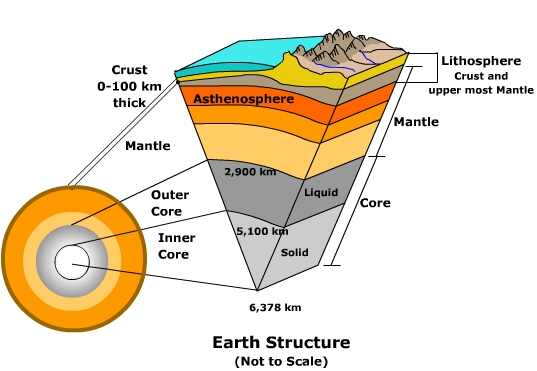
Figure \(\PageIndex{2}\) is a labeled diagram of Earth’s internal structure, combining a cross‑sectional block view with a circular inset showing the same layers from the center outward. Layers from outside to inside:
Crust:
- The top, thin outer layer is labeled crust, with a thickness indication of approximately 0–100 km.
- This is the solid outer surface where landforms, oceans, and life are found.
Lithosphere:
- The uppermost portion of the diagram includes a label for the lithosphere, which consists of the crust and the upper part of the mantle.
- This layer is rigid and forms tectonic plates.
Mantle:
- Beneath the crust is a thick layer labeled mantle.
- It extends to a depth of about 2,900 km.
- The mantle is shown as a large region, indicating it is the thickest layer of Earth.
- It consists of solid material that can slowly flow, driving processes like plate movement.
Core: The core is divided into two parts:
- Outer core:
- Located below the mantle
- Shown as a layer surrounding the inner core
- This layer is liquid and extends to a greater depth
- Inner core:
- The central region of the Earth
- Shown as a solid sphere at the center
Measurements:
- The total radius of Earth is labeled as approximately 6,378 km, indicating the distance from the surface to the center.
Relationships:
- The diagram shows how each layer builds upon the next, from the thin crust at the surface to the dense core at the center.
- The circular inset reinforces the idea that Earth is made of concentric layers
Beneath the crust lies the mantle, a massive layer approximately 2,900 kilometers thick that accounts for about 80 percent of the Earth's total volume. This region is mainly composed of a dense, ultra mafic rock called peridotite, which is exceptionally rich in iron and magnesium. At the very center of the planet is the core, which consists primarily of iron and nickel and spans roughly half of the Earth's total diameter. The core is further divided into a liquid outer region and a solid inner center, a distinction verified by the behavior of seismic waves as they travel through the planet's deep interior. This structured arrangement of layers, from the light surface rocks to the heavy metallic core, reflects the complex chemical and physical evolution of the Earth.
Layers based on physical properties
The Earth's internal structure can be categorized by its physical behavior, beginning with the lithosphere, a cool and rigid outer layer that includes both the crust and the very top of the mantle. Directly beneath it lies the asthenosphere, a softer, more pliable region of the mantle that flows slowly due to convection currents fueled by radioactive decay. Deeper still is the mesosphere, where extreme pressure keeps the mantle material in a solid state despite the high temperatures. The planet's center is occupied by the core, which consists of a liquid outer layer and a solid inner center made of iron and nickel. While the outer core is molten—a fact known because certain seismic waves cannot pass through it—the inner core remains solid due to immense overlying pressure. This dynamic relationship between the liquid and solid parts of the core is what generates the Earth's magnetic field.