

5.9.4: Humid Subtropical Climate
- Page ID
- 42652

\( \newcommand{\vecs}[1]{\overset { \scriptstyle \rightharpoonup} {\mathbf{#1}} } \)
\( \newcommand{\vecd}[1]{\overset{-\!-\!\rightharpoonup}{\vphantom{a}\smash {#1}}} \)
\( \newcommand{\dsum}{\displaystyle\sum\limits} \)
\( \newcommand{\dint}{\displaystyle\int\limits} \)
\( \newcommand{\dlim}{\displaystyle\lim\limits} \)
\( \newcommand{\id}{\mathrm{id}}\) \( \newcommand{\Span}{\mathrm{span}}\)
( \newcommand{\kernel}{\mathrm{null}\,}\) \( \newcommand{\range}{\mathrm{range}\,}\)
\( \newcommand{\RealPart}{\mathrm{Re}}\) \( \newcommand{\ImaginaryPart}{\mathrm{Im}}\)
\( \newcommand{\Argument}{\mathrm{Arg}}\) \( \newcommand{\norm}[1]{\| #1 \|}\)
\( \newcommand{\inner}[2]{\langle #1, #2 \rangle}\)
\( \newcommand{\Span}{\mathrm{span}}\)
\( \newcommand{\id}{\mathrm{id}}\)
\( \newcommand{\Span}{\mathrm{span}}\)
\( \newcommand{\kernel}{\mathrm{null}\,}\)
\( \newcommand{\range}{\mathrm{range}\,}\)
\( \newcommand{\RealPart}{\mathrm{Re}}\)
\( \newcommand{\ImaginaryPart}{\mathrm{Im}}\)
\( \newcommand{\Argument}{\mathrm{Arg}}\)
\( \newcommand{\norm}[1]{\| #1 \|}\)
\( \newcommand{\inner}[2]{\langle #1, #2 \rangle}\)
\( \newcommand{\Span}{\mathrm{span}}\) \( \newcommand{\AA}{\unicode[.8,0]{x212B}}\)
\( \newcommand{\vectorA}[1]{\vec{#1}} % arrow\)
\( \newcommand{\vectorAt}[1]{\vec{\text{#1}}} % arrow\)
\( \newcommand{\vectorB}[1]{\overset { \scriptstyle \rightharpoonup} {\mathbf{#1}} } \)
\( \newcommand{\vectorC}[1]{\textbf{#1}} \)
\( \newcommand{\vectorD}[1]{\overrightarrow{#1}} \)
\( \newcommand{\vectorDt}[1]{\overrightarrow{\text{#1}}} \)
\( \newcommand{\vectE}[1]{\overset{-\!-\!\rightharpoonup}{\vphantom{a}\smash{\mathbf {#1}}}} \)
\( \newcommand{\vecs}[1]{\overset { \scriptstyle \rightharpoonup} {\mathbf{#1}} } \)
\(\newcommand{\longvect}{\overrightarrow}\)
\( \newcommand{\vecd}[1]{\overset{-\!-\!\rightharpoonup}{\vphantom{a}\smash {#1}}} \)
\(\newcommand{\ket}[1]{\left| #1 \right>}\)
\(\newcommand{\bra}[1]{\left< #1 \right|}\)
\(\newcommand{\braket}[2]{\left< #1 \vphantom{#2} \right| \left. #2 \vphantom{#1} \right>}\)
\(\newcommand{\braopket}[3]{\left< #1 \vphantom{#2}\vphantom{#3} \right| #2 \vphantom{#1}\vphantom{#3} \left| #3 \vphantom{#1}\vphantom{#2} \right>}\)
\(\newcommand{\qmvec}[1]{\mathbf{\vec{#1}}}\)
\(\newcommand{\op}[1]{\hat{\mathbf{#1}}}\)
\(\newcommand{\expect}[1]{\langle #1 \rangle}\)
\(\newcommand{\dfn}[1]{\emph{\textbf{#1}}}\)
Geographic Distribution

The humid subtropical climate is found on the east coast of continents between 20o and 40o N and S latitude. The humid subtropical climate can be found in the southeastern United States, southeastern South America; coastal southeast South Africa; eastern Australia; eastern Asia from northern India through south China to Japan.
Controlling Factors
The east coast location of the Humid Subtropical climate places it near the source region for maritime tropical air. Additionally, warm ocean currents paralleling these coasts further enhance the instability of the air. These factors combine to produce moderate amounts of precipitation in most months of the year. The humid subtropical climate is subject to cold temperatures during the winter as cP air masses embedded in cyclonic storms pass through this region.
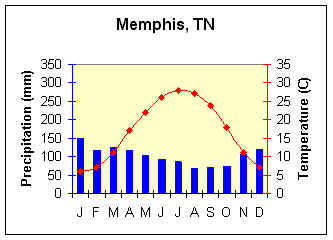
Figure \(\PageIndex{2}\) is a climate graph for Memphis, Tennessee.The horizontal axis shows the months January through December. The left vertical axis is labeled “Precipitation (mm)” and ranges from 0 to 350 millimeters. The right vertical axis is labeled “Temperature (°C)” and ranges from 0°C to 35°C.
Precipitation is represented by blue bars. Rainfall occurs throughout the year, with monthly totals generally ranging between 75 and 140 millimeters. There is no distinct dry season, although precipitation is somewhat lower during late summer and early autumn.
Temperature is represented by a red line with diamond markers. Temperatures increase from about 7°C in January to nearly 30°C in July and August, then decline steadily through autumn and winter. The main conclusions from the climograph are :
Latitude/Longitude = 35oN; 90oW
Average Annual Temperature (oC) = 17
Annual Temperature Range (oC) = 22
Total Annual Precipitation (mm) = 1222
Summer Precipitation (mm) = 536
Winter Precipitation (mm) = 686
Distinguishing Characteristics
Temperature
The humid subtropical climate is noted for its warm summer months, and relatively mild winters. Summer temperatures average between 21o (69.8oF) to 26oC (78.8oF) and no winter month has an average temperature below 0oC (32oF). Many days the temperature can hit 32oC (90oF) or higher. Moving poleward through the various climates of the earth, one notices the distinct development of a seasonal cycle of temperature, especially toward the poleward limits of the climate. The high humidity experienced in the humid subtropical climate makes warm days feel oppressive. The daily temperature range tends to be very small as the evening does not cool down much during the summer. Winter temperatures will dip into the single digits with the relatively frequent invasions of cP air masses, especially on the poleward side of the climate.
Precipitation
The humid subtropical climate gets its name from the high humidity experienced in this environment. Dominance of the warm and moist maritime tropical air creates summers similar to the humid tropics. Precipitation is generally evenly distributed throughout the year. Annual precipitation varies from 254 cm (100 in) near the coast to 63.5 cm (25 in) inland. Frost is generally only a problem in winter when very cold cP air masses penetrate this region, a real hazard for fruit and vegetable growers in the southeastern United States. A monsoon influence is experienced in Asia.