

5.8.1: Tropical Rain Forest
- Page ID
- 42643

\( \newcommand{\vecs}[1]{\overset { \scriptstyle \rightharpoonup} {\mathbf{#1}} } \)
\( \newcommand{\vecd}[1]{\overset{-\!-\!\rightharpoonup}{\vphantom{a}\smash {#1}}} \)
\( \newcommand{\dsum}{\displaystyle\sum\limits} \)
\( \newcommand{\dint}{\displaystyle\int\limits} \)
\( \newcommand{\dlim}{\displaystyle\lim\limits} \)
\( \newcommand{\id}{\mathrm{id}}\) \( \newcommand{\Span}{\mathrm{span}}\)
( \newcommand{\kernel}{\mathrm{null}\,}\) \( \newcommand{\range}{\mathrm{range}\,}\)
\( \newcommand{\RealPart}{\mathrm{Re}}\) \( \newcommand{\ImaginaryPart}{\mathrm{Im}}\)
\( \newcommand{\Argument}{\mathrm{Arg}}\) \( \newcommand{\norm}[1]{\| #1 \|}\)
\( \newcommand{\inner}[2]{\langle #1, #2 \rangle}\)
\( \newcommand{\Span}{\mathrm{span}}\)
\( \newcommand{\id}{\mathrm{id}}\)
\( \newcommand{\Span}{\mathrm{span}}\)
\( \newcommand{\kernel}{\mathrm{null}\,}\)
\( \newcommand{\range}{\mathrm{range}\,}\)
\( \newcommand{\RealPart}{\mathrm{Re}}\)
\( \newcommand{\ImaginaryPart}{\mathrm{Im}}\)
\( \newcommand{\Argument}{\mathrm{Arg}}\)
\( \newcommand{\norm}[1]{\| #1 \|}\)
\( \newcommand{\inner}[2]{\langle #1, #2 \rangle}\)
\( \newcommand{\Span}{\mathrm{span}}\) \( \newcommand{\AA}{\unicode[.8,0]{x212B}}\)
\( \newcommand{\vectorA}[1]{\vec{#1}} % arrow\)
\( \newcommand{\vectorAt}[1]{\vec{\text{#1}}} % arrow\)
\( \newcommand{\vectorB}[1]{\overset { \scriptstyle \rightharpoonup} {\mathbf{#1}} } \)
\( \newcommand{\vectorC}[1]{\textbf{#1}} \)
\( \newcommand{\vectorD}[1]{\overrightarrow{#1}} \)
\( \newcommand{\vectorDt}[1]{\overrightarrow{\text{#1}}} \)
\( \newcommand{\vectE}[1]{\overset{-\!-\!\rightharpoonup}{\vphantom{a}\smash{\mathbf {#1}}}} \)
\( \newcommand{\vecs}[1]{\overset { \scriptstyle \rightharpoonup} {\mathbf{#1}} } \)
\(\newcommand{\longvect}{\overrightarrow}\)
\( \newcommand{\vecd}[1]{\overset{-\!-\!\rightharpoonup}{\vphantom{a}\smash {#1}}} \)
\(\newcommand{\ket}[1]{\left| #1 \right>}\)
\(\newcommand{\bra}[1]{\left< #1 \right|}\)
\(\newcommand{\braket}[2]{\left< #1 \vphantom{#2} \right| \left. #2 \vphantom{#1} \right>}\)
\(\newcommand{\braopket}[3]{\left< #1 \vphantom{#2}\vphantom{#3} \right| #2 \vphantom{#1}\vphantom{#3} \left| #3 \vphantom{#1}\vphantom{#2} \right>}\)
\(\newcommand{\qmvec}[1]{\mathbf{\vec{#1}}}\)
\(\newcommand{\op}[1]{\hat{\mathbf{#1}}}\)
\(\newcommand{\expect}[1]{\langle #1 \rangle}\)
\(\newcommand{\dfn}[1]{\emph{\textbf{#1}}}\)
Geographical Distribution
The tropical rain forest climate supports one of the most lush and diverse environments on Earth. Its location near the equator dominates all aspects of the climate. Year-round warm temperatures and copious rainfall characterize the rain forest climate.
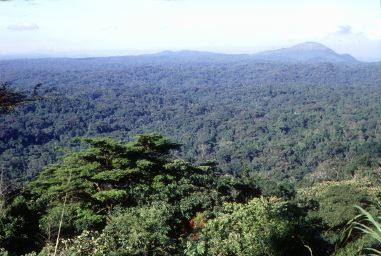
The rain forest climate is generally found straddling the equator and along tropical coasts that are backed by mountains and exposed to the trade winds. The climate tends to be restricted to low elevations (below 1000 meters) because at higher altitudes temperatures are too cool. Large regions of rain forest climate are found in the Amazon River basin of South America, the Congo River basin of Africa, the east coast of Central America and Madagascar. Malaysia, Indonesia, and the Philippines are dominated by rain forest climate.
Controlling Factors
The equatorial location of the tropical rain forest places it in a region of high annual insolation. High sun angles throughout the year make for high annual temperatures with very little seasonal variation. Located in the heart of the Intertropical Convergence Zone and near mE and mT source regions, high annual precipitation is experienced in all months.
Distinguishing Characteristics
Temperature
The low latitude location of the rain forest promotes constant high temperatures throughout the year. Being located near the equator, the incidence angle of the noon sun is always high. In addition, the direct rays of the sun pass over the climate twice throughout the year creating two periods of maximum insolation. Given that the circle of illumination bisects the equator, day length tends to be nearly the same day-after-day.
Annual temperatures in the rain forest average between 20o - 30o C (68o - 86o F). Annual temperature range rarely exceeds 3o to 4o F. In fact, the daily range of temperature is often larger (10o - 12o F) than the annual range in temperature. The larger daily ranges are due to the sunny mornings and cloudy afternoons of cooling rain.
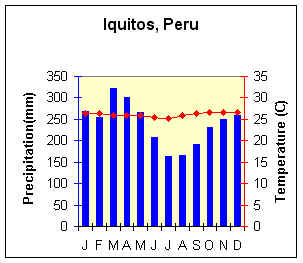
Figure \(\PageIndex{2}\) is a climate graph for Iquitos, Peru. The graph combines monthly precipitation and temperature data.
- The horizontal axis displays the months of the year, labeled J, F, M, A, M, J, J, A, S, O, N, D.
- The left vertical axis is labeled “Precipitation (mm)” and ranges from 0 to 350 millimeters.
- The right vertical axis is labeled “Temperature (C)” and ranges from 0 to 35 degrees Celsius.
Precipitation is represented by blue bars. Rainfall is high throughout the year, generally ranging from about 160 to 320 millimeters per month. The wettest months occur from approximately March through May, with precipitation exceeding 300 millimeters in some months. The driest period occurs during July and August, when precipitation decreases to around 160 millimeters, but rainfall remains substantial.
Temperature is represented by a red line with diamond markers. Temperatures remain nearly constant throughout the year, fluctuating only slightly around 26 to 27 degrees Celsius. There is very little seasonal temperature variation.
Precipitation
The rain forest is noted for its copious rainfall occurring in all months of the year. Over 200 cm (80 in) of precipitation annually falls in the rain forest. Abundant precipitation occurs in each month and is fairly evenly distributed between high and low sun seasons. However, some locations have one month of highest precipitation. Precipitation occurs on more than half the days and is largely generated by convective uplift of warm, moist equatorial air (mE). A distinctive diurnal pattern of cumulus cloud development in the morning, precipitation in the early afternoon, followed by dissipating clouds towards the late afternoon is typical. Thunderstorms are usually concentrated in small areas, so their duration is short but intense. Coastal locations and islands on the poleward limits of the rain forest experience hurricanes, but they do not occur near the equator or inland.

Humidity in the rain forest can be oppressive with dew point temperatures ranging from 15oC - 20oC (59oF- 68oF). Since humidity is so high during the day, when cooling occurs at night, early morning radiation fogs form and heavy dew drips from the rain forest vegetation. These condensation products evaporate into the air as the Sun rises, thus increasing the air's humidity. Under these conditions, the air is oppressive and sultry most of the day and well into the evening. The rate of evaporation and transpiration are exceedingly high requiring a correspondingly greater amount of precipitation to support satisfactory conditions for plant growth due to the high temperature.