

4.1: Getting Ready for Chapter 4
- Page ID
- 40040

\( \newcommand{\vecs}[1]{\overset { \scriptstyle \rightharpoonup} {\mathbf{#1}} } \)
\( \newcommand{\vecd}[1]{\overset{-\!-\!\rightharpoonup}{\vphantom{a}\smash {#1}}} \)
\( \newcommand{\dsum}{\displaystyle\sum\limits} \)
\( \newcommand{\dint}{\displaystyle\int\limits} \)
\( \newcommand{\dlim}{\displaystyle\lim\limits} \)
\( \newcommand{\id}{\mathrm{id}}\) \( \newcommand{\Span}{\mathrm{span}}\)
( \newcommand{\kernel}{\mathrm{null}\,}\) \( \newcommand{\range}{\mathrm{range}\,}\)
\( \newcommand{\RealPart}{\mathrm{Re}}\) \( \newcommand{\ImaginaryPart}{\mathrm{Im}}\)
\( \newcommand{\Argument}{\mathrm{Arg}}\) \( \newcommand{\norm}[1]{\| #1 \|}\)
\( \newcommand{\inner}[2]{\langle #1, #2 \rangle}\)
\( \newcommand{\Span}{\mathrm{span}}\)
\( \newcommand{\id}{\mathrm{id}}\)
\( \newcommand{\Span}{\mathrm{span}}\)
\( \newcommand{\kernel}{\mathrm{null}\,}\)
\( \newcommand{\range}{\mathrm{range}\,}\)
\( \newcommand{\RealPart}{\mathrm{Re}}\)
\( \newcommand{\ImaginaryPart}{\mathrm{Im}}\)
\( \newcommand{\Argument}{\mathrm{Arg}}\)
\( \newcommand{\norm}[1]{\| #1 \|}\)
\( \newcommand{\inner}[2]{\langle #1, #2 \rangle}\)
\( \newcommand{\Span}{\mathrm{span}}\) \( \newcommand{\AA}{\unicode[.8,0]{x212B}}\)
\( \newcommand{\vectorA}[1]{\vec{#1}} % arrow\)
\( \newcommand{\vectorAt}[1]{\vec{\text{#1}}} % arrow\)
\( \newcommand{\vectorB}[1]{\overset { \scriptstyle \rightharpoonup} {\mathbf{#1}} } \)
\( \newcommand{\vectorC}[1]{\textbf{#1}} \)
\( \newcommand{\vectorD}[1]{\overrightarrow{#1}} \)
\( \newcommand{\vectorDt}[1]{\overrightarrow{\text{#1}}} \)
\( \newcommand{\vectE}[1]{\overset{-\!-\!\rightharpoonup}{\vphantom{a}\smash{\mathbf {#1}}}} \)
\( \newcommand{\vecs}[1]{\overset { \scriptstyle \rightharpoonup} {\mathbf{#1}} } \)
\(\newcommand{\longvect}{\overrightarrow}\)
\( \newcommand{\vecd}[1]{\overset{-\!-\!\rightharpoonup}{\vphantom{a}\smash {#1}}} \)
\(\newcommand{\ket}[1]{\left| #1 \right>}\)
\(\newcommand{\bra}[1]{\left< #1 \right|}\)
\(\newcommand{\braket}[2]{\left< #1 \vphantom{#2} \right| \left. #2 \vphantom{#1} \right>}\)
\(\newcommand{\braopket}[3]{\left< #1 \vphantom{#2}\vphantom{#3} \right| #2 \vphantom{#1}\vphantom{#3} \left| #3 \vphantom{#1}\vphantom{#2} \right>}\)
\(\newcommand{\qmvec}[1]{\mathbf{\vec{#1}}}\)
\(\newcommand{\op}[1]{\hat{\mathbf{#1}}}\)
\(\newcommand{\expect}[1]{\langle #1 \rangle}\)
\(\newcommand{\dfn}[1]{\emph{\textbf{#1}}}\)
What you should already know ...
The energy that drives atmospheric circulation is largely that provided by the Sun. The unequal heating of the Earth creates temperature and pressure gradients that result in large-scale circulation of the atmosphere. To a great extent, the major ocean currents are controlled by the circulation of the atmosphere. Atmospheric and oceanic circulation are the means of transport that enable the hydrologic cycle to function. As water evaporates from the oceans or land, the circulation of the atmosphere moves it to another location where it can condense and precipitate out.
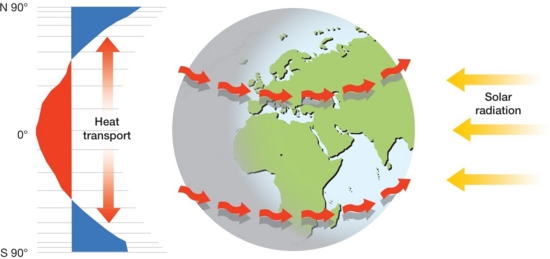
Figure \(\PageIndex{1}\) shows how uneven solar heating and atmospheric circulation redistribute heat across Earth.
At the center is a globe with the equatorial region near the middle. Red arrows form horizontal bands around the planet at different latitudes. These arrows represent large-scale atmospheric circulation patterns that help move heat around the globe.
On the right side, yellow arrows point toward Earth and are directed most strongly at the equatorial region. This indicates that the equator receives the most direct solar radiation and therefore has an energy surplus compared with higher latitudes.
On the left side, a vertical latitude diagram runs from 90 degrees North at the top to 90 degrees South at the bottom, with the equator at 0 degrees in the center. The equatorial region is shown wider than the polar regions. Large arrows extend away from the equator, one pointing northward and one pointing southward. These arrows indicate that heat is transported from the equator toward both poles through atmospheric and ocean circulation.
Overall, the diagram shows that Earth receives more solar energy near the equator than near the poles, and that global circulation redistributes this excess heat toward higher latitudes.
In this we'll examine the processes that cause evaporation, condensation and the formation of precipitation. Using these new insights, we'll be able to explain the geographical distribution of atmospheric moisture. A look at how precipitation patterns may change as a result of human-induced climate change will conclude the chapter.
In particular, you should have a handle on the basic terminology of heat and energy, how the radiation and energy balance relates to the water vapor content of the air, and how pressure systems influence air flow.
Use the quiz below to assess your understanding of a few key topics from these chapters.
- The heat used in the phase change of water is
- ground heat.
- latent heat.
- sensible heat.
- potential phase change heat.
- The average rate of decrease in temperature with an increase in elevation is
- the normal lapse rate of temperature.
- the environmental lapse rate of temperature.
- the latitudinal temperature gradient.
- none of the above.
- The greatest amount of latent heat transfer into the air for a year
- occurs over the midlatitude deserts.
- occurs near the Arctic ocean.
- occurs off the west coast of midlatitude continents.
- tropical oceans.
- The amount of energy required to raise the temperature of one gram of substance through 1oC is
- latent heat.
- potential heat.
- specific heat.
- sensible heat.
- A line that connects points of equal precipitation is called an
- isotach.
- isohyet.
- isobar.
- isobath.
- A cyclone exhibits
- converging surface air and subsidence.
- converging surface air and uplift.
- diverging surface air and uplift.
- diverging surface air and subsidence.
- The amount of heat required to raise the temperature of one gram of water through 1oC is called
- latent heat.
- specific heat.
- a calorie.
- a joule.
- Net radiation for the year is greatest
- over tropical oceans.
- off the west coast of the United States.
- over the Arctic ocean.
- in the Sahara desert.
- A change in air temperature without the physical exchange of heat is called
- a diabatic temperature change.
- an adiabatic temperature change.
- an environmental lapse rate.
- none of the above.
- A negative latent heat transfer
- means heat is removed from water molecules.
- means heat is added to water molecules.
- means the air temperature is high.
- none of the above.
- Answer
-
- B
- A
- D
- C
- B
- B
- C
- A
- B
- A
About your score ....
If you scored 80% or above, Great! ... start reading the chapter.
If you scored 70% to 80% you should consider reviewing the previous material.
If you scored less than 70% you should consider reviewing the previous material and seeking help from your instructor.