

3.1.5.3: Selective Absorption by the Atmosphere
- Page ID
- 40022

\( \newcommand{\vecs}[1]{\overset { \scriptstyle \rightharpoonup} {\mathbf{#1}} } \)
\( \newcommand{\vecd}[1]{\overset{-\!-\!\rightharpoonup}{\vphantom{a}\smash {#1}}} \)
\( \newcommand{\dsum}{\displaystyle\sum\limits} \)
\( \newcommand{\dint}{\displaystyle\int\limits} \)
\( \newcommand{\dlim}{\displaystyle\lim\limits} \)
\( \newcommand{\id}{\mathrm{id}}\) \( \newcommand{\Span}{\mathrm{span}}\)
( \newcommand{\kernel}{\mathrm{null}\,}\) \( \newcommand{\range}{\mathrm{range}\,}\)
\( \newcommand{\RealPart}{\mathrm{Re}}\) \( \newcommand{\ImaginaryPart}{\mathrm{Im}}\)
\( \newcommand{\Argument}{\mathrm{Arg}}\) \( \newcommand{\norm}[1]{\| #1 \|}\)
\( \newcommand{\inner}[2]{\langle #1, #2 \rangle}\)
\( \newcommand{\Span}{\mathrm{span}}\)
\( \newcommand{\id}{\mathrm{id}}\)
\( \newcommand{\Span}{\mathrm{span}}\)
\( \newcommand{\kernel}{\mathrm{null}\,}\)
\( \newcommand{\range}{\mathrm{range}\,}\)
\( \newcommand{\RealPart}{\mathrm{Re}}\)
\( \newcommand{\ImaginaryPart}{\mathrm{Im}}\)
\( \newcommand{\Argument}{\mathrm{Arg}}\)
\( \newcommand{\norm}[1]{\| #1 \|}\)
\( \newcommand{\inner}[2]{\langle #1, #2 \rangle}\)
\( \newcommand{\Span}{\mathrm{span}}\) \( \newcommand{\AA}{\unicode[.8,0]{x212B}}\)
\( \newcommand{\vectorA}[1]{\vec{#1}} % arrow\)
\( \newcommand{\vectorAt}[1]{\vec{\text{#1}}} % arrow\)
\( \newcommand{\vectorB}[1]{\overset { \scriptstyle \rightharpoonup} {\mathbf{#1}} } \)
\( \newcommand{\vectorC}[1]{\textbf{#1}} \)
\( \newcommand{\vectorD}[1]{\overrightarrow{#1}} \)
\( \newcommand{\vectorDt}[1]{\overrightarrow{\text{#1}}} \)
\( \newcommand{\vectE}[1]{\overset{-\!-\!\rightharpoonup}{\vphantom{a}\smash{\mathbf {#1}}}} \)
\( \newcommand{\vecs}[1]{\overset { \scriptstyle \rightharpoonup} {\mathbf{#1}} } \)
\(\newcommand{\longvect}{\overrightarrow}\)
\( \newcommand{\vecd}[1]{\overset{-\!-\!\rightharpoonup}{\vphantom{a}\smash {#1}}} \)
\(\newcommand{\ket}[1]{\left| #1 \right>}\)
\(\newcommand{\bra}[1]{\left< #1 \right|}\)
\(\newcommand{\braket}[2]{\left< #1 \vphantom{#2} \right| \left. #2 \vphantom{#1} \right>}\)
\(\newcommand{\braopket}[3]{\left< #1 \vphantom{#2}\vphantom{#3} \right| #2 \vphantom{#1}\vphantom{#3} \left| #3 \vphantom{#1}\vphantom{#2} \right>}\)
\(\newcommand{\qmvec}[1]{\mathbf{\vec{#1}}}\)
\(\newcommand{\op}[1]{\hat{\mathbf{#1}}}\)
\(\newcommand{\expect}[1]{\langle #1 \rangle}\)
\(\newcommand{\dfn}[1]{\emph{\textbf{#1}}}\)
How Gases Absorb and Emit Radiation
The gasses that comprise our atmosphere are selective absorbers of radiation because each gas absorbs only particular wavelengths of light. Selective absorption by particular gasses and the atmosphere as a whole is shown in Figure \(\PageIndex{1}\). The graph shows very little absorption for the atmosphere as a whole in the shortwave end of the spectrum, especially in the visible light band (the band of maximum emission for the Sun). The atmosphere absorbs far better in the longwave end of the electromagnetic spectrum which is the region of maximum emission (10\(\mu m\)) for the Earth.
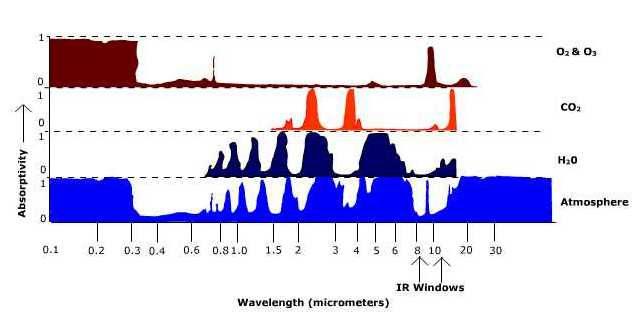
Figure \(\PageIndex{1}\) presents multiple stacked graphs showing how radiation is absorbed at different wavelengths by specific atmospheric gases and by the atmosphere as a whole. The horizontal axis is labeled wavelength in micrometers and increases from approximately 0.1 to 30 micrometers. The vertical axis for each graph is labeled absorptivity, indicating how much radiation is absorbed, ranging from low absorption at the bottom to high absorption at the top.
The top row represents absorption by oxygen and ozone. This row shows strong absorption at very short wavelengths, especially below about 0.3 micrometers, indicating that oxygen and ozone absorb most incoming radiation in that range.
The next row represents carbon dioxide. This graph shows absorption at specific narrow wavelength bands, including a strong absorption region near longer wavelengths.
The third row represents water vapor. This graph shows multiple absorption peaks spread across a wide range of wavelengths, particularly in the longer wavelength region, indicating that water vapor absorbs radiation across many parts of the spectrum.
The bottom row represents the combined effect of all atmospheric gases. This graph shows overall absorption of radiation by the atmosphere, combining the effects of all gases above. There is very little absorption at shorter wavelengths in the region corresponding to visible light, indicating that most incoming solar radiation in this range passes through the atmosphere.
At longer wavelengths, especially beyond about 5 micrometers, absorption becomes much stronger, meaning that the atmosphere absorbs most of the outgoing radiation emitted by Earth. However, there are gaps in this region labeled as infrared windows between about 8 and 14 micrometers. These windows represent wavelength ranges where radiation can pass through the atmosphere into space with relatively little absorption.
Overall, the diagram demonstrates that the atmosphere absorbs radiation selectively depending on wavelength, allowing most incoming solar radiation to reach Earth while absorbing much of the outgoing longwave radiation, with specific wavelength ranges allowing energy to escape.
The IR windows are found at about 8 - 14 \(\mu m\). It is through this portion of the electromagnetic spectrum that infrared radiation is transferred through the atmosphere and into outer space. These windows can be "closed" by clouds which absorb infrared radiation.
To understand why the atmosphere behaves as a selective absorber, see "Digging Deeper: Selective Absorption by the Atmosphere" or continue reading.
So why is the atmosphere a selective absorber? The answer is found at the atomic level where electrons orbiting the nucleus of an atom are excited when struck by a bundle of energy. Though we describe electromagnetic radiation as invisible waves of energy, at the smallest scale it behaves as a particle, like when light is emitted by a single atom or molecule. When energy is given off, there is a change in the orbital pattern of the electrons that surround the nucleus of an atom. As the orbit changes, a bundle of energy called a "photon" is released. Particles of light differ from particles of matter: they have no mass, occupy no space, and travel at the speed of light, 2.9998 X 10⁸ m s-1. The amount of energy carried by a photon varies inversely with wavelength, the shorter the wavelength, the more energetic the photon.
Electrons orbit the nucleus of an atom at fixed orbital distances called orbital shells. The orbital shell for each atom is different and discrete. That is, for a given atom like hydrogen, its electrons can only orbit at particular distances and are different than those for atoms of neon.
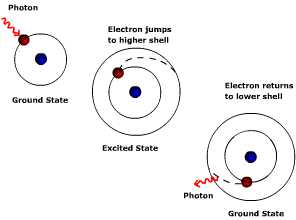
Figure \(\PageIndex{2}\) illustrates how an atom absorbs and emits energy through changes in electron position around the nucleus.
On the left side, an atom is shown in its ground state, meaning the electron is at its lowest energy level, orbiting close to the nucleus. A photon, represented as a packet of energy, approaches the atom.
In the center, the electron absorbs the incoming photon and moves to a higher energy level, farther from the nucleus. This is labeled as an excited state, indicating that the atom has gained energy and is temporarily unstable.
On the right side, the electron returns from the higher energy level back to its original lower energy level. As it returns to this ground state, a photon is released, representing the emission of energy.
The diagram demonstrates that atoms absorb and emit energy in discrete amounts. An electron can only move between specific energy levels, and each transition requires or releases a photon with a precise amount of energy. This explains why atoms absorb and emit radiation at specific wavelengths rather than across a continuous range.
Each orbital shell is associated with a given energy level; the greater the distance from the nucleus the greater the energy level. Electrons jump to a higher shell when excited by the absorption of energy. The photon must have the exact amount of energy to move the electron from, say, shell one to shell two. If the photon doesn't have enough energy to move the electron to shell two, it cannot move the electron half way between shell one and two. The atom does not stay in this excited, unstable state for very long. Energy is given off and the electron returns to a stable state or its "ground state" (lowest energy level or orbital distance). Recall that the amount of energy carried by a photon depends on the wavelength. Thus the atoms that comprise a gas can only absorb, or emit, particular wavelengths of energy (i.e. photons of energy).