

3.1.5: Energy and Heat
- Page ID
- 40019

\( \newcommand{\vecs}[1]{\overset { \scriptstyle \rightharpoonup} {\mathbf{#1}} } \)
\( \newcommand{\vecd}[1]{\overset{-\!-\!\rightharpoonup}{\vphantom{a}\smash {#1}}} \)
\( \newcommand{\dsum}{\displaystyle\sum\limits} \)
\( \newcommand{\dint}{\displaystyle\int\limits} \)
\( \newcommand{\dlim}{\displaystyle\lim\limits} \)
\( \newcommand{\id}{\mathrm{id}}\) \( \newcommand{\Span}{\mathrm{span}}\)
( \newcommand{\kernel}{\mathrm{null}\,}\) \( \newcommand{\range}{\mathrm{range}\,}\)
\( \newcommand{\RealPart}{\mathrm{Re}}\) \( \newcommand{\ImaginaryPart}{\mathrm{Im}}\)
\( \newcommand{\Argument}{\mathrm{Arg}}\) \( \newcommand{\norm}[1]{\| #1 \|}\)
\( \newcommand{\inner}[2]{\langle #1, #2 \rangle}\)
\( \newcommand{\Span}{\mathrm{span}}\)
\( \newcommand{\id}{\mathrm{id}}\)
\( \newcommand{\Span}{\mathrm{span}}\)
\( \newcommand{\kernel}{\mathrm{null}\,}\)
\( \newcommand{\range}{\mathrm{range}\,}\)
\( \newcommand{\RealPart}{\mathrm{Re}}\)
\( \newcommand{\ImaginaryPart}{\mathrm{Im}}\)
\( \newcommand{\Argument}{\mathrm{Arg}}\)
\( \newcommand{\norm}[1]{\| #1 \|}\)
\( \newcommand{\inner}[2]{\langle #1, #2 \rangle}\)
\( \newcommand{\Span}{\mathrm{span}}\) \( \newcommand{\AA}{\unicode[.8,0]{x212B}}\)
\( \newcommand{\vectorA}[1]{\vec{#1}} % arrow\)
\( \newcommand{\vectorAt}[1]{\vec{\text{#1}}} % arrow\)
\( \newcommand{\vectorB}[1]{\overset { \scriptstyle \rightharpoonup} {\mathbf{#1}} } \)
\( \newcommand{\vectorC}[1]{\textbf{#1}} \)
\( \newcommand{\vectorD}[1]{\overrightarrow{#1}} \)
\( \newcommand{\vectorDt}[1]{\overrightarrow{\text{#1}}} \)
\( \newcommand{\vectE}[1]{\overset{-\!-\!\rightharpoonup}{\vphantom{a}\smash{\mathbf {#1}}}} \)
\( \newcommand{\vecs}[1]{\overset { \scriptstyle \rightharpoonup} {\mathbf{#1}} } \)
\(\newcommand{\longvect}{\overrightarrow}\)
\( \newcommand{\vecd}[1]{\overset{-\!-\!\rightharpoonup}{\vphantom{a}\smash {#1}}} \)
\(\newcommand{\ket}[1]{\left| #1 \right>}\)
\(\newcommand{\bra}[1]{\left< #1 \right|}\)
\(\newcommand{\braket}[2]{\left< #1 \vphantom{#2} \right| \left. #2 \vphantom{#1} \right>}\)
\(\newcommand{\braopket}[3]{\left< #1 \vphantom{#2}\vphantom{#3} \right| #2 \vphantom{#1}\vphantom{#3} \left| #3 \vphantom{#1}\vphantom{#2} \right>}\)
\(\newcommand{\qmvec}[1]{\mathbf{\vec{#1}}}\)
\(\newcommand{\op}[1]{\hat{\mathbf{#1}}}\)
\(\newcommand{\expect}[1]{\langle #1 \rangle}\)
\(\newcommand{\dfn}[1]{\emph{\textbf{#1}}}\)
Overview
Energy is the ability to do work on matter. The work done is manifested in a variety of ways. Matter can be pushed, pulled, or lifted over distance when energy is applied. In other words, work done on matter implies a change of position or movement. Potential energy is the energy of position. A block of rock attached to a high cliff face has substantial potential energy due to its position above the ground. When it breaks away from the cliff and falls to the surface potential energy is converted into kinetic energy of motion. When the rock hits the ground, kinetic energy is converted into work when it dislodges surface material.
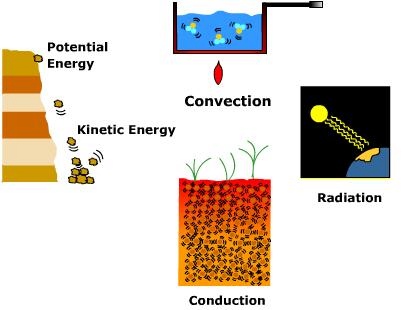
Figure \(\PageIndex{1}\) illustrates examples of potential energy, kinetic energy, and the three main modes of heat transfer: conduction, convection, and radiation.
On the left side, the diagram compares potential energy and kinetic energy. At the top, objects are shown elevated above the ground, representing stored energy due to position, or potential energy. Below, similar objects are shown moving or falling, representing kinetic energy. Together, these images show that stored energy can be converted into motion.
At the top center, the diagram shows convection. A container of fluid is heated from below. Arrows inside the fluid form a circular pattern, with warmer fluid rising and cooler fluid sinking. This illustrates convection currents, in which heat is transferred by the movement of liquids or gases.
At the bottom center, the diagram shows conduction. A solid material is represented by closely packed particles. Energy moves from one particle to the next through direct contact. This shows that conduction transfers heat through a material without moving the material as a whole.
On the right side, the diagram shows radiation. A heat source emits energy outward as waves toward another object. No material medium is shown between the source and the receiving object. This demonstrates that radiation transfers heat by electromagnetic waves and can occur through empty space.
Overall, the diagram compares several ways energy can be stored, transformed, and transferred. Potential energy can become kinetic energy, and heat can move through direct contact, fluid motion, or electromagnetic radiation depending on the environment
Heat or, thermal energy is the total energy associated with random atomic and molecular motions of a substance. Figure \(\PageIndex{1}\) illustrates the three ways by which heat is transferred. Radiation is the transfer of energy via electromagnetic waves. Radiation does not need an intervening medium to pass heat energy from the emitter to the absorber. When radiation from the Sun is absorbed by the Earth it does work by setting molecules in motion and raising their kinetic energy level. In a solid, the molecules may vibrate more rapidly and collide with one another and transfer heat from warmer to colder portions of the mass by conduction. Though conduction is typically thought of occurring within a solid, it can occur between a solid and a fluid. When air, a fluid, comes in contact with the ground, a solid, heat can be transferred through molecular collisions. In fluids like air and water, heat is transferred by the circulation of molecules via the process of convection. Convection implies a vertical transfer of heat, like that which is occurs in a heated pot of water. As water warms it circulates to the surface. The same is true for air. When air is heated by the earth's surface it too circulates upward. While convection is applied to vertical transfer of heat, advection is a term that is applied to the horizontal transfer of heat by the wind.
Don't confuse temperature and heat, they are not the same thing. Temperature is a measure of the average kinetic energy level of a substance, in other words, the degree of hotness or coldness. Heat is the total energy associated with the motion of molecules while temperature is the average energy level. A boiling pan of water has a higher temperature than a tepid bathtub of water, but the tub contains more heat because there is more mass.
The calorie is a unit of measurement for heat. A calorie is the amount of heat required to raise the temperature of one gram of water through 1oC. Energy is expressed in terms of joules. One joule is the equivalent of one watt of power radiated or dissipated for one second. Specific heat is the heat required to raise the temperature of one unit substance (e.g., gram) through a particular temperature interval (1oC, for example). The specific heat of water is 1 calorie/gram °C = 4.186 joule/gram °C which is higher than any other common substance on Earth. This is one reason why large bodies of water play such an important role in the heat budget of the Earth system. Radiation is often measured in watts per meter2 or langleys per minute.