

3.1.3: Day Length and Seasons
- Page ID
- 39991

\( \newcommand{\vecs}[1]{\overset { \scriptstyle \rightharpoonup} {\mathbf{#1}} } \)
\( \newcommand{\vecd}[1]{\overset{-\!-\!\rightharpoonup}{\vphantom{a}\smash {#1}}} \)
\( \newcommand{\dsum}{\displaystyle\sum\limits} \)
\( \newcommand{\dint}{\displaystyle\int\limits} \)
\( \newcommand{\dlim}{\displaystyle\lim\limits} \)
\( \newcommand{\id}{\mathrm{id}}\) \( \newcommand{\Span}{\mathrm{span}}\)
( \newcommand{\kernel}{\mathrm{null}\,}\) \( \newcommand{\range}{\mathrm{range}\,}\)
\( \newcommand{\RealPart}{\mathrm{Re}}\) \( \newcommand{\ImaginaryPart}{\mathrm{Im}}\)
\( \newcommand{\Argument}{\mathrm{Arg}}\) \( \newcommand{\norm}[1]{\| #1 \|}\)
\( \newcommand{\inner}[2]{\langle #1, #2 \rangle}\)
\( \newcommand{\Span}{\mathrm{span}}\)
\( \newcommand{\id}{\mathrm{id}}\)
\( \newcommand{\Span}{\mathrm{span}}\)
\( \newcommand{\kernel}{\mathrm{null}\,}\)
\( \newcommand{\range}{\mathrm{range}\,}\)
\( \newcommand{\RealPart}{\mathrm{Re}}\)
\( \newcommand{\ImaginaryPart}{\mathrm{Im}}\)
\( \newcommand{\Argument}{\mathrm{Arg}}\)
\( \newcommand{\norm}[1]{\| #1 \|}\)
\( \newcommand{\inner}[2]{\langle #1, #2 \rangle}\)
\( \newcommand{\Span}{\mathrm{span}}\) \( \newcommand{\AA}{\unicode[.8,0]{x212B}}\)
\( \newcommand{\vectorA}[1]{\vec{#1}} % arrow\)
\( \newcommand{\vectorAt}[1]{\vec{\text{#1}}} % arrow\)
\( \newcommand{\vectorB}[1]{\overset { \scriptstyle \rightharpoonup} {\mathbf{#1}} } \)
\( \newcommand{\vectorC}[1]{\textbf{#1}} \)
\( \newcommand{\vectorD}[1]{\overrightarrow{#1}} \)
\( \newcommand{\vectorDt}[1]{\overrightarrow{\text{#1}}} \)
\( \newcommand{\vectE}[1]{\overset{-\!-\!\rightharpoonup}{\vphantom{a}\smash{\mathbf {#1}}}} \)
\( \newcommand{\vecs}[1]{\overset { \scriptstyle \rightharpoonup} {\mathbf{#1}} } \)
\(\newcommand{\longvect}{\overrightarrow}\)
\( \newcommand{\vecd}[1]{\overset{-\!-\!\rightharpoonup}{\vphantom{a}\smash {#1}}} \)
\(\newcommand{\ket}[1]{\left| #1 \right>}\)
\(\newcommand{\bra}[1]{\left< #1 \right|}\)
\(\newcommand{\braket}[2]{\left< #1 \vphantom{#2} \right| \left. #2 \vphantom{#1} \right>}\)
\(\newcommand{\braopket}[3]{\left< #1 \vphantom{#2}\vphantom{#3} \right| #2 \vphantom{#1}\vphantom{#3} \left| #3 \vphantom{#1}\vphantom{#2} \right>}\)
\(\newcommand{\qmvec}[1]{\mathbf{\vec{#1}}}\)
\(\newcommand{\op}[1]{\hat{\mathbf{#1}}}\)
\(\newcommand{\expect}[1]{\langle #1 \rangle}\)
\(\newcommand{\dfn}[1]{\emph{\textbf{#1}}}\)
Solstices, Equinoxes, and Day Length
Day length is determined by the length of time the Sun is above the horizon. Day length changes through the year as the orientation of the Earth to the Sun changes. Circle of illumination (Figure \(\PageIndex{1}\) is the imaginary circle on Earth's surface that separates day side from the night side.

Figure \(\PageIndex{1}\) is an educational diagram titled “Circle of Illumination: Day and Night.” The graphic explains how sunlight illuminates half of Earth at a time, creating day and night.
At the center, a globe of Earth is divided vertically by a dashed yellow line labeled “Circle of Illumination.” The left half of Earth faces the Sun and is labeled “Day – Side facing the Sun (in sunlight).” The right half is in darkness and is labeled “Night – Side facing away from the Sun (in darkness).”
On the left side of the image, a yellow Sun emits parallel orange arrows labeled “Sunlight” toward Earth. The illuminated side shows the continents of North and South America, while the dark side shows Europe and Africa with city lights visible.
Above Earth, a label indicates Earth’s 23.5° axial tilt, with the North Pole tilted slightly to the right. A smaller inset on the lower right further illustrates the axial tilt relative to a line perpendicular to Earth’s orbit around the Sun.
A note in the lower left explains that as Earth rotates from west to east, locations move from day into night and back into day again. Another inset at the bottom center shows Earth orbiting the Sun with an arrow indicating Earth’s rotation from west to east.
Figure \(\PageIndex{2}\) shows two extreme cases, the December and June solstices. Note during December that more of a given latitude in the Southern hemisphere is exposed to the Sun.
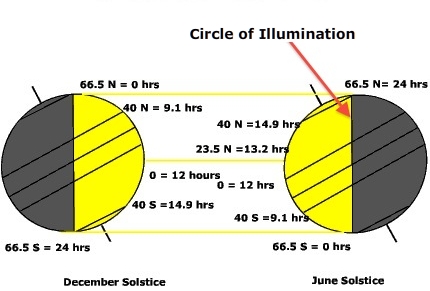
Figure \(\PageIndex{2}\) is titled “Circle of Illumination” comparing day length during the December Solstice and June Solstice. Two globes are shown side by side, each divided into a yellow sunlit half and a dark nighttime half.
- Left globe – December Solstice: The Southern Hemisphere receives more daylight than the Northern Hemisphere. Labels show:
- 66.5° N: 0 hours of daylight (polar night)
- 40° N: 9.1 hours
- 23.5° N: 10.8 hours (implied by the pattern)
- Equator (0°): 12 hours
- 40° S: 14.9 hours
- 66.5° S: 24 hours of daylight (midnight sun)
- Right globe – June Solstice: The Northern Hemisphere receives more daylight than the Southern Hemisphere. Labels show:
- 66.5° N: 24 hours of daylight
- 40° N: 14.9 hours
- 23.5° N: 13.2 hours
- Equator (0°): 12 hours
- 40° S: 9.1 hours
- 66.5° S: 0 hours of daylight
An arrow labeled “Circle of Illumination” points to the boundary between the lit and dark halves of Earth. The diagram demonstrates how Earth's 23.5° axial tilt shifts the circle of illumination during the solstices, creating longer days in the hemisphere tilted toward the Sun and shorter days in the hemisphere tilted away from it.
This is the longest day of the year for those living poleward of the Equator. In June the opposite occurs with longer day length in the Northern hemisphere. Note that in both cases, the circle of illumination bisects the Equator (cuts it in half). The Equator is the only place on Earth that experiences equal day length every day of the year. The Earth's axis is neither inclined toward or away from the Sun on the equinoxes and so the circle of illumination cuts all latitudes in half resulting in equal day length for the entire Earth. Table \(\PageIndex{1}\) summarizes the changing seasonal conditions as seen in the Northern Hemisphere.
| CHARACTERISTICS |
SPRING EQUINOX |
WINTER SOLSTICE |
AUTUMNAL EQUINOX |
SUMMER SOLSTICE |
|---|---|---|---|---|
|
Date |
March 21 |
December 22 |
Sept. 23 |
June 21 |
|
Subsolar Point |
0o |
23 1/2o S |
0o |
23 1/2o N |
|
Tangent Rays |
North and South Poles |
Arctic and Antarctic Circles |
North and South Poles |
Arctic and Antarctic Circles |
|
Day length |
12 hour day length everywhere |
24 hours of darkness at North Pole; 24 hours day light at South Pole; 12 hours day light at Equator |
12 hour day length everywhere |
24 hours of darkness at South Pole; 24 hours day light at North Pole; 12 hours day light at Equator |
Table \(\PageIndex{1}\) outlines how Earth-Sun relations dictate day length, subsolar points (where the Sun is directly overhead), and tangent rays (where the Sun's rays scrape the surface at a 0o angle) throughout the year.
Global Equinoxes (March 21 & September 23)
Subsolar Point : The Equator (0o)
Tangent Rays : Strike precisely at the North and South Poles.
Day Length : The circle of illumination cuts all latitudes exactly in half, resulting in equal 12 hour days and nights everywhere on Earth, including both hemispheres.
Solstices & The Southern Hemisphere Situation
Because the Northern and Southern Hemispheres experience opposite axial tilts relative to the Sun, their seasons and day lengths are completely reversed:
December Solstices (December 22)
Global Parameters: The subsolar point reaches its southernmost limit at the Tropic of Capricorn (23.5o S), and tangent rays strike the Arctic and Antarctic circles. Southern Hemisphere Situation: The Southern Hemisphere is tilted directly toward the Sun, marking its Summer Solstice. This results in the longest day length of the year for anyone living south of the Equator. Areas poleward of the Antarctic Circle (66.5o S) receive 24 hours of continuous daylight.
June Solstices (June 21)
Global Parameters: The subsolar point shifts to its northernmost limit at the Tropic of Cancer (23.50o N), with tangent rays again hitting the polar circles. Southern Hemisphere Situation: The Southern Hemisphere is tilted directly away from the Sun, marking its Winter Solstice. This brings the shortest day length of the year. The region poleward of the Antarctic Circle (66.5o S) is plunged into 24 hours of continuous darkness.