

1.4.3: The Continuum of Geography
- Page ID
- 39968

\( \newcommand{\vecs}[1]{\overset { \scriptstyle \rightharpoonup} {\mathbf{#1}} } \)
\( \newcommand{\vecd}[1]{\overset{-\!-\!\rightharpoonup}{\vphantom{a}\smash {#1}}} \)
\( \newcommand{\dsum}{\displaystyle\sum\limits} \)
\( \newcommand{\dint}{\displaystyle\int\limits} \)
\( \newcommand{\dlim}{\displaystyle\lim\limits} \)
\( \newcommand{\id}{\mathrm{id}}\) \( \newcommand{\Span}{\mathrm{span}}\)
( \newcommand{\kernel}{\mathrm{null}\,}\) \( \newcommand{\range}{\mathrm{range}\,}\)
\( \newcommand{\RealPart}{\mathrm{Re}}\) \( \newcommand{\ImaginaryPart}{\mathrm{Im}}\)
\( \newcommand{\Argument}{\mathrm{Arg}}\) \( \newcommand{\norm}[1]{\| #1 \|}\)
\( \newcommand{\inner}[2]{\langle #1, #2 \rangle}\)
\( \newcommand{\Span}{\mathrm{span}}\)
\( \newcommand{\id}{\mathrm{id}}\)
\( \newcommand{\Span}{\mathrm{span}}\)
\( \newcommand{\kernel}{\mathrm{null}\,}\)
\( \newcommand{\range}{\mathrm{range}\,}\)
\( \newcommand{\RealPart}{\mathrm{Re}}\)
\( \newcommand{\ImaginaryPart}{\mathrm{Im}}\)
\( \newcommand{\Argument}{\mathrm{Arg}}\)
\( \newcommand{\norm}[1]{\| #1 \|}\)
\( \newcommand{\inner}[2]{\langle #1, #2 \rangle}\)
\( \newcommand{\Span}{\mathrm{span}}\) \( \newcommand{\AA}{\unicode[.8,0]{x212B}}\)
\( \newcommand{\vectorA}[1]{\vec{#1}} % arrow\)
\( \newcommand{\vectorAt}[1]{\vec{\text{#1}}} % arrow\)
\( \newcommand{\vectorB}[1]{\overset { \scriptstyle \rightharpoonup} {\mathbf{#1}} } \)
\( \newcommand{\vectorC}[1]{\textbf{#1}} \)
\( \newcommand{\vectorD}[1]{\overrightarrow{#1}} \)
\( \newcommand{\vectorDt}[1]{\overrightarrow{\text{#1}}} \)
\( \newcommand{\vectE}[1]{\overset{-\!-\!\rightharpoonup}{\vphantom{a}\smash{\mathbf {#1}}}} \)
\( \newcommand{\vecs}[1]{\overset { \scriptstyle \rightharpoonup} {\mathbf{#1}} } \)
\(\newcommand{\longvect}{\overrightarrow}\)
\( \newcommand{\vecd}[1]{\overset{-\!-\!\rightharpoonup}{\vphantom{a}\smash {#1}}} \)
\(\newcommand{\ket}[1]{\left| #1 \right>}\)
\(\newcommand{\bra}[1]{\left< #1 \right|}\)
\(\newcommand{\braket}[2]{\left< #1 \vphantom{#2} \right| \left. #2 \vphantom{#1} \right>}\)
\(\newcommand{\braopket}[3]{\left< #1 \vphantom{#2}\vphantom{#3} \right| #2 \vphantom{#1}\vphantom{#3} \left| #3 \vphantom{#1}\vphantom{#2} \right>}\)
\(\newcommand{\qmvec}[1]{\mathbf{\vec{#1}}}\)
\(\newcommand{\op}[1]{\hat{\mathbf{#1}}}\)
\(\newcommand{\expect}[1]{\langle #1 \rangle}\)
\(\newcommand{\dfn}[1]{\emph{\textbf{#1}}}\)
Braches of Geography
Geography is a wide ranging field that incorporates a number of diverse subject areas. Broadly speaking, geography can be divided into human geography and physical geography. Human geography deals with spatial aspects of human activities and culture. Physical geography, our topic here, focuses on the geographical attributes of the natural environment. Figure \(\PageIndex{1}\) illustrates the continuum of geography. Though the discipline can be broken down into two separate areas of study, physical geography and human geography, they are actually seen as blending with one another along a geographic continuum.

Figure \(\PageIndex{1}\) is titled Continuum of Geography. This diagram illustrates how geography spans a continuum between Physical Geography and Human/Cultural Geography, with disciplines listed under each category and some bridging both. Arrows in the diagram indicate a two-way continuum, showing how these fields are interconnected across the spectrum of geography.
- Physical Geography includes:
- Astronomy
- Botany
- Ecology
- Geology
- Hydrology
- Oceanography
- Pedology (study of soils)
- Zoology
- Bridging Disciplines (between physical and human geography):
- Biogeography
- Geomorphology
- Hydro geography
- Climatology
- Soils Geography
- Human/Cultural Geography includes:
- Behavioral Geography
- Population Geography
- Economic Geography
- Historical Geography
- Political Geography
- Extended Disciplines from Human/Cultural Geography:
- Anthropology
- Behavioral Science
- Demography
- Economics
- History
- Political Science
- Urban Studies
As we move toward the center of the diagram we enter a zone where the subject matter of the two meet and intermingle. At the center is where the synthesis of the physical environment with the human/cultural environment occurs. In so doing we create a holistic view of Earth systems. The study of environmental issues like global warming, response of humans to natural hazards, and deforestation requires this kind of synthesis or examination of relationships between society and the natural environment to understand them.
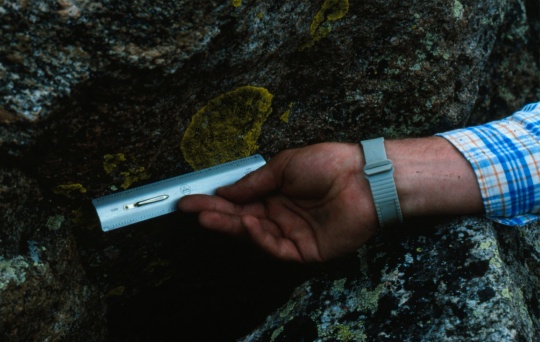
As shown in Figure \(\PageIndex{2}\), borrowing a technique from archaeology and paleontology, physical geographers use lichen growth rate and diameters to estimate the age of debris flows, recent moraines, and other rocky deposits. Each subdiscipline draws on the knowledge provided by a variety of disciplines outside of geography. For instance, to study Earth phenomena like the distribution of soils we have to draw on the expertise of such disciplines as soil science, botany, and climatology because soil properties are a function of vegetation, energy, and moisture. Geography, therefore, is a very integrative science.