

16.7: Adaptations to the Marine Environment
- Page ID
- 10422

\( \newcommand{\vecs}[1]{\overset { \scriptstyle \rightharpoonup} {\mathbf{#1}} } \)
\( \newcommand{\vecd}[1]{\overset{-\!-\!\rightharpoonup}{\vphantom{a}\smash {#1}}} \)
\( \newcommand{\dsum}{\displaystyle\sum\limits} \)
\( \newcommand{\dint}{\displaystyle\int\limits} \)
\( \newcommand{\dlim}{\displaystyle\lim\limits} \)
\( \newcommand{\id}{\mathrm{id}}\) \( \newcommand{\Span}{\mathrm{span}}\)
( \newcommand{\kernel}{\mathrm{null}\,}\) \( \newcommand{\range}{\mathrm{range}\,}\)
\( \newcommand{\RealPart}{\mathrm{Re}}\) \( \newcommand{\ImaginaryPart}{\mathrm{Im}}\)
\( \newcommand{\Argument}{\mathrm{Arg}}\) \( \newcommand{\norm}[1]{\| #1 \|}\)
\( \newcommand{\inner}[2]{\langle #1, #2 \rangle}\)
\( \newcommand{\Span}{\mathrm{span}}\)
\( \newcommand{\id}{\mathrm{id}}\)
\( \newcommand{\Span}{\mathrm{span}}\)
\( \newcommand{\kernel}{\mathrm{null}\,}\)
\( \newcommand{\range}{\mathrm{range}\,}\)
\( \newcommand{\RealPart}{\mathrm{Re}}\)
\( \newcommand{\ImaginaryPart}{\mathrm{Im}}\)
\( \newcommand{\Argument}{\mathrm{Arg}}\)
\( \newcommand{\norm}[1]{\| #1 \|}\)
\( \newcommand{\inner}[2]{\langle #1, #2 \rangle}\)
\( \newcommand{\Span}{\mathrm{span}}\) \( \newcommand{\AA}{\unicode[.8,0]{x212B}}\)
\( \newcommand{\vectorA}[1]{\vec{#1}} % arrow\)
\( \newcommand{\vectorAt}[1]{\vec{\text{#1}}} % arrow\)
\( \newcommand{\vectorB}[1]{\overset { \scriptstyle \rightharpoonup} {\mathbf{#1}} } \)
\( \newcommand{\vectorC}[1]{\textbf{#1}} \)
\( \newcommand{\vectorD}[1]{\overrightarrow{#1}} \)
\( \newcommand{\vectorDt}[1]{\overrightarrow{\text{#1}}} \)
\( \newcommand{\vectE}[1]{\overset{-\!-\!\rightharpoonup}{\vphantom{a}\smash{\mathbf {#1}}}} \)
\( \newcommand{\vecs}[1]{\overset { \scriptstyle \rightharpoonup} {\mathbf{#1}} } \)
\(\newcommand{\longvect}{\overrightarrow}\)
\( \newcommand{\vecd}[1]{\overset{-\!-\!\rightharpoonup}{\vphantom{a}\smash {#1}}} \)
\(\newcommand{\ket}[1]{\left| #1 \right>}\)
\(\newcommand{\bra}[1]{\left< #1 \right|}\)
\(\newcommand{\braket}[2]{\left< #1 \vphantom{#2} \right| \left. #2 \vphantom{#1} \right>}\)
\(\newcommand{\braopket}[3]{\left< #1 \vphantom{#2}\vphantom{#3} \right| #2 \vphantom{#1}\vphantom{#3} \left| #3 \vphantom{#1}\vphantom{#2} \right>}\)
\(\newcommand{\qmvec}[1]{\mathbf{\vec{#1}}}\)
\(\newcommand{\op}[1]{\hat{\mathbf{#1}}}\)
\(\newcommand{\expect}[1]{\langle #1 \rangle}\)
\(\newcommand{\dfn}[1]{\emph{\textbf{#1}}}\)
Adaptations to the Marine Environment
• Ability to float (Zooplankton – some produce fats or oils to stay afloat)
• Ability to swim (Nekton – larger fish and marine mammals)
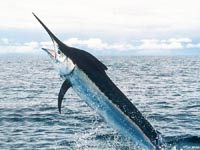
Propulsion and movement of fish - the body plan of fish reflect adaptations to feeding on prey and fleeing predators.
Width/Length Ratio
Tuna - .28
Dolphin - .25
Swordfish - .24
Whale - .21
Most efficient is about.25, but there is a size-scale factor.
Ratio produced from natural selection “the fittest survive and produce offspring”
Compare with Surfboard Design!
| Type | Width | Length | Ratio | Comments |
| Short Board | 19 ¼" | 6’4” | 0.25 | Small – medium waves |
| PT (Ebenizer Townsend, 1798) | 19 ¼" | 6'7" | 0.24 | Large waves |
| Average Long Board | 22" | 9'0" | 0.20 | Like a whale – scale factor |
| Average Surf Board | 18 ¼" | 6’2” | 0.25 | rapid turns, harder to control |
Kinds of Zooplankton
Includes organisms described as floaters and drifters. All forms are invertebrates.
Microscopic Zooplankton include:
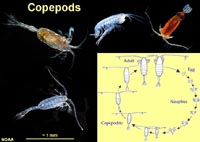
Radiolarians, Foraminifers, Copepods
Macroscopic Zooplankton:
• Krill ( resemble mini shrimp or large copepods, critical in Antarctic food chains)
 |
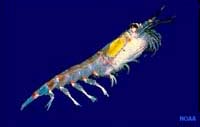 |
| Figure 16.43. Copepods | Figure 16.44. Krill |
Floating Macroscopic Zooplankton include:
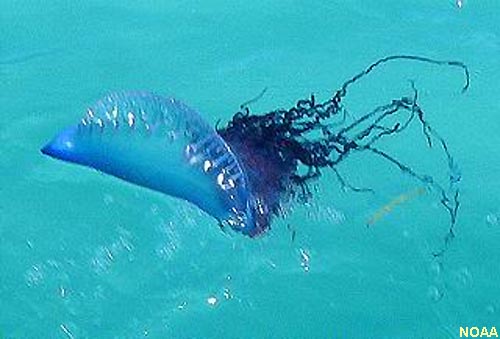
• Portuguese man-of-war (have gas-filled float)
• Jellyfish (have soft, low-density bodies; there are hundreds of species)
Many species of portuguese man-of-war and jellyfish can sting or produce potent toxins.
 |
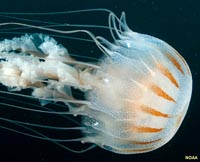 |
| Figure 16.45. Portuguese man-of-war | Figure 16.46. Jellyfish |
Swimming (Nekton) Organisms
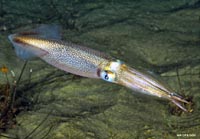
Includes all fish, squids, sea turtles and sea snakes, and marine mammals.
• Swim by trapping water and expelling it (squid, octopus)
• Swim by curving body from front to back (fish, etc.)
Adaptations for Finding Prey
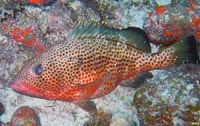
• Lungers wait for prey and pounce (grouper).
• Cruisers actively seek prey (tuna).
 |
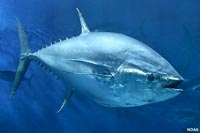 |
| Figure 16.48. Groupers are lungers | Figure 16.49. Tuna are cruisers |
Adaptations to Avoid Predation
• Speed
• Hiding: includes Transparency, Camouflage and Countershading
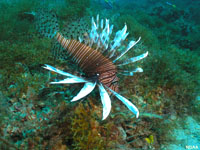
• Poison (to touch or eat: examples: sea snakes, blowfish, lion fish)
• Schooling (safety in numbers, appear as a larger unit, maneuvers confuse predators)
| Video: Schooling anchovies at Scripps Pier (Scripps Institute of Oceanography) |