

6.1: Wind
- Page ID
- 46822

\( \newcommand{\vecs}[1]{\overset { \scriptstyle \rightharpoonup} {\mathbf{#1}} } \)
\( \newcommand{\vecd}[1]{\overset{-\!-\!\rightharpoonup}{\vphantom{a}\smash {#1}}} \)
\( \newcommand{\dsum}{\displaystyle\sum\limits} \)
\( \newcommand{\dint}{\displaystyle\int\limits} \)
\( \newcommand{\dlim}{\displaystyle\lim\limits} \)
\( \newcommand{\id}{\mathrm{id}}\) \( \newcommand{\Span}{\mathrm{span}}\)
( \newcommand{\kernel}{\mathrm{null}\,}\) \( \newcommand{\range}{\mathrm{range}\,}\)
\( \newcommand{\RealPart}{\mathrm{Re}}\) \( \newcommand{\ImaginaryPart}{\mathrm{Im}}\)
\( \newcommand{\Argument}{\mathrm{Arg}}\) \( \newcommand{\norm}[1]{\| #1 \|}\)
\( \newcommand{\inner}[2]{\langle #1, #2 \rangle}\)
\( \newcommand{\Span}{\mathrm{span}}\)
\( \newcommand{\id}{\mathrm{id}}\)
\( \newcommand{\Span}{\mathrm{span}}\)
\( \newcommand{\kernel}{\mathrm{null}\,}\)
\( \newcommand{\range}{\mathrm{range}\,}\)
\( \newcommand{\RealPart}{\mathrm{Re}}\)
\( \newcommand{\ImaginaryPart}{\mathrm{Im}}\)
\( \newcommand{\Argument}{\mathrm{Arg}}\)
\( \newcommand{\norm}[1]{\| #1 \|}\)
\( \newcommand{\inner}[2]{\langle #1, #2 \rangle}\)
\( \newcommand{\Span}{\mathrm{span}}\) \( \newcommand{\AA}{\unicode[.8,0]{x212B}}\)
\( \newcommand{\vectorA}[1]{\vec{#1}} % arrow\)
\( \newcommand{\vectorAt}[1]{\vec{\text{#1}}} % arrow\)
\( \newcommand{\vectorB}[1]{\overset { \scriptstyle \rightharpoonup} {\mathbf{#1}} } \)
\( \newcommand{\vectorC}[1]{\textbf{#1}} \)
\( \newcommand{\vectorD}[1]{\overrightarrow{#1}} \)
\( \newcommand{\vectorDt}[1]{\overrightarrow{\text{#1}}} \)
\( \newcommand{\vectE}[1]{\overset{-\!-\!\rightharpoonup}{\vphantom{a}\smash{\mathbf {#1}}}} \)
\( \newcommand{\vecs}[1]{\overset { \scriptstyle \rightharpoonup} {\mathbf{#1}} } \)
\(\newcommand{\longvect}{\overrightarrow}\)
\( \newcommand{\vecd}[1]{\overset{-\!-\!\rightharpoonup}{\vphantom{a}\smash {#1}}} \)
\(\newcommand{\ket}[1]{\left| #1 \right>}\)
\(\newcommand{\bra}[1]{\left< #1 \right|}\)
\(\newcommand{\braket}[2]{\left< #1 \vphantom{#2} \right| \left. #2 \vphantom{#1} \right>}\)
\(\newcommand{\braopket}[3]{\left< #1 \vphantom{#2}\vphantom{#3} \right| #2 \vphantom{#1}\vphantom{#3} \left| #3 \vphantom{#1}\vphantom{#2} \right>}\)
\(\newcommand{\qmvec}[1]{\mathbf{\vec{#1}}}\)
\(\newcommand{\op}[1]{\hat{\mathbf{#1}}}\)
\(\newcommand{\expect}[1]{\langle #1 \rangle}\)
\(\newcommand{\dfn}[1]{\emph{\textbf{#1}}}\)
Forces acting on air
There are four forces that influence the speed or direction of horizontal winds.
- Pressure gradient force
- Coriolis force
- Centrifugal force
- Frictional force
Pressure Gradient Force
Surface weather maps indicate regions of high- and low-pressure centers as H and L, as illustrated in Figure \(\PageIndex{1}\). Usually, surrounding these "highs" and "lows" are lines called isobars. "Iso" means "equal" and a "bar" is a unit of pressure, so an isobar means lines of "equal pressure". Along each line, the pressure is constant. In high-pressure systems, the air pressure along each isobar increases toward the center as the concentric lines are traced outward. The opposite is true for low-pressure systems, where each concentric line toward the center represents lower pressure. Isobars may be close together or far apart.

The Pressure Gradient Force (\(PGF\)) is the change in pressure over a distance. Therefore, the units of the pressure gradient force are Pascals per meter (P m-1). The pressure gradient is the rate of change of pressure per unit distance. The magnitude of the pressure gradient determines the magnitude of the force it exerts.
\[P G F=\frac{\Delta P}{\Delta distance} \nonumber \]
Without pressure differences, there would be no wind because there would be nothing to cause air to start moving. The speed of the wind is directly proportional to the pressure gradient, meaning that as the change in pressure increases (i.e., the pressure gradient increases), the speed of the wind also increases at that location.

When the isobars are tightly packed, we know that there is a large change in pressure over a short distance as indicated in Figure \(\PageIndex{2}\). This suggests a strong pressure gradient force, resulting in higher wind speeds. When the isobars are farther apart, the pressure changes over a larger distance. This indicates a weaker pressure gradient force, resulting in lower wind speeds.
Coriolis Force
The Coriolis force (\(CF\)) is an apparent force that occurs due to the rotation of Earth. The Coriolis force is a deflecting force and acts only on objects already in motion. Therefore, it cannot generate wind, but it can deflect it and change its direction. The Coriolis force acts perpendicular to the direction of motion, but whether the Coriolis force acts 90° to the right or left of the motion vector depends on the hemisphere on Earth. In the Northern Hemisphere, the Coriolis force acts 90° to the right of the motion vector, while in the Southern Hemisphere, the force acts 90° to the left of the motion vector, as illustrated in Figure \(\PageIndex{3}\).

One way to observe this force in action is to examine what happens when a straight line is drawn on a turning disk, as illustrated in Figure \(\PageIndex{4}\). Picture the Earth as a turntable, spinning counterclockwise. A ruler is placed over the turntable, and a pencil will move in a straight line from the center to the edge. Since the Earth (the turntable) is rotating, the line created will appear curved and not be parallel to the ruler.
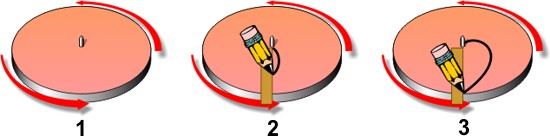
Similarly, when viewed from space, wind appears to travel in a straight line. However, when viewed from Earth, air (as well as other objects in flight, such as planes and birds) is deflected to the right in the Northern Hemisphere and to the left in the Southern Hemisphere. The amount of deflection depends on:
- the rotation of the Earth
- the latitude
- the object's speed.
Thus, the deflection is greater at higher latitudes than at lower latitudes. The Coriolis force on a moving object on the equator is zero, while that at the poles is maximum. The Coriolis force is also strongly dependent on the speed of the object. If we assume the “object” is actually wind, stronger winds will be more strongly deflected by the Coriolis force.
Centrifugal Force
The Centrifugal force is another apparent force that accounts for the effects of inertia when winds move along a curved path. The directionality of the centrifugal force points outward from the center of the curve. Centrifugal force is the opposite of centripetal force, which, in the case of winds, is often the Pressure Gradient Force. As we know, inertia is the tendency of an object to remain at rest or in motion. Therefore, inertia causes an air parcel to “want” to move along a straight line. Turning an air parcel along a curved path requires a centripetal force that acts toward the center of rotation. As a result, a net imbalance of other forces occurs. You have felt the centrifugal force many times in your life. The centrifugal force is easily felt as you travel in a moving vehicle around a corner. The force that you feel pulling you outwards is the centrifugal force.
Frictional Force
Frictional force in the wind is a drag force, caused by the roughness of Earth's surface, that slows wind. The Frictional Force only acts on wind below 1000 m in altitude and always acts in the direction opposite to the direction of motion. If there is no movement, friction is zero. The magnitude of the Frictional force also depends on the type of surface. Imagine walking on a frozen lake. Friction is low on a frozen lake, allowing winds to flow unimpeded. However, winds over forest or mountainous terrain experience greater frictional drag. Near the surface, friction reduces the wind speed. At higher altitudes, farther from the surface, winds flow faster.