

5.2: Atmospheric Stability and Lapse Rates
- Page ID
- 46810

\( \newcommand{\vecs}[1]{\overset { \scriptstyle \rightharpoonup} {\mathbf{#1}} } \)
\( \newcommand{\vecd}[1]{\overset{-\!-\!\rightharpoonup}{\vphantom{a}\smash {#1}}} \)
\( \newcommand{\dsum}{\displaystyle\sum\limits} \)
\( \newcommand{\dint}{\displaystyle\int\limits} \)
\( \newcommand{\dlim}{\displaystyle\lim\limits} \)
\( \newcommand{\id}{\mathrm{id}}\) \( \newcommand{\Span}{\mathrm{span}}\)
( \newcommand{\kernel}{\mathrm{null}\,}\) \( \newcommand{\range}{\mathrm{range}\,}\)
\( \newcommand{\RealPart}{\mathrm{Re}}\) \( \newcommand{\ImaginaryPart}{\mathrm{Im}}\)
\( \newcommand{\Argument}{\mathrm{Arg}}\) \( \newcommand{\norm}[1]{\| #1 \|}\)
\( \newcommand{\inner}[2]{\langle #1, #2 \rangle}\)
\( \newcommand{\Span}{\mathrm{span}}\)
\( \newcommand{\id}{\mathrm{id}}\)
\( \newcommand{\Span}{\mathrm{span}}\)
\( \newcommand{\kernel}{\mathrm{null}\,}\)
\( \newcommand{\range}{\mathrm{range}\,}\)
\( \newcommand{\RealPart}{\mathrm{Re}}\)
\( \newcommand{\ImaginaryPart}{\mathrm{Im}}\)
\( \newcommand{\Argument}{\mathrm{Arg}}\)
\( \newcommand{\norm}[1]{\| #1 \|}\)
\( \newcommand{\inner}[2]{\langle #1, #2 \rangle}\)
\( \newcommand{\Span}{\mathrm{span}}\) \( \newcommand{\AA}{\unicode[.8,0]{x212B}}\)
\( \newcommand{\vectorA}[1]{\vec{#1}} % arrow\)
\( \newcommand{\vectorAt}[1]{\vec{\text{#1}}} % arrow\)
\( \newcommand{\vectorB}[1]{\overset { \scriptstyle \rightharpoonup} {\mathbf{#1}} } \)
\( \newcommand{\vectorC}[1]{\textbf{#1}} \)
\( \newcommand{\vectorD}[1]{\overrightarrow{#1}} \)
\( \newcommand{\vectorDt}[1]{\overrightarrow{\text{#1}}} \)
\( \newcommand{\vectE}[1]{\overset{-\!-\!\rightharpoonup}{\vphantom{a}\smash{\mathbf {#1}}}} \)
\( \newcommand{\vecs}[1]{\overset { \scriptstyle \rightharpoonup} {\mathbf{#1}} } \)
\(\newcommand{\longvect}{\overrightarrow}\)
\( \newcommand{\vecd}[1]{\overset{-\!-\!\rightharpoonup}{\vphantom{a}\smash {#1}}} \)
\(\newcommand{\ket}[1]{\left| #1 \right>}\)
\(\newcommand{\bra}[1]{\left< #1 \right|}\)
\(\newcommand{\braket}[2]{\left< #1 \vphantom{#2} \right| \left. #2 \vphantom{#1} \right>}\)
\(\newcommand{\braopket}[3]{\left< #1 \vphantom{#2}\vphantom{#3} \right| #2 \vphantom{#1}\vphantom{#3} \left| #3 \vphantom{#1}\vphantom{#2} \right>}\)
\(\newcommand{\qmvec}[1]{\mathbf{\vec{#1}}}\)
\(\newcommand{\op}[1]{\hat{\mathbf{#1}}}\)
\(\newcommand{\expect}[1]{\langle #1 \rangle}\)
\(\newcommand{\dfn}[1]{\emph{\textbf{#1}}}\)
Adiabatic Processes
When discussing stability in atmospheric sciences, we typically think about air parcels, or imaginary blobs of air that can expand and contract freely, but do not mix with the air around them or break apart. The key point is that the movement of air parcels in the atmosphere can be approximated as an adiabatic process. Adiabatic processes do not exchange heat, and they are reversible.
Imagine you have a parcel of air at the Earth’s surface. The air parcel has the same temperature and pressure as the surrounding air, which we will call the environment. If you were to lift the air parcel, it would find itself in a region where the surrounding air pressure is lower, because pressure decreases with height. Because the air pressure outside the parcel is lower than the pressure inside, the air molecules inside the parcel will effectively push outward on the parcel's walls, causing it to expand adiabatically. The air molecules inside the parcel must use some of their own energy to expand the air parcel’s walls. Hence, the temperature inside the parcel decreases as the internal energy decreases. To summarize, rising air parcels expand and cool adiabatically without exchanging heat with the environment.
Now imagine that you move the same air parcel back to Earth’s surface. The air parcel is moving into an environment with higher air pressure. Higher environmental pressure will push inward on the parcel walls, compressing them and raising the inside temperature. The process is adiabatic, so again, no heat is exchanged with the environment. However, temperature changes in the air parcel can still occur, but they are not due to mixing; they are due to changes in the air parcel's internal energy.
Dry Adiabatic Lapse Rate
As long as an air parcel is unsaturated (relative humidity < 100%), the rate at which its temperature will change will be constant. A decrease in temperature with height is called a lapse rate; when it decreases with altitude, it is defined as positive. The dry adiabatic lapse rate is equal to 10°C/km. This drop in temperature is due to adiabatic expansion and a decrease in internal energy. An example of how dry air cools as it rises is provided in Figure \(\PageIndex{1}\):

Let’s get back to the topic of atmospheric stability. Stability in the atmosphere refers to a condition of equilibrium. As discussed with the example of a boulder on a hill or in a valley, some initial movement resulted in either more (unstable), less (stable), or no change (neutral). Given an initial change in the elevation of an air parcel, if the air is in stable equilibrium, the parcel will tend to return to its original position after being forced to rise or sink. In an unstable equilibrium, an air parcel will accelerate away from its initial position after being pushed. The motion could be upward or downward, but generally unstable atmospheres favor vertical motions. Finally, in a neutral equilibrium, some initial change in the elevation of an air parcel will not result in any additional movement.
Determining Stability
How do you know whether an air parcel will remain stable after an initial displacement? Stability is determined by comparing the temperature of a rising or sinking air parcel to the environmental air temperature. Imagine the following: at some initial time, an air parcel has the same temperature and pressure as its environment. If you lift the air parcel some distance, its temperature drops by 10°C/km, which is the dry adiabatic lapse rate. If the air parcel is colder than the environment in its new position, it will have higher density and tend to sink back to its original position. In this case, the air is stable because vertical motion is resisted. If the rising air is warmer and less dense than the surrounding air, it will continue to rise until it reaches a new equilibrium where its temperature matches the environment's. In this case, because an initial change is amplified, the air parcel is unstable. To determine whether the air parcel is unstable, we need to know the temperatures of both the rising air and the environment at different altitudes.
One way this is done in practice is with a weather balloon. We can get a vertical profile of the environmental lapse rate by releasing a radiosonde attached to a weather balloon. A radiosonde transmits data on temperature, humidity, wind speed, and position, which are plotted on a thermodynamic diagram. This vertical plot of temperature and other variables is known as a sounding.
Moist Adiabatic Lapse Rate
When moisture is added, everything gets more complicated. In Chapter 4, we learned that whether or not an air parcel is saturated depends primarily on its temperature and, of course, its moisture content. The Clausius-Clapeyron graph shows that, for a given amount of moisture, air is more likely to be saturated at lower temperatures.
We know that as an air parcel is lifted, its temperature drops according to the dry adiabatic lapse rate. So what happens when the air parcel is cold enough that the air becomes saturated with respect to water vapor? The short answer is that if it continues to cool, water vapor will condense into liquid water, forming a cloud.
When water vapor condenses, it transitions from a higher-energy state to a lower-energy state. Energy is never created nor destroyed, especially in phase changes, so what happens to all that excess energy? The energy is released as latent heat. The latent heat of condensation is approximately equal to 2.5 * 106 J·kg-1, which means that for every kg of water vapor that condenses to form liquid water, 2.5 *106 Joules of energy are released.
This has significant consequences for the lapse rate of an air parcel and distinguishes the dry adiabatic lapse rate from the moist adiabatic lapse rate. As latent heat is added during condensation, it offsets some of the adiabatic cooling from expansion. Because of this, the air parcel will no longer cool at the dry adiabatic lapse rate, but will cool as a slower rate, known as the moist adiabatic lapse rate. To summarize, a parcel will cool at the dry adiabatic rate until it is saturated, after which it won’t cool as quickly due to condensation. The moist adiabatic lapse rate varies slightly with temperature, but we will treat it as a constant for simplicity: 6°C/km.
Determining if a Parcel is Saturated and Dew Point Lapse Rates
A common question when discussing the dry and moist adiabatic lapse rates is "Which one should I use?" The answer to that question is primarily determined by whether the parcel is saturated. While there are many different technical ways to determine the saturation status of a parcel, the simplest way (and the one we'll use here) is to compare the temperature of our parcel to the dew point temperature:
- A Parcel is unsaturated (hence, you would use the Dry Adiabatic Lapse Rate) if the temperature of the parcel is warmer than the dew point.
- A Parcel is saturated (hence, you would use the Moist Adiabatic Lapse Rate) if the temperature of the parcel is equal to the dew point.
- When a parcel's temperature is below its dew point, it is said to be "supersaturated." Super saturation is a temporary state because excess moisture in the parcel quickly condenses, lowering the dew point to the parcel's temperature. Because of that, we won't worry about supersaturated parcels here.
Because a rising parcel experiences a decrease in air pressure, the dew point temperature decreases with height, and therefore it has its own lapse rate. Just like the parcel's air temperature, the parcel's dew point lapse rate is determined by saturation:
- If a Parcel is Unsaturated, the dew point's lapse rate is 2°C/km
- If a Parcel is Saturated, the dew point's lapse rate is 6°C/km.
This is because, as a saturated parcel cools, moisture condenses out of the parcel, causing the dew point to drop at the same rate as the air temperature.
Moist Stability
Changes in moisture alter the air parcel's lapse rate and, therefore, affect stability. However, the concepts are still the same, and we still compare the air parcel temperature to the environmental temperature. We have just one added complication—we need to know whether the air parcel is dry or moist. Some definitions are included in Figure \(\PageIndex{2}\), which take into account both dry and wet adiabatic lapse rates.
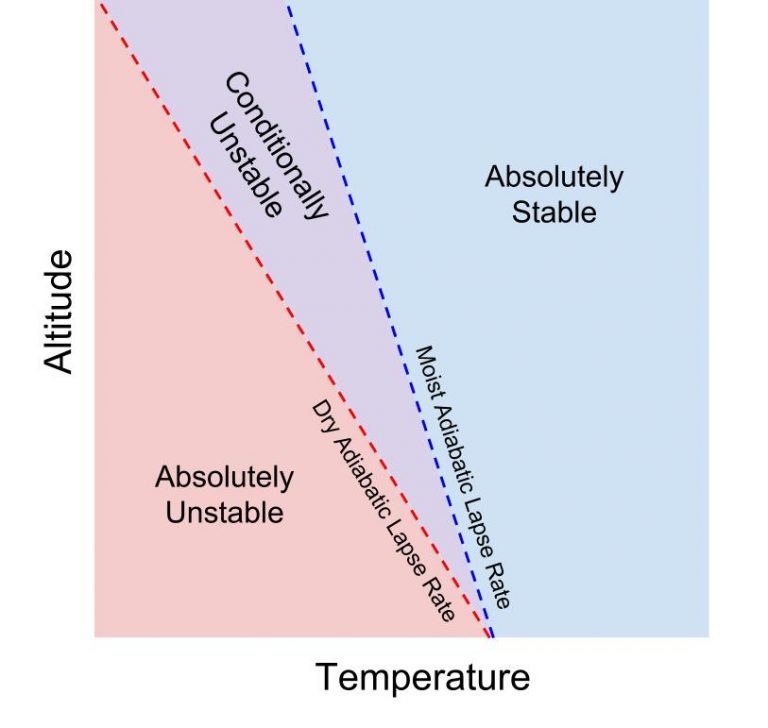
Rising air cools at two different lapse rates, depending on whether the parcel is staturated or unsaturated. An unsaturated parcel of air cools faster with height, thus the line for the dry adiabatic lapse rate is not as steep as the moist adiabatic lapse rate, which represents a saturated parcel cooling at a slower rate with height (hence a steeper line).
The atmosphere is said to be absolutely stable if the environmental lapse rate is less than the moist adiabatic lapse rate. This means that a rising air parcel will always cool faster than its surroundings, even after it reaches saturation. If an air parcel is cooler at all levels, it cannot rise, even after it becomes saturated (when latent heating counteracts some cooling).
The atmosphere is said to be absolutely unstable if the environmental lapse rate exceeds the dry adiabatic lapse rate. This means that a rising air parcel will always cool at a slower rate than the environment, even when it is unsaturated. This means it will be warmer (and less dense) than the environment and will be allowed to rise.
The atmosphere is said to be conditionally unstable if the environmental lapse rate is between the moist and dry adiabatic lapse rates. This means that the buoyancy (the tendency of an air parcel to rise) depends on whether it is saturated. In a conditionally unstable atmosphere, an air parcel will resist vertical motion when it is unsaturated because it will cool faster than the environment at the dry adiabatic lapse rate. If it is forced to rise and becomes saturated, however, it will cool at the moist adiabatic lapse rate. In this case, it will cool more slowly than the environment, then warm up, and rise.