

2.6: Radiation Interaction with the Atmosphere
- Page ID
- 46702

\( \newcommand{\vecs}[1]{\overset { \scriptstyle \rightharpoonup} {\mathbf{#1}} } \)
\( \newcommand{\vecd}[1]{\overset{-\!-\!\rightharpoonup}{\vphantom{a}\smash {#1}}} \)
\( \newcommand{\dsum}{\displaystyle\sum\limits} \)
\( \newcommand{\dint}{\displaystyle\int\limits} \)
\( \newcommand{\dlim}{\displaystyle\lim\limits} \)
\( \newcommand{\id}{\mathrm{id}}\) \( \newcommand{\Span}{\mathrm{span}}\)
( \newcommand{\kernel}{\mathrm{null}\,}\) \( \newcommand{\range}{\mathrm{range}\,}\)
\( \newcommand{\RealPart}{\mathrm{Re}}\) \( \newcommand{\ImaginaryPart}{\mathrm{Im}}\)
\( \newcommand{\Argument}{\mathrm{Arg}}\) \( \newcommand{\norm}[1]{\| #1 \|}\)
\( \newcommand{\inner}[2]{\langle #1, #2 \rangle}\)
\( \newcommand{\Span}{\mathrm{span}}\)
\( \newcommand{\id}{\mathrm{id}}\)
\( \newcommand{\Span}{\mathrm{span}}\)
\( \newcommand{\kernel}{\mathrm{null}\,}\)
\( \newcommand{\range}{\mathrm{range}\,}\)
\( \newcommand{\RealPart}{\mathrm{Re}}\)
\( \newcommand{\ImaginaryPart}{\mathrm{Im}}\)
\( \newcommand{\Argument}{\mathrm{Arg}}\)
\( \newcommand{\norm}[1]{\| #1 \|}\)
\( \newcommand{\inner}[2]{\langle #1, #2 \rangle}\)
\( \newcommand{\Span}{\mathrm{span}}\) \( \newcommand{\AA}{\unicode[.8,0]{x212B}}\)
\( \newcommand{\vectorA}[1]{\vec{#1}} % arrow\)
\( \newcommand{\vectorAt}[1]{\vec{\text{#1}}} % arrow\)
\( \newcommand{\vectorB}[1]{\overset { \scriptstyle \rightharpoonup} {\mathbf{#1}} } \)
\( \newcommand{\vectorC}[1]{\textbf{#1}} \)
\( \newcommand{\vectorD}[1]{\overrightarrow{#1}} \)
\( \newcommand{\vectorDt}[1]{\overrightarrow{\text{#1}}} \)
\( \newcommand{\vectE}[1]{\overset{-\!-\!\rightharpoonup}{\vphantom{a}\smash{\mathbf {#1}}}} \)
\( \newcommand{\vecs}[1]{\overset { \scriptstyle \rightharpoonup} {\mathbf{#1}} } \)
\(\newcommand{\longvect}{\overrightarrow}\)
\( \newcommand{\vecd}[1]{\overset{-\!-\!\rightharpoonup}{\vphantom{a}\smash {#1}}} \)
\(\newcommand{\ket}[1]{\left| #1 \right>}\)
\(\newcommand{\bra}[1]{\left< #1 \right|}\)
\(\newcommand{\braket}[2]{\left< #1 \vphantom{#2} \right| \left. #2 \vphantom{#1} \right>}\)
\(\newcommand{\braopket}[3]{\left< #1 \vphantom{#2}\vphantom{#3} \right| #2 \vphantom{#1}\vphantom{#3} \left| #3 \vphantom{#1}\vphantom{#2} \right>}\)
\(\newcommand{\qmvec}[1]{\mathbf{\vec{#1}}}\)
\(\newcommand{\op}[1]{\hat{\mathbf{#1}}}\)
\(\newcommand{\expect}[1]{\langle #1 \rangle}\)
\(\newcommand{\dfn}[1]{\emph{\textbf{#1}}}\)
Albedo
Not all incoming solar radiation is absorbed by Earth because it is not a perfect blackbody. Instead of absorbing all incoming radiation, some of it is reflected. Reflection refers to radiative energy bouncing back away from an object. We can define albedo (α) as the ratio of the amount of radiation reflected from an object to the amount of radiation received by an object.
\[\text { Albedo }=\alpha=\frac{\text { Reflected }}{\text { Incident }} \nonumber \]
An object that reflects all incident radiation has an albedo of 1. On the other hand, an object that absorbs all the radiation and doesn't reflect anything will have an albedo of 0.
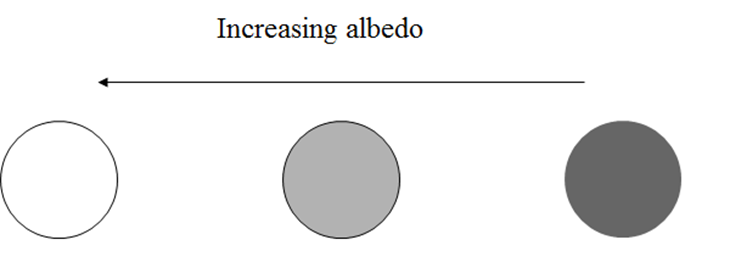
The simplest way to think of albedo is in terms of an object's color. White objects are highly reflective and have a high albedo because the amount of reflected light is much greater than the amount of incident light, as illustrated in Figure \(\PageIndex{1}\). You’ll know this if you’ve been on a white-sand beach or a snowfield and felt the brightness of the environment. Following the same logic, dark surfaces absorb light; therefore, black, brown, or dark green colors typically have low albedo. You’ll know this if you’ve walked across a black-paved surface and felt the temperature difference between the blacktop and the white-painted lines demarcating parking spaces.

The Earth offers a wide range of colors for incoming solar radiation as illustrated in Figure \(\PageIndex{2}\). Fresh snow has a high albedo of nearly 0.9. Thus, Earth's snow-covered high-latitude regions have albedo values ranging from 0.75 to 0.95. Clouds also reflect sunlight and can have albedos ranging from 0.3 to 0.9, depending on their brightness. Meanwhile, forests and grasslands are darker with albedo values ranging from 0.1 to 0.3. Open oceans are even darker, with extremely low albedo values of 0.06-0.1. Note that radiation reflected from an object does not warm the object. Earth has an average planetary albedo of approximately 0.3 (30%).
Selective absorbers
While some components of the Earth-atmosphere system, such as snow and clouds, reflect radiation, others absorb only specific wavelengths. These are called selective absorbers; examples include certain gases in Earth's atmosphere. Figure \(\PageIndex{3}\) shows the spectral intensity of incoming solar radiation (UV and visible in red) and outgoing thermal radiation (IR in blue). The subsequent panels show the total percentage of radiation absorbed and scattered by the atmosphere as a function of wavelength, decomposed by primary greenhouse gases. Greenhouse gases are gases in the Earth’s atmosphere that can absorb and emit radiation, primarily infrared radiation.
The greenhouse gas that interacts with radiation across the largest number of wavelengths is water vapor (\(\ce{H2O}\)), which interacts strongly with the atmosphere, especially in the longer wavelength portion of the spectrum. Other gases, such as Carbon Dioxide (\(\ce{CO2}\)), Oxygen (\(\ce{O2}\)), Ozone (\(\ce{O3}\)), Methane (\(\ce{CH4}\)), and Nitrous Oxide (\(\ce{NO}\)) also interact with radiation.

| Type of Radiation | Wavelength Range (µm) | Radiation Type | Absorption and Scattering (%) | Notes |
|---|---|---|---|---|
| Downgoing solar radiation | 0.2 – 0.3 | Ultraviolet (UV) | 100 | Strong absorption by ozone |
| 0.3 – 1 | Visible light | Less than 25% | High transparency allows solar incoming radiation to reach Earth | |
| 1 – 3 | Near-infrared | ~ 50% | Some absorption by water vapor | |
| Upgoing terrestrial radiation | 3 – 8 | Mid-infrared | ~ 75% | Strong absorption by water vapor & CO₂ |
| 8 – 14 | Infrared "window" | Less than 25% | High transparency allows outgoing radiation to escape to space | |
| > 15 | Far-infrared | 100% | Strong absorption by water vapor & CO₂ |
In Figure \(\PageIndex{3}\) and Table \(\PageIndex{1}\), observe the total percentage of radiation that is absorbed and scattered by the Earth’s atmosphere. You’ll notice two large gaps. These are called Atmospheric Windows, where radiation can pass through the atmosphere without interacting with greenhouse gases. Particularly notable is the Optical window, between 0.3 and 1 μm, which allows most of the visible portion of the electromagnetic energy spectrum, as well as some infrared solar energy, to pass through the atmosphere unimpeded. Meanwhile, various atmospheric gases absorb a large portion of the infrared spectrum. This suggests that Earth’s atmosphere is nearly transparent to shortwave radiation but strongly absorbs infrared radiation. This will be important for the climate factors discussed in a later chapter. Notice that there is another Atmospheric Window in the infrared spectrum, between 8 and 14 μm. This is known as the infrared atmospheric window, which allows some of Earth's upgoing longwave radiation to pass through the atmosphere into space, thereby cooling the Earth. While clouds are not included in Figure \(\PageIndex{3}\), they can absorb some of this upgoing radiation between 8 and 11 μm.