

2.5: Characterizing Emission
- Page ID
- 46698

\( \newcommand{\vecs}[1]{\overset { \scriptstyle \rightharpoonup} {\mathbf{#1}} } \)
\( \newcommand{\vecd}[1]{\overset{-\!-\!\rightharpoonup}{\vphantom{a}\smash {#1}}} \)
\( \newcommand{\dsum}{\displaystyle\sum\limits} \)
\( \newcommand{\dint}{\displaystyle\int\limits} \)
\( \newcommand{\dlim}{\displaystyle\lim\limits} \)
\( \newcommand{\id}{\mathrm{id}}\) \( \newcommand{\Span}{\mathrm{span}}\)
( \newcommand{\kernel}{\mathrm{null}\,}\) \( \newcommand{\range}{\mathrm{range}\,}\)
\( \newcommand{\RealPart}{\mathrm{Re}}\) \( \newcommand{\ImaginaryPart}{\mathrm{Im}}\)
\( \newcommand{\Argument}{\mathrm{Arg}}\) \( \newcommand{\norm}[1]{\| #1 \|}\)
\( \newcommand{\inner}[2]{\langle #1, #2 \rangle}\)
\( \newcommand{\Span}{\mathrm{span}}\)
\( \newcommand{\id}{\mathrm{id}}\)
\( \newcommand{\Span}{\mathrm{span}}\)
\( \newcommand{\kernel}{\mathrm{null}\,}\)
\( \newcommand{\range}{\mathrm{range}\,}\)
\( \newcommand{\RealPart}{\mathrm{Re}}\)
\( \newcommand{\ImaginaryPart}{\mathrm{Im}}\)
\( \newcommand{\Argument}{\mathrm{Arg}}\)
\( \newcommand{\norm}[1]{\| #1 \|}\)
\( \newcommand{\inner}[2]{\langle #1, #2 \rangle}\)
\( \newcommand{\Span}{\mathrm{span}}\) \( \newcommand{\AA}{\unicode[.8,0]{x212B}}\)
\( \newcommand{\vectorA}[1]{\vec{#1}} % arrow\)
\( \newcommand{\vectorAt}[1]{\vec{\text{#1}}} % arrow\)
\( \newcommand{\vectorB}[1]{\overset { \scriptstyle \rightharpoonup} {\mathbf{#1}} } \)
\( \newcommand{\vectorC}[1]{\textbf{#1}} \)
\( \newcommand{\vectorD}[1]{\overrightarrow{#1}} \)
\( \newcommand{\vectorDt}[1]{\overrightarrow{\text{#1}}} \)
\( \newcommand{\vectE}[1]{\overset{-\!-\!\rightharpoonup}{\vphantom{a}\smash{\mathbf {#1}}}} \)
\( \newcommand{\vecs}[1]{\overset { \scriptstyle \rightharpoonup} {\mathbf{#1}} } \)
\(\newcommand{\longvect}{\overrightarrow}\)
\( \newcommand{\vecd}[1]{\overset{-\!-\!\rightharpoonup}{\vphantom{a}\smash {#1}}} \)
\(\newcommand{\ket}[1]{\left| #1 \right>}\)
\(\newcommand{\bra}[1]{\left< #1 \right|}\)
\(\newcommand{\braket}[2]{\left< #1 \vphantom{#2} \right| \left. #2 \vphantom{#1} \right>}\)
\(\newcommand{\braopket}[3]{\left< #1 \vphantom{#2}\vphantom{#3} \right| #2 \vphantom{#1}\vphantom{#3} \left| #3 \vphantom{#1}\vphantom{#2} \right>}\)
\(\newcommand{\qmvec}[1]{\mathbf{\vec{#1}}}\)
\(\newcommand{\op}[1]{\hat{\mathbf{#1}}}\)
\(\newcommand{\expect}[1]{\langle #1 \rangle}\)
\(\newcommand{\dfn}[1]{\emph{\textbf{#1}}}\)
Wavelength, Frequency, and Speed
How fast does the Sun’s electromagnetic radiation travel to Earth, and how can we characterize the waves? All electromagnetic waves travel at the speed of light (often given the variable “ \(c\) “, approximately 3×10⁸ m·s–1). The waves have a wavelength (\(\lambda\)) given by the distance from one wave crest to the next. The waves also have a frequency (\(v\)), which is the number of repeated wave occurrences in a specified period of time. The unit for frequency is Hertz (cycles per second).
\[Wavelength \times Frequency = Speed\]
\[\lambda \times v=c\nonumber \]
With variables for wavelength and frequency, we can define any type of wave with great clarity. But where does this electromagnetic energy come from? It surrounds us every moment of every day in many forms. In fact, any object warmer than absolute zero (0 K) emits radiant energy. To estimate the amount of radiant energy an object emits, a common simplification is needed: we assume the object behaves as a blackbody. A blackbody is an object that emits and absorbs the maximum amount of radiation possible given its temperature. The object doesn't have to be black; it just has to absorb all wavelengths and emit all the radiation back, without storing any energy. Both the Earth and the Sun are considered blackbodies for most practical purposes.
Planck’s Curves
Planck’s curves are used to show the amount of emitted radiation and primary wavelengths of electromagnetic energy that a black body emits, given its temperature. Figure \(\PageIndex{1}\) shows multiple Planck function curves for various black-body temperatures. The red, green, and blue lines represent objects at 3000 K, 4000 K, and 5000 K, respectively. As a black body becomes hotter, it emits at shorter wavelengths and at higher intensities. Higher-temperature curves are taller and broader, peaking at shorter wavelengths.

Table 2.5.1 provides the relevant information from Figure 2.5.1
| Temperature (K) | Peak wavelength (µm) | Peak region | Relative peak intensity |
|---|---|---|---|
| 5000 | ~0.5 | Visible | Highest |
| 4000 | ~0.7 | Visible | Moderate |
| 3000 | ~1.0 | Infrared | Lowest |
Wien’s Law
Planck’s function tells us the amount of emitted radiation and the wavelengths over which it is emitted, given the temperature of the black body. We can use another law to determine the maximum wavelength that a black body can emit. Wien’s Law states that the shorter the wavelength emitted, the hotter (more kinetic energy) the object is. In Wien’s equation, sometimes the numerator is given as “a”, a constant equal to 2898.
\[\text { Maximum Wavelength }=\frac{a}{\text {Temperature}} \]
\[\lambda_{\max }=\frac{2898 (µm \cdot K)}{T (K)} \]
Using Wein’s equation to find the wavelength of electromagnetic radiation yields an answer in microns (µm). One micron is equal to 10-6 meters.
Our sun is a yellow dwarf star with a surface temperature near 5800 K. What is the maximum wavelength of the radiation it emits? Where does that radiation fall on the electromagnetic spectrum?
Solution
Wein’s Law gives us an equation that relates temperature to the maximum wavelength of radiation emitted by an object:
\[\begin{gathered}
\lambda_{\max }=\frac{2898}{T} \\
\lambda_{\max }=\frac{2898}{5800 K}=0.499
\end{gathered} \nonumber \]
This radiation, with a wavelength of 0.499 µm, falls within the visible-light range, which is typically defined as 0.5 × 10^-6 m.
Stefan-Boltzmann Law
One last fundamental law for radiation will be discussed here. The Stefan-Boltzmann Law relates the total radiation emitted (total emitted power per area) to the area under Planck’s curve. This shows that the hotter an object is, the more energy it radiates per unit area.
\[\text { Emission }=\frac{\text { Power }}{\text { Area }}=\text { Stefan }- \text { Boltzmann Constant } * \text { Temperature }{ }^4 \nonumber \]
\[E=\sigma * T^4 \]
Equation 2.6.2 shows that the radiance emitted per unit area is proportional to the blackbody temperature raised to the fourth power. This relationship is extremely important. It shows that the amount of radiation emitted depends heavily on temperature, so small temperature fluctuations can lead to large changes in emittance. The Stefan-Boltzmann constant is 5.67×10⁻⁸ W·m–2·K–4 and the symbol sigma, \(\sigma\), is used.
Pro Tip: Whenever you see the Stefan-Boltzmann constant being used (σ), you know that the assumption of a blackbody has been made.
Solar versus terrestrial radiation
The Sun’s average temperature is above 5,000 K, while the Earth’s average temperature is in the range 210-310 K. This means that the Sun and Earth radiate energy very differently. This follows directly from the electromagnetic energy spectrum and the respective temperatures of the Sun and Earth, as illustrated in Figure \(\PageIndex{2}\). The Sun emits higher intensity radiation at shorter wavelengths (0.2 - 4 µm), with a peak in the visible spectrum around 0.5 µm. This is because it has a higher temperature than Earth, and Planck’s curve for higher temperatures peaks at shorter wavelengths. The Earth emits lower-intensity radiation at longer wavelengths (3-100 µm), with a peak in the infrared spectrum around 10 µm. Thus, in colloquial terms, the Sun emits shortwave radiation, and the Earth emits longwave radiation.
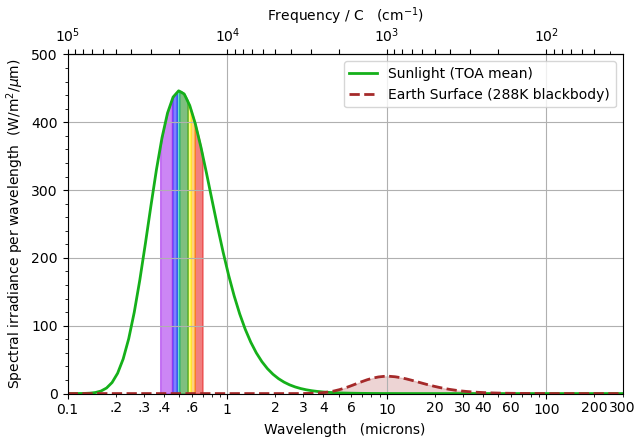
The relevant information from Figure 2.5.2 is provide in Table 2.5.2.
| Source | Peak wavelength (µm) | Peak irradiance (W/m²/µm) | Region |
|---|---|---|---|
| Sunlight (TOA mean) | ~0.5 | ~450 | Visible |
| Earth surface (288 K) | ~10 | ~30 | Infrared |
So, what happens to all this high-energy solar radiation that impacts the Earth? We learned that a black body absorbs all incoming radiation and emits the maximum possible radiation given its temperature. In the Earth-Sun system, this means Earth absorbs all incoming radiation from the Sun and emits as much as possible given its temperature. In practice, it is a little bit more complicated than this.